Winning at Retention: Proven Strategies to Reduce Cancellations, Winback Customers & Drive Value
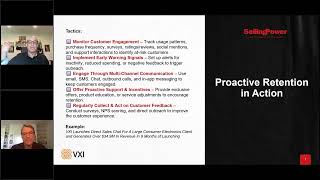
A 25-minute conversation (webinar) between Gerhard Schwartner (Selling Power) and Michael Aronowitz (VP of Growth, VXI) about customer retention strategies, proactive churn prevention, win‑back programs, and the role of data/analytics and outsourcing. Key claims: improving retention can boost profits (speaker cites a 25–95% uplift), average subscription lifetime referenced as 39 months, and effective programs require hiring the right people, targeted training, and real‑time data. The session also promotes a deeper free masterclass (≈1.5 hours) for practitioners.
Questions this video answers
Gerhard Schwartner (founder/publisher, Selling Power) and Michael Aronowitz (VP of Growth, VXI).
25% to 95% (claimed by speaker).
39 months (speaker's example).
June 5 (speaker said 'I believe it's June 5th' and noted uncertainty).
Gold Stevie Awards (speaker cited multiple awards).
Chapters
Well, hi everybody. My name is Gerhard Schwartner. I'm the founder and publisher of Selling Power magazine. And it's my great pleasure and privilege to introduce Michael Aronowitz. He is the vice president of growth at vxi. And today our topic is customer retention. Welcome, Michael.
Thank you so much for having me. Looking forward to our conversation today and giving some tips of how you can win at retention.
These days. You know, it's easy to acquire a customer, but retaining them is a whole nother ball game.
Tell us a little bit about the challenges that companies are facing in this unpredictable economy. Because everybody seems to be focusing on new customer acquisition. And don't look at the math, how much more profitable they can be if they had a better retention strategy.
In the retention world, it's no longer just about customer service. It's literally about revenue recognition. What are you doing these days to keep the customers?
We look at different factors and we have sales agents and we have sellers who now must be trusted advisors and help individuals.
And customers decide how they're going to interact. And so one of the things that I've been working on over the last couple of years is how to build winning retention strategies.
And so tell you one of the reasons why it matters more than ever. Acquiring customer.
Can really increase profits by 25 to 95%. Existing customers are more likely to buy customer loyalty. And all these different factors go into it. We talked earlier a couple weeks ago about there's so much focus on acquiring customers. What's your cost per acquisition? What's your marketing channel? How do you acquire all these customers? And then one day your customer decides they don't want to be your customer anymore. What happens? How do you fix that? What do you do? And so building strategies along the way to keep them or identifying. And we'll talk about today on data and analytics and different things you can do to keep these customers.
One of the.
Factors that are coming into place is what we call click to cancel, allowing consumers just a frictionless opportunity to cancel. And so if you take a step back and you analyze why your customers are canceling, I think that's the first step here. Are you using data and analytics? Are you using any call tracking metrics? Are you looking at the emails? But why did someone who was so excited to purchase your brand or purchase your subscription now decide they don't want to do that anymore? And one of the factors is when you're looking at this whole approach is you have ratings, you have other mechanisms. So I'll pause there for a Second and kind of regroup and say, one of the challenges again in retention is do you have the right individual who's taking that interaction? Because if you don't have the right individual, you're going to have lost revenue, you're going to lose your upsell and cross sell potential, you're going to lose referrals. And that customer acquisition cost that we talked about earlier, that CPA is going to just go right out the window along with your brand reputation. Because we know that a happy customer could bring you one or two customers, but an unhappy customer could lose you 10 potential customers. When you're happy and you buy something and it went well, you tell everybody.
But when it doesn't go well, well, that's a whole nother conversation. So I'll pause there and see. Gephardt, you have any questions?
Well, is there.
A checklist that companies go through to assess their own level of effectiveness when it comes to customer retention?
Great question. And you know, when we talk about checklists, let's do the first conversation is how is your existing customer reaching out to you? Was it through an email? Was it through a chat? Was it a voice interaction? So the first checklist is looking at where.
Are the call drivers? We always call them call drivers. Where are they coming from? They come from chat, they're coming from voice, and how often are they coming. So the first thing we have to measure is where they're coming from and how often. So if someone dials two or three times a day, you should set up a warning flag that.
There could be a problem. Someone says an email and there's a question that you don't answer for 24 or 48 hours. And there's another problem. So the first checklist is really taking inventory of how are you dealing with your customer interactions.
There's a shift from reactive to proactive. We used to focus on how do we save them, Giving individual scripts, giving them promotions, what can we do to. Now in the new model, it's using data and analytics.
You can do some pro re acting right? React, be proactive, react. Send an email to existing customers who may have a question. You can pick up a phone and call someone. How they doing? You can have real time chats. So the industry has changed to where if you're being reactive, it's probably too late to save that customer. If you're being proactive, you could not only save that customer, but you can do upselling and cross selling. And anyone who buys a second product or a third or third or fourth line of business is more likely to stay. We talked about this a couple days ago.
If I have a customer in a subscription model with the average lifetime of 39 months.
And I'm getting kind of interactions at month seven or eight, those are the warning signs. If you're getting a cancellation seven or eight months into this, giving them a free month is not necessarily the right answer. Free just means I'm going to probably prolong the pain for another month. But if you can do an upsell or a cross sell, you've retained that customer. And that's the most important thing. Because I think what companies don't realize is again, we talk about all the interaction they put on the front end of acquiring customers. They understand their marketing methodology. They put so much time is into it. Paid search, is it SEO? Did they come from a keyword? Did they come from a social media channel? Right. They have all those different ways to come in that they measure.
But they're not doing that on the retention side of all the different ways to save the customer and why. And you know, certain market and methodologies have a higher propensity to cancel than others. So we have to start looking at the data and understand if they came in on a promotion.
And that promotion is about to expire after 12 months, we may want to reach out on month 10 because usually when that promotion expires, we develop switchers who then go, oh, there's another promotion over here, let me go there. And so we have to understand there's different ways to acquire a customer. Was it on a promotion, was it through a referral, through paid search, all these different channels? Right. And so now it's a new model. We're able to look at real time data and say, okay, if Michael's promotion is going to expire on May 1, why did I reach out to them on April 1?
If I look at the life cycle of Michael, on month three, we did a retention call and we saved them.
On month seven, month eight, month nine, their usage on my product went down to zero. So if we could measure usage or measure certain factors, we can then decide who has a propensity to cancel and who doesn't. So those are the different factors that companies should be doing.
Is there a way, Michael, to create maybe.
A red, yellow and green signal system where you have the green customers that are going to be very loyal, they are solid and the yellow ones that need a certain amount of attention and then the red ones are the high risk at deflection where you give them intensive care treatment?
Yeah, There's a couple of different ways and the first one is are you monitoring customer engagement? And depending on whatever channel you're in in terms of sales, if you're in retail, it's a one time buyer. So you know, if you have a customer who bought once, there's a challenge there. If you have a subscription model and like I said.
The average is 39 months and you're starting to see that on month seven or eight or nine, they're not really using it, there's no engagement.
Those are red flags to look at. The other warning signs are.
Was there a billing or technical issue? You know, most people in general try to go and have no interactions. They just want their product, they want it to be smooth. But if there's issues along the way and they're not solved, higher propensity to cancel. So that's why I always go by that interaction. Did you solve their problem.
Which is solution? And were you able to upsell and cross sell in the cross sell and upsell is going to solidify if that client's going to stay with you or not. That's the second red flag. You know, if I'm in the, the telco or cable or some of those in different industries where they have four or five different products, they have one product and there's a problem, you weren't able to sell another product, it's a warning sign. I have a subscription model.
And again there's five users potentially in the house and there's only one license.
Probably is a warning sign that why isn't four other users on this technology?
Could be they're not happy. So these are the warning signs that are out there that you should be looking for and then you can be proactive again knowing if you're under a contract. There used to be a fear like someone signs a monthly subscription and we just hide and we wait and we say okay, well now there's too much competition out there to wait. So again if someone signs up for a 12 month or a 24 month subscription.
Let'S figure out on month eight or nine, let's do outreach. Now having said all of that, the win back strategy is completely different. You have retention which you're trying to save and then to win back a customer. And I would say that when you start looking at win back customers, one of the biggest mistakes that company makes are hiring that individual specifically for win back Outbound. What we talked about earlier, it's a completely different animal when you're doing outbound companies make mistakes is that hey, we're slow this week. Let's put 10 people on the phone and see if we can get customers back.
Let's start a win back team and let's take, you know, 15 customer service reps and we'll give them 30 days on the phone and see if we can win them back. Those programs don't work. A win back is not an agent, it's a seller. The hardest sale of all is to sell something who didn't want your product anymore. And I can say that 10 times and sometimes people don't understand that. But again, the hardest thing is I had your product for three years, I canceled. To win that back, you're going to need someone who has product knowledge, selling skills, conversational skills to overcome immediate objections of all the things that may have gone wrong. So hiring that profile is key in win backs. The second part is the training that you're going to give that individual. Not in three days or 30 hours. You have to have a ramp to proficiency. You have to have good training and nesting and all these different things with leadership that go along that. I've been part of many successful win back strategies in teams because we hired right, we trained right, we put the right leadership in place and then we use data and analytics, interaction analytics to listen to every interaction to help them rebuttal and overcome the objections. Because again, if I had a very bad experience with your product and I canceled, you're the last person I want to hear back from. But you know, if you do it the right way, they may not be happy with their current provider or solution that they're using now and they miss certain benefits and features that you have. So the win back team is imperative. And again, you can have your retention team built a certain way and your win back team built a certain way. But one is usually inbound and one is outbound. They can't do both. That's where people make huge mistakes. It's like, hey, we'll have them do both. I don't know about you, but you can dial a hundred dials a day and maybe 10 people will answer the phone. So I got 10 shots to win that versus inbound. You're getting hit all day long, right? So there's two different types of teams.
When you're doing win backs, one of the things that you really need to focus on is the data. The list we call it, who we calling, who are reaching out to. Are we reaching out to customers that canceled previously 30 days, six months or a year ago? It's not the same Conversation. You know, someone that just canceled your product 30 days ago is really still probably not up to listening to that conversation six months ago in a year, it's a different opening line and it's a different conversation. So making sure that you again, go back to the training to make sure to understand that there's different buckets in win backs. And then it's.
Give me a reason why I should come back to you. Like, tell me what, tell me why is it a promotion? Is it more channels? Is it a better price.
Better promotions? What are the different factors of why I should come back? And then are you doing a multi pronged approach? Like, so I called and you didn't answer, but I also have your email and I have permission to do an sms. So let me do two or three different things. Let me follow up. I know you're not interested in hearing about us, but there's some great promotions going on for customers that were existing that we're trying to bring back. And then having that data in front of you because there's nothing worse than calling someone who says, do you understand what happened last time? So understand that you know the reason the cancels, right? That's matching the CRM up with the CRM that's going to do the data so that you're not calling someone who's going to ask you a question and say, gerhard, do you know the reason why I canceled your service? No.
So if I be proactive and say I understand the reason why you cancel the service, there's a lot of outages, some of the shipments were not on time, all the different reasons. But here's the improvements we made in our process.
Then with the right promotion, you make enrollment easy. But.
Again, you have to make sure that you have the right individual with the right training and the right programs. These are factors that really make these programs successful.
Then I'll leave you with the cross sell and the upsell. And I've said about it earlier, which is really important.
The cross sell and upsell solidifies the trust in a relationship.
And.
When the initial call comes in to say, you know what, we're done with your services and then you're able to save that customer and give them other lines of business with you. That solidifies that you're doing the right thing. And you do that by personal recommendations, incentives, but education and value, because now they're feeling good again. And many times people purchase things but they don't realize the features and the benefits that come along with that. I didn't realize I had 24 months of a warranty. I didn't realize that you offer that service. So the upsell and the cross sell solidifies the customer relationship and then extends that lifetime value accessibility. In a subscription model where someone's paying 59 or $79 a month.
If it's now going from 59 to 79 to 129 to 159, they're feeling good about themselves, right? They bought additional products. These are all the different factors. So you got your three buckets, you know, you got your retention, your win backs and your upsells, your cross sells all have different stellar profiles. And so as we get to wrap this up, what I always like to say to everybody, if you want to be successful in retention, win backs and cross selling comes down to three things. Did you hire right? Did you train right? And then you give them the right data and analytics. If you do those three things, you're successful. And so, you know, one of the things.
That I do is outsource it, right? People, companies come to me all the time. How do I get better at retention? How do I get more customers, how do I lower my cost per acquisition? And you do that by all the things I just said. And if you're not outsourcing.
Because you've never done it before, that's not a reason not to outsource. And if you are outsourcing and you're not getting the value that you see from your current provider, then let's have a sit down conversation. Because what we do better in my industry is that we take all the findings of all the different programs that we do. And so we understand there's a difference between retail and travel and subscription models and TV and Internet and phone. Right? It's not the same profile. So we're able to scale, find the right talent. We have proven playbooks, we share best practices, we have data and analytics, and then we create dedicated teams. And so to me, the best retention teams are outsourced teams. The best win back teams are outsourced teams because we allow companies to focus on what they do best, which is probably marketing or product development. And so I'll pause there and I know I'm running out of time and see if there's any questions. I threw a lot in a little time.
I want to add and amplify what you just said because I believe that when you go to an outsourcing company like you.
You not only benefit from the innovative experience that you have within the company, that you transfer to new clients. But you have that more advanced technology tool set that is specifically designed for the challenge of winning back and improving retention. And a lot of companies don't have the integrated AI strategy that you are pursuing where I think AI is going to change the game of doing business for everybody. And you can use AI to catch those signals that companies are not aware of.
Yeah, I, I'll say this in when you look at our company as a whole, we've won gold Stevie awards, we've won many different track, many different factors. Right. Of why we're the best and when it comes to outsourcing. But remember this, people like to buy from people they like and trust. And that trust factor is really important. We use AI tools and all different technology. But going back to what we said earlier, when someone makes a conscious decision on April 29 that I don't want your product anymore, you better have someone on the other end of that interaction that can save them. And if they can save them and sell them another product that's from people. So you know that's from people.
I know we're running out of time. I'll just see if there's any questions from anyone in the audience I'd love to answer.
What are some innovative or effective proactive strategies to prevent churn before it happens?
First thing you need to do is.
Create a retention team. Create a win back team.
And start looking at the data that you have that shows churn risk. But let's also, when you create that team, what is your current.
Cancellation rate? How many customers are you losing a month and why? So let's have that first conversation and.
Figure out where that leaky bucket is. That's the first thing you need to do. You have to sit together and put a strategy behind why you're losing customers. And what I said earlier. Is it because a specific marketing channel? Is it a promotion that's not lasting long? Is it a price point that you changed? Is it bad customer service? Is it bad technical support? Does a competitor have a better promotion out there? That's why, going back to what I said with outsourcing, when you sit with someone who does this all day long, we can look at the different channels and strategies that we put together to help you craft that retention team.
Well, that's awesome. You also have agreed to teach a masterclass with selling power. Tell us a little bit about that.
So we're going to get deep into the weeds of how to build all these different things that we talked about. The masterclass will talk about how to build a Retention team, how to craft a strategy on win backs, how to correctly upsell and cross sell. And that's what the masterclass is going to be. This is a short version of 25 minutes. The masterclass is going to go deep into all the different things that companies need to do to be successful in these three channels.
And there is a link where people can sign up. We are going to drop this in the chat right now. The masterclass is actually free. It's an hour and a half. And Michael has agreed to do a much deeper dive so that we can learn not only from the master Michael, but also from each other. And that brings me back to the best practices.
What are the best practices for reaching out to somebody who is freshly canceled with.
What is the.
The best practice is to understand the why. And I think that's where that disconnect comes in. Where, you know, let's get to the. Are you using a CRM? Good note taking. So did it. We, we have the clip to cancel that we talked about. But there's. The factor is, is why did they cancel in the first place?
When you start to understand that, then you can have the second part of that conversation.
Looking at again, when someone.
When someone calls to cancel and the person on the other end of the line says, is there a reason why you're canceling? And they go, do you not see my account? I've called nine times in the past two days. What do you think is going to happen? Or I've had this service for nine months. I haven't used it once. Is there a. You know.
So it's the data. It's always successful. Programs like this come down to people, process tools and technology. You can't shortchange either one of them.
If you shortchange one of those, you're just not going to have that. The last thing I would say, there's a lot of companies that do this, right? Like they understand that there's a percentage of people.
That are going to call at a specific time or email at a specific time because they study the data and they put the right people on the other side to do the cancellation, to retain them. And then there's a specific amount of people who are very good on win backs because they know that there's that sweet spot right between 0 and 30, between 30 and 60 and then 90 days beyond how to approach that conversation. These are all things that we teach individuals how to do. And the reasons why companies come to ours is because our success, like I showed you on those three, three Gold Stevie Awards that we won recently.
So here's another question. Besides the churn rate, what are the most important KPIs we should be tracking to measure the success of our retention and win back efforts?
Monthly recurring revenue.
There's a cost per acquisition on the front end.
Monthly recurring revenue. If I'm able to extend that recurring revenue three or four or five more months, that's what you need to measure. What you don't want are retention programs that take the monthly recurring revenue from 129 down to 59. You want to take that program from 129 to 179 and that's what it's always about. The revenue. There's three things you got to look at in this business. Cost per acquisition.
Revenue per interaction. Lifetime value of a customer. The lifetime value of a customer is the most important thing. Do you want a customer for life or do you want a customer for four months?
The reality is, right.
We all know this day and age, people are not brand loyal. People are loyal to white glove service that makes them feel good. The people that help them.
Can you share one quick customer success story?
I could share many customer success stories over the years, but one recently is a win back program where customers have.
Changed.
Many providers over the last 24 months. And we put together a really good outbound strategy to speak to customers and make them understand that sometimes the promotion that they switch to in the long run will cost them two times of what they're paying today.
So that's the understanding of understanding promotions. Why customers leave on a promotion versus when that promotion runs out.
Sometimes they're not even aware of it. So signed up $79 a month, six months, boom. All of a sudden it's $159. Just making that outbound call to make them take inventory of what they're actually paying. These are success stories.
That's awesome. Well, Michael, I want to thank you. We have to slide up. Here's how to get in touch with Michael. Here's his email. You can also connect with him on LinkedIn. And I would like to invite you to the masterclass. What are the dates, Michael?
It's.
I believe it's June 5th. Don't hold me to it. I don't have my notes in front.
Of me at 1:00pm yeah. Yes, please sign up. The link is in the chat. Thank you so much as always. It's great to learn from you. You're a great teacher and you have an enormous vault of wisdom in your mind about retention.
Well, thank you for that. And you reminded me I need to write a book. And from our conversation the other day, it's long overdue. And so I will, at some point, start working on the book.
We all need it.
Yes. Thank you so much.
Thank you, Michael. Thanks, everybody.
More from Gerhard



What Selling Looks Like When Your AI Agents Have the Context Your Sellers Do

Better Conversations, Smarter Support: Wearable AI in Business






When Scarcity-Built Systems Meet Abundance - The Judgment Gap in AI-Powered Sales Leadership
