You Are the Methodology: How Sales Leaders Win Together
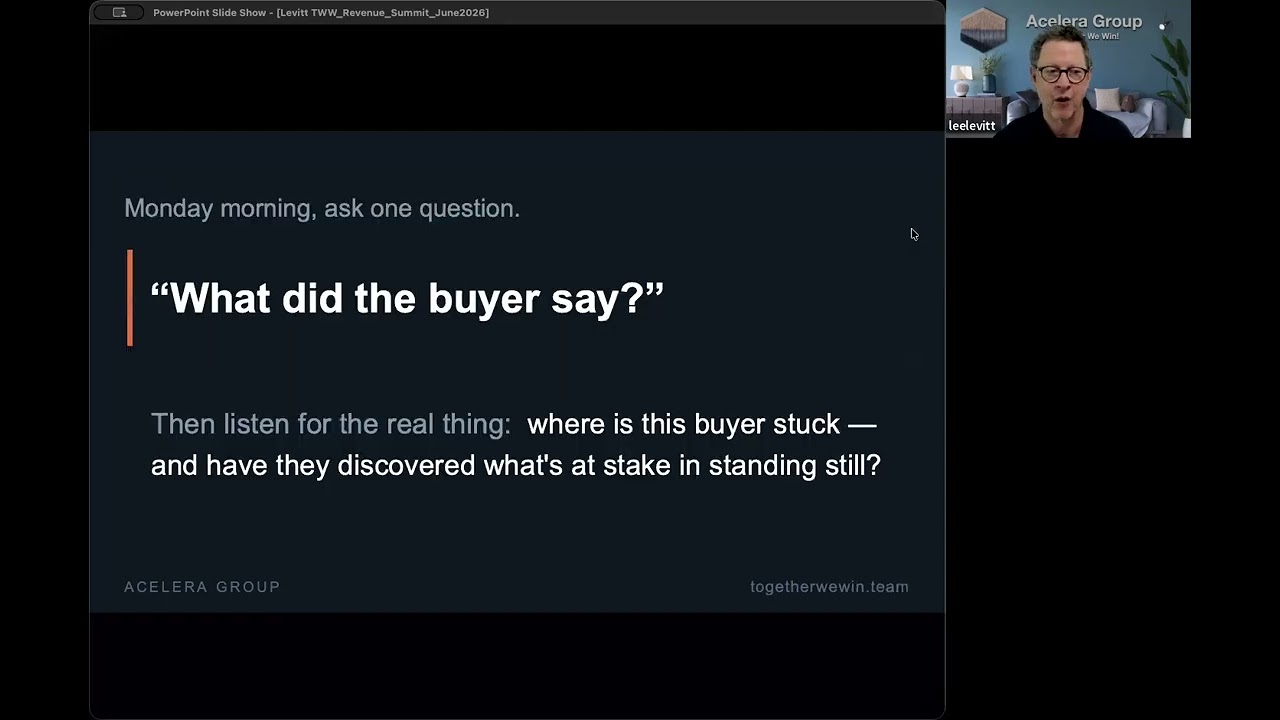
Lee Salz explains why 40-60% of enterprise deals stall: buyers fear the consequences of choosing, not missing out. He shares a hospital-elevator story where a rep's genuine passion revealed the cost of inaction, then introduces the PATH discipline and a discovery question, "What did the buyer say?" to uncover where buyers are stuck.
Chapters
Gerhard's been asking sales leaders and salespeople the same question for as long as I've known him. Decades. Who are you? Today, I want to take a run at answering that question, and not for me, but for everyone in this room. Because something weighs on you every day. 40 to 60% of your deals end in no decision. They're stuck and you're not sure why. Over my 30 years of sales, sales leadership, enablement, and coaching, Here's what I've learned. Who you are, the question that Gerhardt asks, and who your reps are is the most valuable thing you bring to a customer. And most sales leaders have never been taught to use this or to develop it in their reps. With this awareness, customers stop getting stuck and you start plugging the biggest leak in your pipeline, the revenue you lose to no decision. No new spend, no new technology, No new methodology, just fewer frozen deals. And here's what might get your attention. If only 10% of those deals stay unstuck, you're looking at something like a 16 to 20% uplift in revenue. 20% uplift in revenue with no new marketing spend or headcount. Think about what that would do for your customer acquisition costs. I'll start with a deal you'll probably recognize. Great first meeting. The buyer leans in, asks good questions, says all the right things. You walk out thinking, "This one's real." Happy years, right? And then nothing. No follow-up. No competitor swoops in. It just stops. Sound familiar? That deal didn't stall because of your methodology. And here's where we get backwards. We think the buyer is frozen because moving forward feels risky to them. It's actually the opposite. They're frozen because standing still feels safe. It's a big difference between those two. And here's the thing. Those frozen deals, they're not lost to a competitor. They're lost to inaction, to no decision. Because emotion drives enterprise purchases or kills them. Yeah, emotion. And that's why no decision is the biggest threat to a pipeline that looks healthy, bigger than any competitor you have. So here's the uncomfortable part. You can't fix this with more of what you've already been doing. Not another platform, not another methodology, not more training or enablement or certifications, AI, not more headcount, not even another consultant. When a buyer is frozen, no system makes them move. The thing that moves that frozen buyer was never in your tech stack. But here's the good news. Everything you've built, the tech, the methodology, the training, it tells your reps what to do. That all still matters. This is different. It's not tech. It's how your people show up. It's a way of being that sits above your tech stack or your methodology, and you already have it. You've just never coached to it. And it costs nothing to do. We've spent this summit discussing this question: as AI floods the sales floor, what stays human? And how many times has Gerhard said the two words authenticity and trust over the past two days? So here's my answer in one deal. Many of you know that I love telling stories, so I'll tell you one about a deal with a hospital and a rep named Rod. Rod's an enterprise rep at a large tech company, a household brand. He was selling an automation software upgrade to this hospital, about $200K for the purchase. The customer was engaged, their old software was going end of life, and they kept asking questions. But then just before the quarter end, just before the software was about to go on extended support, something changed. The facilities director told Rod they weren't going to do the upgrade. And as far as he was concerned, everything was fine. Why spend the money? So I asked Rod one question: What does the software control? And he said, building systems, HVAC, lighting, elevators. What happens if the software goes down, Rod? The systems go down. Including the elevators? Rod gets quiet, and then he said, Patients could get stuck on those elevators, all of it running on software we're about to stop supporting. Patients stuck in elevators might not get care, he said. Patients could die. Talk about impact. I asked Rod how that made him feel. He said, I feel angry. Good, Rod, take that to the customer, not as pressure, but as Passion. Help them see what they hadn't let themselves see. Share that perspective. He did. The deal closed the next day. Now, the customer trusted Rod completely. He'd brought them perspective. He'd been straight with them. But they wouldn't move. Not until they discovered for themselves what was really at stake in standing still. Rod didn't tell them. He helped them see it. Before, Doing nothing felt safe. After? It didn't. Nobody pushed. They discovered it. That's the whole game. Helping a customer see what standing still is really costing them before someone else does. Or before it's too late. Before the elevator stop. That hospital wasn't unique. Buyers freeze for reasons you can learn to read. Stuck. Safety. Trust. Uncertainty, complexity, knowledge gap. The facilities director at that hospital was frozen on the first one, safety. Doing nothing felt safe until it didn't. Every stalled deal in your pipeline is frozen on one of these five, I guarantee you. And here's the shift. It's not the deal that's frozen, it's a person, a human being stuck for one of those five reasons. Identify the reason and you know what's in their way. And then you have it, not the fix, a new perspective. It tells your rep what they missed about the customer. And that's the lens. That's why customers are stuck. And then the other half, how your reps show up to meet what's alive in the buyer, the way Rod did, that's a discipline of its own. I call it PATH. It's waiting for you with a full stuck guide at togetherwein.team/path. Sales3.0.com/summit. So here's what to do Monday morning, or if you want to wait till the end of the quarter, Wednesday or Thursday. At your next deal review, ask your reps one question. This is a game changer. You might want to write it down. What did the buyer say? It's a discovery question. You're not telling your rep what's wrong with the deal. You're helping them discover it. Same move Rod made with his customer. Same move I made with Rod. It's the same move all the way through. And what you're listening for is this: where is this buyer, this person stuck? And have they discovered what's really at stake in standing still? That's free. You can do it Monday. No new spend, just one new question. We had a name for this at Oracle, deal de-risking. Pressure testing the deals you're counting on before the quarter does it for you. And this is bigger than one question. It's a different way of leading a sales team and a growing group of leaders who believe deals are won by who their people are in the room. It's called Together We Win. The first chapter, the stuck guide, the path guide, it's all at togetherwewin.team/summit, along with something special. Jeff is dropping that in the chat now. togetherwewin.team/summit masterclassassistant. Sign up, pass it around. Gerhardt asks, who are you? I think it's the most important question in sales leadership. Not what's your methodology, not what's your number. Who are you? And does your team feel it? Gerhardt and Marc, thank you as always.
Lee, you said bias-free is because standing still feels save. And, um, I think it's a little backwards from what most of us were trained. So tell us a little bit more about the underlying psychology here.
So the underlying psychology, and, and this was really well covered with, uh, with Matt Dixon and Ted McKenna in, um, in The Jolt Effect, uh, the research they did 5 years ago, um, it used to be, uh, customers were afraid of missing out. Now they're afraid of messing up. You make no decision and you're left with the current state, the business as usual. Everybody knows how bad it is, but at least we know how bad it is. If you make a choice, if you make a conscious— if a buyer makes a conscious decision, then they own the results. And that could be political suicide, it could be a career suicide, it could be organizational suicide. So more and more buyers are perfectly happy with not doing anything. That's why 40 to 60% of deals don't end up in anything but closed, no decision.
So let's go back to your stuck lens. What's the most surprising thing that that lens has surfaced?
It's a really good question. The thing that surprised me most is Buyers who don't talk very much, they're not necessarily stuck. They're processing. Typically, it's the responsive buyer, the ones that are asking a lot of questions. They're asking a lot of questions because they're hiding behind the fear of doing something. So the responsive buyer could well be the stuck buyer. So just because someone is actively engaging doesn't mean they're going to do anything.
Rob Peterson just texted, FOMO, fear of missing out, now is more like fear of messing up. Really cool.
He's exactly right. Rob is a genius.
So you're talking to the leaders who supervise and run and coach the reps. What should leaders do differently come Monday morning?
Come Monday morning. Um, this is, this is a difficult, um, uh, answer to hear, Gerhard, because it flies in the face of, of sales leadership for as long as there's been sales leadership. Let go of the number. Be in service of the customer. Sales is not about selling. Sales is about helping the customer achieve their strategic goals. If you do that, the number will be met and then some. If you focus on the number, that inside-out view, you burn out customers, you burn out reps, you burn out support, you blow up the organization that's designed to make the number. When you serve the customer, then good things happen. Think of Disney. Disney over its almost 100 years now has focused on customer delight. And they're really busy underneath and on the back end, they focus on customer delight.
Well, when you look at the reasons why deals are not being done or lost, the most official reasons are budget and/or authority, not feelings. So why do you think that is? People are rational, better at rationalizing than at emotionalizing.
So the key here is that if someone says, we've decided to invest our money elsewhere, what that means to me is the rep hasn't developed the perspective around what's the most impactful for the customer and help the customer get there. Gerhard, I first heard you say the word co-creation over 20 years ago. It's co-creating a new way of running the business, of delivering the business goals. And good salespeople can help customers see a different way of doing things. And so then budget gets reassigned to what has become reprioritized.
Got it. Well, Lee, I can't thank you enough for illuminating us and educating us and reminding us that, uh, at least for me, that sales is an art and a science. And, um, I think we need to develop both. I, I remember asking that question at a conference, uh, in Miami and asked people to raise their hands and, uh, if they believe that sales is an art. And 50% of the hands went up, and then, uh, the other 50% said it's a science. And then I picked people in the audience and said, you a scientist and you an artist, so here's a microphone and, uh, try to convince the other side, uh, that your vision is the better one, or that you are correct. And what was really funny is that at the end, all agreed that selling is both an art and a science, and technology is the foundation of science we need to create for the art to happen.
That's right. And two things can be true at once.
Yeah, exactly. And the other big takeaway for me is that emotion and logic, the key drivers for sales. And Zig Ziglar once said that logic makes people think, but emotions make people buy or emotions make people act. And that could be also not buying, right? Well, together we win. Is an interesting take that I think that everybody should explore that. Take a quick scan of that QR code or visit your website. What is your website, Lee?
So the site for Together We Win is togetherwein.team/summit. All the goodies will be there. There's some tools as well at togetherwein.works. So feel free to browse around, take whatever you want.
There's, there's a drop your link to your LinkedIn profile so people can connect with you on LinkedIn. Perfect.
Looking forward to talking with, with folks.
More from Gerhard



What Selling Looks Like When Your AI Agents Have the Context Your Sellers Do

Better Conversations, Smarter Support: Wearable AI in Business






When Scarcity-Built Systems Meet Abundance - The Judgment Gap in AI-Powered Sales Leadership
