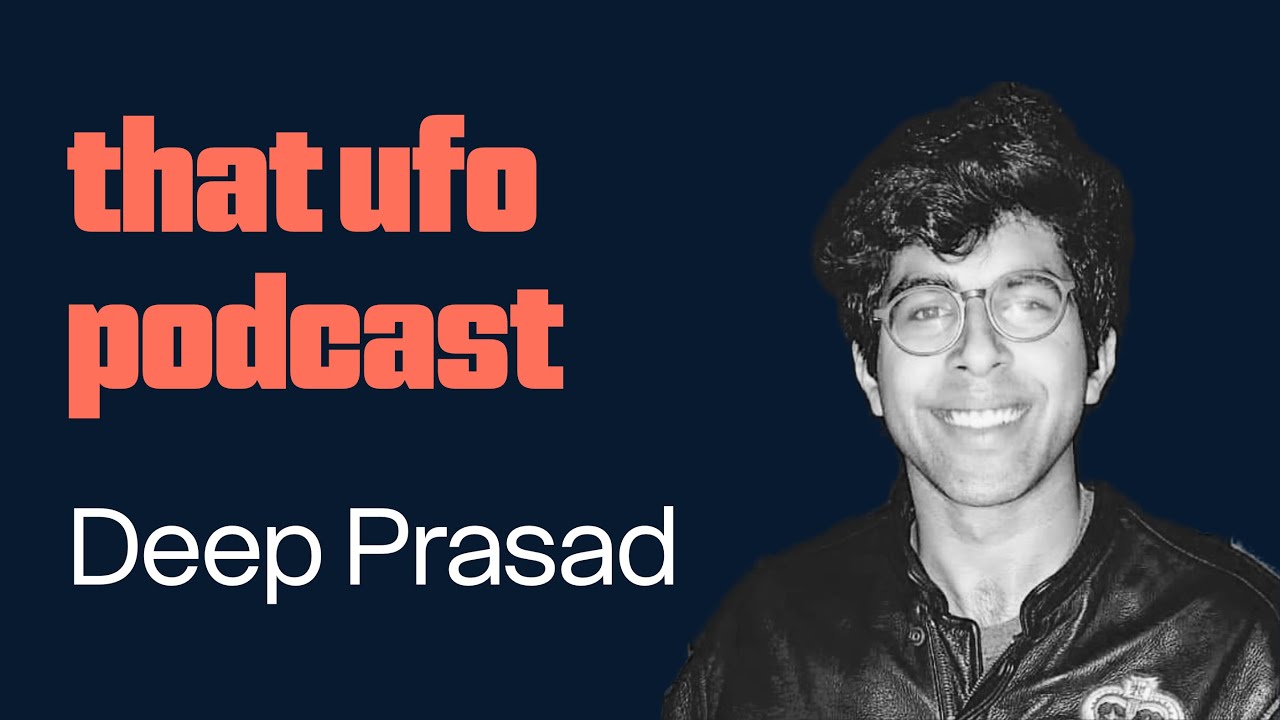
Deep Prasad, physicist discusses extraterrestrials, consciousness, and quantum entanglement | #712

Physicist Deep Prasad describes capturing thermal footage of a Tic-Tac-shaped UAP with anti-gravity behavior and a 2019 sleep-paralysis episode featuring entities and a recurring DNA message. He argues for scientific study of anomalous aerial phenomena and plans field investigations on California Islands.
Chapters
Hi guys, and welcome to another edition of the Kevin Moore Show. Now on today's show, I'm about to be joined by my guest Deep Pasard. Now Deep is a physicist, entrepreneur, and the CEO of ReactiveQ, engaged in building the world's most advanced multiphysics systems. Deep, welcome to the show.
Thank you, Kevin. I'm very honored to be here.
Deep, it's great to have you on. It's going to be a fascinating interview to have someone that's in the sciences. And just to begin with, Deep, just tell us a bit of background on yourself as well.
Yeah, sure. So I have a background in industrial engineering, but then I immediately I jumped into the world of quantum computing. I got accepted into the world's first quantum computing incubator. They had partnerships with the only quantum computing hardware companies at the time. So these are, and they still do. So these are machines that cost anywhere from $5,000 to $20,000 an hour to run because you have to have very specific, like very extreme environmental conditions. Like we're talking about recreating temperatures 10,000 times colder than the coldest point in space. So we're creating that, right, like in the lab, and it obviously costs money. But once you can do that, you can suddenly do so many more cool things with manipulating information and processing information. So, um, I really got into this from like, uh, initially from a philosophical perspective. I was like always obsessed with quantum mechanics. Uh, for some reason I, I got the bug. That's what I call it, in my last year of engineering. And I, yeah, I went through this incubator. I started a company. It got funded. I really got a view of the entire world of physics and engineering, like the absolute cutting edge of what we know about the world when it comes to that. And suddenly, like, I guess by happenstance, I also got into this whole UFO stuff about a year ago, just over a year ago. So it's been an interesting time, but My background is, yeah, like I've worked in artificial intelligence. Like I've helped file patents for banks on my own work in that when I was like 21. And yeah, now I just kind of, I do a lot of things. I can't, I try not to give myself a title anymore because it's never accurate.
No, right. So you're in Canada obviously right now.
That's right, Toronto.
Toronto. And so what are your qualifications then? If we sum those up.
Yeah, okay. So, uh, background in industrial engineering. I've run one of the world's first quantum computing companies, uh, and it's been operating for almost 2 years now. Uh, it's funded by Bloomberg, uh, which is like Bloomberg's venture capital arm. It's one of their moonshot projects. So if you know what a moonshot is, like, uh, do you know what that is? Like the idea?
Uh, no, no.
So the, the idea of a moonshot, it came from, of course, the era before we went to the moon. So before we went there, it was literally crazy to claim or like even think of like how you could get to the moon, right? Nobody wanted to touch that idea. It's literally a moonshot project. You're launching an object thousands, hundreds of thousands of kilometers into space and you have no— and there's so many like variables. Like we barely— we were— we understood orbital physics, but you have to keep in mind to calculate the actual trajectories and all that, Even if you know the math, you need to use modern computers to really solve it quickly. So these people were not only just doing these dense calculations manually, it was super moonshot. So that's where the terminology comes from. Bloomberg has a set of moonshot projects that they invest in, things that have probably a low chance of succeeding, but if it works, it would be historical. So yeah.
So are you a working physicist then?
Uh, certainly. So when I have a paper that was accepted, uh, in one of the most prestigious quantum information, uh, conferences in the world, I'll be presenting, uh, probably virtually depending on how Corona goes, uh, this November. Um, and fun facts. So like, I like to tell people this from time to time. Um, you might find this fun. Uh, so I was looking at all the abstracts that were accepted. Um, and it was mostly groups of physicists, like PhDs. And professors. There were a couple solo, about 10% were solo papers, like, um, and they were all PhDs except for myself. Um, and I'm 24, no PhD, but I still made it. So like, uh, I was pretty proud of that.
Is that something that you— well, yeah, exactly. Well done for that. Is that something you want to do to get your PhD?
Uh, no, I, I don't. I honestly don't see a purpose. Like, it's just there's so much I need to do in life. I really don't have the time and if I can demonstrate and like help push the knowledge in a way that other PhDs accept it, why? I don't see the point, honestly. But maybe I, who knows, maybe that'll change. Life is weird. I always prove myself wrong.
Right. Absolutely. You could be watching this back one day thinking, damn, how much it changed, right?
I could be watching this in my dorm room. Like, yeah, exactly.
Well, um, do you think that, um, because obviously, you know, you're, you know, I, I deal with many different people, right, in, in different fields, even true crime right now. So, so lots of different things. But, um, do you think that, um, um, that, that you could, uh, have been blacklisted by some, by some of the scientific community for delving into some of the subjects you're doing?
Um, maybe, but I don't think it's as bad as it used to be. So now with, uh, the ability to point to the fact that the Navy studying and accepting that this is real, that there's so many scientists like, for example, the Scientific Coalition for EAP, real efforts out there. It would be, uh, yeah, like, uh, it would be stupid for people to blacklist me. The ones who are, are probably not the scientists I would care about anyways. That's been my experience. Um, once you talk to a person and you talk to them human to human and you acknowledge and you remind them that, listen, I'm not crazy, like, uh, I care about the facts just like you do. That doesn't change. It's it. You know, a lot of good things can happen. One of my favorite examples is I had a conversation with a physicist influencer friend of mine. He's like a he's a really like up and coming guy. So he is a physicist PhD, and he really does a great job at condensed like at like conveying really condensed information in theoretical physics. to a large audience. So we were having this very in-depth conversation about UFOs, and his audience included professors of physics, and they're literally Googling Gary Nolan and mainstream people in ufology live time. And it was such a respectful conversation. So it— yeah, it's interesting times.
Oh no, no, it really is. And it's like I say, you know, I know you're going to go places and it's great to have you on at the beginning part of your career here as well. Because how old are you? 24, did you say?
Yeah, I'm born December 12th, 1995.
Okay. Wow. Okay. Well, the world definitely needs people like yourself to want to look at some of these subjects. And how do some of your peers, you know, think about what you're doing right now? Because obviously, they've gone into different directions as well.
Yes, certainly. So I've actually been pleasantly surprised. I was ready for a much more defensive view where I would have to, like, constantly explain my point. But so I'll give you one of my favorite examples. I have this one friend, and she kind of like, she studies in med school. So she's like gonna be a doctor one day. And I like, she used to have this like kind of meme perspective, I feel, about UFOs where like only people who are schizophrenic, you know, might think about these things and talk about them. And so when I finally like just went, you know, serious about it, like she confronted me, I just, I was like straight up, I was like, here's my case for it. Here's why I do what I do. And instead of like making fun of me, which is what I expected, or like being like, why was I, you know, you know, friends with this person? She said, you know what, Deep, like, we, I respect people like you because like every like revolution has required people who have, who needed to step up and stand up for something, even if nobody else, you know, could believe it or was absurd. Like, you know, I, so I brought up the example of germs and bacteria and how nobody acknowledged, not even most of the scientists and doctors 200 years ago. Even Richard Feynman is famous for not acknowledging bacteria even till his death. Like, so, so, so she said, like, so I was bringing up that example. She's like, it's simpler than that. You're overcomplicating it. She's like, think of the women's suffrage movement or like the women's— like, like, like, I was like, okay, fair enough. Like, she's like— and then she went further. She's like, when the first woman said, for example, I want to vote, or I want my own rights, it was seriously, as crazy as it sounds, like an insane thing to fight. Yeah, so I found that this kind of view, this kind of like, yeah, like, just like, do it, like, fight it, instead of like disrespecting my intelligence, that's been like the overviewing response. But I've had like some, you know, negative responses, but it's been mostly from strangers rather than people I know.
Yeah, yeah, yeah. Well, that's bound to be the case sometimes, do you know what I mean? You just got to be able to take it on the chin and, uh, keep moving forward like you are. And I find you, uh, very, uh, balanced in what you're doing. I mean, um, we're going to get into the, uh, UAPs. And just for those who may not know what UAPs are, just very quickly, what is that?
So they're the— they're, um, the acronym is Unidentified Aerial Phenomena, and, uh, they're the, uh, United States government's attempt at officially rebranding UFOs. They're literally the same thing, means the exact same thing. They're using the same way. They just feel like it has so much stigma that— and they want the public to take it seriously. So this is one, one, uh, yeah.
So stepping into the, uh, UFO field a little bit, you've been to some conferences, of course, and, uh, you know, you know a few people on the fringe of that community as well, but it's a very diluted community in a sense. And also there's a lot of discernment. How do you apply discernment to getting attached to a story and, and, and, you know, you know, making sure that you're using discernment in your work as well?
Yeah, so I use corroboration a lot and corroborating with people that I respect and have professional relationships. Sometimes I get lucky and I, I, and it turns out I can corroborate with somebody who I've had a working relationship with outside of UFOs. So it, it sort of increases the chances that this person is just not, you know, like a completely bogged down like I am, right? Like, it's good to have a very diverse set of view. Um, on top of that though, like, I always— uh, so I've recently proposed what's called Runaversic. We can talk about that later, but it's kind of my response to the fact that science is not appropriate in itself, and neither is philosophy or any other subject for dealing with, uh, anything that's more intelligent than us, like, fundamentally. So, um, so yeah, what I take, what's called the Runaversic approach, which is you accept whatever you're being told at face value and you try to describe it Perfectly. So without any bias of yourself, like you don't try to debunk it, you don't try to believe it, you know, you just like listen as much as you can. And then you try to categorize it as best as you can. So if you've actually been rigorous in your definition part, your categorization should be simple and very accurate. And then the third step is to explain it. So, and then you just keep repeating it. And so you explain it with your best model of science. and physics and stuff like that. And so, yeah, like, I'm really just trying to— I find that just by being respectful and listening to as many people as I can, I can figure out where I can apply my science, you know, as best as I can. You know, you don't want to miss something. Yeah.
And what are some of the experiments that you're doing when it comes to UAPs?
Sure. So one of the things that we wanted to do was one of our— so I'm the vice president of technology specifically for artificial intelligence at a SETI-type organization. So we're also searching for extraterrestrial intelligence like techno signatures. And it's a nonprofit organization. It's run by a guy who was the chief radar operator during the Nimitz 2004 incident. So you know how the Navy like, like released those videos? He was there that day. And like, he was actually the reason why that video even exists for the 2004 case. Because this guy was tracking these UFOs for 2 weeks straight. And it was finally at the 2-week mark around then where he said, okay, we need to investigate these things. Not only are they weird and impossible, and we've checked if it's our instruments like making these errors, it's not. They're infringing on airspace and we have no— they're not identifying themselves. They're clearly physical objects. So they sent— he ordered the interception. So this guy is our CEO and we have a bunch of scientists and we're trying to essentially create a completely open scientific collaboration. We work with everybody, like anybody who's willing to scientifically look at the phenomenon. So within that, one of the experiments that we've— what I've done and we've done is one of our scientists proposed— he's a professor and former NASA physicist. I mean, yes, scientist.
Yeah.
Was that the reason why that 2004 UFO was there was because it was studying whales. That was his hypothesis because he thinks that was what was seen underneath that UFO because there was a disturbance in the water underneath the water, but nobody knows what it was. So that's his guess. So we wanted to test if there's some sort of interest or correlation with whales and/or just ocean life, whales or dolphins mostly. and UFOs. And so what we did was one of our engineers, he's a 30-year experienced FLIR engineer. So that's a— it's a thermal, like, infrared camera, right? So it lets you see different parts of the electromagnetic spectrum.
Yeah.
So, so he has an over $50,000 camera that he uses to, like, try to track UAPs. Something that I found very common after, like, just doing the science and also working with other scientists is that most UAPs are not seen in the visible spectrum. You actually see these very clearly physical objects, but they're outside of the visible spectrum. And I found that like especially peculiar because that doesn't happen to meteorites, right? Like you don't have invisible meteorites. You don't have invisible anything. That's just strange already. And so like, so one experiment that we did going back to it is what the same engineer created this very interesting device. It's novel. And what it does is it lets you modulate different light or electromagnetic frequencies based on sound, and it can convert it back and forth in a very like, yeah, in a way that you can beam out sound signals in the form of light or whatever carrier, yeah, frequency carrier wavelength you want. So when it, so what he did was he modulated a bunch of whale sounds and dolphin sounds, and he— and all you see is this like light coming out, right? Like you have no idea what it means, and he just shot it right into the sky. Um, and within, uh, like I believe minutes, uh, within, within an hour for sure, like a Tic Tac-like object showed up, and it was not visible through his normal binoculars or naked eye, only through this very powerful camera. And it's, first of all, it's It has no propulsion system, exactly like the Tic Tac that was seen in 2004. Uh, it's the same cylinder-type shape, and it's moving at a way that, uh, it shouldn't be able to. Because imagine, it's as weird as this. Imagine you have a Tic Tac, like, like the mint, sitting on your table, and it just starts floating in the air, right? And it goes like this, and it starts incline. That's what we recorded, and we posted it. Like, uh, like, we're very We posted other videos as well, like weird anomalies. And so this, we were able to calculate like its temperature. It was way too cold. Given that its incline, we should expect to see some sort of friction because the more inclined and the faster you're going through air, the aerodynamics essentially says that your material object, your body, your chassis will heat up. But this thing is not heating up at all. And not— and it's also moving in an incline on an angle that Doesn't match with the actual way that it's tilted. It's like kind of going like this. Like, it's so useless. It doesn't make any sense, you know, like none of it honestly makes any sense. So 25 minutes later, it was followed up by an orb, like a sphere-shaped object, very large as well, and it followed the same trajectory. After that, we got nothing. And since then, we've been able to record more times that this object Tic Tac has been seen. And similar, uh, UAP accounts.
But, uh, where is that footage?
So, uh, you can— I can send it to you if you'd like. Like, uh, it's been posted to my Twitter. It's, uh, like, yeah, like, uh—
And your Twitter is?
Uh, Deepneuron.
Okay. Is that the best place for people to communicate with you?
Uh, certainly. Yeah, that's where I'm most active. Like, um, yeah, certainly.
Okay, well, we'll put that link in the description below as well, and we'll try to link up the video that you described as well. Incredible stuff. And, and some of these TikToks, right, you know, I mean, they, they went There was one example where it went sort of from 28,000 feet—
Yeah, that's the Tic Tac.
Sorry, dropping 28,000 feet in just a second. And that's not possible with conventional craft.
No, no, it's not, for many reasons. Number one reason is that you have a conservation of energy problem here. So when you want to— like, let's suppose that I want to calculate the momentum and the conservation of momentum of the time that the craft is at 28,000 feet and the time that it reaches 50 feet above the sea level, which is— and it specifically, it did that in just 0.78 seconds. So less than, less than a second, right? But like, but you're right, like it's, it's super fast. And I like, I want, I like to have people visualize what I'm saying here because a lot of the times when I, when we talk numbers, it's very abstract. So try to, try to picture this with me. You have this large 50,000— like 50 feet, let's say, truck. It's a massive, like, cylinder gas truck, you know, we've all seen them. Um, and suddenly it's like levitating about like 30,000 feet in the air almost. So that means that you can look as high in the sky as you'd like and you would— you might, uh, be able to see it, but you know, actually you wouldn't be able to see it at all. Uh, so like, uh, if that's the case, um, and then suddenly that truck comes to you. and it's like 50 feet above you in less than a second. That's freaky. And so right from an intuitive visualization perspective, I feel like the human side of us should go, something's wrong there. Right? Like, like, what do you think about that? Like, what kind of feeling does that give to you?
Well, absolutely. Absolutely. It's, it's, it's something out of our perceptualization, isn't it? It's something out of our reality. Yeah.
That's right. It's hard to really even like feel, go through what you would actually feel like if you witnessed that.
Uh, And even if you witnessed it, what can you say to someone else? I mean—
Oh, totally. You know, they'd be like, no, it's so hard to— I agree. Yeah, I agree. And I feel like this is happening very often, right? Like, that's part of the basis why this, you know, there's truth to this to some extent, in my opinion, very clearly. But anyways, so like, going back to this analogy, you have this 28,000-foot object, and going back to the whole conservation momentum, Now I want to put some math behind why we feel like that's odd, like a very clear way to see it. So, so you have this object and what— by the time that it reaches the 50 feet mark, it needs to conserve its momentum. So if it accelerates at some rate, it needs to be able to decelerate fast enough, but also with enough power that by the time it gets to the bottom, it's conserved its overall momentum. And so like Basically, simply speaking, you can't have something that accelerates instantaneously and decelerates instantaneously because that breaks the conservation of energy. It breaks the conservation of momentum laws specifically because you needed to apply energy and force like, like over time to slow your body down and accelerate it. If you're suddenly increasing and stopping, there's no— there's a certain amount of force that's unaccounted for. And that force is related to energy, right? In many ways in physics. Yeah.
And then, I mean, are we talking about it jumped dimensions or something, or it was, it went out of our reality?
So, so, so, so, right. Well, it's, it's one possible theory, which is that, uh, like, okay, maybe it's not actually violating the conservation of energy laws or anything like that. There are some kind of, in some form, whether it's, uh, in current physics where we have compact dimensions or other physical dimensions, or there's some sort of area of space, if you want to think about it that way, uh, a little bit easier, uh, that we just don't know yet. We haven't quantified it. It's beyond measurement, beyond our instruments, but it's clearly a physical thing. That's the big difference. It's not some mental thing. It's a physical thing that they're able to leverage and we can't because we lack the science and energy. Like, that's the very real possibility. And frankly, I think there's few other possibilities more realistic than that.
So, so your whole thing as well is obviously, you, you know, you're chasing the idea of what is anti-gravity as well, in a sense, because I guess that's what it is. If it is anti-gravity.
So we're observing anti-gravity-like effects, right? Like, uh, because when we say anti-gravity, we marry ourselves to it's the opposite of gravity, or it's this weight of gravity, or maybe there's some other spacetime effect that, you know, some kind of particle we don't even imagine, and family of forces we haven't even imagined, right? So who knows?
Oh gosh, yeah. I mean, you know, you've had your own experience as well. This is not, you know, um, I mean, what, what was that, if you could very briefly just touch on that?
Yeah, so, um, I've had like a couple, I would say, but they all started, uh, from like this, um, essentially like one main event that really, uh, blew my mind. Uh, it made me change, you know, how I think of how realistically I was approaching this subject. So, so for context, uh, I was researching UFOs, um, around October 2018. Like, that's like, uh, when I really got into it in some extent. But I couldn't get that deep into it because I was going through this incubator and I was trying to get my company off the ground, trying to— like, I was doing a lot. I had to do a lot. So, um, so, so, but, but still, like, I found that, you know, like, I, I found that video compelling of the NYT, uh, like, and all that stuff. And I started researching other cases and I watched documentaries. I even watched Greer's films. And, you know, I figured that a lot of this must have been like, you know, fake, but I felt there were enough credible witnesses even in this documentary that I can't just dismiss this. Like, it's worth studying. So I would debate like, uh, the topic with people on Twitter. Um, and like, I also went on Reddit, you know, read like, uh, just like everything I could. I really absorbed it, um, whenever I could. Um, and then suddenly in February, like February 1st, uh, I'm just working my bed and it actually looks very much like this. Like, so I have my laptop on my lap right now. It's actually ironic. I was very much in this setup and position, and I felt this like the equivalent of what sleep called sleep paralysis. Like you know when you can't move your body or anything like that? The difference is that I was completely awake. So I'm like a lifelong experiencer of sleep paralysis. That's a funny thing. When I talk about my experience, people say, "Did you not consider this?" Like Yeah, no, it was literally the first thing that came to my mind. But, uh, like, like, I know, and I know how to wake myself up from sleep paralysis. Have you ever experienced it?
Only once or twice. Not, not much. But yeah.
Oh, fair. Oh, that's not a lot. You're a lucky guy. So, so when you, when you do experience that ever again, if you ever do, and, or anybody who's listening, uh, wiggle your toes and fingers. It will work. Like, I, it's almost always worked except for 3 certain experiences. But this one, when I was waking, it's never been like that, where I've actually never even just been paralyzed in the daytime ever other than this incident. And that itself sounds weird, right? Like, I— it's just not a very healthy individual. Like, I don't have, um, I don't know, those things just don't happen like normally. So anyways, I, um, I immediately like figured something was off because like I wanted to get up and I wanted to just like move my arm, but I couldn't. And I also have like this series of thoughts, like this is something that I, I'm getting kind of better at explaining just because it's so not normal. But so like, imagine you have, like, we're gonna have a conversation, you and me, right over the next, like, let's say 30 more minutes or whatever. And we'll have some takeaways. So imagine you got all those takeaways without the conversation. And it happened just like that. Like, you know, Exactly like, oh, this, this, this, like a complete thought. This will happen, then this will happen, then you will use your mental lexicon. You will fail at using words, and you will use the word abduction to describe this. That these were my thoughts, and they weren't verbal. That's the crazy part. I just had a I know it. I know, right? It's so, and it's so hard to like describe. But the fact that I'm glad that you can even like kind of conceptualize it. It's just it's so weird. Like, is this straight up? I wish I could do that all the time, but it's a also dangerous power without permission. You know, like you could overload people.
So what actually happened in that experience? So you're paralyzed?
So yeah. So yeah. So, so I'm, uh, so now I'm paralyzed. And initially what I saw was kind of like, um, these clear black visors, like about as black as my jacket, like almond shape. And they're huge. Uh, and they're like just standing like right in front of my wall, uh, between the gap in my bed. And this like shimmering like whiteness comes around it. And at first I thought like I was more afraid of my body, like the fact that I couldn't move. And at first I thought this thing would disappear. And like I see it and like I, I start like moving my eyes like left to right, and then it's like completely, uh, there and it's, uh, completely materialized. It's physical, it's huge. And I see this like little short, um, being. It's like white suited. I don't know how to— how else to describe it other than this white— like, everything I'm gonna say is gonna sound weird, by the way. So like, so like, this is this like little white-suited thing. And by the way, there's like, like very quickly, like in quick succession, almost 2 other things right next to it showed up, like one on each side, and they look almost the same. I'm pretty sure though that they weren't like— that was my impression that There were some differences. And so this thing is like, first of all, I was shocked by how big his head was and how robotic it looked. It looked like this droid, like this very— like a face shield, very angular, sharp, not like smooth face at all. And it's like one suit the whole way through, so there was no necklines or anything like that. And like you could see there's like golden set of symbols in the center, like near what I would call its chest. Maybe that's not anatomically accurate, but it was near the center, near the top, and it was constantly— imagine it like getting traced out. So like I had the symbol and it's just being traced out and it's just changing very quickly, and it was just beautiful, very mesmerizing. Like my shirt can't do that because it's not nanotech or something like that or whatever, but it was so cool to see. I would love to make something like that one day. And I was shocked. At first I was in serious disbelief because I'm hoping, I'm still hoping low-key that these things will go away, right? And suddenly they're still walking. So when I look away, just trying, just hoping that they'll be gone. When I look back, they're like walking. And one is moving around here closer to my left side on the bed. And one is like doing something on what I think is a tablet. And like, I like to recall that that was one of the things I noticed was off because I felt, why does this thing even need a tablet? Like, if it— like, what is this exactly? Like, is this for, you know, like, is symbolism? But here's the thing. So And I also just quickly glimpsed like the one on the right, like moving this way. But as soon as like I kind of registered what was going on with that tablet thing, these like visual hieroglyphs start floating in front of me and they're moving very fast. They were clearly like sentences. It was in this very like deep, like blood red types, like letters, like a— and they were like this I describe it using ancient Egyptian and Japanese, like being married together. It had like the similar, like, like width and differences. It was very— it was just, it didn't make any sense, first of all. It was just like, and it's just flipping very fast. And I'm looking at it like, it's like, it's almost like my room was like augmented reality. Like, I couldn't tell if those things were I felt they weren't physically there. Like I was sure of it. There's no way they were flipping real symbols. I felt that it was like just being projected through my mind or something. But and it felt very smooth too. So like whenever I would look away, by the way, like for too long, I would get guided back to these symbols to look at them again. Like I would feel this vibration. I would know what to do. And so I estimate I must have seen. About 10,000 of these symbols, and closer to the end of my experience, like after watching these, and sometimes like my like I would be completely like out of body, you can say, and I would I would just be like being shown this complete thought, like it would be as if I'm physically there. There was no way I could have differentiated, and I'm talking like as real as this room, not like as real as like a Where you know, you know, if you become aware. And so it just felt, yeah. So so near to the end of the experience was probably one of the most profound things. No, actually, I would say it is the most profound thing I've ever experienced, like easily. Is I felt this crazy amount of euphoria, like euphoria, you know, oneness, bliss. Like that word oneness, kind of like that concept came to my mind where I felt like. instantly, like, I call it clarity. Like, that's a word that I'd like to use, like I've been trying to use recently. Like, I felt clarity. So, you know how— have you ever had that thought, you know, as a child or even growing up? I'm sure you even have it now. Like, why does anything exist at all? Like, what?
Right?
Like, what's, what's going on, right? Like, seriously. So I felt like I had clarity there. For once, I felt like Okay, like, it's not like I knew all the answers, like I could jot down the physics. I've— all I felt was that I knew that I was going to exist, that like this, uh, was just, uh, almost like a conception, like, uh, something that, you know, it's all like, uh, it— first of all, it felt like the universe was sentient. Um, that was also like— and it was— that's weird too.
Yeah.
Isn't that weird? It felt like I was First, it felt like it was reminding me, and I was acknowledging that I knew that all the time. And I also knew that I would be here one day, that I would be specifically experiencing this, uh, like as I am right now. And there's no verbal words or anything. It was suddenly just a knowing, like clear, like, oh, stop having this existential crisis, dude. Like, you knew exactly what you were doing. Like, you knew you were going to be this guy. It was insane. I— and, and, and I felt like I knew that the universe was teeming with life, and I could just like— it was— and the aftereffects were crazy too. Like, for several weeks, I felt like, um, I was at a completely what I described as an advanced version of myself. Like, I, I had like no fear for, for the most part. Like, other than if it was like if I walked in front of a car, I would be scared. But like, I had— like, I physically could not feel fear when I try to think about this topic. or what had happened to me or about anything else. I had like, it was very hard to make me hate. Like when I got mad, it would last for like a second or 2 and it would just like sizzle. It was such a profound, like beautiful feeling. And I realized that like, and I'm a man of science, right? So I didn't feel that, you know, my spirit changed. I felt that there was some sort of neurological change that happened in my brain and that I could actually trace it if I could. But like, I'm not the type to randomly like, you know, stop my day and like get MRI scans because I had a dream about aliens. I just could not do that at the time.
How long ago was that?
So this was just over a year ago. This was February 1st, 2019.
Oh my gosh, not that long ago. Wow. Um, and how did it end? Did it just, did you just sort of snap out of it?
Uh, sort of. I actually felt like I lost consciousness for like a, like 1 second. And so, so it's— it ends with this being like basically right here. And it's like it had like tapped my head like 3 times. And then it's just like staring at me. I'm looking at it and it's like transparent at this point. But I could still see the gold moving very clearly. And suddenly like— and my room is like pretty bright and feeling the euphoria. And suddenly boom, like, like I feel this like, like close, slow closing. I wake up like, well, I don't know if it was a wake up and I look around and there was nothing, no sign of them there. Like it was still my room. The only difference was there was literally no beings, no symbols, no like heightened sense of awareness or anything like that.
Any communication telepathically or, um, after, like through the doing the thing?
Like, uh, so, so I would say during the, the experience. The closest I would have gotten was when I lifted my head, not only did I see like their ship emerge as if my room was halfway merged with a different reality, like I could hear— I heard voices, like 3, well, probably at least 2 voices, a male and a female, kind of floating, like talking in third person, like not like— I'm not sure exactly like really what they were saying. I have my guesses. But so other than that, one word that I could interpret, it was literally the only English word that was repeated and shown at all ever during these sandwich between these 10,000 symbols. I don't know if this will be relevant to anybody, was DNA. I have no idea why that's important, but that was like a recurring thing totally. Like that has to be some kind of communication. That's not an accident at all, in my opinion.
DNA, right? Okay, well, there must be something in, in what, what, uh, what was said there. But, um, I mean, obviously, you know, you can't prove this to anyone. Uh, it's your own personal experience. Were you smoking anything, taking any drugs beforehand, or having a party? Nothing.
No, nothing. This was, this was before 12 PM noon. Like, I've been up for a couple hours. Yeah, yeah, yeah. No, I, I, yeah. And I remember, like, I was reading some random, like, quantum physics paper. Like, uh, I I had a lot of things to research. Yeah.
Wow. What has that experience done to you so far up to this point right now? When you look back at that as to what you're doing now, has it changed your course at all?
That's a, that's a very deep question. I mean, there's a lot to say there. Certainly the short answer is yes, 100%.
Okay then, has it made you look more into the ideas of consciousness and that we're more than our body?
It's— yeah, that's one direction it's pulled me to. It's made me question deeper than I ever have what I assume about reality, what I assume about other intelligent beings, and how I perceive the world around me, and how I dictate whether something is intelligent or not. It's made me question how I even gain my truth. Like, oh, I use Google every day. I trust that the people behind Google know everything about the world. You know, like, I suddenly have I've had to question everything, uh, and just change how I see the world.
I get you, I get you. I understand what you're saying. Um, that quote about the, um, the universe itself being intelligent, being conscious.
Yeah, that was weird. Yeah, I don't know if I like— uh, I keep in mind, if this is a real intelligence and not like some insanely un— as of yet to be diagnosed medical you know, something like phenomenon. Uh, like, if it's not that, if it's the real deal, then there is one thing we can't rule out, which is that it's a psyops. It's a superior intelligent being with advanced technology that it likes to induce religious experiences, and it wants me to believe in this thing or this idea. Like, there's a whole, um, like, field of— yeah, you see what I'm saying? Like, field of ufology that entertains that concept, the idea of the trickster.
The trickster, but tricking from what reality though? I mean, putting you off course in what way though? I mean, you're—
I agree, I agree. Yeah, no, there's lots of flaws. I'm not saying we should believe it. It's just something we can't rule out, just, you know.
Yeah, well, not yet. I think it's a good point. I mean, I mean, you know, um, what, what if we're quarantined on this planet in some respects? We think we've got the free will. Yes, we've got the International Space Station. Yes, it's an amazing, uh, you know, human achievement just to even have that out there, you know, a floating laboratory like it is. Yeah.
Right.
But really, when I used to look at the night sky and think, my God, infiniteness, I mean, what is that? I can't even get the infiniteness in my— I can't even conceptualize it, do you know what I mean? Just what that is. How can something go on and on and on?
Well, there's different kinds of infinity, right? That's the fun part too.
Right. How can infiniteness come from nothing?
Yeah, that's the most important question to ask. How is it even anything existed in the first place? Like, forget why, you know, or it's just strange. I mean, it shouldn't be possible.
Right, right, right. Or the potential, you know, collapse of that infinitiveness one day. Um, there's a word for it, isn't there? Um, um, uh, could be that there's a word I came across today just about the, you know, the expansion of the universe and the collapse of the universe. The scientific community has got a word for it. I cannot remember what it is, but, um, So there's a couple of things.
There's heat death, which is a concept that eventually all the stars in the universe will burn out. And we'll all— like, that will be the death of the universe, the official, when there's just like nothing left but honestly just energy running around and there's no distinguishable matter. So that's one. Then there's a great contraction rather than— That's the one, the great contraction.
Yeah, sorry. Yeah. And it would seem pretty pointless, wouldn't it, after all this, of contracting back?
But we I think it's so much weirder than that though. Like, let's be real, we don't know anything.
No, we don't. Well, we don't even know about the human brain much, do we? Do you know what I mean? In some respects scientifically. But, you know, we all look out at the night sky sometimes and, you know, sometimes all this, you know, when we look so deep, it all comes back to how are we living in this present moment right now? Because that's all we've got sometimes. Do you know what I mean? But I mean, I think to look out is an incredible thing. And that's what you do as well. You're looking into the vastness of what this may be. I wonder what the older version of you could tell your younger self right now.
That's funny. I imagine I have zero chance at guessing what it would be. I couldn't have guessed that I would be here like a year ago. Well, no, exactly.
You never know where life's going to take you, and I think it's a fascinating search that you're on. But obviously this experience as well, I mean, what— where do you think consciousness plays a role in the, um, search for extraterrestrial life as well?
Well, I'd like to put forward first that we don't know enough about consciousness as a concept. Like, we haven't even defined it well enough, right? There's not enough agreed enough. So I try to stay away. There's one of my favorite philosophers is Ludwig Wittgenstein. I feel like one thing that he really gifted to the world is a release from our imprisonment that's been made by language and our dependence and our failure of it. So like a lot— like he, he brilliantly showed how we like are never using language properly. We're never rigorous enough. We're never descriptive enough, nor do we have enough words and all that stuff. So I really believe in that concept with consciousness. We need to better understand it and come up with new words in science. But when it comes to advanced intelligence, I have no doubt they would be much more neurotic and scientific about their own consciousness, their own experience in day-to-day life. And so in order for us to understand truly how to interact, let's say, with another being, or it's expected, so we would have to truly understand what it means to increase our self-awareness in different ways and what it even really is and how we can manipulate it.
Uh, absolutely. And, um, would you say— would you feel the UAPs are extraterrestrial?
Uh, it's hard to say, like, uh, that they're only any one thing. Um, I, I have no doubt, uh, in my mind that some of them, at least some of them, are truly— and I'm talking about the UFOs that are defying laws of physics, by the way, before somebody says, oh, they're unidentified, right? I'm talking about the ones that the Navy can't classify, like real things that are of scientific— so those Some of them, I believe, come from other planets, other stars, galaxies. Um, but I believe, uh, a very good number of them, more than I probably, you know, most people can even imagine, are coming from other parts of the multiverse, and they don't even originate from this universe.
What was— okay then, so what's your take on the multiverse then? Do you think it's a— you think it's a possibility?
Um, I think it's an inevitability because there's just so many unknowns that will never work in our model of physics if we assume that only one universe exists. It's just, uh, we're gonna keep failing, and there's so many different points in theoretical physics and philosophy and just intuition that makes me say that eventually we'll have to acknowledge that there's so many other worlds out there that, uh, that are real.
No, thank you. These UAPs could be coming from other dimensions, other parallel universes.
Yeah, of some sort, of some sort. It could be that we— this physical world lies on some sort of more intense, logically intense plane where it's more information and less physical matter, and we kind of live on top of it. And there are life forms in this plane as well. And it could— I feel, I honestly feel like it's an ecosystem, and there's a huge hierarchy. The same way that there are dumb ants and intelligent beings like Einstein, there's that in the universe too.
Well, that comes back to—
and we're definitely the ants at one point.
Well, yeah, yeah, yeah. Well, we're trying, we're trying.
Um, yeah, yeah.
But, but, but then, um, okay, so, so what that comes into the idea of— well, I'll— well, maybe it doesn't, but let me ask the question of the simulation, you know, because I've had other guests on here before. You've talked about this before as well, about living in a— this may not be real, that we— it's real to us right now, But it may not be what it really is showing itself to be.
Yeah, yeah, certainly. Well, um, like, and I— my always, uh, my always, uh, kind of redirection is the fact that we've used different analogies, like, throughout the, uh, history of mankind, right, to describe what the universe might be, from like a machine to a turtle to a computer. And one day it'll be a quantum computer. Once people catch on to that, you'll see that much more often. It's a quantum computing simulation. But I think that, uh, it's, um, it's just a good approximation, but not to take it too seriously. They're like, reality is so weird. Uh, how can you say one thing is more real than the other?
Well, it's like déjà vu, isn't it? You know, I mean, I did that. I've already done this. I've already had this conversation. We're having it, having it again. I've already done this action. Why? We have that all the time, don't we?
Yeah, certainly. Uh, it's, it's funny indeed. There's a lot to be said about the— so imagine if I could map out, I had some sort of godlike capability and I could map out every possible physical action a human can make. And I could also map out every single thought a human could make. Like, I wish that we could actually do that and then understand whether that's deterministic or stochastic, whether there's a finite set of thoughts and physical actions we can make, or an infinite number of them, or of just the thoughts? These are important things to be figuring out.
Oh God, absolutely. Yeah, I mean, they're lifetimes' worth of work, aren't they? Everything that you're describing is so needed. But we seem to be— do you think we're in a new era of science right now where we're much more open to these types of ideas?
Yeah, absolutely. Yeah, absolutely. I mean, in one way, COVID kind of kickstarted this international collaboration spirit. And I feel like it's weird because it's weirdly good timing. Like, maybe we can leverage that. But even before that, like, scientists have started realizing that we've hit multiple dead ends. And, you know, we're looking for ideas. Like, they're so much more open-minded than they were, let's say, 20, 30 years ago, where they were getting results all the time through, like, particle accelerators and stuff like that. And they had no need to look elsewhere. But now it's like, Oh wait, let me listen to this guy. Like, he's— he speaks my language, you know. Um, but— and this is interesting, there's facts behind it. So yeah, we're totally a different generation.
What's— you know, I'm just thinking of a story. I was gonna say, I was gonna ask you there, what stories do you think that, that really have, uh, in the UFO community that have some substance in them? But I was just thinking of one story before I even asked you, was like the idea that some of these, uh, abductions people have, there's a sort of commonality with some of them where they talk about that these travelers are from the future, a future timeline or something. Think. Um, yeah, it just sounds like we're going into a movie there, do you know what I mean?
Yeah. Um, again, it goes back to the whole trickster phenomena. We really need to be careful why a superintelligence is telling us what it is, right? It could be, it could be a complete translation error, and they could mean we're from the future and we're related to you, but they don't mean literally related to you. Like, you know, like, how are you? This thing is way smarter than you. Like, it had to learn English by extracting our radio signals, right? Like stuff like that. That's what we have to—
Well, when you look at the UAP, their, their, um, behavior is, you know, they don't— there's no interaction, you know. And that's—
So I would— yeah, yeah. So there is some interaction supposedly, uh, but it's classified. So what Luis Elizondo, the director of the Pentagon UFO program, says is that any time that there has been communication of some form, whether it was an attempt or anything like that, That's all classified. So he didn't give a positive, right? He didn't give a positive or negative answer of whether that was successful.
But yeah, it's so wrong to make that classified. I mean, you know, I agree.
Well, you have to— it's hard, man, because like, because I like work with so many of these guys, I see their point of view too. But I also see your point of view totally. Like, think about it from their perspective. They have a national security kind of mind where If there is something that happens, they need to make sure that, like, let's say even from a tactical advantage, this alien gave you some interesting knowledge. Let's say it is real advanced intelligence. Why would you want to tell other countries? Why would you broadcast that? So that's honestly a very common pattern. Or like it would, let's say, change the world too quickly and you don't want to be responsible for that. So there's, yeah, there's a lot of factors. But I agree, that kind of stuff is, it should be in the possession of all of mankind. Ethically speaking.
And again, you know, when, when many— when people have observed the, the Tic Tacs, have they both observed the same kind of sighting, or has their, uh, reports been different in any, any way?
So there are some misalignments, uh, like for example, um, I think like, like the, the misalignments are more about like the logistics after the fact, and that's because you have guys like On 2 different ships. So their stories are slightly different about what they think happened. For example, one person ensures, like, he's like a captain who, who's like, who ensures, like, he's positive that nobody signed NDAs. But the guys on the other ship are all positive that they did sign NDAs and they're not liars. These are Navy ship people, you know, they're all honorable guys. And they say that you have no way of knowing, you would have never known, like, if we signed an NDA or not. And the other guy, because like he has an ego, in my opinion, he refuses to like believe that anything could have happened without him knowing, because he was the 6th highest-ranking officer on that other ship. But he has like— it's so compartmentalized anyway. So, but the actual sighting, everybody agrees there was a 50-foot-long object, like being able to maneuver through reality and breaking laws of physics, fundamental laws, like I explained. And it was in a way, taunting them. Like, that was something that they both, like, all the people who interacted with it, all the aviators felt that they were engaging with an intelligent reactive object. If you watch their interviews, this is, and the way that they explain its actions, it's all consistent, and the perceptions of it.
Yeah, because that kind of footage only sort of came out to the public, just, you know, recently. There's been some breaking news today, you were talking about earlier on, actually.
Yeah, yeah, yeah. So yeah, exactly. CNN, many, uh, uh, art places covered it. Uh, that was the Navy releasing it through their official, uh, channels, like through the DOD channels, that same UFO video. For the longest time, um, many people had written off these UFO videos because they hadn't officially come from the Navy. Uh, they had maybe like, you know, like they didn't not deny it. And so this was historical for that reason. Um, and that video itself, for a person who doesn't understand physics or engineering, it honestly, I can see how it could be useless. Like it's just a blurb, but to somebody who does get it, that's fascinating, that kind of video. And that too is the fact that it's being released, released from the Navy. It's like we're living in the Twilight Zone if you understand what's going on.
No, absolutely. And do you, have you done any work with Tom DeLonge? Are you in any contact with him or?
I'm in contact with other members of his team. Uh, not necessarily Tom DeLonge. And it's more for like moral support and brainstorming. I don't have any like professional working relationship in the sense that we have any paid contracts.
Right. Okay. Okay. Okay. Not yet. Well, you don't know where this work's gonna take you, do you? I suppose, do you know what I mean? The more you kind of, you know, meet people and go on your journey of looking into this. What is the biggest— what's one of the big things you'd like to achieve right now in the work that you're doing? Would you say? What's some of the major things that you want to do?
So are you referring to UFO or quantum computing?
Yeah, UAPs.
Or just in general?
Just in general. Just in general.
I see. Yeah, that's a tough one too, because there's so many things I want to accomplish. But fundamentally though, if I had to pick between all the things I care about in life, the first one would be a scientific consensus and worldwide recognition that we are not alone in the universe and that we're being visited by more intelligent beings. If that happens and it's backed by science, I would love that. And if I play even the smallest role, perfect.
Yeah, and the science is very important, obviously, because without that, we, you know, we don't have a repeatable experiment, do we? Do you know what I mean? To say that this is some sort of reality. But, you know, do you think that this is part of our own, you know, part of our own disclosure, part of the bigger disclosure in a sense that there is something more? I mean, do you think that people, departments like the Navy, really, you know, take much of an active interest in or trying to figure this out?
Oh, they certainly are. Don't think for a second that there aren't hundreds, maybe even thousands of subgroups of very guys like me, but even higher up in the military world or in the intel or private, not talking about it, studying it and saying, screw everybody else, we're going to get ahead of everyone else. And it is what it is. So, so yeah.
Yeah, yeah, absolutely. And what is your most— I mean, if there was an important message, what would that be if there was one?
I think just be prepared to be proven wrong in the most unexpected ways.
Yeah, simple as that. Yeah, and yeah, I guess not a lot puts you off because you've been studying this for a while right now, do you know what I mean? For some people, it would be very shocking, wouldn't it, to know that there's It totally is.
And, you know, I've had a— yeah, I try to have as much empathy as I can there. I try to remember that I'm kind of desensitized to that topic. Even then, I think about every day, it's not— because it emotionally impacts me, I still research it, right? So, like, it would be a lie for me to say that it still doesn't impact me. That's how powerful something like this can be to somebody.
Of course. And are you on any research projects soon? Are you going anywhere soon? Or?
Yeah, so we're hoping to travel, uh, this November or December to California Islands where these Tic Tacs that I was describing to you were seen and have been seen in the past as well. So it's like a hotspot, and we'll be going, uh, dozens of scientists, you know, very— and like lots of expensive, uh, high scientific measurements and instruments and stuff.
So I hope you document that. I'm sure you will be.
We will.
Yeah, okay. And so people can get you, uh, in contact with you on Twitter. That's the main way. We'll link some of your other websites below as well. And I know there's so much we could, we could have talked about here right now, but obviously there's a bit of a time constraint. But listen, Deep, just, just thank you so, so much for joining us today.
Thank you. Thank you. I appreciate it. And I had so much fun.
More from Deeptanshu



Deep Prasad | Quantum Computing & Technologically Advanced Species | Special Edition #20


Using Quantum Computers to Build Alien Technology - Deep Prasad [NASJAQ NASCAST Episode #3]


The experience: Deep Prasad reveals details of his encounter - Part 2 - Mystery Wire

