Webinar: How B2B Teams Are Cutting Paid Ad Waste (Without Losing Pipeline)
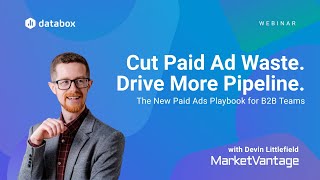
Devin Littlefield, CEO of Market Vantage, shows B2B teams how to cut paid ad waste by tracking six core metrics: CAC, cost-per-X, LTV, ROAS, payback period, and deal-value. A LinkedIn Ads case study cut spend 50% while doubling sales-accepted leads through aggressive audience segmentation.
Questions this video answers
If paid spend is not driving any sales conversations or pipeline opportunities—i.e., no new deals, low conversion rates, or the campaign exceeds the typical sales cycle without delivering qualified leads—it’s a strong signal to pause or cut the program. Upper‑funnel metrics like very low conversion rates can also indicate a need to stop.
Share data‑driven stories using Databox reports that show concrete outcomes (e.g., % ad‑spend reduction while improving qualified lead quality). Align on overlapping targets, demonstrate how marketing actions (target‑account lists, ABM ads) directly generate sales‑accepted leads, and regularly communicate these results to sales leadership.
There is no single best channel; performance depends on brand perception, audience, and ICP. A multi‑channel, integrated testing approach—running experiments across LinkedIn, Google, Microsoft, etc.—lets you identify the most effective mix. Use LinkedIn’s brand‑lift studies and iterative testing cycles to pinpoint which media delivers the highest conversion for your specific account set.
A fully integrated CRM (e.g., HubSpot, Salesforce) that tracks the full deal pipeline, combined with a connector (such as Databox) that brings ad‑level data and CRM lifecycle stages into a single dashboard. This enables you to map paid‑media touchpoints to sales‑qualified leads, opportunities, and closed‑won deals.
Chapters
Okay everyone, I think that by this time most of you probably already connected. Uh, we're gonna wait a few more minutes just to make sure that everyone gets on today's call. Hey, Devin, I think you're muted.
Yep. Hopefully you can hear me okay.
Yes, I can. Welcome. I just shared with everyone that we're waiting a few more minutes for everyone to connect. I think most people already connected, so we might be able to get started here in a second. Maybe we wait another minute. I can see a few more people connecting. We got a good number of people joining here. Where's everyone joining from? I'm curious. I'm currently in Slovenia in Europe, which is a very small country. Not many people know it. Where's everyone else calling in from? Greenwich, Minnesota, Portugal, London, Boston. I love it. Aberdeen. Quite an international audience here. All right, I think we can get started. So a quick hello from my end. I'm glad all of you could make it to today's webinar. My name is Emil. I'm with the Databox team, and today I'll help host the webinar. I'm joined by Devin Littlefield, the CEO of Market Vantage, who is our main panelist today. And before we get started, just a couple of housekeeping rules and then we're going to dive into today's agenda and everything. We will cover questions most likely towards the end of the webinar, but feel free to ask questions throughout in chat. Just make sure that you have the everyone option selected so everyone can see your questions. And also, if you'll have any maybe technical issues, just let us know and our team is gonna step in and help out. So to get started, today's webinar is about how B2B teams are cutting paid ad waste without losing pipeline. And Devin will walk us through here in a second, uh, through the current paid ad challenges and how he is helping clients cut wasted spend, improve lead quality, and rebuild paid programs around true profit. Today's agenda is going to be about why the playbook has changed and just Devin doing a deep dive into more specifically, again, some practical examples, what's working in today's area, for example, and how to adapt to these changes, the different frameworks that are proven to really work, some practical takeaways, some tools and resources that everyone can take with themselves after the webinar. And obviously also we're going to go through Q&A at the end. Just a quick overview, quick glance at today's agenda, but I know everyone is eager to get started. So, uh, before we actually do get started, I just wanted to give a quick, uh, summary of Databox. Databox is a modern BI tool that's focused on helping businesses centralize all of their data in one place so they can start tracking performance and spend, and spend more time making better decisions. The platform offers a ton of business intelligence functionality that is still easy to use and doesn't have a learning curve. We also recently started launching new AI features, one of them being the ability to connect your AI agent to Databox via MCP, so you can analyze and summarize your performance faster. This way, anyone can really start making data-driven decisions to improve performance. If you're curious, you can check it out at databox.com to sign up for a free 14-day trial. And of course, our team would also be then more than happy to help you get set up. And before I hand it over to Devin, I just wanted to give a quick intro about you, Devin, if that's okay.
Sure.
So for everyone here today, Devin is the CEO of Market Vantage, a B2B demand gen agency. And he has over a decade of experience in digital marketing and leadership. He's an award-winning marketing leader and has driven over $50 million in pipeline for B2B companies and has managed millions in ad spend. Devin, it's so great to have you here today.
Thank you so much, and it's a pleasure and an honor. Super excited to share a bit just about the learnings that I've had over the years and yeah, excited to share what I think we're seeing is winning in 2026 looks like from a paid advertising perspective. And yeah, hoping everybody will come away with some really practical nuggets, some good stories that they could take back to their leadership teams, and especially excited to be able to, yeah, just walk people through how we're kind of working through clients in today's day and age. Awesome. So let's go ahead and jump right in. First things first, I do have a tendency to make webinars very engaging. My focus is to not try to just put everybody to sleep. So we've got a quick poll here that we want to start This is one of three, so be on your toes. Don't put me off to the side while you're tuning out, doing other work. Stay right here because there's going to be a lot of practicals. The first poll for the day: what best describes your paid ads performance right now? As you can see, there's various options here that are available. So I'll just give people a few seconds. Just go ahead and pick one of the answers there. It could be that you're not running any form of paid. You could be scaling confidently, in which case, kudos. Hopefully, maybe you'll pick up a tidbit or two, but you probably know a ton already, so would be excited to see just what people land with. So we'll just give a few more seconds for that poll. And by the way, if you see me looking off to the right here, I've got the Zoom window pulled up on my other screen. So I'm just kind of monitoring on that side. Give it about 5 more seconds. 3, 2. Awesome. And so now we should be seeing some initial results coming in here in just a second. And yes, Leah, just so you know, the recording will be shared afterwards, by the way. Awesome. Okay, so this is interesting. All right, it looks like about 11, 11 of you or so, maybe I guess probably 30% say costs are rising and ROI is slipping. Ooh, that's a big one. We're definitely gonna be talking a lot about that today. A number of you are not running any form of paid now. Great. So hopefully you will come up and be able to get some great answers coming out of this. We've got some performing well and scaling. Kudos to you all. And then some breaking even but hard to grow. Okay, so awesome. There's a lot of good, a lot of good insights here that I'm hopeful everybody will be able to walk away with today. So first things first, what I want to do is just set the stage for why the playbook has changed. There's a number of different reasons that we're kind of seeing, but I think the first and the obvious one, as most of you pointed out, rising advertising costs. Right now, what we're seeing is that the average Google Ads CPC has increased about 13% up to now $5.26. That is a global average, by the way. We know many B2Bs are probably laughing here on this call because $5.26 is not your average CPC, probably. It's much higher, I'm guessing. The median cost per lead across B2B is now around $70, you know, 5% increase from '24 to '25, and then about a 147% jump in LinkedIn CPCs from '24 to '25. That is because of what we know. Many B2Bs jumped right on the LinkedIn bandwagon as soon as usership started coming up, LinkedIn Ads platform became easier to manage. There's just a number of different reasons why that is, and especially the B2B buyers are what we know those B2B buyers are present on LinkedIn. So what does that mean? Ultimately, higher costs, shrinking returns, and poor, poor lead quality, as I think the poll kind of accurately pointed out. And by the way, before I go further, I just want to point out the slides will— for this will also be shared out afterwards. You're going to see links to reference data below. And yes, for those of you who are curious, all links have been verified. All data was verified as well. This is not just AI output with bad, bad links being turned in. Just, I feel I need to put a nod to that now in today's kind of current AI era. So what else do we know though? 94% of buyers today are using AI at some point during the sales process. That's coming out of data from Forrester that was actually just released literally last week, their latest 2026 State of Business Buying. It's pretty wild because I'm sure for many of you, you've used ChatGPT or some other form of LLM to ask questions while you've been evaluating tools. I've personally seen it several times now where I've had either existing clients or prospective clients literally evaluating even things as peculiar as HubSpot versus Salesforce. They're trying to define, okay, wow, which one is going to be best for our business? They get the personalized answer. You don't run into a quote-unquote salesperson to influence you because it's unbiased. What generally it means is that we need to be thinking about AI first in today's current era. What we also know is that about 30% of the average marketing budget is being allocated towards paid. That's out of a Gartner CMO survey from 2025. That's a pretty hefty chunk. It may not be the largest chunk of the total marketing budget, but it's pretty substantial by, by most, by most measures. What this also reveals to us is that as far as effectiveness goes, being able to track the end-to-end lifecycle of the dollar going in to the dollar coming out is critically important in 2026 and beyond. And what we also know from that same survey, this was actually the top priority for CMOs going into 2026 was leveraging data analytics and measurement to optimize performance. Everybody today is in the squeeze of how can we make sure that we're getting the most effective use of our dollars, whether that be in advertising, events, or, you know, certainly other, other marketing efforts, we need to be able to see the full end-to-end performance. And that's why obviously using DataBox has been really helpful for that. I'm going to share a bunch of use cases and frameworks of how we can take advantage and make sure that we're showing and leveraging that data and analytics appropriately. But this was, again, to reiterate, the top priority, excuse me, from CMOs coming into 2026. So ultimately, what does this mean? We have media inflation. Sorry to be a little politically charged there, but with that term inflation, but we are seeing that, of course, the media costs— this is proof in the pudding— media costs is rising. We have longer journeys. And what I would also add is maybe convoluted journeys because we have empowered buyers. We have people that are able to make decisions faster and more autonomously than ever before. Where they don't need the influence of a salesperson, and they can get the answers near instantly. So what this could mean, though, is that ultimately, as paid media teams or paid media experts, we need to be thinking about how we are distinctly using all three of these kinds of outcomes to our advantage. Before we get into how we're actually going to do that, though, let's take another quick poll here. Again, poll number 2 of 3: which paid channels today are driving the majority of your results? Go ahead, it will take just a few seconds here. I've got some pre, kind of pre-picked options here. I'll add that again, if you are in the category where you're not doing any form of paid advertising, just go ahead and say we haven't found a consistent winner. We'll know that you're generally, you're kind of batched in that category. So go ahead, we'll take a few seconds for that. Awesome. And let's wrap that up here in 5 seconds or so. Awesome. Let's close out that poll and let's see what the results were. Okay. Yep. So not entirely surprising. It's pretty much came down to 3 categories: paid search, which was the highest. So, you know, Google and primarily Google, I'll assume, but Bing is in there. Paid social, which primarily, again, I'll assume for most of you is going to be LinkedIn. And then we haven't found a consistent winner. So those are really the 3 buckets. Hardly anybody— actually, excuse me, nobody was in the ABM or the retargeting categories. Good to know, and thank you for filling out that info. All right, so that leads me to then what is working right now. What are things that we see that we know are going to be effective for paid ads teams? Again, according to, uh, some research data from coming out of Wintor, integrated and multi-channel— 34% of B2B marketing leaders report the biggest returns from integrated campaigns across paid ads, like paid social, LinkedIn, email, and SEO combined. It should be obvious, but if we are able to share a unified message across different channels going out at the same time, those marketing leaders that have been doing it will report higher returns from that. Completely makes sense. And again, this is a little bit of '25 data coming into '26. But I expect these trends certainly to continue well into this year. Again, we'll go also into practicals in just a few minutes. Audience-first segments. 26% of leaders invest in detailed ICP segmentation and mapping customer pain points. You know, I will say this is probably honestly one of the biggest opportunities for most of you on this call. I would suspect being able to properly make sure that you have ICPs and buyer personas as an example defined and mapped out for every pain point in the customer journey, I think is a massively overlooked opportunity. We see that what can happen is it can completely influence or change how you approach paid search campaigns, as an example, based on just the understanding of the pain points and using those keyword pain point related keywords even instead of just direct, you know, bottom of funnel, highly intent-driven keywords. Those are big opportunities for folks to be able to be thinking about. And we find that at the core because people are overlooking perhaps that initial ICP or buyer persona definition upfront. They may be missing those opportunities for improving things like paid search down the road. So this is a big one and one that I want to make sure that everybody here walks away with understanding this is a high priority or should be a high priority for '26 if you don't already have this done. And then fully aligned to sales. I think as much as maybe some of you might be begrudging or moaning hearing that, I think the bottom line is understanding exactly who the sales team is targeting and how we can be supporting them. It used to be the core function of ABM was really just around the sales and marketing alignment, right? That was one of the first things that we heard about if you went through like the demand gen, the Demandbase ABM program was getting fully aligned to sales. That is absolutely a mission-critical need for B2B teams today. You must be able to spend that time understanding who they are targeting, why they're targeting them, and being able to support that customer journey. Incredibly important, especially from a paid perspective. I would, as I would assume many of you, if you are doing some form of LinkedIn advertising, you may already have ABM-based plays inside of, inside of that platform. I highly recommend continuing to iterate on that this year, especially you are going to see dramatically more enhanced performance and more opportunities to get in front of people on ABM-related platforms using, using that approach, as long as you are really tied down to what the sales team is looking for, getting target account lists defined and making sure that you have a full kind of ABM suite plan. So what we also know, again, just to kind of hype on this point from Winter's Trends research, is that ABM, you know, as Andy points out from a B2B SaaS and software company, you know, it's a very big part of the mix. Ad dollars are getting squeezed. It's allowing Andy to be able to be more targeted, more effective with every new campaign, and ABM is bringing that better effectiveness to the table. So again, it is something that I'm highly recommending everybody on this call make sure to explore this year. But ultimately, where do we land with this, right? This kind of helps us get to the conclusion that we need to make sure that we are evaluating our media mix, that we are understanding exactly how performance is being tied back to those revenue and those dollars. And then adjusting our campaign strategy accordingly. Thinking about the pipeline, of course, not just our vanity metrics of impressions, clicks, cost per lead, or lead volume, but how are we actually looking against pipeline? And then getting much more aggressive, of course, with experimentation in ABM programs. And don't worry, we're going to get into practicals on all of this here in just a second. I will point out that one of my favorite or my preferred kind of ABM platforms right now is actually brandgen.io. This will benefit. It's a great platform for those of you who are using HubSpot as your CRM and marketing automation platform and running any form of paid on search or social. Great platform to be able to actually, from a CPM model, no minimum investment, be able to actually run programmatic ads against a target account list and sync that data from HubSpot. Game changer. It's one of my favorites right now, and it's a really cost-effective way to get up and get a against the target account list and then cut ineffective programs ruthlessly. Again, I'll talk about all the math behind this here in a second and how we might make that type of decision. All right. So other quick math just to make sure we're all on the same page here. This is what we're thinking about in terms of key metrics to evaluate your paid performance against. This is not to say that other metrics aren't important. If you're like me, you're a data nerd and you spend all day long looking at what your CTRs are, if you're looking at your CPMs, if you're looking at your, your reach or your total impression count, right? These are all important metrics, but particularly these next 6 metrics that I show up on the screen, these are the ones that help kind of drill in for me what is most effective for paid advertising today. So of course, the first and foremost, thinking about CAC, right? Our customer acquisition costs. How much are we spending to how many customers are we actually generating? That's a really important one. Another one, and I put this in here with an X, cost per X. What I'm referring to is the cost of generating a contact within an individual lifecycle stage. So this does require having a CRM or marketing automation platform mapped against your campaign strategies. This is maybe potentially a little bit of a technical lift here, but that is where I love Databox being able to come in to help support that because we are able to literally map what is our cost per sales qualified lead, our cost per opportunity, our cost per sales accepted lead, right? Whatever your lifecycle stages that you're using, you're able to get all that kind of seamlessly mapped in, in the data box and reported on. So that's what I mean when I say cost per X, because I don't just want the number of leads that I generated or the number of conversions. I want to see how are we actually influencing further down in the funnel, particularly cost per opportunity. That's one that again, we're really kind of deriving how much are we spending to get opportunities or pipeline generated. Lifetime value, of course, we need to make sure that we understand across all of the math, right? If you all are selling a $99 a month software trial or a software product, the math on that looks very different from $100,000, you know, single opportunity. Then we just need to look at how paid ads is performing differently based on that lifetime value of the customer and what we expect to be able to generate. That of course influence our revenue, our return on ad spend, our ROAS, revenue from ads divided by ad spend. Pretty straightforward. We want to make sure that every dollar that we're putting in, we're getting more in return with our ad spend. Payback period, I think this is kind of an, I don't know, maybe a metric that's been a little overlooked from the years. This is what we're looking at for CAC divided by MRR per customer. For those of you who maybe measuring it a little bit differently. I think there's some nuance perhaps with that answer. Maybe payback period is not the completely correct number to look at, but this is basically the metric that will help us determine, okay, how fast are we going to get those dollars back, right? I think this is a really, again, an often overlooked metric, but one that's very, very important in terms of making decisions around your media mix in particular. And then of course, just probably should even put this a little bit higher up or maybe earlier on because this is slightly more upper funnel, but new deals being generated by dollars and/or, you know, a deal dollarized value or dollarized amount generated. And we need to be able to look at from different attribution models, how many deals are we actually bringing into the door, knowing that for probably many of you, if you have a longer sales cycle, say greater than 60 days, Some could even be pushing into 180 or 365 days in some cases like we have worked with before. Really, these are more important than new deals by either dollarized values or numbers are incredibly important to be looking at for making decisions because certainly return on ad spend is nice. But if you're, if your pipeline, it takes 365 days to go from a new opportunity to close one, looking at return on ad spend is not going to be incredibly valuable for 365 days. It's going to take a while. So that's where I say the math— these are several of the calculations that we look at. I'm not saying everybody on this call needs to do every single one of these. Your mileage will vary based on the type of business you have, what your average deal velocity is, and frankly, just how many deals you're bringing in on a regular basis. Those all carry an influence. But I think for hopefully the majority of you on this call, calculating all of these in some capacity is going to be incredibly helpful to make sure that you are completely understanding just how effective your advertising campaigns are against this. But again, without the— that ability to be able to track campaign-level performance to these metrics, it's going to be very hard to make these types of decisions on the fly around your media mix, around what campaigns are being effective, et cetera. So that is probably one practical takeaway. I'll, I'll skip, I'll skip to the punchline now just to be a little early. One of the things you're going to need to make sure that you do is with your paid advertising efforts in '26, make sure that you're evaluating all of these metrics against individual campaigns. You need to be able to tell the story of not just by channel, not just by type, campaign type, but by campaign How effective were we at doing these things? So that's just one other quick tidbit there that I want to make sure people take away from. All right, so now, now that we got some math, we know the data, what we're seeing, let's actually talk about the framework that helps you win inside of 2026. This is a framework that we've actually gone ahead and developed. We call it the PEAK framework. You're going to see there's a little cheeky bit at the end. I apologize for being a little on the nose here. But so first things first, we need to make sure that we have a plan. And this is simple. I don't want people to overcomplicate this. What I'm literally talking about is just a basic document. Let's have a plan around what we're actually going to test, right? This is an experimentation framework that you can use for Google Ads, Microsoft Ads, LinkedIn Ads, any platform, any campaign that you're working on. It's simply the basis for being able to go from here's an idea to here's what we've learned, right? We want to plan out first. We want to make sure that we identify who your ICP is, your buying committees. We want to make sure that we've forecasted any potential budgets and ensure tracking is in place for this framework. What it could look like is just simply, okay, I have a, I have a theory that if we look for pain point related keywords, inside of Google Search as an example, that might be more effective than targeting intent-based keywords on Google Search. Again, just one quick example. So let's build a plan around that. Let's simply document it and say, okay, here's a hypothesis that I have coming into this type of program. Let's see what happens, right? We then want to be able to, of course, to go execute on that. Now I know, again, a little on the nose here with the, the peak— you'll get that in a second. But we want to be able to use different variants and test what's working. I'll show exactly what kind of variants you may want to test, testing cycles in a second. But we want to be able to execute on that campaign and we're tracking all of that. We want to see what is actually working. Did our pain points versus our intent-based keywords, how are those actually lining up? What is the data we're seeing? Of course, then we're going to analyze that. We're going to try and understand, did we kind of get to enough significantly statistically significant data to be able to help us understand how did we do? Didn't we see improvements in CTR, CTL, whatever your metrics are that you're picking along the way, we want to analyze and understand, okay, against pain point versus intent, we found this result, right? And I think for many of us, that may end up being slightly upper funnel metrics or you know, more ad campaign related metrics. Over time though, you should be able to tie that back to then actual pipeline generation, to CAC, to your LTV, whatever it happens to be. We want to make sure that we're actually tying that data back. And then no, I think this is funny enough. I think this is often overlooked with a lot of experiments like this, right? You have this framework where you've now kind of, you've come up with this answer. You now know, okay, maybe pinpoint keywords are better than intent-based keywords. But that's not necessarily impacting your plans moving forward. Again, a little on the nose, but what we then want to be able to do is take that information and continue actually driving forward and implementing that in some greater amount of scale. So this could be then taking these learnings from one channel, testing them on another. If you are, say, doing that on Microsoft Ads, which I do love using Microsoft Ads for testing purposes with, uh, search in particular, we can then go apply that to Google Ads, then see if we get the same results. That's one example of how we can then take that knowledge and then go apply it elsewhere. So I'm sure all of you are kind of like, okay, I get it, there's PEAK, interesting, seems like a pretty basic framework, but what could we actually do with this, Devin? So how would we actually apply this in real life? What we're going to do is continuously run these iterative cycles over periods of time to be able to run different experiments. So things that I would typically look to test inside of a framework is messaging, right? Even basic, even basic messaging testing, I think often overlooked, can have a huge impact on performance down the road. Audience testing, especially if you're doing any form of paid LinkedIn advertising as an example, we want to make sure that we can test Is audience A doing better than audience B? Are we seeing that different asset— different assets perform better for one versus the other? Can we change up the messaging for the audience and see what's actually being effective? This is a really critical area, especially if you're doing LinkedIn. We want to see more aggressive audience testing. Campaign formats. Believe it or not, again, just using a basic example with LinkedIn ads, a document ad versus a, let's say, a single image ad with a lead gen magnet could be the same exact offer, same exact audience. We can find dramatically different performance related to cost per click, cost per lead, even how many times it's reaching your ideal audience for the same exact audience, same exact daily bit, daily budget. It's because of how LinkedIn is serving that content, who it's serving it to, that can all have an impact on performance. So you want to iteratively test these types of formats to see what is driving more effectiveness. And creative. Again, I cannot stress the amount of creative that I think B2B teams need nowadays. Not only are we kind of flooded with, you know, all these kind of TikTok or YouTube Shorts related creatives that are taking over video world, but we've also got even just in LinkedIn, again, square and vertical creative. Those have absolutely taken over the feed in both places. And we see generally on average, those drive higher results for our B2Bs. So we need to make sure that we're continuously testing those types of things. Those are all examples of what we would run inside of a framework. And then typically, you want a minimum of a 14-day interval for different testing cycles, I would potentially look at running, say, a creative test over a 14-day period, because I think we can find even within that short amount of time, that, that has pretty top of funnel or top line metrics that are very easy to be able to point out what's working versus what's not. But when we're, say, talking about audience testing, we need to be thinking about that in a longer cycle because ultimately, again, if you have a long sales cycle as an example, we may not see the impacts of some of that for 60 to 90 days out. So we need to make sure that testing cycles kind of move accordingly with that, with that framework. And so let's take a look at a case study from this. We did this with a new client coming in from LinkedIn Ads. And just some brief overview of that client. They're a B2B AI SaaS company. So of course, pretty hot right now, right? They've got the cool AI product. They're trying to come in and oust the big competitors here. They had an average 3-month sales cycle, complicated buying group, a lot of decision makers in the process. And they're mid-five-figure deal values. So just again, to set that stage, they had $85,000 a quarter to spend on LinkedIn ads. And they initially were concerned around the lead quality and driving sales conversations. And then one other thing to note, they had custom lifecycle stage definitions that they were tracking. They were not using the very typical lead, MQL, SQL, opportunity, deal. So this is an overview of where we kind of started, right? You can see right in the top corner there, 62 leads generated in Q2 of 2025. But what you also see is that 50, almost 50% of them were immediately disqualified, right? That big bar chart at the top, disqualified, massive, unbelievable. What we were really looking for was that sales accepted lead rate. 2 quarters later, right? So Q4 of '25, this was their actual data that came in. Now, of course, they still had some disqualifications disqualified opportunities or, you know, contacts coming in. But we were able to get them to now a 60% rate. We did this through Q3 primarily of doing kind of iterative testing around the audience, around the creative. We did not change the assets. We did not change anything related to, you know, just like their offers, what they were actually doing. We just simply modified a lot of that stuff. We did aggressive audience testing and believe it or not, we also cut that budget in half. So we said, hey, we can actually be way more effective or drive a higher effectiveness rate for half the spend. Let's give it a shot and see what we can do. Now, coming into Q1 of '26, this same exact client, we're now going back up to that original budget. And what I fully expect is that now we are going to completely scale these efforts. Sales accepted leads to them, by the way, does mean a sales conversation. So that is what we're actually looking for. That $628 cost per SAL, that is completely acceptable. In fact, it's under their target. So for them, they're thrilled. So what did that actually look like in practicality? Like I said, we planned, we tried to intentionally cut down 50% of the budget. We developed iterative audience testing against those existing campaigns. And what we did was take a layered campaign approach inside of LinkedIn where we said, okay, we're no longer just going to target 1 to 2 swaths of people. Literally their audience size in LinkedIn was over 8 million, 8 million contacts, which is just insane. So we took a layered approach where we said, okay, here's our target persona, here's our ICP, let's marry those up and then target within LinkedIn using that same approach, dramatically better performance. What did we then of course do, we were trying to optimize towards, like I said, the sales accepted leads, not just leads reported in LinkedIn. And now what do we know? We now know that we are able to double down on the gated content and the thought leadership to be able to drive more sales. We did find that thought leadership ads were not a priority in the slides I showed you. Really, really important for driving that upper funnel awareness. And we did see that it had nice downstream impact on the website conversions in particular. So that's where we were really prioritizing those two things moving into now 2026. So just a few practicals here, and then we're going to go to our last poll, then a Q&A. So first things first, determine your own benchmarks. I can't iterate this enough. The B2B benchmark data out there, not that great, to be honest. And a lot of it's dated. Most of you are probably referencing the WordStream article that they keep updating and keep ranking number 1 in organic search. I think that there's a missed opportunity. Evaluate your own benchmark data. Every company that we've ever worked with is different. No two are the same, and what success looks like to them is also different. This is even an example from another customer. Many of you are like, oh my gosh, it costs $7,000 to, you know, to get a customer from paid search. Yes, but also to them, the lifetime value on that customer, massive, right? Much bigger return. So the reality is that is actually a tolerable CAC for that particular client. I can't stress it enough, without your own benchmarks, which By the way, that's an improved CAC of by about 50% in the last quarter since we started engaging with them. Massive opportunity to make sure that you are really trying to bring down and understand your own benchmarks. Evaluate your campaigns by goals. Again, I think this is really often overlooked by a lot of paid media teams, being able to actually look at a campaign level and see how many sales are you driving, or in your case, how many marketing qualified leads, how many sales qualified leads, opportunities, right? We need to make sure that we're evaluating at a campaign level. That does require the syncing of CRM and marketing automation data with your paid ads performance report. So Databox obviously helps make that very easy for us. That's why we love it. But I would add that for anybody, no matter your circumstance, being able to evaluate your campaign strategies like that, huge. And then set a budgeting framework as well, right? We started at the top around What is the ultimate media mix, right? It's understanding what are those revenue goals, calculating your LTV and your CAC, estimating the number of leads you would need in order to kind of satisfy and get to that revenue. And then ultimately, I think it starts by estimating per channel, then evaluating monthly, and then readjust as you go. And just please keep in mind your deal velocity in that process as well. If you tell me that you have a 90-day sales cycle, and you're trying to adjust, you're allocating your budgets and changing it monthly, that's not going to be an effective part of your paid ad strategy. You need to make sure that the changes that you're making and how you're allocating your media is somewhat reflective of that, that deal velocity and your sales cycle. So just keep that in mind. All right. I think we've done it. We're coming in towards time. Poll number 3, how confident are you in your current strategy going into 2026 for paid media? We'll just leave that poll up here for a second. And so, by the way, I recognize, of course, there's a lot of stuff in here. I'm barely scratching the surface. In just a second, I'm going to quickly go into free tools and then we'll open it up for Q&A. Um, but there's going to be a lot of free resources you'll get links to here in a second. All right, and let's wrap up that poll then, see where we are at. If all of you went to very confident, by the way, I will be very humbled coming out of this, this presentation. Okay, so we're heading into the somewhat confident, unsure, needs a little work. I think that makes sense. A few of you need a reset. So hopefully this has been a good opportunity for you to take away a few tidbits that you can bring back as you are resetting. I love that very one very confident answer. That's awesome. Keep up the good work, my friend. And, uh, awesome. Let's get into some free tools and resources. I, like I said, there was a ton here. I wasn't able to get into everything during our time, but I first want to start— we have a free assessment. I've worked with the Databox team. We have paid ads dashboards. And what I would like to offer for everybody on this call, a free— no, you know, no, no bias here— 15-minute one-on-one performance assessment What we would need you to do is first make sure if you're not already, sign up for Databox. Then step 2, download the templates. The links are all provided here. And then 3, once you've done that, schedule an assessment with me. It's a really easy, free way to be able to get a gut check on how you're doing. Like I said, no obligation, just want to be able to offer any insights that I can for you. If you're running any paid at all, we do find that you'll, you'll walk away with a few tidbits to help drive growth this year. If you're not currently running paid, feel free to schedule an assessment anyways. It's fine. I can go over historical stuff, give you some insights for what you may want to try in the future. Totally fine. So just first and foremost, make sure that you do take advantage of that because I really want to make sure that you have the tools and the resources you need to be successful this year. The next is a scorecard. So this is actually a use case video that I produced with DataBox previously. Giving some ideas around actually how can you leverage Databox to be able to get an ultimate paid media scorecard in place. This is a weekly metric reporting where then you can actually quickly go in, look at your single Databox dashboard, and be able to see, okay, how are we doing here? Where do we need to improve here? Right? It's a scorecard for tracking performance. So make sure to check out that video when you get the chance. And then lastly, the lead value calculator. This is a tool that we made using AI. Fun, fun. We want to be able to see and help make sure that you really know your math around what is an acceptable cost per lead, how much should you be budgeting, etc. So make sure that you— it's a free tool. You could just punch in your own numbers. It's really quick. It's responsive. So make sure that you take advantage of that if you're not already familiar with your own math and how much you're willing to get a lead for. All right, well, that was fun. That was fun. Time for some Q&A.
It definitely was fun. Thank you so much, Devin, for walking us through all that. It's extremely relevant, extremely timely for today's time. So I'm excited that you took time from your busy schedule to be able to run this webinar, and I'm sure that there's a lot of valuable insights that others are also taking from today's session.
Awesome.
And I also, um, so we did get a couple of questions. If anyone has any more questions, feel free to just either ping me or Devin directly, or obviously use the everyone selection in chat. But a couple of questions we've got are, what's the clearest data signal that tells you it's time to cut the program? Devin, what do you think?
Oh, good one. Um, I think a little bit of that depends on, you know, your business and what your sales cycle looks like, and particularly if able to tie back your paid performance to your pipeline or your opportunities. Assuming that you can, what I'm just strictly looking for is, are we driving any sales conversations at all? Right? I think that's a very simple way. And where I said, what are the numbers behind paid math, right? New deals being generated from paid. If you're showing some initial indications that you're getting sales opportunities batted up, awesome. I think that's a great opportunity. But if you exceeded your typical sales cycle and you haven't driven those opportunities, I think that's a great time to potentially cut it. Now, the one caveat I will say, don't ever be afraid to come back and try things again as well. Right? I think ultimately people might say, oh, I ran a 30-day Google search experiment and it didn't work, so I'm just cutting Google search in general. Yeah, but you ran it in December, right? December is not a great buying time for most B2Bs, right? Let's try it again, perhaps in like like, I don't know, May and see how it goes before people go into summer vacation mode, right? So I think don't be afraid to also go back to some experiments as well and just retry. I think that, that's one other thing to keep in mind here. If you don't have the complete CRM connection like that and you don't fully understand how paid is driving pipeline, then one other thing you may want to look at is just some upper funnel metrics, certainly conversions and conversion rates. I think are other easy, easy metrics to look at to help tell you when it's time to cut or not. If you're seeing, you know, below or very little conversion performance, then I think it may also be time to cut too.
That makes a lot of sense, Devin. And we also got a question from Martha. I spend a significant amount of time aligning with the sales team, but it feels like a one-way effort. It seems they don't see the value of marketing activity. So do you have, Devin, any insights, any tricks up your sleeve how, for example, teams can then better position their work, their outcomes to other teams?
Great one. And that is definitely, unfortunately, a very common challenge today. I think what that often comes down to is just knowledge and just kind of sharing that level of insights. What we do especially is we take a lot of the Databox reports that we provide for clients and we make sure that the leadership teams at that company is very aware of what the marketing efforts are driving. That does even involve just the marketing and sales alignment, right? If you can craft a compelling story that shares, we actually cut our ad spend by 25% and now we're reaching much better, more qualified companies as a result. Here's what the data is showing us. I think that's a perfectly viable story to share. And a lot of leadership teams and sales teams, I think what it just comes down to is not having that, that clarity of what they're doing, right? I think to sales it may feel like, oh, the marketing people, they're bugging us again for target account lists. Yeah, I just keep giving them to them, etc. But they may not have that full understanding of exactly kind of why it's benefiting them. And especially if you can help show a compelling story that says, hey, we took your target account list, we ran some ads against them on LinkedIn, we drove several more sales conversations on your target account list because of that list sync. Thank you. I think that's a very— they'll be absolutely thrilled with that and they'll say, great, how many more companies can we give you today? You know, so I think having that feedback cycle is really critical, especially for leadership teams. I find more than anybody else.
I agree. So connecting the work that you do with outcomes of the other team that they are being measured on. So what we call that is overlapping targets between marketing and sales because only the quality of those leads will actually be visible in the sales cycle. So that's the lagging outcome that we will then also measure marketing on.
Absolutely. Absolutely. You nailed it. Cool.
I also had a question from Barbara. Assuming ABM is in place when advertising, which ad media is generating the most conversions? My Google Ads are dried up.
Yeah, it sounds like for Barb and Barb, we happen to know each other, of course. So great to see you on the call as well. Excuse me. I think what it comes down to, especially— let me just make sure— what ad media— I think it's going to come down to just a personalized mix. At the end of the day, you know, no one company has— even if there were, let's say, two different software companies that did the same exact thing, similar ICP, similar buyer personas, you may end up getting some slightly different results from your paid ad efforts, even if we were on the same exact channels. And the reason could be things that we are— it's very hard to tie back. So like your brand and maybe the, you know, the perception of your brand in the marketplace as an example, that's a very hard one to kind of measure. LinkedIn Ads uses what's called a brand lift to see, okay, with a certain amount of spend and certain types of campaigns, can we actually improve the reach and the kind of the understanding of your brand across the marketplace? That's one experiment that they'll do, you know, typically if you're spending a certain amount. I don't know that there's a perfect media mix. I think what it comes down to is multi-channel. Like I said, multi-channel and integrated testing. Can we just test different markets or different channels and see what's more effective for you? I'll also add again, with the iterative testing cycles, using the framework that I pointed out, you should be able to actually kind of pinpoint any or identify any problems within your existing campaigns and come up with a plan of how to fix them. So I think between those things, you know, what I would hope is that everybody doesn't walk away feeling like, oh, I need to go invest $30K in Google Ads today or $50K in LinkedIn Ads today. I don't think that's the answer at all. I think your answer varies depending on where you are and what your goals are, right? So map out what the value, the lead value is for you. Map out what the, you know, how much are you willing to spend to get an opportunity in your pipeline or a deal close in your pipeline? And then use that and start running targeted experiments across multiple channels. I think that would be, hopefully everybody takes that away and understands that that's really an effective part of the strategy for 2026.
Agreed. That's a great, great answer and great, I think something for others to easily apply and just test out themselves. And I know that we're approaching time here or we're at time already, but there's one more question, Devin, that I really wanted to to make sure also others hear. For teams just starting to evaluate paid against pipeline, what's the minimum data setup you would require?
Oh, good one. What I think what's really critical for today's paid media teams or even just marketing teams in general, you've got to have that clear line of sight into your deal pipeline. So whether that be, you know, inside of a CRM like HubSpot or Salesforce, you need to be able to look across, you know, from your marketing efforts to your sales pipeline and understand truly what were the touchpoints that occurred to get to close opportunities. You know, if you can do that, then I think you start really actually pulling back the onion on what's effective or what could be, you know, or what will be effective for paid ads teams. Because without it, I think it's a little bit of a shot in the dark. You know, a couple of years ago, if you'd asked me, I would have said, oh, just use all the conversion reporting inside of LinkedIn or Google directly, you'll be fine. As long as you can see the form fills coming in, the, you know, the rest doesn't matter, quote unquote. Not, not the case now. You need to be fully integrated with your CRM and your deal pipeline tool. So whatever platform that happens to be, DataBox can probably connect with it. Got many hundreds of connectors available. So you should be able to pull in that data very easily.
Awesome. Thank you so much, Devin. And I know that we're at time, so we're going to wrap, but Um, again, thank you so much, Devin, for walking us through today's topic. A lot of great insights, and obviously it's extremely relevant for 2026. I also hope that others feel the same and also feel that there's so much more opportunity that you just need to really put your head down and potentially get expert help like Devin and his team. So thank you again, Devin.
Thank you so much for having me, and thanks to everybody for joining in. Don't hesitate to reach out to me as well, devin@marketvantage.com, if you have any questions.
Awesome. Thank you so much. Again, as already mentioned earlier, we're going to make sure to send all resources over email, including a recording to this presentation, to this webinar, including also the deck and other links, relevant links as well. Thank you again, everyone, and hopefully I'm going to see you on the next one. Thank you again, Devin.
Thank you. Take care.
More from Devin
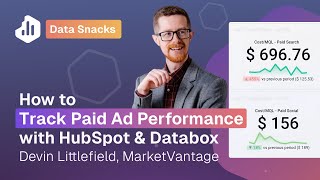
How to Track Paid Ad Performance with HubSpot & Databox | Data Snacks | Reporting Tutorial

Webinar | AI Marketing Excellence: Building Scalable Channel Partner Programs | May 2025
How to Create a Marketing Scorecard in Databox | Step-by-Step Reporting Tutorial