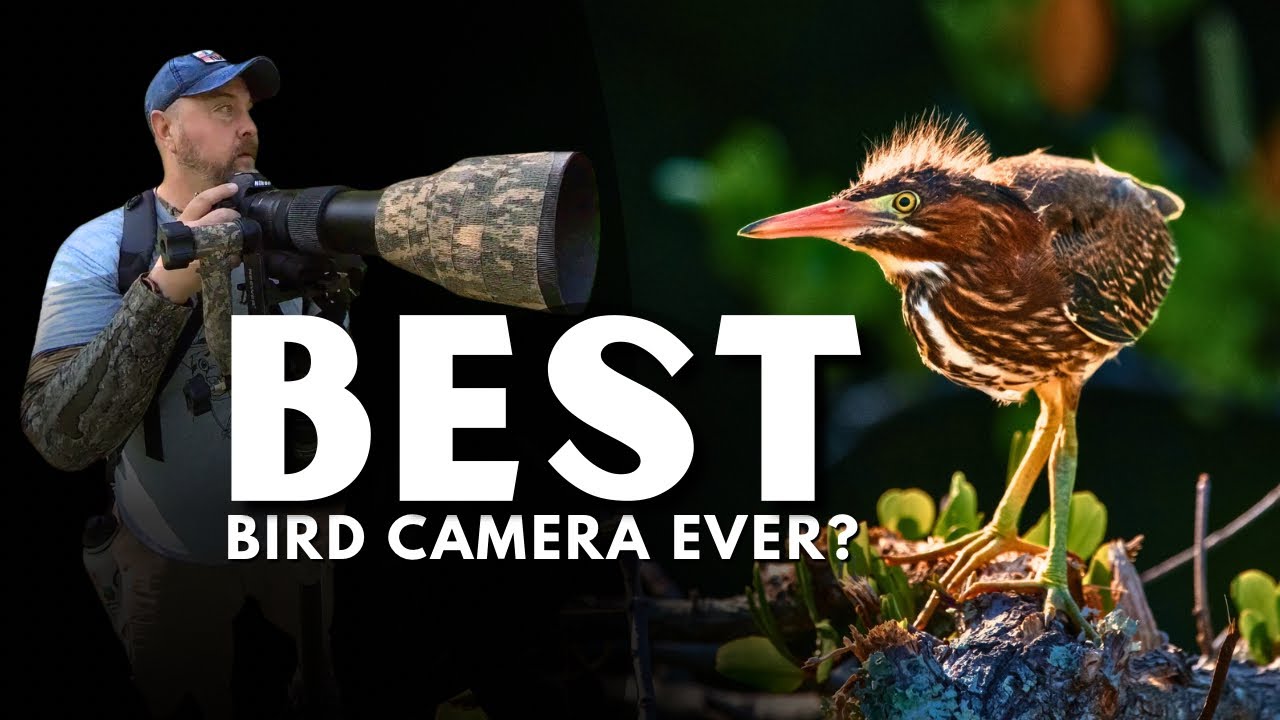
Wildlife photographer Don Orkoskey explains why the Nikon D850 is his choice for bird photography. The camera's high-ISO performance lets you shoot faster shutter speeds with smaller telephoto lenses, and its dynamic range recovers detail in highlights and shadows. Orkoskey uses manual mode with auto ISO and relies on the D850's three back-button focus options to track moving birds.
Chapters
The Nikon D850 is a powerful camera for bird photography. It is my go-to, and I'm going to tell you why it should be your go-to camera for bird photography as well. I'm wildlife photographer Don Orkoskey, and I've been making a series of videos about the Nikon D850 and why they are so excellent for bird photography. And in this video, I'm going to talk about the specific features of this camera that I think make it the best DSLR out there for photographing birds. Let's get into it. First and foremost, the Nikon D850 has incredible high ISO, and why that's important is because high ISO means that your shutter speed can be faster. Not all of us can afford gigantic super telephoto lenses with huge apertures, f/4, f/2.8, so on and so forth. Most of us end up with kind of middle-of-the-road lenses that have a maximum aperture when fully extended of f/5, f/5.6, f/6.3, sometimes even f/8. Being able to use those lenses with those smaller apertures and still have the shutter speed where you need it to be to freeze motion or to just avoid camera shake means that you need good high ISO performance, and the D850 gives that to you in abundance. In addition to that, the D850 has really great dynamic range. In fact, I'm often kind of blown away by how great the dynamic range is. So if I'm shooting in a high contrast situation, I can often get it close enough that then with the raw photo, I can make adjustments in post-production to get it where I want it to be. And I still have all those details in the highlights and the shadows that maybe didn't show up in that initial preview image. Now, of course, you still have to get it close enough in order to be able to make those changes, but the D850 offers you some great options for doing so. My favorite way is to use manual exposure with auto ISO. Manual with auto ISO means that you can set your shutter speed where you want it to be, you can set your aperture where you want it to be, and the camera will then do its best to get you close with your exposure. And of course, you're welcome to disagree with it by using exposure compensation. Exposure compensation button on the D850 is right up here. It's very easy to find when you're Actually taking photos when you're looking through the viewfinder. In fact, the button layouts and ergonomics of this camera are incredible. Now, I do have big beefy hands, which is why I like this camera a lot more than the modern mirrorless cameras, which tend to be smaller. So that's a consideration. If you have smaller hands, then something like a mirrorless camera over the D850 might make more sense for you. That being said, and getting back to my point about Manual with auto ISO, the button layout on the D850 has allowed me to use matrix or scene metering as my default, but then to choose a button, and I have it set to the bottom button on the front of the camera where my ring finger sits, to go down to single point focus. This means if I'm worried that the background is too bright or too dark in comparison to my subject, I can quickly just hit that spot meter and make sure that my subject is what is appropriately lit. In addition to that, the button right above it, which is usually set default at the preview button, so it's going to show you what the aperture depth of field looks like. It's going to stop down for you like that. I have that set to single point focus. Now, a lot of modern mirrorless cameras are equipped with different algorithms that understand how to Seek out animal eyes and bird, specifically bird eyes. That's wonderful. You're not going to get that in the D850 because it's a DSLR and not a mirrorless camera. So having the option to set different focus areas like single point focus versus 9-point versus 25-point, which just happened to be the, the setup that I have, is really helpful for you to be able to choose where you want that focus to be. So I mentioned that that preview button on the front is my single-point focus. I'm a back-button focus shooter, which means that when I half-press on the shutter, nothing's going to happen. It doesn't refocus on, on anything. I have to hit the AF-ON button, that button in the front, or press down on the joystick that's on the back in order to activate the autofocus. When I do that, the front button again is single point focus. My AF-ON is 9 points, and that toggle joystick is set to 25 points. The reason for that is if an animal is moving much faster than what I can reasonably keep in a small area, being able to switch quickly, just moving my thumb from autofocus on button to that joystick means that I can more successfully get that bird in focus even if it's flying around because that 25-point takes up a lot of room inside. Of my camera. I quickly want to say when it comes to manual with auto ISO, you can do that with a lot of cameras. The secret is making sure that you have 2 control dials. Cameras that only have a single control dial, you normally have to press on the exposure compensation button in order to change your aperture or shutter speed, whichever the control dial is not controlling. So if you have 2 command dials, one for aperture, one for shutter speed, then you can press that exposure compensation button and change that exposure compensation. Now, of course, that doesn't mean that if you only have one command dial that you can't use manual with auto ISO. It just means that you can't disagree with the camera in terms of what that exposure should be. Let's talk about who the D850 is really for at this point. It being 2026. If you are an experienced DSLR photographer, then the D850, especially if you're a Nikon user, then the D850 makes a ton of sense. If, however, you are new to bird photography and you're just looking for the right camera and you're watching videos like this to figure out which one you should get, then I would actually consider a mirrorless camera. Like I said, unless you have big beefy hands like me, it might make a lot more sense. Even if you do have big beefy hands like me, it still might make sense because those mirrorless cameras give you more information up front before you take the picture in terms of the amount of brightness that is going to end up in your final photo. The reason for that is with a DSLR, you're looking straight through the lens. With a mirrorless camera, you're looking at a screen which is giving you a little bit better preview of what it's going to look like when you actually take the So if you are interested in bird photography and you want to know more about the Nikon D850, or just more about what you should think about in terms of what camera to buy to do bird photography, then make sure to watch this video here where I'll help explain a lot of that stuff. Thank you so much for being here. I really appreciate you. If you enjoyed this video, I hope that you'll like it and subscribe to my channel. And I'll see you next time. Thanks so much. Bye-bye. Bye.