How to Shoot Bird Photos in Harsh Midday Sun (And Bad Light)
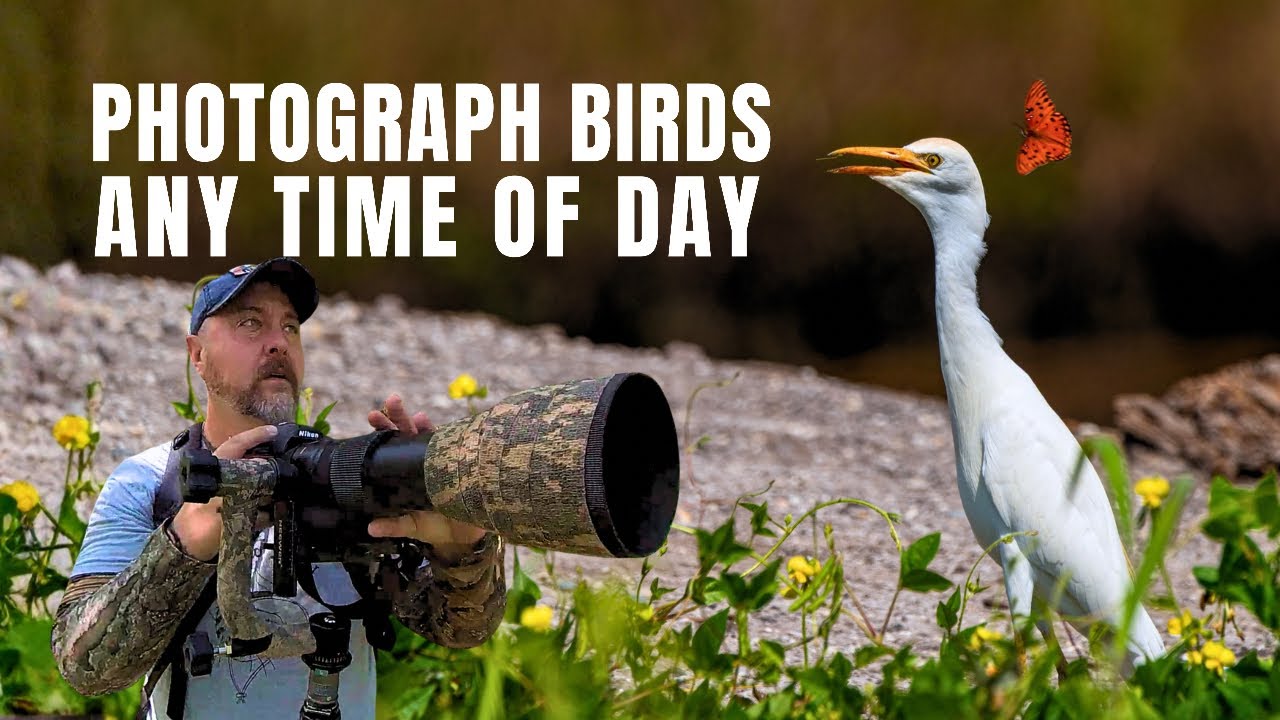
Shoot birds in midday sun by finding darker habitats like forests and edges, using exposure compensation, and spot metering. Birds are less active in heat unless feeding young. Understand their behavior, diet, and water needs to predict where they'll be, and spend time at habitat edges where multiple biomes meet.
Chapters
The best time to photograph birds is early in the morning, but sometimes you can't do that. Maybe you're on vacation somewhere beautiful, but the family has other plans, or you just can't make it up that early. Your best chances for doing successful bird photography at midday is to come out when it's overcast, or at least mostly cloudy. That's going to give you the broadest light that's going to bring down the contrast level and make it much easier to photograph birds once your exposure is set. Let's be real, you don't control the weather, so you may be stuck going out on a bright, cloudless, sunny day. Darn, doesn't it suck to have to be outside on days like that? If that happens, you really have to look for places where you can find lower contrast. That means going to places that are naturally a little bit darker. So just into the forest if you can. It also means that you need to be aware of where the sun is. There are going to be times when a bird will land behind you with the sun behind it, and you're going to want to turn and take that shot. And you know what? Go for it. The worst that's going to happen is that it's a bad picture right now. If that does happen, what you can do to try to mitigate that is before you take the shot, use exposure compensation, or if you're manually setting your exposure entirely, make sure that you are overexposing. You can also use spot metering, but spot metering, if that bird is not completely covered by the area of your spot meter, you're still going to have to overexpose to overcome that light in the background. Now realize the other thing that's going to happen is that your background is now going to be completely blown out. My best advice for that is instead of just taking that shot and calling it a day, take that shot, try to move yourself If possible, to an area where that bird is now lit by the sun and you're on the other side of it. If you can't move, waiting for the bird itself to move and just watching where it goes and hoping that it goes in a place that it's better lit by the sun so you can get that shot, that's gonna be your best bet to come away with a much better photo. No matter what time of day it is, if you go out to photograph birds, your best chance for finding them is going to be at the edges. What do I mean by edges? I mean areas where more than one biome meet. For example, at the edge of a river, like here behind me at the Chattahoochee. But that's not the only edge space that you can use. You can find edges everywhere. If you take this example, it looks like we found some edges, right? How many edges do you think we have in this spot? We have this cutaway in the forest, so it's really one forest. However, it's a big enough cut that to a bird, those are 2 separate areas. In addition, we have a bit of swampy wetland at the bottom, so there's another biome. We have a bit of a field. We also have a hillside, and as the hillside climbs behind us, that is going to be another area where birds like to be. There is a lot of pine here in the lowland, but as we go up behind, it's more deciduous trees, at least on this side. By going into the forest at midday, we not only bring that contrast down, but we're more likely to find birds that are either perched and relaxing or nesting just inside the forest. 2, we can take advantage of the abundance of light right outside the forest and stay along that edge And we'll find a lot more birds in that location. More than anything else, and again, this applies no matter what time of day you're going out, more than anything else, finding areas that birds are likely to be in is super important. And to understand where they're likely to be, you have to understand bird behavior and what birds like to eat, where they like to drink, where they like to bathe, and so on. To do that, it's helpful to understand at least broadly what type of birds you're going out to photograph. If you're going to a coastal marshy area, then you're probably going to see a lot of marsh type of birds— herons, egrets, so on and so forth. Those birds obviously Eat a lot of fish. You can also find similar birds in major riverways along with things like cormorants and often osprey. If you're more interested in songbirds, it's good to know their preferred diet. This is why it's important to do your homework before you ever go out anywhere. And if you're going on a trip somewhere where you're going to do bird photography, then it is very helpful to do a lot of research on not just the specific location that you're going, but also the birds that you're going to find there, what they like to eat, where they like to nest or perch if it's not nesting season. Birds, like everybody else, need water. So finding places where birds can get a drink and also bathe makes a lot of sense. Birds are going to bathe less when it is cold and more when it is warm out. So finding areas with gently moving water where the water itself gives a bird pretty flat access to it, and where the water in that area where the access is is not moving fast. Another huge consideration, especially especially for midday bird photography, is that the hotter it is, other than if they're bathing, birds are probably going to move much less. Now, the exception to that is in the spring when they have young to feed. Then they're going to be much more active. But again, the places to find them are going to be places where they can get food. If they haven't built a nest yet, where they can get nesting material. And if they have young to feed, somewhere where they can get an abundance of food, and they're going to hang out in that area, go feed their young, and then return to that area. So hanging out and waiting, spending a lot of time where you're seeing birds means that you're going to see them leave and return, and that is your opportunity. Because they will perch in the same place, they will gather food in the same place, they will grab nesting material in the same location. A great example of this is this blue-gray gnatcatcher that I got photos of today, where it came to this cattail and grabbed a bunch of that soft material, flew back to its nest, took the time to install that in its nest, and then returned for more. So I managed to get several sessions of photos of this Blue-gray Gnatcatcher. I want to say one last thing that I think is vitally important, and that is no matter how you come to bird photography— whether you're a birder who wants to take photos of the birds that you're seeing, whether you're a photographer who is getting into birding, whether you're a hobbyist who Or your therapist told you, you know, you need to do something to relax yourself. At least in the United States, we often have this idea that we have to be productive 24/7. And I think that that is a huge disservice to ourselves when it comes to hobbies and things that we should be able to enjoy, like being out in nature doing bird photography. I really hope that you will enjoy your time out here, that you will not only listen and look for birds, but you'll look around at the beautiful surroundings. You'll notice how the light hits different trees. You'll smell the fresh air, and you will come away just much more relaxed and having had an enjoyable time, even if you weren't productive in terms of the photos that you got. If you enjoyed this video, I hope you will like it, and if you're not already subscribed, that you will subscribe to my channel and watch all the other great content that I'm creating. I appreciate you being here. Thank you so much, and I will see you next time. Bye-bye.









