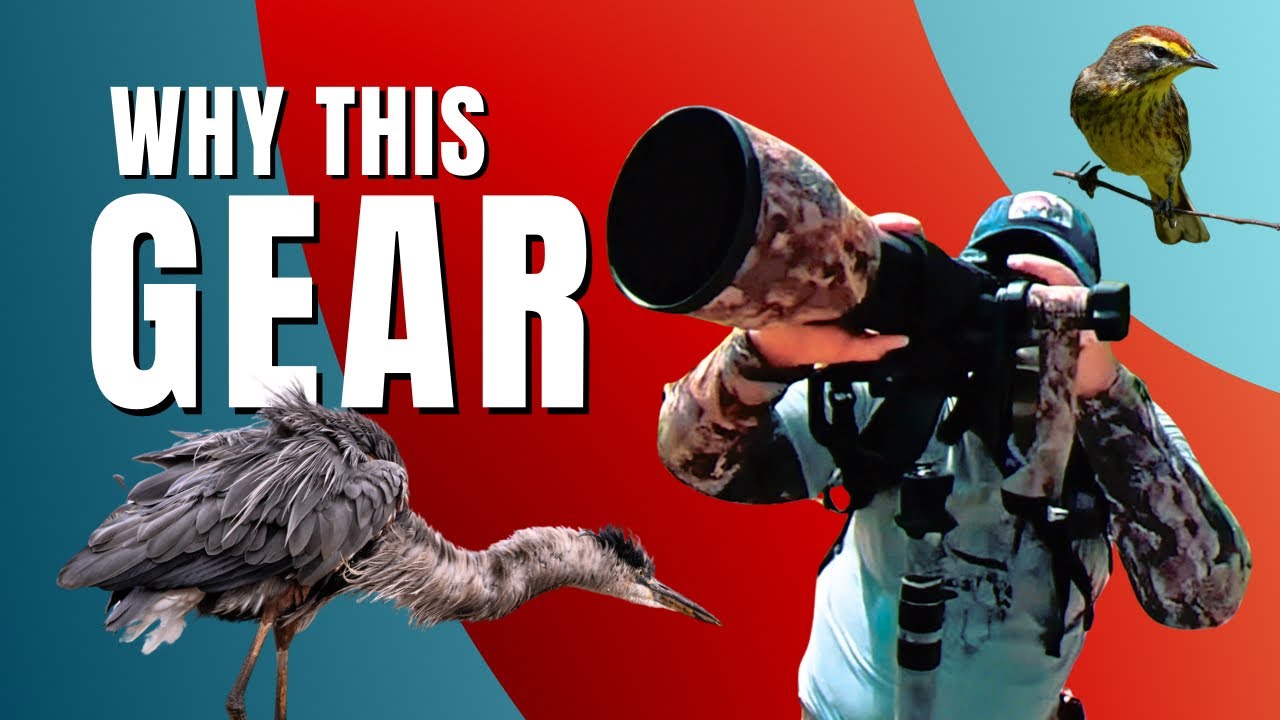
Don Orkoskey explains his Nikon D850 setup for wildlife photography, including back-button focus, a Sigma 150-600mm lens, and a Neewer gimbal that lets him shoot at 1/30 second with ISO 12,800. He walks through his custom button layout and manual mode workflow with auto-ISO.
Chapters
Hi, it's Don from WDO Photography, and ever since I posted my video about the Nikon D850, which is my go-to wildlife photography camera, I've gotten questions from you guys. First, you've asked for examples of the photos that I've gotten with this camera. and what type of wildlife it's good for photographing. 2, a lot of you have asked for information about my entire setup, my whole kit, in terms of what else I'm using to photograph wildlife. I really want to do that for you today and tell you more about all the pieces that I'm using here. And finally, I just want to talk about the Nikon D850 versus mirrorless cameras and other cameras, because a lot of people have jumped on the fact that I called this the best wildlife photography camera available. I want to explain that this is YouTube. There's going to be some hyperbole, especially in the titles. Also, for me, it is my go-to camera and why even with modern mirrorless cameras, I still am always out here using it. And I'm going to actually start there. Oh, I see a little Phoebe that's right behind you. The camera I'm shooting this on. So pardon me a second while I see if I can get some, some photos of this little, this little Phoebe here. The D850 has a number of programmable function buttons, and that's really what makes it my go-to wildlife photography camera. Now I'm using back button focus, which means when I press, half press onto the shutter release button, Nothing happens. My camera doesn't change focus. So I have this button where my middle finger sits when I'm on my shutter release button that takes my focus down to a single point. On the back, my autofocus button here is set to 16 points, and pressing on the little joystick trigger here is set to 9 points. So I can go from a fairly wide area of focus to a slightly smaller area all the way down to a single point. This is really helpful for me if I'm shooting through a bunch of branches and things and I can't use that larger focus point. Also, if an animal is standing still, it allows me to use that single point focus. The big benefit of having these different focus points or focus area settings Is that if my subject is sitting still, I can use single point and I can try to get it right on my subject's eye. Whereas if my subject is moving or in flight, using that bigger focus setting will allow me to spread out that area and keep them in focus, even if I can't stay exactly with them in terms of their pace. So there's another button that is on the front of the camera here that is near my ring finger, and that button I have set to spot metering. I'm normally using matrix metering. I generally shoot in manual with auto ISO, and the reason for that is I like to control exactly what shutter speed I'm at based on what I can get away with and the movement of my subject. I also like to control that aperture so I know exactly where that's at And then use exposure compensation to control that ISO. Now, there are times when I can use matrix metering and I can, just from having done this for so many years, can go, oh, okay, I know that my subject is relatively close to the tonal grade of what's around it. So I don't necessarily have to mess too much with what my camera is telling me is the correct exposure. And remember, the only way that I'm correcting it is with the ISO that I'm telling it with exposure compensation to make it brighter or make it darker. But there are other times where I'm photographing something that is a very dark subject against a very light background or vice versa, where I have to disagree with the camera. And at times it's so extreme that using matrix metering It's not going to get me where I need to be. So having spot metering at my fingertips where I can just push down that button and get it right locked on in the same spot that I'm using a single point focus is ideal. Now let's talk a little bit about the other equipment that I have here. So I'm using my Sigma 150-600 Contemporary lens. They did make a sports version of this lens for a while, but they've discontinued it. You might still find it available used. The contemporary, it's not as weather sealed. There's some other differences, I guess, but it was a much better seller. I think it was also less expensive. Right now, depending on what camera mount you have, you can find this for I think under $1,000 for most cameras or around $1,000. Now that might be refurbished, but that is a great deal when it comes to having 600mm of reach. That said, because it's 600mm, my maximum aperture with this lens is f/6.3 and I'm normally stopped down to f/8. I am using a gimbal and a monopod. The gimbal that I use is just a fairly inexpensive Neewer brand gimbal. I'm not sure how much it cost, I bought it a number of years ago, but once it's balanced it will keep the camera very still. It's super handy and it allows me to shoot at much lower shutter speeds, so if my subject is sitting still, like if it's a bird on a branch or, you know, maybe a deer that's been a little startled and it's frozen looking at me, then I can shoot as slow as 1/30th of a second or 1/50th of a second with it on this gimbal and have great results. There's a lot of videos out there about gimbals that will teach you how to properly balance them so that when you are Moving the camera around, it stays exactly where you put it. This is not one of those videos. The other piece of equipment that I have here is the Sirui monopod, and this is a single release. So if I twist here, the monopod drops, and I can do a single twist and bring it back down. This is incredibly handy. It It is, however, on its own, without the camera, without the gimbal, very, very heavy because all of these internal mechanics in there, internal mechanisms in there, they just weigh a bunch. But it's a lot easier than having to twist and unlock and relock individual legs, individual parts of the legs on a monopod or a tripod. These are becoming more and more popular. There's other brands that have them out there, including SmallRig. Some have an actual, like, trigger that you pull in order to release it, and that seems like a much more user-friendly situation. Beyond that, there's not really a whole lot more to my kit. I have some really inexpensive gauze-style camouflage tape, and you see I don't have it around everything. I probably should put some onto my Gimbal, but I'm not really dressed today for wildlife photography necessarily, at least not to fool any wildlife into thinking that I'm not here. After all, I'm in the middle of the woods and talking into another camera pretty loudly. So the animals that I'm seeing around me right now are pretty used to people. So in addition to the other parts of my kit, in addition to the things that I really love about the Nikon D850. When it comes to wildlife photography. I promised you all some samples, and I've been showing you some. There were some back at the beginning of this video, but I really want to pack the end of this video with shots that I've taken with this fairly recently so that this entire setup is involved and you can see what it's all capable of. And that's going to include these first couple shots, which were taken at 1/30th of a second. Maxed out ISO, which is something that if you watched my previous video about the, the D850, you will have seen that the 12,800 ISO is still absolutely usable on this camera and is something that I never mind actually shooting at. Well, I hope you enjoyed watching this video and that you will stick around and look at more of the videos on my channel. I'd also really appreciate it if you would like this video and any other videos that you watch. That really helps for YouTube to show them to other people, and it shows that you appreciate the work that I'm doing by making these videos. So I'm very thankful when you do that. That's all for today. And once again, I really appreciate you watching, and I'll see you next time. Bye-bye.









