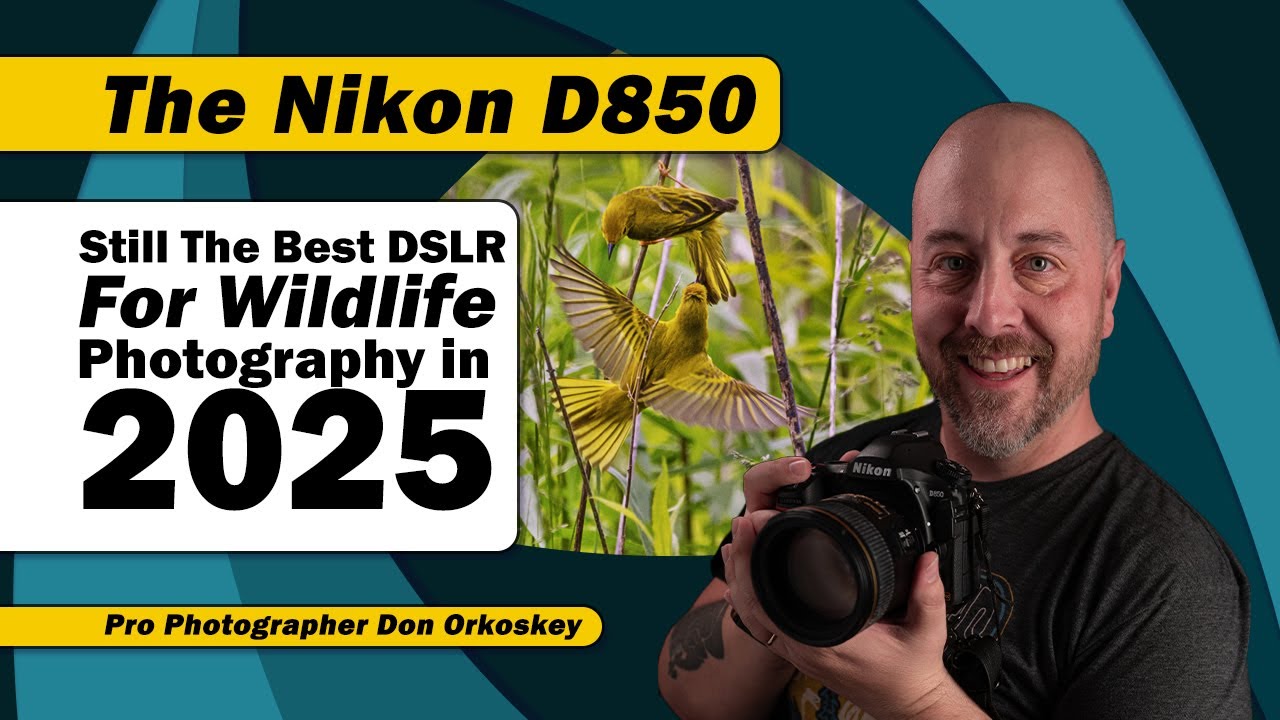
Don Orkoskey argues the Nikon D850, released in 2017, remains the best DSLR for wildlife photography. Its 45-megapixel sensor balances resolution and low-light performance, producing usable images up to ISO 12,800, while its fast autofocus and customizable buttons enable rapid focus-point switching in the field. At $1,000 to $1,500, it costs a fifth of the flagship Z9, leaving budget for better lenses.
Chapters
Despite having been released in 2017, the Nikon D850 is still the best DSLR for wildlife photography. You don't have to take my word for it. Search on Reddit, Google it, you'll see lots of people love this camera and agree that it is a powerhouse when it comes to wildlife photography. My name is Don, and I'm a professional photographer with more than 25 years of experience. So let's talk about what makes the Nikon D850 so special. Sure, there are some mirrorless cameras that are available today that have amazing features such as eye tracking, which is great for wildlife photography. Even setting aside the massive price difference and those upgrades, the D850 is still a powerful camera. So let's talk about what features make it so amazing. The D850 has 45 megapixels. If you know me, you know that I'm not a big megapixel advocate. In fact, you'll never see me going out and specifically praising those 108-megapixel cell phones. The reason for that is the more megapixels you jam into the same size, the smaller those pixels are. And where that really becomes a factor is with low-light capability. 45 is the perfect sweet spot where you get great resolution. You can crop in if you need to, but you have excellent low-light capability with the D850. And if you are on a budget and you're using something like the Sigma 150-600 that has a maximum aperture of f/6.3 when fully zoomed out at 600, then it's incredibly helpful to have that high ISO ability that you can push it When you're photographing things that are in motion. Now, for comparison, I also shoot with a Nikon D6 II, and because I do a lot of event photography in addition to wildlife photography, I find myself in places where I need that low-light capability. And don't get me wrong, I love my mirrorless, but I will not shoot that above 6400 ISO. The pictures just aren't usable beyond that point. Not only are the pictures usable with the D850 at 6400, I'm actually fine using pictures at 12,800 with the D850. Sure, they take some work in post-processing to get rid of that noise, bring up the saturation, bring up the contrast, and so forth, but they're still very good pictures. The next thing that really makes the D850 a beast when it comes to wildlife photography is its fast autofocus. If you have a lens that has a built-in motor, then that motor is going to take over, but the ability of this body to identify your subject very quickly and transfer that information to the lens for focusing is unbeatable. The third thing I'll say is the amount of function buttons that I have on the D850. Once again, all of these things in combination are really what makes this thing stand out. So, I have 2 buttons here in the front which I can control with my ring finger and my middle finger while still keeping my pointer finger on the shutter release. I'm a back button focus user, so having the AE/AF button there to focus is super helpful. There's an additional function button That is down in this back corner here as well. The way that I shoot with back button focus is I have a 9-point area focus when I press my AE/AF button. Then when I press this button here with my middle finger, it goes down to single point. So I can switch back and forth super fast if I need to get into a tighter little spot, especially if I'm photographing something that's maybe in the weeds or a bird that's amongst the branches. It comes in handy really a lot. This is something that I use all the time. In addition to that, this other button that I have down here I use to change from full-frame metering, matrix metering, scene metering, whatever your camera manufacturer calls it, down to spot metering. which allows me to use that single point, and I often am using those in conjunction to get that single point focus and spot meter on exactly what I'm focused on. I still will sometimes use it with the 9-point focus that's there, but it really gives me a level of flexibility that is not available on a lot of other cameras. Don't get me wrong, Sony does a really good job with packing in the function buttons. But again, we're talking about the overall value in, in the full package. So when you take into account the low-light capability, the great number of megapixels— again, it being right in that sweet spot, right?— the speed of that autofocus, and all of those function buttons, you really get a package that is unbelievable. The final thing that I'll say about the D850 is price. Now I know I said that if you set aside price that the value of this thing beats any of the modern mirrorless cameras when it comes to wildlife photography. When you factor the price of the D850 versus say the flagship Z9, which honestly has a lot of comparable features, but I still think that the D850 comes out slightly ahead, it's a no-brainer. Because this thing, this D850, brand new for just over $1,500. The Z9, just for the body, is $5,000. That gives you a ton of extra money to spend on lenses. 2, you can get a refurbished D850 for around $1,200 and a gently used one for right around $1,000. Which makes it a steal. Would you rather spend that $5,000 on an amazing— yes, absolutely amazing— flagship mirrorless camera, or would you rather have all that extra money, again upwards of $4,000, to spend on buying a great lens? To me, I think the answer is Now that said, I already own the D850, so if you see me using a Nikon Z9 or Z8 in the future, don't, uh, don't try to bust me with a gotcha, because I'll tell you, this body is going to be my go-to wildlife body for as long as there's nothing better out there. And like I said, right now there is nothing better than the Nikon D850 when it comes to wildlife photography. So if you're looking for a new body, don't skip the D850. Thank you so much for watching. This has been Don from WDO Photography. If you enjoyed this video, please like and subscribe. I mean, you've watched it to this point, right? So why not give me a follow and check out some of my other videos? Thank you so much, and I'll see you next time. Bye-bye. Bye-bye.