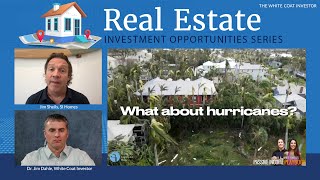
This is a YouTube video titled "Are Hurricanes Really Bad For Florida Real Estate?" featuring a conversation involving Jim Dahle and other speakers discussing the impact of hurricanes on Florida real estate, particularly focusing on building codes, insurance implications, and the resilience of newer constructions in Punta Gorda, Florida. The discussion highlights how updated building regulations have improved property durability and insurance rates following major hurricanes like Hurricane Ian.
Hurricanes. This is a really interesting one.
So hurricanes are something that I like to focus on because a lot of people get scared with them in Florida. This is a picture right here of.
There we go. This is Punta Gorda, Florida.
Now, if you look right here on the right, there was one roof taken right there that got blown on. But let's look at this overall area.
This is the day after Hurricane Ian came through it. And if you're looking, you're going, gosh, there's some trees down, some wetness, but the houses looked pretty intact. You know, besides that one roof, look at this. This whole area looks pretty intact.
All the homes are there.
Everything's good.
Well, the reason why is Punta Gorda, Florida, changed all the rules. It was hit in 2004 by Hurricane Charlie, and the government stepped in and changed the rules after that because it was absolutely decimated. They said, you got to build on higher ground, you got to build with stronger structural design.
So this is the day after a Category 4 came through, and this is.
What it looks like.
And that is the advantage of new construction with hurricanes, because you are building.
On higher ground, you're with stronger structural designs. And a lot of the times, even though we're in coastal communities, we're at least five miles inland.
All of these things matter to insurance companies.
We have no problem getting insurance on our individual properties. Why?
Because they've been built newer than 2004.
So we're held to those guidelines of building on higher land. The old homes, they were built at 2, 3ft above sea level. We're building 13, 14ft above sea level with stronger structural designs. And that is why insurance companies love to insure us and also give us way better rates than some smaller, older homes that could be only a few miles away. That could be seven, eight times the annual premium in insurance. Now, when we went through that large Hurricane ian, we had four projects out of 278 in Southwest Florida, that Greater Fort Myers and Punta Gorda, where the eye of the storm went right over.
We only had four that needed insurance claims.
And why did they need these claims?
Well, because they were just freestanding walls.
We had just started the project, and in the wind, they fell down. We didn't have time to tie on the roof, which gives that strength, and we had no flooding. So this is a remarkable track record that we were a little nervous about, to be honest. But it showed that, gosh, the new construction really doesn't give a protection of not only actual hurricanes, but also insurance rates. Because after this, our insurance rates have actually dropped for our average client starting this year because we've performed so well through big things like this.
The hosts of the White Coat Investor are not licensed accountants, attorneys or financial advisors. This podcast is for your entertainment and information only. It should not be considered professional or personalized financial advice. You should consult the appropriate professional for specific advice relating to your situation.