DOs vs. MDs - Which is the Best Degree? - WCI Podcast #368
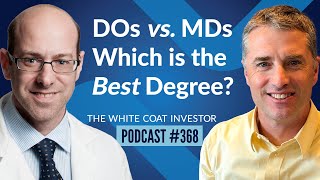
Jim Dahle and Dr. Ian Storch, a gastroenterologist, compare osteopathic and allopathic medical degrees. They cover the history of both paths, how training differs, manual medicine practice, and what residency matching looks like for each. The conversation helps medical students decide between a DO and MD.
This is the White Coat Investor Podcast where we help those who wear the.
White coat get a fair shake on Wall Street.
We've been helping doctors and other high.
Income professionals stop doing dumb things with their money since 2011.
This is White Coat Investor Podcast 368 DOS versus MDS which is the Best Degree? Today's episode is brought to you by SoFi. Helping medical professionals like US bank borrow and invest to achieve financial wellness. SoFi offers up to 4.6% APY on their savings accounts as well as an investment platform, financial planning and student loan refinancing featuring an exclusive rate discount for med professionals and $100 a month payments for residents. Check out all that SoFi offers at whitecoatinvestor.com SoFi loans originated by SoFi Bank NA NMLS 696891 advisory services by SoFi Wealth LLC. The brokerage product is offered by SoFi Securities LLC, member of FINRA SIPC investing comes with risk, including risk of loss. Additional terms and conditions may apply. All right, welcome back to the podcast. We have a fun episode today. Got a guest on that we're going to interview. I've been on his podcast. It's Dr. Ian Storch. He's a do, he's a GI doc, and I'm going to ask him a bunch of hard do questions. So we're going to talk a little bit about getting a do versus an MD, what that means now, what it meant 25 years ago, what it meant 100 years ago. So. So I think it should be a fun episode. But before we get into it, let's get through a few preliminary things. First of all, let's do our quote of the day. Ben Graham, right, the mentor of Warren Buffett, said the individual investor should act consistently as an investor and not as a speculator. I totally agree with that. We got something really cool coming up that people have been asking us for for a while. I can't announce it today, but it'll be on the blog within the next week. So watch the next the blog this next week or listen to the podcast next week and you'll get all the information about that. But it's a pretty cool new online course or courses that people have been asking us about for a while and as usual there'll be a special promotion that goes with it. So watch for that next week. All right, those of you who are residents, we got something else going next week. May 29th, it's your turn. The students had their turn a couple of months ago. It is your turn to get me to come and talk to you at your residency. Except I'm not coming in person. We're going to do it online because I can't come to all the residencies in the country. But if I could, this is the talk I would give to you. I'm recruiting my friend Andrew Paulson, one of the founders of studentloanadvice.com and the two of us are going to give you a presentation. We're going to talk about making a smooth transition so you can hit the ground running as an attending. We're going to talk about what you need to do in those first 12 months after training. We're going to talk about what you should be doing with your student loans these days. We're talking about having the right insurance protections in place and not buying insurance you shouldn't need. We're going to talk about saving and investing your money so you can reach your goals and spend the rest on whatever you like, guilt free. We're going to talk about all these building blocks, the basics of investing, how to build wealth. It is a presentation geared at residence, appropriate for fellows as well. It's totally free to you and I don't have to get on a plane to come give it to you because it's going to be online. So sign up whitecoatinvestor.com resident that will be May 29th. It's going to be live. We will take your questions live and if it's like the student one we did, we're going to stick around for two hours afterward answering your question. You can stay with us if you want, but a lot of times that's the best part of the presentation. It's going to start 6pm Mountain May 29th. We'll see you there. Sign up whitecoatinvestor.com resident even if you're not sure you can make it, sign up and we'll at least get you a recording of it. All right, let's get into this interview with Dr. Storch. Let me get him on the line here. Ian Storch is the mentor and host of the podcast do or do not, which aims at educating pre medical students and practicing physicians about osteopathic medicine and the osteopathic physician's journey. Ian, welcome to the podcast.
Happy to be here, Jim.
All right, since I know you, but our audience doesn't, why don't you tell us a little bit about your upbringing and what it taught you about money.
Okay. That may be like a therapy session, but I'd be happy to do that. Yeah. So I grew up on Long island, and my mother and father were not college graduates. They're sort of working folk. And my mom was always the saver, and my dad was the spender. And growing up at the. The idea was sort of frugality from my mom. It was definitely something that she imparted on me. And again, my dad liked nice cars and probably things that he couldn't afford. So I kind of grew a distaste for those things. Ultimately unfortunate for my wife. That's kind of gone into my current life. I think I'm more, from my mother's perspective, a saver than a spender.
All right, tell us about your education and career up until this point.
Yeah. So I never thought I was going to be a doc. I grew up really being. I think my expertise was English literature and social sciences, So I was an English major in college. I went to state school. I went to SUNY Binghamton. It's a New York school where I chose it because I had a. Again, my parents didn't go to college. I had a cousin who was really smart, who's now my attorney. He's still really smart. And. And he went to Binghamton. So I said, you know what? He is smart. He went to Binghamton. I'm going to go to Binghamton, too. And somewhere along the way, I had an interest in medicine. I actually saw a car accident. It's a little, you know, a cliche story maybe, but saw an accident. My. My roommate was one of these EMT guys with the lights in his car and the oxygen in the. In the. In the backseat. And we got out to help this woman. And, you know, after we saw the car accident, I thought if I'd been by myself, I wouldn't be able to help. Help the woman. So I took an EMS class, and it was sort of. I fell in love with medicine. I decided I wanted to go to medical school. I really didn't know much about medical school. No doctors in my family. So I started studying for the mcat. And again, I was an English major, so I took some. Some science classes.
And.
And I had a Baron's book. And the Baron's book, it was like, you know, they don't have books anymore, obviously, everything's online but Barron's book to medicine and dentistry. And it was medical school, dental school, and the last few pages were something called osteopathic school, which I had never heard of before. So I did some research on osteopathic school, and I thought, this is really Cool. And this is something I might want to do. I went home and I actually had a physical schedule. Then I went to my primary care doctor and I had the book. I showed him And I said, Dr. Horowitz, what do you think of this stuff? Is this something that's worth doing? What do you think of osteopathic medicine? And he said, I'm a do. Which was shocking to me. I never even heard of it before. And I said, why do you have Dr. Horowitz on your jacket? And he said, I don't know. People just keep asking me questions over the years. It's a little annoying. So I just took it off my jacket. But it's great and I think you should do it. So I researched osteopathics school. I thought I was going to be a family practice doc or primary care doc. And a little bit of a long story that I'll skip, but I ended up. I actually, I'll give you a little. A little bit of it. You know, we. I interviewed at Kirksville, actually. I wanted to go. If I'm going to do it, I'm going to do it right. So Kirksville is the founder school. That's really where I wanted to go. I had a girlfriend at the time, was in New York, and she kind of convinced me that I should stay. Needless to stay to say, we were. We dated for another few months and broke up. But that's a long separate story. So I went to the New York College of Osteopathic Medicine for four years. And during my rotations, I fell in love with gastroenterology. Just met a gastroenterologist who I thought was spectacular. And I said, I want to be like him. I interviewed all over for internal medicine, Mayo Clinic, Cleveland Clinic. At the time, DOS could be free agents. But I ended up staying in New York at North Shore, which is actually where I am now. So I spent three years of internal medicine at North Shore on Long Island. I did a chief resident year. I was blessed that they asked me to stay and teach the program for a year in internal medicine. That's an extra year. And again, I was blessed with a fellowship at a very prestigious program, University of Miami, which is. Which is just a spectacular GI program. I spent three years doing gastroenterology. I did full liver training. I was able to pack some biliary work, which is advanced training, into that three years. And, you know, I had met my wife, actually. I dragged her kicking and screaming down to Miami to hang out with me during fellowship. And she said, Ian, I really think I want to go home. So she says, beautiful here. We had a great three years. Let's go home. So we came back to Long island and I joined a private practice. We'll talk about that, I think, a little bit later, but I joined a private practice and that's still where I am.
Awesome. Great summary of a great career so far. Let's get into our subject today. You're the podcast host of the cleverly named do or do not podcast, and today we're going to talk about Dr.
Sounds great.
Including the history of osteopathy and how that affected osteopathic education and practice. Today, there's a few things about the philosophy and history of osteopathy that are a little odd, and I want to hear your take on before we get into those questions, though, I think it's important to point out that the history of medicine itself is not exactly a shining example of a beacon of ethics and scientific practice. When George Washington was dying of epiglottitis, one of his three physicians wanted to try a newfangled technique called endotracheal intubation. But the other two overruled him. They went with the best treatment of the day. Bloodletting. And I'm sure hemorrhagic anemia really did a lot for zepoglottitis. Doctors didn't even wash their hands until the mid-1800s, spreading puerperal fever as they went from corpses to delivering babies without any time in between. The mark of a good surgeon in the Civil War was whether or not you could take a wounded limb off in less than 10 seconds with a saw. Ether as an anesthetic wasn't discovered until 1846. Anesthesiology before that was a bottle of whiskey and a stick to bite on. Insulin wasn't discovered until 100 years ago. Before that, diabetics just died. Antibiotics are even newer. Prior to Hippocrates, illness was attributed to evil spirits. Hippocrates actually moved us into the imbalanced humors, you know, blood yellow bile, black bile and phlegm era. And it wasn't until pasteur in the 1860s that we even had germ theory. So there's still plenty of things we do in modern medicine that really have little if any evidence for them. But with that introductory material out of the way, just to make it clear that we're not in a glass house throwing stones, let's talk about the origin of osteopathic medicine. In the 1870s, frontier doc Andrew T. Still was pretty Dissatisfied with modern medicine, he felt the drugs were useless or even harmful. He was probably right about that. So he founded a philosophy of medicine, at least nominally focused on wellness, disease prevention in the whole body rather than just parts of the body. He wanted to treat causes rather than effects of disease. He was probably highly motivated by the fact that his wife and three of his children all died of then untreatable meningitis. So, so far so good. Right, then it got a little odd because still believed you could treat a variety of diseases by diagnosing and treating the musculoskeletal system. Epilepsy, dysentery, asthma, period related pelvic pain, digestive disorders, depression, colic. The idea was that there's an osteopathic lesion or a myofascial continuity causing a somatic dysfunction. And you. If you fix the osteopathic lesion through manipulation of the musculoskeletal system, the somatic function will go away. Now, the UK's NHS says there's some evidence to suggest that osteopathy may be effective for some types of neck, shoulder or lower limb pain, some types of headache and recovery after hip or knee operations. But there's only limited or no scientific evidence that it's an effective treatment for conditions unrelated to the bones and muscles. And in fact, osteopathy was treated as a cult by the AMA in the first half of the 20th century and in fact its code of ethics forbade physicians from associating with osteopaths. That's obviously dramatically relaxed over the last century. But do schools still teach stills philosophy in some form and still teach every student osteopathic manipulative medicine techniques? So with all of that information out there, as a modern day do, what are your thoughts about the history of osteopathic medicine?
Yeah, so first of all, that was an amazing summary of like 2,000, 3,000 years of medicine in three minutes. Bravo. Right, great job. But you know, I think at still. So at still founded osteopathic medicine. As you pointed out, he. As you point exactly. As you pointed out, we have to put everything in context. So you can't look at a da Vinci robot when you're talking about medicine in 1870s. As you said, we didn't even know that bugs were causing disease. Penicillin wasn't invented until 1920s, I believe so. So we're talking pre antibiotic, we're talking pre everything that we have now. As you said, morphine chopping off limbs, leeches, you know, allopathic medicine was not what it is today. And again, AT still had a different. Took a different approach. So the people that came to train with AT still a lot of the. He was not an md, so I mean, he was not a medical doctor. You know, he was a frontier doctor. You know, again, the system. There weren't medical schools the way we have them now. When you're talking about the history of medicine in the United States, the Flexner Report, which was. Was a. A person that reviewed all medical schools and actually got rid of a lot of MDO and other homeopathic type schools because of the way that the education was just not what it should be and really standardized everything that none of those things had come about. So again, he started practicing this manual medicine and a lot of allopathic doctors came and trained with him and sort of became MDDOs or DOs Doctors of osteopathic medicine. And the profession really evolved from there. So as a practicing do today, it's interesting. We definitely have come a long way from. And this is the 150th year, interestingly. So the profession's been around for a long time and evolved over time. But we're complete physicians. So dos practice full spectrum of medical care. In the United States, which again you mentioned the UK Osteopathic treatment or osteopaths in other countries are different than osteopaths. Doctors of osteopathic medicine in the United States. In the United States, we are complete physicians. We get a medical license in almost every state that's exactly the same as an MD would. The license is the same. There are a few states that have separate DO licensing associations, but most of them, again, same licensure. I have the same plaque on my wall that you would have as far as my ability to practice. And we can go into any specialty of medicine, et cetera, et cetera, from surgery to family practice. As we discussed, the. The. The thing that makes us different is the philosophy which you mentioned, which we have kept from Andrew Taylor still and the manual medicine, which Andrew Taylor still started, but has really evolved and come a long way since.
Let's talk a little bit about that. Manual medicine. A lot of people look at it and they can't help but see the similarities between osteopathic manipulative medicine and chiropractic treatment. What do you see as the difference between those two?
So I'm just gonna preface with this is not my area of practice. I am a gastroenterologist, as I stated, But I think again as the host of do or do not, I'm Happy to try to tackle the answer to that question. And I'll give you a little interesting story story before we start. So my uncle, I have an uncle who's actually my father's best friend, but we're just going to call him Uncle Freddie. Uncle Freddie is actually a chiropractor. So I grew up with a chiropractor as an uncle. And interestingly, when I. And again, I'm not directly answering your question, but I'm going to come back. Uncle Freddie, when I went to him with that book, I said, uncle Freddie, what do you think of osteopathic medicine? I'm thinking about doing this. He said, don't do it. He said, don't do it. He said, you should either become an md, be a medical doctor or be a chiropractor. I'm not into this osteopath stuff, which was interesting. And he's come full circle and I think he fully respects osteopathic medicine after many, many conversations with him. But when you're talking about osteopathic manipulative therapy, which there are a few different terms, Osteopathic manipulative medicine, omm, Osteopathic Principles and Practice is opp, and osteopathic Manual therapy, which is omt, there are some nuances to those terms which I may or may not be able to explain to you, so I'm going to bow out. But they're all kind of encompass osteopathic therapies. First of all, dos, I'm going to reiterate, especially in the United States, are complete physicians. So if you are going. And again, to take a step back, I have nothing against a chiropractor. Nothing that I say is negative to a chiropractic. Uncle Freddie is a chiropractor. I love him. But a chiropractor is not a complete physician. A chiropractor only practices manual medicine and is not trained as a complete physician. An osteopathic practitioner in the United States is a complete physician that is trained, takes all the same classes that an MD takes and again has a medical license that's the same as an MD as far as the therapies go. You know, I'm going to talk again about strict chiropractic because some chiropractors do osteopathic therapy, some chiropractors do physical therapy. So just talking specifically about chiropractic therapy, chiropractic therapy as a generality focuses on the spine and the nervous system coming out of the spine. Most of the techniques that people think about when they think about chiropractic therapy are high velocity thrusting techniques, which are those sort of back cracking techniques. Dos look at multiple. And again, we're not talking about philosophy, we're just talking about therapy. Dos look at not only the nervous system, but the lymphatic flow of the body and blood flow. So there's a really thinking about all of the whole body, sort of everything that you can manually work on by manipulating the musculoskeletal system. The osteopathic treatments range from soft tissue techniques, muscle energy techniques, to high velocity techniques. So there are multiple techniques and they even go to some sort of advanced techniques I call them, which would be things like cranial manipulation, where there are doctors that work on the cranium and the sacrum and there are different ebbs and flows that are felt to affect health. And not all osteopaths obviously practice this as we discussed at the beginning, but that's the basis again, some chiropractors do craniosacral techniques, but in general they focus on the spine.
I often tell people on this show, take what you find useful, leave the rest. What do you find useful about the osteopathic philosophy and what have you chosen to leave where you found it?
So as far as manual therapy, I don't practice manual therapy. I'm a gastroenterologist. I practice again. I trained at University of Miami. There were no dos. I was the only DO in my fellowship. So I practice the same gastroenterology as any other gastroenterologist, MD or DO would. As far as philosophy, again, the other thing that I think really makes osteopathic medicine distinct is the philosophy. And again, just similar to talking about chiropractic, I have plenty of MD friends that say, look, of course we believe in that. And I think one of the interesting things about osteopathic medicine is that it's sort of become mainstream to the point that everybody is buying into or agrees with at stills philosophies. So they're not as mind shattering, earth shattering as they were in the 1870s. Now people look at the philosophy and say, of course that's true, MDs and DOs. So the tenets of osteopathy, I'm just going to go through, we like to chant this, but the body is a unit, mind, body and spirit together. And they recommend that doctors look at all of these things. The body is capable of self regulation, self healing and health maintenance, structure and function are reciprocally interrelated and that rational treatment is based on these principles. So the Bottom line is, again, I don't think anybody's going to argue that when you see a patient, you have to look at the whole patient, mind, body and spirit.
And.
And, you know, do we do this? You know, again, I'm a gastroenterologist, but when a patient comes into my office, you know, I try to engage with the patient. I try to make a relationship with the patient. You know, you could argue that this is just because I was chief resident in internal medicine, but I always take time to make sure they saw their primary doctor, they had their mammogram, they had the cholesterol check. You know, I'm really always thinking about the whole patient, not just the fact that the patient's coming in with rectal bleeding, you know, so I feel that that's sort of my osteopathic background. What do I leave from the osteopathic philosophy? Nothing. I think the osteopathic philosophy is great. Part of my pride in being a do is the reason that I started the podcast. I think that it's really a great way of thinking about patients. And again, the manual medicine, I don't practice. You know, I always kid around. I've talked about it on a few interviews. But my son is 16 years old, and this is a little odd, but I'm going to share it with you anyway. My son is 16 years old. He wants to be a physician. Not any push from me, but I would love for him to be a doctor. And he carries a very heavy backpack, which I'm frequently trying to convince him to stop. And then he says, dad, you know, my back is killing me. So at some point he asked me, can you do some of that OMM stuff for. For my back? And I started doing some soft tissue techniques and occasionally a little high velocity thrusting technique. It's probably the only OMM I practice at this point. But he's like, he's addicted. Like, he's. He, you know, he's got to leave me alone. I'm like, no, I just did like 20 colonoscopies today. I want to take a nap.
And.
And he's like, come on, dad, can you just rub my back a little bit? It really makes me feel much better. But other than that, that's kind of not part of my practice.
There's critics out there who call osteopathy, and I think mostly they're talking about the manual medicine. They call it quackery. There's an article on quack watch about osteopathic medicine. What's your response to those who call it quackery.
Okay. So, I mean, I would just start with the term quack, if you don't mind. I'll just define where did quack come from? So quack is Dutch for quacksolver. That's where it comes from, which is an unregulated practitioner who sold cures of dubious origin without a doctor's prescription. So my first response in the United States is that osteopaths are doctors. We're complete physicians. So it's not without a doctor's prescription, and it's not unregulated. So we have regulating bodies, et cetera, et cetera. You know, when it comes down to evidence, you know, on our podcast, again, this is not my area of expertise. I can't quote papers on osteopathic medicine. But there is evidence, There is some evidence on osteopathic medicine, and I think many practitioners. You know, there's a doctor named Jordan Keys who's. Who's just awesome. We've. We've interviewed her, and she's a great woman. She's at the New York Institute of Technology College of Osteopathic Medicine, and she is trying to group together different practitioners to. To work on advancing research. She's trying to, you know, a lot of dos really are focusing now on evidence based for manual medicine, for osteopathic manual medicine. And I think it's super interesting. They know it's needed and they're working on it.
When I applied to medical school 25 years ago, I applied to both MD and DO schools, got into some DO schools interviewed was accepted, and the main explanation I heard when I went there was that, yeah, we teach you medicine. We also have OMM classes. Do you think do schools should still be teaching OMM classes?
So 100%, do schools have to teach OMM classes? I think that OMM is part of our culture, our history, and I think it's important to have a perspective. And sometimes people come to see me and they comment that I'm a little more. Again, I am a standard gastroenterologist. I don't do anything different than an MDGI doctor would. But there are a lot of people that do a lot of different alternative therapies or complementary therapies. And I think to have just having been exposed to manipulation in medical school, I believe gives osteopaths not only an appreciation for manual therapy, but appreciation for other complementary therapies that may not be, you know, the standard of care in the United States, but that patients want and are seeking out. And rather than Again saying the practitioner that's talking about probiotics, which, you know, we're looking, you know, again, I can talk to you about GI things for a year, but microbiome is really coming to the forefront. Everyone in GI is talking about microbiome now. But if you asked someone about probiotics two or three years ago, they may have said, you know, anybody who's using probiotics is a quack. There's no data. So sometimes it just takes time for the data to come. Again, answering your question, I think that it's integral, Manipulation is integral to our history. It's, you know, I think it's integral to, to who we are as osteopaths. And even if DOs don't practice it, I do think it's important to teach it in school.
Now, on average, based on objective data, test scores, GPAs, acceptance rates, etc, it's still a little easier to gain acceptance to a do school than an MD school. What advice do you give to a student who's trying to decide which medical schools to apply to? Should they apply to only MD schools? Only do schools? Both? What advice do you give?
All right, so first of all, I'm going to circle back to our first question about, you know, your question to me about finances. And I'm going to give like sort of a Jim Dolly answer if that's okay. I'm not, I don't want to be the white coat investor or take your spot, but, you know, I, I, I'm my son again, I already told you, my son wants to go to medical school. And he asked that question. He said, dad, am I going to do school or am I going to MD school? So, you know, I, I, my thought is, first of all, look at your finances. You know, I think medical school is so expensive, you know, I think that's got to play a big part into where you go to medical school. But number two, it's, you know, I think it's similar to advice that you give someone about choosing a college. You gotta, you gotta do your research. You gotta see if the school offers you what you want, whether it be location, whether it be outside of school, the area that the school is in, whether it be, if you have a passion for a holistic philosophy, you should go to osteopathic school. If you have a passion for manipulative therapy and complimentary therapies and you want to learn something more, I think you should look at osteopathic school. As you said, people go to schools for different reasons. Some people only get into one school. If you applied to MD schools and do schools and you only got into do schools, I think that's great. I think it's probably something that you should consider. But I think you have to look at all of those factors when you decide where you want to go.
Same advice once they get in, say somebody gets accepted to a D.O. school and an MD school, same price, they're fine with either location. You'd tell them to make the decision based on philosophy and how they feel about it.
I agree. Yes, absolutely. I think at any school. The other thing that I would think about, and it's very difficult when you're applying to medical school, but you have to have some thought about maybe what you'd want to do. I would say what you want to do when you grow up. You know, if you look, you know, do schools are the most of the mission statements are to produce primary care docs. If, if you want to be primary care, it's a no brainer. But you know, maybe if you wanted to be a neurosurgeon and you looked at, you know, I would say look at the school, see how many, you know, do schools that we have interviewed do neurosurgeons. There are plenty of do neurosurgeons, but that's not what the average do goes into. Maybe look at the schools, see if things that you're interested in people have gone into those specialties. And again, I would say the same thing for an MD school.
It's tricky too though because about half of us change what specialty we want to do. At some point in medical school I thought it was going to be an FP coming in. I ended up being an emergency document and I think probably half my class changed. Some of us changed a dozen times trying to figure out what specialty we were going to do.
Absolutely, yeah. You can't see the future. It's definitely difficult. Again, I thought I was going to do primary care when I first started as well and I ended up becoming a gastroenterologist. So there's no perfect answer when you're picking a school. But I'm very proud of my education as far as going to osteopathic school. You know, the ends justify the means. So you could only, you know, say if your pat. If your choices were correct when you look at where you are at the end. So, and obviously I'm hopefully I'm not at the end but you know, you know that, that you can only, you know, the ends justify the means. So looking back again, I was very happy with my decision to go to osteopathic school at the time and, and today I'm very happy with the school that I went to, my education and everything that I built off of it.
Yeah, I've noticed a trend recently. There's now three medical schools in Utah. There's the University of Utah School of Medicine up in Salt Lake where I went, and there's two new D.O. schools, one in Provo and one in southern Utah. It feels to me like most new medical schools these days are DO schools. Do you have any idea why that is? Is it some sort of regulatory thing?
Yeah, it's a great question, Jim. I honestly, I would like to know the answer. Also. I do not know the answer. We recently interviewed. The interview hasn't gone up yet, but there is coco, which is accrediting agency for osteopathic schools. We interviewed a dean that is on coca and I don't think they actually have any input as to what schools are open. Obviously you talk about this on your show. We need more docs in the US A lot of docs go to South America or the Caribbean or other countries to train. We don't produce enough doctors in the United States DOS and MD to fix to fill all our residency spots. So I definitely, you know, and again, I have nothing against Caribbean schools, but I don't see why students in the US if we need US docs, why we're not producing them here. So whether there are more MD schools or DO schools, you know, I don't think that matters. I think either is great. And again, your question is, I think why aren't there, why aren't the MD schools increasing in size to fill that need? Why are the DO schools increasing? And there's definitely been a dramatic increase in the number of D.O. schools over the past 10 years, but I don't know why that is one issue with it.
It seems to me that a large proportion of those DO schools, particularly the newer ones, they're not associated with their own teaching hospital. They farm out their students all over the region. They sometimes expect the students themselves to line up core rotations like medicine and surgery with non academic docs at community hospitals. Do you think that's a problem and if so, what should be done about it?
Yeah, so I mean, again, I can, I'll tell you from my experience. So I went to the New York College of Osteopathic Medicine. They did have a lot of affiliate hospitals where we rotated. There wasn't like one main core hospital. And for me it was actually a Great experience because I could pick and choose, you know, what rotations I felt were strong. And maybe if I just had one hospital, I wouldn't be able to pick those. As far as going into the community and not, again, not being in a big university, sometimes it does make research a little more difficult to get. So I actually did a lot of research in medical school, but I had to seek that out. Again, it depends on the MD institution. You know, I'm actually a professor now at an MD institution and a DO institution for, you know, it depends on its institution to institution. So I wouldn't say every MD institution allows you that research opportunity, but I do think that's something that the D.O. schools are working on and need to work on. You know, as far as rotations, again, I don't speak for the American Osteopathic Association, ACOM or any of the schools, but, you know, I think that if you're picking a school. If I was a student and I was picking a school, and again, I have students that, that I mentor that go to DO schools all the time, and I recommend that they really take a good look. I think it's so important to make sure that your school has strong rotations, strong affiliates with hospitals. If they are community, that's okay, but make sure that those rotations are great or those rotations are solid and that there's good placement for residency and fellowship after they leave. I think they just have to do their homework. As far as schools that don't have those affiliations, I think that's beyond anything I can comment on how to make that better.
Perhaps the biggest change in MD and DO relations came just a few years ago. I mean, the MD match has essentially been open to DOS. It was kind of phased in between 2015 and 2019. I think the DO match went away completely. Right.
Yeah, there's a. There's a combined match now. That's correct. Now, correct.
What recommendations do you have for DO student as they approach the match process?
So, you know, it's so interesting. Like, again, I think that, you know, and I've had a lot of. Again, I'm not. I'm going to say this like 20 times, but I'm not academic. I don't work for the nrmp, you know, but. But I have a lot of students that I mentor, so I kind of try to keep my finger on the pulse and I do give them advice and I'm happy to share that. Um, you know, so we. It used to be. So when I, when I did, when I applied for internal medicine, you could go through the DO match. There was a deal match. You could go through the. The NRMP or the MD match or however you want to call it, or you could actually be a free agent. So I actually signed outside the match. So it was really a nice thing. It was a. People said it was unfair. So I was offered spot at Mayo Clinic. I was actually, actually signed my spot at North Shore outside the match. So, you know, again, you could say that's really. Like, my wife would say that I cheated. You know, like, I don't know, like it was a little loophole, you know, not really cheating, but, you know, so as a do, it's kind of nice. You could sign out outside the match. Again, people felt that's not fair, and they got rid of it. So, you know, the, the. The combined. There's now a combined match. So dos can again, cannot sign outside the match. Cannot. There is no do match. It's combined. So all of those do programs, you know. And again, is it fair to MDs that MDs can't apply to those do spots? How's that fair? Right. That's not really fair either. So again, it is what it is. There's now a combined match. Again, another question that comes up with students, are boards being pass fail and what do you do? My advice to do students or any medical students, again, I have MD students that I mentor also is always, you know, it depends on what you want to do. So, you know, if you want to be. If you want to go into pediatrics and in an. And you want a rural experience, it's not competitive. It doesn't matter that much. But if you want to go into pediatrics and you want to be a chop, you know, you want to be at a competitive program, whether you're an MD or a do, I think you have to do your best to try to showcase yourself at that hospital. I think you have to try to do research, which is the coin of the realm. And you have to do what on your boards and, you know, even more so of those things if you want to go into a very competitive subspecialty like orthopedics or dermatology.
Yeah. Or. Or gi, frankly, GI fellowship isn't. Is pretty competitive, too.
Yes, the GI G. You know, GI is interesting. So. And, you know, I think that's an interesting fact also. So I'm a big primary. I'm. I'm very big pro primary care. You know, I think, you know, I did internal medicine, obviously, before I did gi. I think the internist the family practitioner, pediatrician. I think those are the most important people in health care. I know on your show we talk sometimes about compensation for those things, and maybe they're a little less compensated than surgical subspecialties, but I think those are the most important people in healthcare. Those are the people that are seeing the patients and helping them get to where they want to be. So, you know, a lot of. We talk about a lot of dos going into primary care, but, you know, primary care, like internal medicine, pediatrics, you. A lot of people that go into primary care end up doing a subspecialty afterwards. So that I think that's a little misleading. Gi, without being totally obnoxious, is the most competitive subspecialty off of internal medicine. There's actually probably part of it because there are not as many spots as things like cardiology, but cardiology and GI are the most competitive. And if somebody wanted to do gi, you know, again, it's like you get into that internal medicine residency and especially at home, which is your best shot at getting a fellowship, you know, make sure that you're known as a hard worker, make sure you care about your patients, make sure that you do your research and do well on your. On your tests.
I was fascinated by, by gastroenterology when I was a medical student and thought that it would be a really great career, but there was no way I was going through an internal medicine residency to get there. I just could not round for three years. There's no way I could have done it. I wouldn't have made it through.
Jim, I love rounding. I'm an internist at all. There's nothing better than rounding. And I'll tell you, you know, again, again, it's. It's so interesting when you think about choosing a subspecialty. Like, I would never do emergency medicine, you know, I just couldn't do it. And I'll tell you the reason. I'll tell you the reason why I couldn't do er, just like you can't do medicine because you couldn't round, you know, I couldn't do ER because you have to make so many decisions on a daily basis, you know, whether to treat the patient or send them home. And that's. Some of those decisions are really tough. You know, I think it's really tough and it's very unforgiving. You know, I think the system's very unforgiving. You know, you can't admit everybody, and some people you're going to send home and they're going to get Sick and need to come back, you know, and you judged on that.
Yeah. Well, now everybody's training basically in the same programs. After that training is done, after residency, what do you think employers and patients themselves should think about the medical degree of their doctors that they might hire, whether they have an MD or a do? Do you think there's any advantage or disadvantage at that point that still remains, or should it just be ignored?
You know, once, once we get out of training, there's absolutely no difference, you know, as far as, you know, patients. I've been practicing gastroenterology now for 20 years. Sometimes, you know, I think the only do comments that I get, I mean, thank God I have a very busy practice. You know, I'm blessed that people want to come see me and have me take care of them. The only DO comments that come up, which are kind of funny sometimes, is once, once a year or so, patient will come in and say, I really wanted to see you because you're a DO gastroenterologist and I want a holistic approach. So, you know, again, there's not that much holistic approach to colonoscopy for screening. Right. It's kind of like they're just, you know, they're getting checked and we're taking out some polyps. But I always try, I always smile and, you know, it makes me happy. But, you know, again, as far as patients go for most things, we're the same.
After you finished your training, you deliberately took one of the lowest paying jobs you were offered. Tell us why and how it worked out for you.
Yeah, so as you said, Jim, so interesting. It's very competitive to get gi. I actually applied twice. So the first time I applied, I did not get a position. They offered me chief resident, which again, is a very prestigious teacher teaching year. And then I reapplied the second year and got my fellowship at University of Miami, which again, I couldn't say enough about. So it was a really difficult road to get a GI fellowship. And then after I got out, there were like 250 job offers. Like people were falling over themselves to give me a job. And it was like. And what's so interesting is I thought getting a fellowship was hard. And again, we're talking about getting into medical school is hard. And maybe you only have one choice. Like that always seems terrible, but it was actually so much harder to pick a job. And I just didn't know what to do. So ultimately I was offered and I never looked at money. When I thought about maybe it was naivety, but you know, I just did what I loved. You know, I love gi. And that's what I did. And when I got offered salaries, I was like, really? They're going to pay me that much to do what I love? That's great, you know, But a lot of the jobs that I looked at had restrictive covenants and had turnover, had doctors that had turned over. And I interviewed with a doctor who was a fellow. When I was an internal medicine resident, he was a fellow. He went off into practice with another doctor, and they had actually had a little bad divorce, and he was on his own. And I spoke to him. I actually came in for an interview as an attending physician working for the hospital, and I ran into him walking out, and he said, storch, like, listen, I really got to hire somebody. I'm so busy. I know I had sent him a letter, I think, or called him. He's like, would you be interested in a job? I'm like, yeah, I would love to talk to you. So I sat and talked to him, and he said, listen, let me think about it, and I'm going to make you an offer. His offer was he sent me a contract or sent me a proposal, and it was basically, this is what I'm going to offer you. I don't really have a practice to offer you, so you're not going to have any patience. I'm going to pay you about half of what everybody else is offering you. I'm not going to make you sign a restrictive covenant. So if I mistreat you in any way, you can hang a shingle next door. I'm going to give you occurrence insurance, you know, and you can build your own practice. And I really saw it as a great opportunity, and I really, you know, blessed with my wife. You know, my wife's just a very, very supportive woman. And, you know, it was tough. You know, we were like. I mean, Miami was great, but we were not living the good life in Miami. You know, my salary, I think when I graduated, and again, this is going back a number of years, but I think it was 24,000 or something like that. So, you know, in fellowships, sometimes the more prestigious a fellowship you get, the less they pay you because they know you're going to come. But I told her, look, I think I could build my own practice as opposed to taking this big salary and a restriction and taking someone else's patience and having them grow my business. I think I could do this on my own, and I think I could grow my own practice. And I think this is the way to go, I think I got to bet on myself. And my wife was supportive of the decision. I was a little. Again, it was a very difficult decision, but I took the job and still have my own practice, still in the same practice. And again, looking back, I could not have been happier or done better with any of the other 249 jobs that was offered.
And financially, how'd you do? Did you feel like you came out ahead despite starting at a relatively low rate, 1,000%?
No. There is absolutely no question that I would not be financially in the position that I'm in if I had taken any other job. You know, again, obviously I can't go down those other paths, but I can't imagine I would be as in, as good a position as I am now. You know, it's, you know, I believe, you know, and this was my philosophy when I was looking at a job was have a five year plan. Look at every, you know, so sometimes students come to me and they, you know, they ask me for advice. You know, docs coming out of, of residency students that I've mentored in the past, or they find my name on the bathroom wall and they're like, storch, what do you, what do you think of this job? And I always tell them, like, don't look at, and, and again, this was kind of my own thought process, which I really feel is true. Don't look at that initial salary, you know, because when, when you start off as a doc, you know, that's not your top end. Your top end is going to be 5, 7. It depends on what you're doing, but it's going to be a few years down the road. So I think it's so important. And as you said, even with changing your mind in med school, you may not be with the same job, but you want to take a job that you really think you're going to be with because you want to maximize your chances of getting to that five year or whatever year. That is where you're going to be, you know, have your wings fully stretched and that's where you're going to do the best, you know, is if, if you get to that point. So if you're bouncing job to job, you know, you're never going to get there and your earning potential is going to be much less. So, you know, again, I was fortunate that I built my own practice. Again, I didn't owe someone, you know, I didn't have to buy into my practice. I didn't have to give someone, you know, My partner, that was the other piece. There was no buy in, it was sweat equity. So he made some money off of me for a few years and then, and then whatever I had was mine. And again, if I wanted to leave, if, you know, we had a disagreement, you know, I didn't have to give up that five years or whatever years of reputation that I had built, you know, I could keep it and stay. So it worked out great.
Yeah. A lot of people I think don't realize there's value to a non compete now. It sounds like they're probably all going to be outlawed soon anyway. But there's value. You ought to get paid more if you're signing a non compete because you're losing something when you do that. So they should pay you more if you're having to sign non competes.
Absolutely, yeah. And Jim, I'm sorry, I would just say, I think advice that I would give or that I regularly give. You have to know yourself. And this may sound sort of negative, but you have to know are you the person that just needs to be employed? You just want to come in, you want to check in, you want to do your thing and go home? Right. Are you the person that you're going to hustle, you're going to stay late, you're going to, you know, you're going to put in 110% because you know, again, there's nothing wrong with, you know, being an employed doc. You know, again, I have my own practice. There's a lot of business pieces that I have to do. Those things take a lot of time. I love it. I wouldn't trade it in for anything. But you have to decide do you want to bet on yourself? And if you really believe in yourself and you really know that you are awesome, always bet on yourself.
Do you have any other pearls? I mean as a private practice doc, there's not that many of us left. As a private practice doc, what pearls do you have about contracts, partnership working with insurance, et cetera? That, that you've applied in your practice over the years.
Yeah. So, you know, I would say, you know, again, coming into practice, you just mentioned the restrictive covenant. We'll see what happens with that. As you said that that may or may not go out the window, but that would definitely be great for people coming out if it does. But as you said, not for me, not having a non compete was, was great. You know, when you, when you become a partner, you know, part of the problem is, and you know, it's interesting when you're looking at A job. There was a practice actually offered me a letter of intent. So practices don't tell you or they're not going to legally tell you. You'll be partner at year five and this is what it'll look like because maybe things won't work out. But there was a practice that offered me a letter of intent of this is what partnership will look like. My attorney told me that had no value, but in retrospect I thought it was real nice. So I think it's a nice thing to have in writing. What partnership's going to look like private practice. As you said, there's not that many of us around. Most docs, majority of docs at this point are employed. I think there's great value in private practice. Again, it's an effort, it's extra work. It's not easy. But I think that there's something extra that you can offer to your patients as a private practice doc. And don't get me wrong, there are plenty of, I have plenty of colleagues and friends that are employed and practice like a private practice doctor. But you know, private practice doctors in general, you know, because it's theirs. You know, I think, you know, if, if it's five o', clock, six o' clock and you know, like today I had office hours, a referring doctor called up and said, storch, I have somebody in my office. I know you probably have an interview with Jim Dali later today. But you know, can, can I, you know, they're having an issue. I would love if you could see them. I'm send them over. You know, again, you may not have that ability if you're employed. You know, it may be, look, the office closes at 2:30 because we have an interview with Jim Dali. So sorry you can't see that extra patient. You know, again, waiting times for procedures, you know, again, my, my practice is very blessed. You know, we're busy but you know, we can always, you know, if somebody comes in and you know, I got a phone call today. A patient is having a kidney transplant. They really need to get their colonosco before the transplant. You know, no one else will do their colonoscopy. Everybody else is booked out for two months. Like, you know, of course we're going to take care of that patient and make sure that they, they get what they need. So I think those are, you know, people talk about private practice going away and they're not being private practice anymore. You know, I guess that's possible, but you know, in my opinion, I think there'll always be that, that niche of, you know, the extra value add that private practice can give. And as far as insurances, you know, the, the, the negative to being in private practice, you know, I think most private practice docs, most docs in general with an IPA or you know, a physician organization that helps them get better contracts, obviously that's, those things are always helpful and you can do that and still be independent. Definitely hospital systems can negotiate higher rates. And you know, many times, you know, organizations that want to acquire my practice will point that out. But, you know, the question for those situations for big groups that hire docs is, you know, is that are those monies actually going to the doc? So even if they're making more money on the procedure, you know, is the doc actually seeing that money? That's question number one. And the other question that I always think about is, you know, patients have high deductible plans, they have responsibilities. You know, I think it's important, or at least in my practice, it's important to sort of provide great care at the lowest cost possible. And that's, you know, to, for the, for the healthcare system at large, for the insurance company, you know, they look favorably on people that are lower cost providers. You know, again, if you could do it for less, like, don't do it in the hospital. If you do outpatient procedures instead of doing them in the hospital, saves money again, when clinically appropriate. And for the patient, again, patients have high deductible plans for a lot of things. So it's unfortunate that patients are consumers, but they are. And I think you can help more patients have access to care and get the care that they need if you provide lower cost.
One of the best things I like about private practice is just control. As you move through your career, the control matters. You get less burned out when you have control over your work environment and how much you're working. And, and I think that's the best part about being in private practice, that new grads don't realize how important that's going to be to them in a few years.
Yeah, so just 100%. So, you know, that ranges from, you know, I recently one of my endoscopy technicians said, you know what, it would be great if we had another pediatric colonoscope. What do you think? I said, you know, I think that's a great idea. I think we should, that's, yes, we should have an extra pediatric colonoscope. And I called up my scope rep and I told them, look, can you send us another scope? And we cut him A check and we got a scope. There's no red tape. That was a great idea. We got a new scope on the other side. I have a good friend who was in private practice. He's with a hospital system now. And I remember when he first joined, his son had a hockey game two weeks from the date that he found out about it on a Friday. And he went to his office manager and said, listen, my son's in the hockey championship two weeks from now on Friday. I just need to take the day off. She said, no. And he said, what do you mean no? It's two weeks from now and I really want to be there for my son and spend time and go to his hockey game. And she said, there's of a bunch policy in the office. You need to give a month notice for elective and you already have patients booked and you can't take that day off. So, you know, I don't know that people realize that, you know, when they sign up.
Yeah, those sorts of situations are very burnout inducing. You know what else has helped a lot of people with burnout though, is having some sort of a side gig. And I know you've done some. What do you see as the role and the benefits of side gigs in a career for adults?
Yeah, so burnout's so interesting to me. You know, I would say, first of all, like, burnout is. We all know burnout's a huge problem. You know, I think the best way. And again, I'm not answering any of your questions directly, but I'm going to come back. The best way to avoid burnout is to do what you love. You know, I think you got to pick something that you love. So, you know, it's always interesting when I speak to students and they're like, you know, what do you think I should do? And maybe they're. They're going on a medscape, you know, search and seeing what docs are making the most money or, you know, have the least hours. You know, I think those are like bad ways to make a decision. I think you got to try everything on. As you said, you may Change your mind 15 times, but pick what you love. I love coming to work. I love gastroenterology. You know, I mean, God bless. I've been doing this for 20 years. I work a lot of hours and I don't think I'm getting burnt out, but I definitely think having outside interests and doing other things is amazing. I definitely think it's true that it avoids burnout. The term side gig is Always interesting to me. So I don't know that I have side gig. Side gigs would be like if I worked at McDonald's on top of my GI practice. So most of the things that I do outside of my clinical practice, and again, we can call them side gigs, but they're kind of like affiliated ventures. So. You know, the great thing about gi, and I know you said you didn't want to round to do gi, but the thing that's so appealing about GI is, you know, I have my practice, I see my patients, I have relationships with people, but then on the side I get to do cool procedures. I mean, that's just fun. And part of that is the tech of gi. So I've always tried to stay involved with of companies that are developing tech and little interests of mine are like capsule endoscopy, which I've been very involved with since it was FDA approved in 2021. I mean, the idea that you can swallow a little movie camera that takes pictures of the small intestine as it goes through and give you diagnostic information is super cool to me. So I have had some ability to work with some companies to develop different technologies specifically for capsule endoscopy, which, which has been great. And sort of early in my career, another, another thing that I was able to get involved in was defense defending doctors for malpractice, which, you know, that's like such a hard time for any of us. You know, that's, that's sort of like the dark times for a doc. And you know, whether we like it or not, we're all going to end up, most of us, in some sort of malpractice suit, you know, whether you do something wrong, which happens sometimes, like I said, I couldn't be an ER doc because at some point you're going to send somebody home that if you look back, maybe it looks like you shouldn't have, even though at the time it was the right decision or you didn't do anything wrong and you're just getting sued. So I was very interested in medical malpractice. I did a lot of work defending doctors again early on in my career and ultimately, you know, I've been fortunate to be brought onto the board of directors of Malpractice, you know, a company that insures doctors for malpractice. And it's just been such an interesting thing to be involved in, in the business aspect of a company. And again, it's just, I, I definitely think, you know, it's all these things are time I'm Blessed that, you know, again, from a financial perspective, my wife hasn't divorced me and taken half my money. That's always a good thing. Like, she' sometimes a little less happy when I actually am home. She's like, don't you have something else to do? We have our own thing going on, so we're kind of ying and yang and work out. But again, I agree. Burnout for me is definitely less because I stay interested in a lot of different things.
We've been talking with Dr. Ian Storch, the podcast host of the do or do not podcast, and it's been great to have you here. Obviously, people can look up that podcast. They want to hear more from you. Do you have any last words of advice for people before we let you go and get to your scopes this afternoon?
Right, so I'm going to give one little anecdote, if that's okay. One little story. So we always think about. People ask me if I think I'm successful or what doctors are successful. And again, I think it's very difficult to rate success. But my little story. And again, this is from New York College of Osteopathic Medicine, my osteopathic school. You know, when, when you're in school, the, the, the biggest bond that you have, I think, for many students is in your anatomy pod. Jim, I don't know if you remember your anatomy pod, but it's like. Right. It's like five guys or gals put together, and you spend a ton of time, you know, digging and, and, and finding nerves and arteries, and it's, it's very difficult, but you really form a tight bond. And those many times, I think, are your besties. Right? Do you have those or.
Yeah, absolutely. Although I'm not sure it took precedence over the friends at the foosball table, but, you know. Right, right.
All right. Foosball tables. I only have time for one story, right?
So.
So my anatomy group, which I always think is so interesting. So, so my anatomy group, you know, we really bonded and, you know, of course, you get, you get older and everybody has their career and their family. You don't see each other as much as you like. But, but I story that I tell people and the question, you know, the framework is who's the most successful? All right. And I'll just tell you. I just think it's so interesting. I think about this a lot. So see, you got me. You got Ian. Right? So, Ian, you know, again, you heard my story. You know, Nicom Internal medicine at North Shore University of Miami GI Private practice. Right. Great. And then my buddy Joe. Joe went to NYU Long island for medicine. He did cardiology there, and he ended up going to Mass General. He went to Harvard for electrophysiology, and he's now an employed EP doc. So that's top of the line cardiology. Dare to dream. That's what you do. My friend Pat, who's actually my roommate, he decided he hated rounding Jim, so he agreed with you. He ended up doing ER at Lenox Hill. He went out into practice on eastern Long island, and he decided he wanted to do administration, so he went into an administrative position. He is now president and CEO of a large healthcare system on Long Island. Pretty impressive, right? Then the other two are Bob. Bob did family practice at a community hospital. His grades were spectacular. That's what he wanted to do. He spent three years in family practice, and one day he went to get a hair transplant on Park Avenue. And this is a true story. He can't make this stuff up. And the guy was thinking about retiring, and he said, do you know, he told him he was a doctor. He said, do you know what you want to do when you finish? And he said, no, I don't have a job yet. And he said, maybe. Maybe I'll teach you a hair transplant. So he learned hair transplant and he took over the guy's practice. He's now doing hair transplant on Park Avenue. That's pretty cool. And then the last doc that I had in my anatomy pod was Adam. Adam did internal medicine. He went into. He went into primary care. He has a beautiful practice. He's still a very close friend of mine. And when we go out to dinner at a restaurant, he's got a beautiful house, he's got a beautiful wife, he's got a beautiful kid. And we go out for dinner sometimes, and every time we go out to a restaurant, a patient comes up to him and says, doc, you saved my mom's life. You know, he's like a celebrity, like everyone, Everyone loves him. And I am so blessed that I'm even sitting at the table with him. And I'm always impressed at these people. And he's so humble, amazing. So, you know, I think you have to decide, you know, I. I think it's such a cool story because there's. There's no right answer to what makes you the most successful. And, you know, I always think about who the most successful person in our anatomy pod is, and I don't have an answer.
Awesome. Great anecdote. Thanks so much for your time and for being on the podcast today.
Thanks for having me, Jim. I appreciate it.
Okay. I hope you enjoyed that interview as much as I did. Dr. Storch is great. And while we kind of made the title of this podcast a little bit clickbaity, I think as we've seen over the last hundred years, the MD and DO streams of doctors have really merged more and more and more and more, and it'll be interesting to see over the next 20 or 30 or 50 years any other changes that may come with the merging of those two branches of medicine. As I mentioned at the top of the podcast, SoFi is helping medical professionals like U.S. bank, borrow and invest to achieve financial wellness. Whether you're a resident or close to retirement, SoFi offers medical professionals exclusive rates and services to help you get your money right. Visit their dedicated page to see all that SoFi has to offer at whitecoatinvestor.com SoFi that's whitecoatinvestor.com sofi loans originated by SoFi Bank NA NMLS 696891 advisory services by SoFi Wealth LLC. The brokerage product is offered by SoFi Securities LLC. Member Finra SIPC investing comes with risk, including risk of loss. Additional terms and conditions may apply. Don't forget, watch next week the big announcement on the blog and then following on the podcast about a new course coming out. Don't forget about the resident webinar May 29, 6pm Mountain Whitecodeinvestor.com resident It will be worth your time and if it's not, you can always turn it off. It's totally free to you. No commitment. Just sign up whitecodeinvestor.com resident Tell your friends. Tell your residency classmates. Shoot them an email. This is literally the talk I would give you if I came to your residency. Thanks for leaving us five star reviews. It does help spread the word about this podcast. A recent one came in saying I wish I knew about you years ago. Saddened about this, the time and money I wasted. Optimistic about the knowledge I'm getting from the White Coat Investor 5 stars. Well, we're glad you're here. Whether you found us as a student, as a resident, as a young attending, as mid career, as an old attending, as a retiree. Whether you're not a doc at all, we're glad you're here. Thanks for being part of the White Coat Investor community. Keep your head up and shoulders back. You've got this and the whole community standing behind you, helping you be successful with your finances and your career. In your personal life, the hosts of.
The White Coat Investor are not licensed accountants, attorneys or financial advisors. This podcast is for your entertainment and information only. It should not be considered professional or personalized financial advice. You should consult the appropriate professional for specific advice relating to your situation.
More from Jim










Physician Takes a Youth Sports Team to the State Championship - MtoM Podcast #236
