Hospitalists Become Financially Independent after 12 Years - MtoM Podcast #194
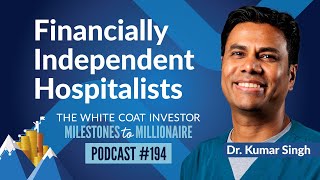
This is a YouTube video titled "Hospitalists Become Financially Independent after 12 Years - MtoM Podcast #194" published in October 2024. It features a podcast episode from the White Coat Investor series where Jim Dahle interviews Kumar, a hospitalist who achieved financial independence 12 years after residency. The discussion covers Kumar's financial journey, investment strategies, lifestyle choices, and advice for other medical professionals. The episode also includes detailed information on retirement account options for self-employed individuals. The content is primarily an interview and financial education talk hosted by Jim Dahle.
This is the White Coat Investor podcast Milestones to Millionaire celebrating stories of success along the journey to financial freedom. This is Milestones to Millionaire podcast number 194. Hospitalists become financially independent after 12 years. Are you using multifamily to build long term wealth? If not, I strongly encourage you to take a look at 37 parallel properties. They are multifamily specialists with 100% profitable track record that crossed over a billion in transaction volume since 2008. Investing with them is like partnering with a highly tax advantaged family office building an income producing long term wealth development platform. With 37th Parallel you get access to institutional quality assets conservatively managed with proven results. Their educational content on passive multifamily investing is also very good. Visit 37th parallel.com WCIToday for more information. All right, welcome to the podcast. I hope you feel part of the community here. It is a large community of white coat investors. It's spread all over a bunch of different platforms. Though you may not realize this if you're only on one of them, but we have a large Facebook group, it's almost 100,000 people. We have a subreddit if you're into Reddit. And the number of subscribers on there is like 80,000 or something like that as well. We have 30,000 something Instagram followers. We even have a TikTok channel and we still have the X channel. I mean, I guess it was Twitter before the X channel. I started many, many years ago with a lot of people following us there. But whether you're in our communities or whether you just follow the blog or podcast, or whether you're on these social media channels, take advantage of the opportunity to connect with other wciers, get your questions answered, you know, engage with the community and you'd be surprised how much you can learn from other people on the pathway with you. All right, we got a great interview today. I think you're going to enjoy it. If you want to come on this podcast yourself, you do not have to complete a milestone as impressive as this person's right. We'll celebrate any milestone with you. I don't care if you just got back to broke after 28 years out of residency. We will celebrate it with you. I don't care if you just bought your first beater as a resident. We'll celebrate with you any financial milestone you reach. We will use it to inspire others to do the same because there is somebody in a similar situation to you. You can apply@whitecoatinvestor.com Milestones all right, after the Interview. Stick around. We're going to talk for a few minutes about retirement accounts for the self employed. My guest today on the Milestones to Millionaire podcast is Kumar. Kumar, welcome to the podcast.
Thank you for having me.
Let's start by introducing yourself a little bit. Tell us what you do for a living and what area of the country you're in and how far you are out of training.
So I did my training in internal medicine. I graduated in April of 2012. So basically 12 years out of my residency.
Okay, and you're working mostly as what? You're in the clinic, you're in a hospital.
So I've been working for last 11 years. I left my full time job. So now this year I work maybe 10 days an entire year and I've just switched to a per diem job, but still as a hospitalist. But currently I'm not a full time employer or even a part time as we speak as of now.
Okay, so should we call it part time or should we call it semi retired?
More like complete retire. I would say, like much more than a semi retired. As you can. I only worked 12 days in entire last year.
Okay, so one day a month is essentially what you're working at this point. You're 12 years out of training, you worked as a hospitalist. Now this is going to be, I mean that in and of itself is pretty impressive to everybody, I think. But let's talk about what milestone we're celebrating today.
I reached my 5 million last month.
Last month. 5 million in net worth or in investable assets?
And just investable assets.
Okay, so net worth even higher because you own your home, I believe, mortgage free. Right.
It's totally owned. I didn't have any mortgage. I paid cash up front. It's close to now 1.3 million as we speak as of now today value. So if you'll add that. So if you add the house as well, the equity of the house will be close to 6.5 around given J. Yeah.
Okay, so this is a very impressive net worth. I mean aside from the fact that you're essentially retired 12 years out of training, this is a very impressive net worth for a hospitalist that's only worked for 12 years. Fill in the gaps here. How did you get here? You got to tell us the story. Yes.
I'm like, first of all, I'm an immigrant from India, so I did my medical school from back of India. So I did not have any student loan to begin with. So I, when I started my residency, I started the clean slate. I Had no depth whatsoever. So, you know, I saved during my residency up for three years. I met my wife or, you know, at that time she was also doing internal medicine residency as well. And that's what we met. We married in 2012 after graduating from internal medicine. And since then we both have been practicing hospitalist medicine, you know, for this for last 12 years. She continues to work. She just left her full time job last month, so she's taking a break for the three months and then she'll continue to work part time as well.
Okay, so a dual doc income, a dual hospitalist income. What do you think your income is averaged over the last 12 years between the two of you?
Five or 600, somewhere around 600 to 650.
Okay, so $600,000 you made $600,000 you made a year for 12 years. So this is about, you know, $7 million or something you made and you basically have it all left. How do you manage that?
That is because of the power of compounding. And you know, when I started investing in 2013, I didn't have much knowledge. My brother was an investor banker, so he set up my brokerage account. I have not heard of index fund or anything like that. I have not read any books. So what I did, I just basically pick up buying stocks like Apple, Facebook, Netflix, Tesla without knowing anything about it. I just bought them in 2013 and I just kept.
You were buying individual stocks starting in 2013. Has that been your approach the whole time or did that change over time?
Most of the time, to be honest, that's been my approach. So I'm the outlier though now I have read hundreds of books and I know index fund works. You cannot beat the market and everything. You can, you know, listen to your podcast and the blogs. I've read all your blogs, most of them if I read your books. So. But again, that was all after I started investing already. So now my investment did well. And again, it's not because I'm smart or anything. It was sheer luck that I bought all the fans I have, the Magnificent Seven I have. I bought Nvidia in 2018 without knowing anything about Nvidia. And today, as you know where it stands, so I've compounded my money. I was just looking at my brokerage account before this interview and my, you know, I've compounded annually for the last eight years more than 20%. At the same time, the S and P has already done an average of annually of 12%. So your. My cumulative return currently is 260% while if I've invested in S and P, it will be 150%. So I've beaten the S and P again not because of anything, just because of luck by close to 9% for the last nine years or so.
Yeah. Any plans to change your style of investing at this point?
Do you plan to continue to invest in individual stocks? Yeah, so now I don't earn much, so I'm what I do like. Recently I sold my stocks in Tesla so I bought index fund. So I'm trying to switch from my individual because I know it's quite a risky proposition going in the future to change some of them to index fund. But gradually I don't want to create too much of capital gain tax as well because they have appreciated a lot. So I understand, even if it is riskier, I have not left my job, my wife still works, I continue to earn. So we are not withdrawing any money from our portfolio, we are just riding what's go. So even if it drops, you know, two or three million dollars, it won't change our lifestyle because we don't need that money for next five, 10 or 20 years for.
So what percentage of your gross income do you think you saved on average over the last 12 years?
Yeah, initially you were saving like after taxes, whatever I was getting, you're bringing home almost close to 70%.
70% of your net income.
Yes. We were living in a very low cost of area near Buffalo when I graduated from residency. So I didn't read your book but I was still living like a resident, you know, because my mortgage was $400 for the month. So you know, it was a very cheap though I spent or wasted money a lot on buying cars and other stuff without knowing much. But after that, you know, we were, we were good saver, we invested and we enjoyed our life, you know, but we were able to save a lot of money up front and that made a big difference.
Now most doctors have a lifestyle explosion when they leave residency. They start spending dramatically more than they were. Why do you think you didn't?
No, actually I did just because, you know, I bought, my first car was a Mercedes. Then I bought a 7 Series BMW. Then I bought an Audi, then I bought a convertible Mercedes. My driveway, that there was three cars on my driveway must raise me under the Audi, which was more expensive than my entire house. So I didn't waste my money. I went to fancy vacations. But after that a certain extent it all wanes as we all know that, you know, you enjoy for a couple of months and something you feel good, you put on the social media and stuff and then everything just goes back and you're back to the treadmill. So later on realize that, you know, these things are fleeting now. The biggest thing of money I think can buy is freedom right now. I wake up today morning. We have one daughter so we spend a lot of time with her. She's nine years old. So that's the whole purpose of this approach of leaving the job is not that I hate my job or anything brings me money, but able to spend our time with her. So that is very, very critical piece and that made me to do all this so that I can able to especially the golden years. She just turned nine so you want to be there all the time for her. So that's our number one purpose.
Yeah, those years between five and ten are pretty magical, aren't they? I've got a nine year old too.
So we have not hired any aid. We don't, you know, we just take for her. We spent lots of time with her, you know, whole day, you know, throughout the year.
Now you're an immigrant. I don't know if your wife is an immigrant, but how did your upbringing affect how you manage your money, do you think?
Yeah, we both are an immigrant. My wife was also an Indian. We did a medical school back in India and you know, did our gave a USMLE and started doing our residency from my family background. So we came from a very, you know, I would say middle class, typical Indian middle class background where money was there but it was not like an abundance. So we always learned from our parents to save. Saving was inborn in us. Not that investing and being very smart with the investment, but saving was already built in. So even during my residency in three years when I finished my residency, I had more than $100,000 during my residency itself where we were getting paid what close to 60,000 every year. So out of that, you know, or you know, I was able to close around 92. I still remember $93,000 I had saved. I did not invest it because I had no idea at that time all we were talking about is, you know, people are busy doing their fellowships researches or talking about the cars. I was surrounded by people who had no idea what the investment world is. We didn't read your book, which I had read your book and right now I would have been much more better and better position. But you know, so that time, you know, we had no idea. But what we did was we saved the money though. I wasted on other stuff, but we Were always been a good saver to begin with.
How much do you think you guys spend now? What do you think you'll spend in 2024?
I think give and take. We spend around 120 to 150,000 in a year because we don't have any debt. So no loan, no mortgage, everything is, you know, clear. We live in a house where, you know, so most of the money goes in paying our property taxes. And then we do a lot of vacations. So spend on that. And then my child goes to a lot of post school activities, you know, private tennis, private swimming, she plays golf. So, you know, so basically those are major expenses. So. But still, I would say somewhere around 120, maximum 150 an entire year is more than enough for us.
Do you remember the first conversation you had with your wife about money and, and what your plan, how you guys were planning to manage your money? Tell us about that and how that went.
Yeah, my wife is not too much into that. So, you know, she was used to work, money used to come. She just cares. You know, we live a house, we eat good food and go to vacation. She is not into. So basically I was the one making 100% decision though we were earning exactly same amount because our job, we have been working together at the same place, same job. Our W2 salary was exactly mirror copy of each other. We never did any extra moonlighting or extra work, but most of the investment was done by me. So initially for the first five, six years, she didn't even knew that I was putting so much money in stock. She didn't knew that we have saved so much of money because she would think that, okay, why we have to work so much. So it was in the later part of my year when we moved to this area where we start discussing and you know, she's been happy because, you know, we have hardly worked anything harder or we did any more education. We are the least qualified doctors in America. We just did three years of residency. So you know, to say that, you know, you need a lot of. And we have worked, you know, less than 120 days a year. We work our full time job. So it's, you know, it's been a very smooth sailing for us and you know, so we are very lucky and fortunate to be at the position where we are right now.
Yeah. How do you view your careers now? Do you consider being a doctor an important part of your life? Do you plan to practice more later, less later? About the same amount later?
Yeah. No, I mean right now our Priority, as I said, is all spending time with my daughter. You know, that is the number one priority. So I don't want to do any full time, even a part time job because you don't have the flexibility in your scheduling. You know, when you work a part time, full time, you know, you have to ask for vacation or days off or, you know, I want to be with her, you know, at least till she goes to the college, which is another, you know, seven, eight years or even more. So that's the goal to do, but continue to do a part time. I don't want to leave the job altogether. So, you know, because she earns me a decent income and then I don't want to have a big gap in my CV as well. So that way I, you know, I continue to work maybe when she is out of the house and to the college and stuff, then might go back, work more or volunteer more. Haven't thought that far ahead. But at right now our, my sole goal is to be at home with her and spend as much as of time. That's the whole thing why I pursue this financial independence, why I was investing aggressively, knowing that, you know, it might not work out because I didn't have, you know, there's a very certain amount of time with my daughter which was very, very critical. And once I achieved, there was no point of working, you know, as a full time.
Okay. Somewhere out there there's somebody that's just like you were 12 years ago. Maybe they're an immigrant, maybe they're not, but they are in medicine or family practice or something that maybe doesn't pay a gazillion dollars a year and they want to reach financial independence relatively quickly. They want to do what you've done. What advice do you have for them?
I mean, I would say first thing is like a post residency, you know, when you start working, start saving. I mean as you said, live like a resident for the next four or five years. You know, during residency, please study, you know, some personal finance and be, you know, have some literacy. Because that was one of the drawbacks which I, I had no personal, you know, literacy. I didn't even know I have to, how to file a tax and what the brokerage account is till I, you know, started earning money. So if someone can know, that's, you know, a very good upfront itself. But then you, at the, when before you start the family, if you're young, work as much as possible, just focus on working, earning, save and keep investing. I mean, like just upfront that investment in the first five years will help a long way after that, once you have reached somewhere, you know, good net worth, then you can start thinking again, spending time with your family and other stuff. But I think up front, you need to save. Save and save and invest money. That's as simple as that. Control your ego and stuff. Because you're a doctor. I mean, like, you know, you can, you'll get time to spend all your money, but I think, you know, if you're done early, as you know, the compound interest, how it works, it's just that not the smartest person, the person who starts the earliest has a very, you know, high chance of winning this, you know, whatever the race or whatever you call it.
Well, Kumar, I congratulate you and your wife and your daughter on your success and thank you so much for coming on the Milestones podcast to share it with others and inspire them to do the same.
Thank you so much for having me.
All right. That was a fun interview to do. Right? You don't see that very often. People become an FI just 12 years out of residency, especially in a specialty that most of us consider a relatively low paid specialty. Right. This is not a neurosurgeon or an orthopedic surgeon or a plastic surgeon or whatever you consider to be the, the top earning specialties. You know, it's internal medicine. It's being a hospitalist. It's, you know, grinding out those 12 hour shifts, days and nights, admitting patients to the hospital, rounding on them, discharging patients, hassling with hospital administrators. Right. It's not the world's easiest job. But you know what, if you work hard at it, you can get paid well. And if you save a big chunk of that income, you can obviously become wealthy very quickly. Now, Kumar admits that he got lucky with some of the stock picks he made. But let's be honest, what's going on here? They make $600,000. They spend $120,000 to $150,000. Once he got over his new car thing right after he got out of training, that leaves a big gap of money to save. When you're saving three or four hundred thousand dollars a year, that's three or four million dollars they save just in brute force saving. Yes, it grew. Their money grew because they invested it. And stocks have done well. The stocks they picked have done particularly well. But even if they just bought all the stocks, they still have four or five million dollars right now. Right. It wasn't the stock picking prowess or luck, as he describes it, that enabled them to become wealthy, it was a high savings rate and working hard and earning well and putting a whole bunch of that into something reasonable. And you too can do that. You know, most of us might pick a more moderate path. We might not save 70% of our net income. And I don't want you to think that you have to save 70% of your net income to be a white coat investor. You do not. I do Recommend you save 20% of your gross income. That might work out to be closer to 30% of your net income. That is kind of required if you want to maintain your standard of living once you get to retirement. But you can, you know, watch it as you go and might be able to cut back sooner than you might think, saving that amount. But the point is, the more you save and invest, the sooner you get to financial independence and the sooner you're in control of your life. Whatever you want to do with your life, if you want to go on mission work and on another continent, if you want to just be around to raise your nine year old, if you want to change your practice to something that you enjoy doing more, whatever you want to do is within your power as a doctor. You've already got a high income. And the steps to becoming wealthy are make a lot of money, don't spend a lot of money. Take the difference between those two and invest it in some reasonable way and then make sure you don't do anything dumb to lose it. That's basically all there is to getting rich. But let's be honest, 90% of it is in the earning. Most Americans have an earning problem. If you're listening to this podcast, you probably don't have an earning problem. All you've got to do is do the rest, right? And as I tell people a lot when I'm out on speaking gigs, you know, you're a little bit like the Seattle Seahawks in the Super Bowl, I think it was back in 2017. They're on the two yard line, they've got the best running back in the NFL, Marshawn Lynch. All he's got to do is take two steps forward over the goal line and they're super bowl champions. But what do they do they call a complicated pass play, throw an interception, the super bowl is over and they lose. That's like doctors when they come to managing their finances right? They basically, all they gotta do is take two steps over the goal line. By virtue of having their high income, you know, there's not that much else you have to do to build wealth and become Financially independent, all you have to do is manage it in some reasonable way. And so that's my caution to you. Don't be like the Seahawks, right? Play smarter. You can. And you can be successful. And you can do this even if you don't want to do it in 12 years. It's totally fine to do it in 20 or 25 or 30 years if. If you want to. Okay, I promised you at the beginning, we're going to talk about retirement accounts, retirement savings plans, whatever you want to call them for the self employed. Self employed means you don't have a boss, right? You are the boss. And so that might mean you're getting paid on a 1099. For most docs, that's what it means. You don't get a W2 at the end of the year, you get a 1099. I'm not going to talk about K1s, people that K1s are in partnerships. And in a partnership, your retirement account options are mostly limited to what the partnership offers. Just like when you're an employee, you are limited to the retirement accounts offered by your employer. When you're a self employed person, you are the employer. So you get to go out there and choose the employer offered retirement plans. Okay, so let's talk about what those options can be if you are self employed. The mainstay of retirement savings for the self employed is what's called an individual 401K. And this is just a 401 where there's only one person in the company. Right. You can have your spouse in there as well, but that's it. Once you have more than your spouse, you got an employee beyond your spouse. You can no longer use an individual or a Solo 401. But these are awesome. If you have one of these, you should be so happy because it is a great way to save if you make enough money and you don't have to make that much depending on the type of contributions you make. If you make enough money, you can put $69,000 in there this year. For those under 50 for 2024, it goes up with inflation each year. But $69,000 is a lot of money. You put $69,000 away every year for retirement and you will retire a multimillionaire if you have any sort of reasonable normal career length. The cool thing about these accounts though is you're in charge. You can go anywhere you want to open them up. Now, these days I actually think it's worth passing on some of the free ones that you can open at Fidelity And Schwab, you can't do this anymore. At Vanguard, they got out of this business recently. But I actually think it's worth paying someone to set this up for you. And the reason why is if you get a customized one from some of the people we have on our recommended page, if you go to the tab and go down to retirement plans, you'll see the 6 or 8 of people there that can help you do this, but they can put together a customized plan. And the benefit of that is you get to choose all the investments. Right? You can actually choose investments that aren't typically offered in 401ks. You can make it basically a brokerage window. You can buy anything available at the brokerage that often includes some private investments if you're interested in those sorts of things. And so that's cool. But you can also put in some cool options. You can have a Roth option. You can have an option to take loans from the 401. You can allow after tax employee contributions and in plan conversions. And you put those, those two together, it's often called a mega backdoor Roth IRA. Yes, you could put all $69,000 in there as Roth contributions. So there's a lot of cool things you can do when you have a customized plan. Your 401 offered by your employer or your partnership may offer some of those, but it's pretty uncommon that it offers all of them, but your individual 401 can offer all of them. And as we've grown here at WCI, we had to abandon our individual 401s, but we opened up a 401 that offered all those options as well. And so it's been pretty awesome to be able to participate in that. Not only as an owner employee, but I think the employees appreciate having a good 401k as well. Okay, that's the first option. A lot of you out there are sitting there with a SEP ira. And a SEP IRA is used by lots of people that are self employed. The total contribution limit is the same as 69,000. But it has a number of downsides that make this less than ideal for most white coat investors. One is you don't have as many options for like the mega backdoor Roth option and that sort of a thing. You actually have to have more income in a lot of situations to max it out than you do with an individual 401 because you don't have the $23,000 for those under 50 employee contribution to help get you to that maximum contribution. A lot of times, well, a SEP IRA is not going to allow for after tax employee contributions like an individual 401k can. So those are downsides. The other big downside, though, with a SEP IRA is it counts toward the pro rata calculation when you're doing your backdoor Roth IRA each year. And so that's why a lot of white coat investors avoid it. If they have a SEP IRA, they tend to open an individual 401 and roll the SEP IRA in there. It's just not ideal. It's not as good as an individual 401. The only advantage really that it has over an individual 401 is it can be opened a little bit faster with a little less paperwork. And you don't have to file a form called 5500EZ. This is not a hard form to file. It's just an informational return you have to do for the IRS each year. It's due July 31st every year. When you had more than $250,000 in the account at the end of the prior year, that's when you have to file. And so that's not a bad thing to file. It's not that hard to file. You just have to remember to do it. Because the penalties for not filing it are terr terrible. Right. And if you botch it once, a lot of times they'll kind of forgive you if you ask them to. And you can get out of those penalties, but they're really high penalties. So if you have an individual 401 with more than $250,000 in it, you do have to file a 5500EZ every summer. Okay. Don't forget to do that. Okay. Some companies, you know, small practices or whatever, they decide to open what's called a simple IRA. And simple doesn't mean it's just an IRA. It's not a traditional IRA. It's a simple IRA. And the problem with the simple IRA is it's generally inferior to a 401. It's not even as good as a SEP IRA. You can't put as much money into it. But in some situations, depending on who your employees are and how much they want to save, it might make sense. If you got a bunch of employees in your practice, they don't want to save a whole bunch of money. A simple IRA can actually make sense to be the main retirement savings plan at your practice. But if you're paid on a 1099, you're just an independent contractor and you don't have any employees, you do not want a simple ira. That is not the best plan for you. Don't open that, okay? Now remember that. Anybody. Oh, the other thing you can do. I ought to mention this. We're getting into the weeds here a little bit. But you can actually open what's called a cash balance plan. And this is a type of defined benefit plan or pension. And you can open a personal one even if you're the only employee, right. You're paid on 1099, you're an independent contractor, you can open a personal defined benefit plan. And depending on how old you are, you might be able to put a whole bunch of money in there. My partnership has a cash balance plan like this. I'm allowed to put $120,000 a year in there. If I was working more and seeing more patients and earning more, I could max that out. Right now I don't make enough to max that out. But I'm only 49, right? If you're closer to 60, you can put even more money in there. So if you really want to defer a lot of money and, you know, dramatically lower your tax bill, you can open one of these plans. It costs a little bit more than, you know, your 401k does. The investment options aren't quite as awesome. There's a few more restrictions because remember, this is a pension, you know, really is an extra 401k, but it's masquerading as a pension. So it has to follow some pension rules. But eventually you're just going to roll the balance into your 401k. So it's like an extra 401k but something to look at. If you want to save more than that $69,000 you can stuff into an individual 401k. Okay? The other things you can do are things that anybody can do, right? Whether they're an employee or not. You can do a backdoor Roth IRA for you and your spouse. Right? You got to beware of the pro rata calculation. If you got some money sitting in a SEP simple or traditional Iraq. But for most of us, if you're under 50, you can put $7,000 in there for you this year and you can open one for your spouse and put $7,000 in there for them each year. Obviously it's a two step process. You put it in the traditional IRA, then you move it to the Roth IRA the next day or the next week or whatever. So you're contributing to the Roth indirectly. That's another 7 to $14,000 more if you're 50 plus that, you can put in there. Okay, everybody that whose only health insurance plan is a high deductible plan can contribute to a health savings account. I think the limit for this year is 8300 for a family. And remember, a family can be you and your kid. It doesn't have to be you and a spouse. And so that's another great savings account, right? Triple tax free. Yes, it can be invested. You don't even have to take the money out in the same year that you contributed or that you spent it on health care. You can save the receipt for decades if you want and pull the money out later. Tax and penalty free. After age 65, it acts just like your IRA basically just comes out and you got to pay tax on it, but no penalty. Even if you're not spending on health care, if you have access to an hsa, there's really little reason not to max it out. Okay. The other thing everybody has access to is just a taxable brokerage account, right? There's no contribution limit. There are no restrictions on when you pull the money out or what it can be spent on. Obviously it's taxed as it grows. That's the downside to it compared to all these retirement accounts. But it is nice and flexible and you can put as much as you want into it. This is actually the biggest part of our savings now. Just because we were able to save more than we were able to put into retirement accounts for a number of years. And that's the case for many people. But don't forget, a taxable account is not the end of the world. You don't have to stop saving for retirement just because you filled up your retirement accounts. You can always invest more into a taxable or non qualified brokerage account. You can still invest it tax efficiently. Typically people are investing in things like a total stock market index fund or your municipal bond fund or things like that to keep it tax efficient. But there's no reason you can't invest as much as you want there. All right. So I hope that is helpful to you as an overview of what is available to the self employed when it comes to retirement accounts. Our sponsor for this episode is 37th Parallel. Are you using multifamily to build long term wealth? If not, I strongly encourage you to take a look at 37 parallel properties. They are multifamily specialists with 100% profitable track record across over 1 billion in transaction volume since 2008. Investing with them is like partnering with a highly tax advantaged family office building an income producing long term wealth development platform. With 37th Parallel, you get access to institutional quality assets, conservatively managed with proven results. Their educational content on passive multifamily investing is Also very good. Visit 37Parallel.com WCIToday for more information. Thanks so much for being with us today. We appreciate you listening to the podcast and being part of the White Coat Investor community. Keep your head up and your shoulders back. You've got this. We're here to help. We'll see you next time on the podcast. The hosts of the White Coat Investor are not licensed accountants, attorneys, or financial advisors. This podcast is for your entertainment and information only. It should not be considered professional or personalized financial advice. You should consult the appropriate professional for specific advice relating to your situation.
More from Jim










Physician Takes a Youth Sports Team to the State Championship - MtoM Podcast #236
