Marketing Your Practice - WCI Podcast #378
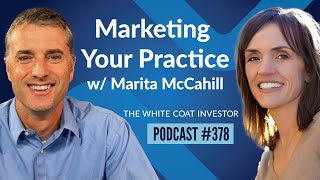
This is a YouTube video titled "Marketing Your Practice - WCI Podcast #378" published in August 2024. It features a podcast episode from the White Coat Investor series where Jim Dahle hosts a discussion with Marita McCahill, a marketing consultant for healthcare professionals. The episode covers topics such as financial advice for physicians, retirement account rollovers, and strategies for physicians to market their medical practices effectively. The content includes multiple Q&A segments with Jim Dahle providing detailed financial guidance, followed by an interview focused on marketing practices for doctors. The conversation is aimed at helping medical professionals improve both their financial health and practice growth through marketing.
This is the White Coat Investor Podcast where we help those who wear the white coat get a fair shake on Wall Street. We've been helping doctors and other high income professionals stop doing dumb things with their money since 2011.
This is White Coat Investor podcast number 378. Marketing your practice. Today's episode is brought to you by SoFi. Helping medical professionals like US bank borrow and invest to achieve financial wellness. SoFi offers up to 4.6% APY on their savings accounts as well as an investment platform, financial planning and student loan refinancing, featuring an exclusive rate discount for med professionals and $100 a month payments for residents. Check out all that SoFi offers at whitecoatinvestor.com SoFi loans originated by SoFi Bank NA NMLS 696891 advisory services by SoFi Wealth LLC. The brokerage product is offered by SoFi Securities LLC. Member Finra SIPC investing comes with risk, including risk of loss. Additional terms and conditions may apply. All right, welcome back to the podcast. We're glad you're here. Thank you, thank you, thank you for what you do on a daily basis. It's important work you do. Thank you for spending your 20s in school or residency training. It is not a small sacrifice and commitment you have made to your profession. Thank you so much for doing it. Here at the White Coat Investor, we want to teach you how to take that high income and turn it into wealth. It's so important to understand the difference between income and wealth. Lots of people are out there confused about this. They think that rich people have high income and while they often do, that is not what makes them rich, right? Being rich, being wealthy, being comfortable, whatever word you want to use for it is measured by net worth. Everything you own minus everything you owe. So if you're coming out of your fellowship and you're making $400,000 a year, but you have a net worth of negative $400,000, you are not yet rich. High earner, not rich yet. You are a Henry and we want to take you from being a Henry to being wealthy. And the reason why is not because we want doctors to have lots of money necessarily. It's that we think doctors that have their financial ducks in a row are better doctors. They're better physicians, better partners, better parents. They take better care of people because they're not worried about having to make their car payment. They're not worried about the stress of their financial, you know, their student loans hanging over their head. All these things that people are stuck with. You listen to our Milestones podcast and you hear about people who at one point were very much struggling and the effect it has in their psyche and the effect it has in their day to day life, it is not a good thing. We don't want that to happen to you. The net worth surveys show that about 25% of doctors in their 60s, these are doctors that have had physician level paychecks for 20 or 30 or more years. 25% of them are still not millionaires in their 60s. And I think that's a real shame. Not that they need to be millionaires, but because they are holding onto so little of what they've earned. And by the time you're in the 60s, I think you ought to have an amount of money similar to what you've earned in the past, thanks to your money doing some of the heavy lifting. And that effective compound interest. If you've earned five or six or eight million dollars during your career, by the time you're getting close to retirement, you ought to have something similar to that that just comes from saving 20% and investing it in some intelligent way. And I think if you do that, you'll not only have a comfortable retirement, you'll be able to help others and you'll end up being able to be a better practitioner throughout your career. All right, let's take some questions from you guys to start with. We're going to talk a little bit later about marketing your practice, which I think is pretty important. And we've got a new partnership out. You can find details of about that@whitecoatinvestor.com marketing but we'll bring on somebody to do an interview later in this episode to talk a little more about that. First, let's take this question from Justin. Hi Dr. Dali, this is Justin from New York. Firstly wanted to thank you for all of your teaching and guidance over the last several years. Much of your teaching has sparked my interest in really taking command of my personal finance and promoting this kind of work to my fellow colleagues and peers. And so I'm indebted to your service and to all the teachings that you've done. My question revolves around contributing money from a Roth 403B to a Roth IRA. I'm currently in my fourth year of residency. I have another year left and I've been contributing to a Roth 403B through my academic center. I plan on eventually or hope to eventually contribute this money to a Roth ira, but was not clear or sure if this is something that I'm able to do without paying Any more sort of taxes. And so I was curious to get your thoughts on whether this contribution or conversion of a Roth 4,3B to a Roth IRA after training is something that I'm able to do. Thank you again for everything. Okay, Justin, great question. It allows me to talk about some stuff that's important for everybody to know. There are a few people in the audience that are like, what the heck is Justin talking about? Right? Because they already know this. But there's a whole bunch of you out there that don't know this. So let me teach this to you and you'll never get confused about it again. Terminology matters. Precision of terms matters. What you say matters, Right? Because each of these words we're throwing out there in questions and answers like this has an actual definition. A contribution is when you put money into a retirement account. And there's limits to how much you can contribute because it's such a good deal to be able to save in a retirement account, the government says you can only put so much in per year. For example, if you're under 50 in 2024, you can only put $7,000 into an IRA. You can only put $23,000 as an employee contribution into your 401 or 403. Those are contributions, and there's a limit on those. Often you have a choice between a Roth or a tax deferred or traditional retirement account, but those are contributions. Another thing you can do is to make a transfer or a rollover. Sometimes people use the term rollover when you take possession of the money for less than 60 days before it goes into the new account. But rollover is a pretty broad term that often includes direct transfers from one retirement account provider to another. So if you are moving money from a tax deferred account of some kind into a tax deferred account of some kind, right? Whether that's going from a governmental 457 or 403 or 401 into another 401k or an IRA, right? That transfer or rollover, as long as the same type of account has no tax consequences, there are no penalties, there are no tax consequences. Now, usually you'll have to separate from the employer before the plan will allow you to do that. But it costs you nothing but your time and a couple of pages of forms you often have to fill out. And this process is super intimidating until you've done it once and then you're like, that's it. All I had to do is put the account numbers on there and the addresses and. And it goes over it takes two or three weeks for whatever reason, but it's really a super simple process. And you're going to have to do this a number of times during your career. So just get used to doing it, figure out how to do it. Usually it's easier to pull the money into the new account than it is to push it from the old account. So I usually start the paperwork process with the new account. But this is no big deal. So this is what you're going to want to do, right? Because you're going from a Roth account to a Roth account. You're a Roth 403 to a Roth IRA. There's no tax consequences. That money's already been taxed. You're not taking it out. So there's no penalties to pay. It just goes. You separate from your employer, you go to Vanguard or Fidelity or whatever and you say, I want to do a rollover from my Roth 403 to a Roth IRA. And they say, fill out this form and three weeks later it's in the Roth IRA. That's it. You also throw out another term which is called a conversion. What you're wanting to do is not a conversion. A conversion is moving money from a traditional or tax deferred account to a Roth account, okay? And generally speaking, there is a tax cost to doing that. There's no penalty or anything, but there's a tax cost because that tax deferred money, that pre tax money has never been taxed and you want it in an after tax or post tax or tax free account. So you got to pay taxes on it at some point. You do that in the year you do the Roth conversion. Now you don't convert money from a Roth back to a tax deferred account. Occasionally you got to do what's called a recharacterization of a contribution, which feels a little bit like that. But you really don't convert money back from a Roth account. It's always a Roth conversion. You're going to a Roth account. So what you want to do is very simple. It's very smart to do. I mean, occasionally in some states you get a little less asset protection in an IRA than a 403. Also keep in mind, if you're getting toward the end of your career, you can get into 403s and 401s after you separate from the employer at age 55, penalty free. Whereas you got to wait till age 59 and a half with an IRA. So you don't always want to go to an IRA. But for the most part, when you leave an employer, you do want to go from the 403 or 401k, et cetera, to an IRA, particularly if it's a Roth account. Now if you're doing backdoor Roth IRA every year, you don't want to have money in a traditional ira. So in that case, you want to go from your old 403 or 401 to your new 403 or 401k rather than putting it into a traditional IRA. But as a general rule, most Americans, when they leave an employer, they move their money into IRAs. All right, our quote of the day today comes from Henry David Thoreau in Walden. He said the cost of a thing is the amount of life which is required to be exchanged for it immediately or in the long run. A lot of wisdom there, all the way back from the 1850s. Next question comes from Dave hi WCIT.
I'm an incoming fellow newly matched into a three year program and my wife is a primary care physician. As part of our move from my fellowship we are comparing retirement contribution options at my wife's new job and one of the options for partners is a kiosk plan which I am having trouble wrapping my head around. The contribution levels are structured as a percentage of eligible compensation times a predefined contribution percentage. The contribution levels are 25, 50, 70 or 100% of the contribution percentage as actuarially determined each year. What I'm struggling to conceptualize is how much of an effect this will have on our cash flow month to month as each of these contribution levels would fill the employer contribution limit of $69,000 in 2024 well before the end of the year, potentially creating a yo yo effect and even some cash flow challenges depending on the actuarial adjustments year to year. To make matters more complicated, while my wife would be on a three year partner trek and the cubic plan only applies to partners, the decisions participating in the plan and the contribution level must be made within the first 180 days of which is then permanent. The employer also has an unmatched 401k and a pension which my wife is unlikely to qualify for as we are anticipating moving to be closer to family after my fellowship is completed. So how should I think about this plan as a potential vehicle for retirement investment and do you think it would be a good idea in our current situation? My sense of date has been to avoid financial plans with components that I have difficulty fully understanding but want to give my wife accurate insight.
Wow, complicated situation. I think you said she's not eligible to use it anyway until she makes partner and she's in a three year partner partnership track and you're in a three year fellowship and you guys are leaving after your fellowship. So I don't know that any of this matters, does it, if she can't use any of that stuff. But I don't think that can possibly be true because you're not allowed to keep a full time employee from being able to contribute to a 401k more than about a year after that. You have to allow them into the 401 or it won't pass testing. So I'm sure she'll be able to use at least the 401. I don't know about the kids, Keog. You know, it's kind of an older term. People don't use it very often, but it works very similarly to a profit sharing plan. You know, the $69,000 limit is probably combined with that 401k in some way to share the same $69,000 limit. I think what I would do in this situation is I would go sit down with HR or the HR person or the managing partner or whoever it is and figure out exactly what this is going to look like. You know, okay, what's this look like? We choose the 25%, the 50%, 75%, whatever. What's that going to mean for our cash flow? What's that going to mean for how much we get in there at the end of the year? Decide what your goals are, right? If your goal is to max this thing out as soon in the year as possible. If your goal is to spread it out as much as you can throughout the year, but still max it out. If your goal is just to get $20,000 in there during the year, figure out what your goals are first and then go to them and go, this is what we'd like to do. What's the best way for us to do it? Which of these things should we choose? And then you can maximize whatever benefit you're interested in getting out of that. But when it's confusing, usually that's just because you don't understand how it works, right? And sometimes HR doesn't understand how it works. But the problem is every retirement plan is a little bit unique, has a little bit unique rules. And so you can ask for the document, they got to give you the document. But even so, a lot of them just aren't written that well. And you got to go in and get clarification of exactly how they work. I'm Also a little skeptical this thing can never be changed, that you've got to decide as a pre partner how this thing's going to work three years from now. That doesn't make any sense. So I'll bet there's a little more flexibility there than you think there is, but you're not going to be able to figure out how much without going in and talking to hr. And it sounds like you're kind of the finance person in the relationship, so the two of you probably ought to go in together to get this sorted out. It's well worth your time, right? Pay attention to these details. Read your plan documents, figure out how your plans work on the front end rather than just ignoring them because they're complicated. And you may decide that you don't want to use this plan at all. And that's fine. But let's get all the information first so you really understand what your options are. All right, I mentioned this podcast is going to be about marketing your practice. Let me bring on our newest partner in regards to that. This is Marita McKay Hill. Let's get her on the line. I'm here Today with Marita McCahill. She is the founder of Practice Grow, does consulting for helping people marketing their practice, and has recently created an online course to assist physicians and similar professionals in marketing their business. Marita, welcome to the White Coat Investor podcast.
Thank you, Jim. I'm excited to be here.
Let's start by just telling us a little bit about yourself and how you got interested in the marketing of healthcare practices.
Sure. My background is more. I spent 10 years in marketing for large IT outsourcing companies like Fortune 500 companies. And then as I started growing my family, I wanted to scale back and do consulting for different smaller businesses. And at the time, I had a lot of friends and family who were in the healthcare arena, particularly physicians. And they would come to me and just ask questions about, hey, how do I get more patients? Or what do you think about this campaign? And I just realized there was a huge lack of understanding around personal branding and marketing in terms of the individual physician. So that's kind of how I started started this journey.
So what is it about doctors that makes us so terrible at marketing ourselves?
Kind of very similar to finances. It's just a matter of there's no education around it in the med school process, so no one really is exposed to some business courses, some simple personal branding and marketing courses. I don't think people are innately bad at marketing. I I just think there's no education around it. You guys are so indonated with all the medical training that there's no time taken out to tell you how to build your finances, how to grow your practice so you are financially viable and you have a great life. So personally, the marketing, I don't think doctors are particularly terrible at marketing. I just don't think they understand it.
I mean it's a major people can major in marketing. You do, you know, years of coursework at learning marketing. Yeah, but I imagine there's some principles that are kind of high yield and once you understand those, you get, you know, 80% of the benefit with 20% of the work probably compared to someone who gets a degree in it. Yes. Let's talk about Dr. Marketing. What are the most effective ways to market yourself these days? I mean everybody talks about online reviews, talks about your website. I mean, do docs still need to be going around in person, you know, specialists going to primary care, docs trying to get referrals, you know, take an ER call. And what are the best ways to market yourselves these days in the 21st century?
Well, in my opinion, and there's some, there's data to support this, I believe that it's a combination of having a strong online presence coupled with. Yeah, I do think specialists still need to do outreach to referral providers. I think there's some data and I have this covered in my course. But three, the three main ways to grow your practice is one, with a strong personal brand and online presence, second is through referrals. And third, and when I say referrals, it's referrals from other providers as well as friends and family. So people who know you or your patients, friends and family, that's a huge referral network for you. And then last is like other doctors, other providers in the arena. So I am a big proponent of growing your practice in all three areas. And so actually the methodology I use is grow. It's generate your personal brand and then reach your target audience followed by optimize your marketing. And I think there's so much providers can do that doesn't require a large spend. Monetarily, there are lots of things you can do to grow your practice that cost very little.
What I mean, I always get the sense being an emergency doc that some of us don't need to worry too much about our online presence, that nobody's checking our reviews before they come to the ER or you know, an anesthesiologist. What specialists really don't need to spend much time worrying about this.
The two you just Mentioned for sure. The way I look at it is anyone who requires patients to find them and look for them, then they need to market their practice. But even an ER doctor or an anesthesiologist, where you don't choose those providers, you just show up and there they are. If they ever want to pivot and go to a different kind of area of medicine, or if they want to go into concierge medicine at some later state in their life, they should still have some basic marketing knowledge. But for sure, anyone who needs to attract patients is someone who needs to market their practice.
I think these days something like 78% of physicians and not quite that high of a percentage of dentists don't own the practice. You know, they're employees or you know, they're partnering with the hospital like we do. Right. I mean, we're our own business owners. But let's be honest, when you get an ER bill, 80% of it's going to the hospital. How do you decide whose responsibility it is to do the marketing? Whether it's the hospital or the group or yours individually, how does that get sorted out?
So my thought process is this, if you are part of a group or hospital, they're going to take care of the large majority of your marketing. However you want to be involved and you want to honestly build your personal brand because if you don't, you know, a lot of providers move practices. So you might be hospital based for the first half of your practice and then second half of your career you go into private practice or reverse or you might. A lot of, you know, private practices are getting bought right now and so you move to a hospital based system, maybe you decide you don't want to go with your group. So my concept is you need to future proof your individual brand because you really don't know what, what's going to be thrown at you and where your career is going to move to. So I highly recommend every provider own their own personal brand. And when I say that they should be building their credentials online through reviews, so they have their own online presence, separate from their group, but not competing with their group. So an instance of that would be if you work for a certain practice, you wouldn't want to go off and create a brand that conflicts with that practice, like a totally different name. So I work with providers to really understand their own brand and how to market it, but also not conflict with your hospital or not conflict with your private practice.
So I should go out and buy jimdolley.com and drdolly.com and maybe link those back to the practice website. That sort of a practice?
Yeah, something like that, yes. Because if you at some point decided you want to move cross country and move to Connecticut or somewhere like that, owning your name allows you to do that a lot more seamlessly. And that is what I've worked with a number of providers is that the first half of their career they didn't own their own reviews. And then when they decide to move, they're starting from ground zero. And it just doesn't need to happen that way. You can really transfer those reviews with you wherever your career takes you.
We're talking with Marina McKay Hill. She has designed a course, developed a course to help doctors learn to market themselves better. You can learn more about this@whitecoatinvestor.com marketing this is a course that's you can buy with your CME dollars. It's eligible for eight CME category AMA category one hours. So it's a wonderful benefit there. Now, as far as online reviews, a lot of people don't get interested in their online reputation or online marketing until they get a bunch of bad reviews. You know, they're not exactly proactive about it. So let's say you're starting from that point, like I suspect many people are. You've got a few bad reviews that you think are hurting your business. What can you do about it?
You can. One of the best things you can do is offset the negative reviews with a lot of positive reviews. So say, I mean, you have 20 reviews and five of them are negative. Really the only way to offset that percentage is by building up your positive reviews. And this is something I cover in the course quite extensively. First off, if you get a negative review, how do you respond to it properly? And there's HIPAA compliant ways to do that. And, and a lot of times physicians aren't doing that themselves. It's someone in their office, which is great. But if you're in private practice or you own a smaller practice, you're going to want to make sure whoever is responding to those reviews is doing so in a HIPAA compliant manner. Second, there's a lot of ways to deal with negative reviews and one of them is just to reach out to the person, the patient directly and try to resolve it offline. If you have negative reviews and hope maybe they take it down, if they don't, you're just going to need to bury bad reviews with a lot of really positive ones. And that's a great approach to doing that. And then just another thing that I cover in the course is how do you just avoid getting negative reviews in the first place? Cause a lot of negative reviews come from some very simple things that could be avoided. And one of them is you're running late. Like people. A lot of times people write reviews. The doctor didn't respect my time, he was running late. And there's some easy strategies that you can employ in your practice to get ahead of someone leaving you a negative review. So those are some of the things I cover.
Yeah. A lot of them don't have a lot to do with the doctor. They're mad they got charged for parking at the hospital or they're mad that the front desk person didn't treat them well, or they didn't like the waiting room or those sorts of things.
Yeah.
Do you get the sense that people reading reviews understand that that stuff isn't about the doctor, or do you think they're just going, wow, five negative reviews?
I think they read the reviews and they do consider what's being said. However, most people want to have a positive experience. So if you do have a lot of negative reviews, even if it's not on you, it still reflects on you. So if there's a lot of reviews about a negative receptionist, people probably will say, well, I'd just rather go to a provider that have these negative office experience. I know personally as a patient, I left a provider's office because they had a very rude receptionist and that caused me to take my business. And it was a pediatrician's office elsewhere. It had nothing really to do with the provider. As a patient, you deal with your front office staff quite a bit. So again, I teach tracking how patients sleep reviews and looking at if it is coming from the front desk, then you need to spend some time working with the people in the front desk on how to do better customer service. Or if it's constantly that you're late, how do you avoid those issues? So you don't get the negative reviews because at the end people look at the number of negative reviews you have or Your percentage of 5 star reviews.
Is there a way to get good negative reviews? Let me give you an example. One of the ski areas around here launched this campaign using all their one star reviews. There are lots of silly ones, just like there are for national parks. They had one star reviews that said too much powder or the terrain is too steep, or all the people that, you know, all the things that people come to Snowbird looking for. Right. They highlighted those as negative reviews. Have you ever seen that done by Medical practice?
No, I haven't. Although I do love snowboard more than any mountain. No, I have not seen a practice do that. And in large part because you don't want to get too creative with reviews because of HIPAA issues. So no, I haven't seen that. But I mean, and I've never seen really great negative reviews left online either. For providers.
Those are, you can't ask your patients to leave you a one star review that says the doctor's always running early and waiting for me, you know.
Oh yeah, that'd be funny. Yes, that'd be hilarious. But no, I have not seen that.
Well, tell us a little bit about what Practice Grow does as a business. I mean, the business isn't just an online course provider. What else do you guys do?
We honestly help small practices look at what they should do to grow their marketing and like what tools you can use. So for instance, we've worked with an orthopedic group, a chiropractor, and generally in like a cancer clinic. And sometimes they already have their marketing team in place and they're just looking for a review of what they're doing. And we can look at it top down and say, hey, you're doing really well in this area and you could probably improve this area. And let us, let me give you some tools or resources that you can use to say, grow your reviews or get better traction with patients through your word of mouth marketing. So I look at things pretty holistically. I am not. Our practice is not like, let's build your website. I think there's a lot of great medical website builders out there that really focus on that. And I would say we're quite different in that I look at it from a strategic level and really understand what it is, the goals of your practice. And it might be launching a new area. Like we worked with Orthopedic to build an ER and so it had nothing. Their practice itself was great, but they want to do an urgent care specific to their practice. And so we can take a program like that and build it, launch it and then exit because we hand it over back to the practice to run. So I think that's where I'm going.
To a lot of consulting kind of work.
Yes.
Tell us about your partner at Practice Grow, Larry. What does he bring to the table?
Oh, Larry's brilliant. He really is a visionary. And he can look at graphically like, let's make this so intuitive and easy for a patient to want to come to your practice. And he just brings a lot of Business insights as well. We've been working together for, I mean, we worked in corporate too for about 20 years. So we kind of are yin and yang and we just work together pretty seamlessly. So depending on what the client need is, we both kind of manage clients and make sure that they're getting what they need and, and learning to, you know, grow their practice and make more money.
Yeah, it's obviously an important part of physician finances. Right. I'm always talking to people saying, boost your income. This all gets way easier when you make more money. Right. It's easier to pay off debt, it's easier max out retirement accounts and save up a down payment and all the things you need to do in your life when you just have a higher income. And for those in private practice, those owning their own practices, marketing is a big piece of that.
It is.
Tell us more. What else can you tell us about the course? What can people expect from the course?
The course is basically at your own pace course and really will teach you some really fast strategies you can use yourself to build your personal brand and to grow your patient base. So I take it from an individual level because I do strongly believe every provider should understand how to market themselves as an individual practitioner. And then how do you adapt those strategies to a group without conflicting with the group or the hospital? And depending on where you are in your practice, some people might not need to. I mean, you don't need to know that much about search engine optimization or online ads. That's a component of the course that if you want to dig into, great. But I would say primarily the course is how do you individually build your brand so that you can attract more patients. And some of that is online and a lot of it is through other strategies that I just don't think are covered enough in med school or covered at all in med school. And it doesn't matter if you're a new provider or you're really an experienced provider, if you want to attract more patients to you personally, then you need to have some sort of branding strategy for yourself. And that's really what I think. People will walk away from this course if you get five new patients from this course. Actually, if you get one new patient from this course, it will exponentially grow your business. And I cover that just because patients refer patients to their friends. So word of mouth marketing is huge for providers, I believe.
What can people expect? I mean, what results have prior clients seen? I mean, I know the course is fairly new, but you know, you've been working with practices For a long time. I mean, what do they see? Do they see a 10% increase or a 5% increase or a 50% increase? Or what's the range of results people see from focusing on their marketing like this?
Oh, you will definitely see an increase in your number of patients coming to see you. And specifically people will get responses from patients saying, oh, I saw your, my friend referred me to you and I went and looked and you have great reviews. So I've never tracked it to like the exact number level because again, something about marketing which is very different from finance is there, there's less ways to track. There's a lot of intangibles with marketing that people don't understand. And a lot of the intangibles are. And particularly with marketing, a practice is that word of mouth marketing, but you can track it and I can teach people how to track that. And referrals to from other providers, you track those and those numbers will go up exponentially. And I have helped providers with that. So spending some focused time on say, a specific referral base, you can double triple easily your referrals from a particular provider if you track the numbers and you spend some time tracking cultivating that relationship. So I've seen that grow, that number grow tremendously with providers I've worked with.
Awesome.
Yeah. And in terms of reviews, there are several tools out there that make collecting online reviews very simple and automated. And for instance, one provider I worked with went from five reviews to hundreds of reviews very quickly by using a tool. So those are some of the things I cover in the course.
Awesome. So the URL again for that course is whitecoatinvestor.com marketing. We're running a promotion for this from the 29th of July through the 6th of August. We're throwing in one of our courses for free. So it's a two for one deal. We'll throw in our Continuing Financial Education 23 course. That also comes with a substantial amount of CME credit once you enroll. It's an eight hour self paced online course, help you to attract more patients, to leverage VIP patients to be your best marketing channel to solidify your referral network future, proof your practice and earn CME credit all at the same time. It's marketing 101. Again, that URL is whitecoatinvestor.com marketing. Marita, thank you so much for being willing to come on the podcast and tell us about the importance of marketing our practices.
Thank you so much for having me.
Okay. I hope that's helpful to you. A lot of times here at wci, we're not sure exactly what partnerships are going to work out. Awesome. Before we do them, we think this is a great course. We think it'll help a lot of docs. We do know that marketing is very important for physician practices, but we have no idea if this is going to be super useful to a lot of you or not. So check out the course, right? Take a look. If you're thinking, man, I sure wish we were busier. This is the sort of thing you ought to be looking into, right? Or if you're just looking for, you know, a better or different way to market the practice. Check it out and let us know what you think and send us that feedback and we'll adjust accordingly. Whether it's adjusting the course or adjusting the partnership or, you know, adjusting pricing or whatever. Give us that feedback and we'll try to help you as best we can. All right, our next question comes from Bob.
Hi Dr. Dali, I'm Bob from the Midwest. I'm a fellow about to graduate and start my first attending position. My wife and I have both been making traditional IRA contributions for years. Recently I have started listening to your podcast and learning a lot more about personal finance. I see now that some of our traditional contributions are tax deferred, while our most recent six to seven years worth of contributions are post tax contributions because our income surpasses the limit. Currently my wife has 350k in her account, 40k of which is post tax contributions and I have 75k with 25k in post tax contributions. Our former financial advisor never advised us against this and we are now working with a new group recommended by wci. It seems that I am able to clear out our accounts by placing the tax deferred contributions into a 401 or other tax deferred account while simultaneously placing the basis into a Roth via the backdoor. I read this on IRS Notice 2014 54. What are the logistics of doing this correctly? So I avoid the pro rata rule and can make backdoor Roth contributions going forward and any documentation needed besides 8,606 of note. My wife is self employed and we plan on opening a solo 401k and I have a 401k with my current and future employer. Thanks for everything you do.
Okay, this is all going to work out fine. Number one, so reduce your anxiety level wherever it might be. Two, you've got an advisor. They should be taking care of all this for you. You're paying them presumably thousands of dollars a year. Let them sort this out, you shouldn't have to deal too much with this other than sign in a few forms. Right? The general rule though is yes, unless you've got the money, when you come out of training to convert everything to Roth, and some people do, I'm guessing you don't, given she has a $350,000 tax deferred account. That's an easy way to clean things up is just convert everything, pay the taxes on the pre tax money. And of course you don't pay taxes on any after tax money and you move it all into your Roth IRA as you move into your career. That works very well for lots of people, but typically people with smaller accounts than yours. In your case, you're almost surely going to want to roll your tax divert accounts into new tax divert accounts. So there's no rush, right? Wait until you get the new accounts available to you, that you have access to your new 401k or 403, and then go there and get the paperwork to do a rollover into there. But it sounds like you've got some mixed money in those accounts. And I'm not sure if these are IRAs. I suppose they're IRAs. I don't know exactly why you've got mixed money in there. Typically when you are in a 403 or 401, they're kind of separate sub accounts. But given how big these are, I'm guessing they are in 401ks, 403bs. So basically the bottom line is you want to take the after tax money and you want it to go to a Roth account, you want the pre tax money, you want it to go into another pre tax account, another tax deferred account. And the nice thing about that is when you do rollovers, you can typically do that. Sometimes you have to isolate the basis. And if you have to isolate the basis because it's all mixed into one account, you'll find that most 401 s and 403 s only accept pre tax money or only accept Roth money. They don't accept after tax dollars in any sort of a tax deferred account. So you roll an amount equal to your pre tax money in there into the new account and what's left is basis and you can just convert that to a Roth IRA tax free. Like I said, your financial advisor ought to be able to walk you through this process. It's not that complicated. I did it once with the thrift saving when I got out of the military. And it's nice to get your Tax, you know, after tax money into a Roth account so that earnings are no longer pre tax dollars but are tax free dollars. So it's not that complicated. You'll be able to do it. Your advisor can walk you through it. But it's mostly the process is isolating that basis and then converting the basis to Roth. All right, let's take a question from Chris.
Hi, Dr. Dali, this is Chris from Colorado. I'm a physician's spouse and have just started my own business. I have $134,000 in a Colorado para.
457B account from a previous employer that.
Has invested in actively managed para advantage funds.
I am planning to Open a solo.
401K now that I have a business and I'm wondering if I should roll.
The 457B money into the Solo 401K.
My wife and I are in our.
Early 40s and will likely have the option to retire by our early 50s.
We have about one and a half million dollars invested in low cost funds and a taxable brokerage account that will be used for our early retirement. And I was thinking about using the 457 funds also. However, a Solo 401k seems like it will give me better investment options and even the option to invest in alternative investments like private real estate funds, but has early withdrawal penalties.
What do you think is the best.
Option for the 457B money?
Is it worth it to trade the penalty free early withdrawals in the 457B.
For better investment options in a solo 401K? Also, I just want to say I.
Am very grateful for what you've taught me over the years and the substantial.
Positive impact you've had on my family's finances.
Thanks. Okay, good question. You're saying this 457B is from Colorado? I'm assuming the state of Colorado said this would be a governmental 457B. That's the first thing to check, right? If it's a non governmental 457B, you can't roll it into an IRA or a 401K or a 403, but a governmental one you can. So I think this is an option for you and I probably would take the option. I'll tell you why. It's because you already got a million and a half dollars in a taxable account, right. How much money are you going to need from the time you retire in your early 50s until age 59? Right. I mean, the taxable account's probably going to cover it and chances are between now and then it's going to grow some more anyway. And even if it doesn't, right, there's all kinds of reasons why you can tap into tax deferred and tax free accounts before age 59 and a half. If nothing else, you can take advantage of the substantially equal periodic payments rule. But you can also get in there for things like health insurance and a first home for you or your kids. Or in the event of disability or debt, there's all kinds of excuses you can use to avoid that 10% early withdrawal penalty. So I wouldn't worry too much about this. I'd roll it into the Solo 401 and get into some better funds. If you told me that you're going to retire in a year and you want to spend 457 money first and you didn't have any taxable money, and I might say, well, it might be worth it to leave that money in the 457 for you to avoid that age 59 and a half issue. But I think you've got enough money to get you at age 59 and a half without touching this. I don't know for sure. I don't have all the details. We haven't sat down and created a financial plan for three hours, but I'm guessing if you run the numbers, you don't actually need this money before age 59 and a half. And if that's the case, I would have no qualms whatsoever about rolling it into your solo 401k. And chances are it's worth doing anyway, because it's not that hard to get money out of retirement accounts before age 59 and a half. And in fact, with the 401k, it's age 55, right? You stopped working. You got money in your solo 401. It's age 55, not 59 and a half. So if you're retiring at 52, that's only three years. You got to live off that taxable account. You already got a million and a half in there. No big deal. As I mentioned at the top of the podcast, SOFI is helping medical professionals like US bank borrow and invest to achieve financial wellness. Whether you're a resident or close to retirement, SoFi offers medical professionals exclusive rates and services to help you get your money right. Visit their dedicated page to see all that SoFi has to offer at Whitecoatinvestor.com SoFi one more time, that's Whitecoatinvestor.com sofi loans originated by SoFi Bank NA NMLS 696891 advisory services by SoFi Wealth, LLC. The brokerage product is offered by SoFi Securities, LLC. Member Finra Sipc Investing incomes of risk, including risk of loss. Additional terms and conditions may apply. Don't forget if you're interested in that marketing course whitecoininvestor.com marketing you can learn proven practice management techniques and marketing fundamentals to establish, grow and future proof your practice. Thanks for those leaving us five star reviews and telling your friends about the podcast. Latest one comes in from Greenmed said Terrific. No hype resource. The podcast is great for commutes, but make sure you combine it with the fantastic WCI webpage. They've got clear, concise articles on nearly any question you have. This is one of the single best financial literacy sources I've found in years. Thanks for that great five star review. Keep your head up, shoulders back. You've got this. We're here to help. We'll see you next time on the White Coat Investor Podcast.
The hosts of the White Coat Investor are not licensed accountants, attorneys or financial advisors. This podcast is for your entertainment and information only. It should not be considered professional or personalized financial advice. You should consult the appropriate professional for specific advice relating to your situation.
More from Jim










Physician Takes a Youth Sports Team to the State Championship - MtoM Podcast #236
