MLG Capital's Fund VI Details
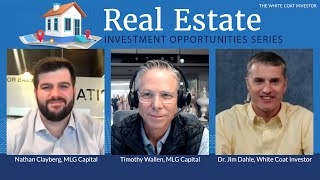
Nathan and Tim break down MLG Capital's Fund VI structure, including its leverage, preferred returns, and waterfall mechanics. The fund targets medical professionals and offers specific tax benefits through its investment vehicles.
So we'll talk Fund six quickly. Many hopefully have heard of the offering we have out right now. But we're raising $400 million. We have the right in our fund docs to go to 450 million as we sit today we're sitting at about 242 million. And with that equity we'll go out and buy roughly 1.2, 1.1 to 1.2 billion in real estate. One thing we haven't hit on, but that's crucial to our strategy is we like to be pretty moderately levered, generally targeting 60 to 65% leverage in our fund. That gives you a lot of cushion in navigating through different cycles when you're at that more modest leverage point. The quickest way that we see a real estate groups getting themselves in trouble today is by taking on too much debt. They're over leveraged. Oftentimes they don't fix the debt. Fund 6 is 100 fixed rate financing. But that's, that's how another way that we're, we're protecting our investors capital. Like we mentioned earlier, we target returns in these funds of 11 to 15%. The way we get there is through a three tiered waterfall. First, an 8% cumulative compounding preferred return. One thing that's unique about our structure, and maybe this part is common in funds like ours, we won't be paying 8% right out of the gates. With where pricing's at even today, and multifamily where interest rates are at, it's hard to produce an 8% return right away. However, our investors accrue 2 and 8. So if we pay a 4% early on in the fund, which is more like what we would expect, that unpaid 4% both accrues forward and compounds at 8% interest. Until we make investors whole on that. That's a critical differentiator within our structure. The second phase of our waterfall is a full return to capital. We target returning all of our investors original capital within 6 to 8 years of when the fund begins. What's critical to note about that is that means investors get 100% of the net cash flow that the fund produce until they have an 8% annualized rate of return and all of their money back. Investors get the first two bites at the apple. Within our structure, you'll see other funds in the marketplace. If they sell the first property that they bought in the fund and they produce $10 million, they're able to reach in and pull out their $2 or $3 million share of the profits on just that deal. Our structure has all of the money go back to the investors until they've gotten all their money back plus 8% annualized. Above and beyond that, we typically split the remaining distributions once investors have all their money back, 70% to the investor and 30% to MLG is the manager. We have a special deal with the White Coat Investor Group. We're thankful for the relationship we have with, with this group. And we actually have amended that to 75. 25 investors get a higher share of the profits on the back end because the group has collectively invested greater than 5 million. Was our, was our threshold in Fund 6 and I'll hit on in a second but we've actually far surpassed that now over double the threshold that we needed to get.
So Nathan, let me add one little thing there on that structure because I think it's important to understand that most of our industry allows the real estate guy, as he sells individual assets to grab assure the profits for every asset that as it's sold. In our structure, Nathan and all the other key guys in our organizations that share in that third 30% or 25% of the upside, they can't get any of that big bonus dollars until you as investor got all your money back and an 8% rate of return. So that means my team is highly motivated to get your money back and an 8% rate of return because they can't go get that extra money to buy that bigger house or a second house or go on some big vacation. They can't get that that money until they get your all your money back. And so I do it that way because I want my team to care deeply about getting all your money back in an 8% rate of return. And I think it's important structurally. And again, it's not common in our industry to be structured that way. But it's called the European waterfall structure. But I think it's an important differentiator that we have in our industry overall.
Yeah, it's very true. So we've hit a little bit on this in past webinars. I'll breeze through this. We have two different vehicles by which you can invest in Fund 6. The first being our private fund offerings. A traditional LLC structure that allows for depreciation to be passed through to investors. We do everything we can using cost segregation studies and bonus depreciation tax law to maximize the depreciation write off that we pass through to investors. In the first year that you invest, we typically estimate 20, 24 be roughly 40% of what you invest will come back to you in the form of a passive loss. So said differently, if you invest $100,000 in our fund, your K1 at the end of the year will show a $40,000 loss. Even though you're going to be getting that 4ish percent distribution right out of the gates. Those losses can be very powerful for those that have other passive income in their tax picture. They can often be used to offset and defer that other passive income, which for many docs or highly compensated individuals, that can be offsetting ordinary income that would otherwise be taxed at near 40%. So that's a very powerful benefit. The downside of this side of the fund is that we are trying to get you geographically diversified. From a risk mitigation perspective, it's a great tool. However, there could be an obligation to file taxes across multiple states. So it's worth talking with your cpa. Second option. We call it our dividend fund. It's really inceptive for those looking to invest through a retirement account. We flow property or we flow cash from the properties through a non traded REIT vehicle and up to investors from there. In doing so, we accomplish two things. One, if you invest through your retirement account, we're approved with Fidelity, Schwab, Pershing, many of the custodians that are on the marketplace. You could invest through your retirement account and avoid any additional taxes being levied against the income that you realize from this investment. If you invest passively debt financed real estate through those vehicles without this structure, you could be subject to an additional tax called unrelated business Taxable income or ubit. This structure avoids that. It also has the option for those who want to invest cash. They can invest in this side of the fund and avoid the multi state filing obligation. So if you want to keep your taxes simple, this, this can accomplish that for you. The REIT entity captures the depreciation benefit and it doesn't pass through to investors, so you won't see a loss on your K1. However, the REIT uses it to offset and defer income at the rate entity level. So it's still a tax efficient vehicle, but maybe not quite as powerful as you'd find in the private fund.
Nathan, let me add a little something here just because you know, again I was a, I was a tax guy at Price Waterhouse. So my goal was to have my clients not pay a lot in income taxes, just minimize it. And I certainly do it for my own benefit, but I do really do it. We do it for Everybody. We have 12 CPAs on staff here, very focused on reducing the taxable impact. So for those that I won't give the exact number but it's hundreds of thousands of dollars. If you're investing hundreds of thousands of dollars, the cost of multi state filing may be worth it to you and it's worth a conversation with your tax accountant to see if it makes sense. But the tax benefits that we produce in the main fund, I think add another 1 1/2 to 2% in all in returns above and beyond the 11 to 15% property returns. This is money you save from the government because you're converting some of your medical doctor income to from ordinary rates to cap gain rates if you invest over a long period of time in our structure in our funds. Again, there's a whole article that I've written on this and certainly Nathan can provide that to your group if you guys ever want to read it and truly try to understand it. But it adds another 1 1/2% to your all in returns if you're in. But there's a cost of multi state filing. It's not huge. Computers do most of the work. But it could be worth it to you to you know, consider doing the regular fund if you're investing enough capital because you guys have a lot of ordinary income as doctors.
Yeah, that's a great point, Tim. Worth a conversation with your CPA is what we would say there. But it'd be very powerful. Last, last thing we'll hit on here. This is just a Fund 6 overview. This is from Q3. We're updating Q4 numbers now. Like I mentioned, we're now at 242 million raised about 230 million of Dallas deployed. So we had some acquisitions in Q4 of this past year. But you can get a general sense here of the composition of the fund, the different geographies that we're investing in. We're happy to provide more information on this that you can, you can peruse at a deeper level. One thing that many investors appreciate about MLG is the transparency that we have within our structure, within our organization. You can look through as deep as you want into our portfolio, even down to property level financial financials that are updated monthly. Monthly. But we also provide quarterly reports that give a more tailored sense of what's going on at the property. So any interest in learning more, please reach out. We're happy to share but that's where we stand with Fund 6 today. Last thing we'll hit on. We mentioned it a couple times but we're at almost 11.4 million from the White Coat Investor Group. We're very thankful for this relationship. We feel like we're just in the early stages and feel like there's a lot of opportunity to grow. But we've already had a significant investment from the group and hopefully that encourages more people to feel comfortable in investing with mlg. One note I'll add is if you do reach out, please make sure that whoever you're speaking with on our team is aware that you're part of the White Coat Investor Group. We'll mark that in our system. But also when you do the subscription agreement, you'll have to indicate White Coat Investor under the investment group field, so be sure to do that when you're filling out the paperwork.
The hosts of the White Coat Investor are not licensed accountants, attorneys or financial advisors. This podcast is for your entertainment and information only. It should not be considered professional or personalized financial advice. You should consult the appropriate professional for specific advice relating to your situation.
More from Jim










Physician Takes a Youth Sports Team to the State Championship - MtoM Podcast #236
