Radiologist Gets PSLF and Finance 101: Charitable Giving - MtoM Podcast #202
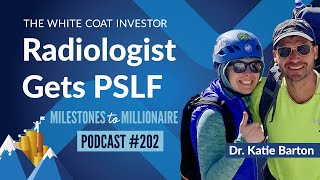
This is a YouTube video titled "Radiologist Gets PSLF and Finance 101: Charitable Giving - MtoM Podcast #202" published on December 23, 2024. It features a conversational podcast episode hosted by Jim Dahle and Katie, an academic radiologist. They discuss Katie's journey to becoming debt free through Public Service Loan Forgiveness (PSLF), her financial strategies, and advice for medical professionals managing student loans. The episode also covers topics on charitable giving, including tax-efficient donation methods and donor advised funds. The conversation blends personal finance insights with practical tips for physicians and medical trainees.
This is the White Coat Investor podcast, Milestones to Millionaire celebrating stories of success along the journey to financial freedom.
This is Milestones to Millionaire podcast 202. Radiologist Receives Public Service loan forgiveness and becomes debt free. As a white coat, you have valuable knowledge. Various companies want that knowledge and they're willing to pay you for it. That's why we've put together a list of recommendations for companies that pay you to take surveys. If you're looking for a profitable side gig for not too much effort, getting paid for surveys could be the perfect solution for you. You can make extra money, start a solo 401k and use your medical knowledge to impact new products. One of the WCI columnists made an extra $30,000 a year just doing these surveys. Sign up today and use a fraction of your downtime to make extra cash. Go to whitecoatinvestor.com mdsurveys to get more information today. By the way, you can go to whitecoatinvestor.com do surveys too, or physician surveys. Whatever you want. We made it so they all work. All right, you can do this though, and the White Coat Investor can help. Little extra money never hurt anybody. By the way, we're going to be talking a lot today about student loans, and student loan management has never been more complicated than it is now. We, we recognized this a few years ago and in fact started a company to help. That company is called studentloanadvice.com and I think our main consultant there, Andrew Paulson, may know more about physician student loan management than anybody else on the planet. For a few hundred dollars, you can feel confident that you have the ins and outs of the perfect student loan plan for for you so you can sign up for that. Studentloanadvice.com all right, so we've got a great interview today. I think you're really going to like our guest. I was thrilled to talk with her and, you know, maybe we'll get to go do some outdoor adventures together at some point in the future, but stick around afterward. We're going to talk for a few minutes. This podcast drops just before Christmas. We're going to talk for a little bit about giving as soon as we finish this. So stick around. Our guest today on the Milestones podcast is Katie. Katie, welcome to the podcast.
Thanks, Jim. Nice to be here.
It's wonderful to have you here and tell us where you are in your career. How far are you out of training? What do you do for a living? What part of the country are you in?
I am an Academic radiologist. And I just passed five years out of training.
Five years out of training.
Yep. And I live in the Pacific Northwest.
Very cool. Okay. And we're celebrating one, maybe two milestones today. Tell us about what you've accomplished.
Yeah, so it was probably near the top of my to do list when I got public service loan forgiveness was to contact you all and be on this podcast. So public service loan forgiveness is the big milestone. And then by earning that public service loan forgiveness, my husband and I are completely debt free.
Whoa. Debt free. Five years out. Okay, wait a minute. We gotta ask a few more questions here. First of all, does your husband work?
He does.
Okay. What does he do for a living?
His academic background is as a librarian. And so all through my training, he worked in higher education, mostly as a librarian. And then as I have advanced through attending hood, he's been able to actually step back from that and become self employed. He's a outdoor adventure entrepreneur.
Oh, that sounds fun. I'm going to have to get to know him a little bit better.
He's great.
What are his favorite outdoor adventures?
So his work is around stand up paddleboarding and kayaking. And then the two of us together, we really enjoy hiking out in the mountains as much as we can be.
Very cool. Well, I'd love to record a podcast just about hiking, but I think that would be frowned on by our audience. We're supposed to be talking about finance, so we'll talk about finance Here. This is for you guys. I hope you're happy about this. Right. I would have wanted to talk about hiking today, but yeah, the pictures we're talking about money.
And the pictures I shared with Megan were us in the Tetons. We felt like it was so fitting, so.
Oh, very cool. What'd you do in the Tetons? Hopefully you didn't fall off any mountains like me.
Oh, thank goodness, no. And in fact, I listened to the second episode of your heroes podcast this morning. I got up early to make sure that I'd heard it all before I met you. So.
Yeah. Well, now everybody knows how far in advance we're recording this podcast.
Sorry, I gave it away.
I just got pins out of my wrist yesterday. So it's a big week for me too.
Yeah, definitely. My dad is a very serious climber and he has taken me on the grand twice. And both times we got kind of. Our plan got scuttled at the lower saddle. So the lower saddle is our.
Our.
Our shared spot together.
But sorry, I'm sorry to hear that because there's a lot of beautiful stuff above the lower saddle on the Grand Teton, that's for sure. All right, enough going to talk about climbing and hiking. Let's talk about your finances. You're now, it sounds like the main breadwinner in the family, given that you're a diagnostic radiologist. But now you say debt free.
We are debt free.
What debts have you had in your life so far?
Yeah, so that's a really good question because we've been very debt averse. For example, I've never taken a car loan. The only cars I've ever bought, I've bought with cash. The same for my husband. And we have chosen not to buy a house. Right now we're renting and so we don't have a mortgage. And then the only debt that I ever incurred was school debt. So I grew up modestly. My parents had great jobs, but not ones that paid well. And so I went to college on a combination of scholarships and pell and then took a tiny little loan. It was a Perkins loan, like less than $10,000 for undergrad. And then med school was all loans.
And so what did total when you left? How much did you owe when you got out of med school?
Yeah, so I'm from Montana. We don't have a medical school. So I was kind of guaranteed to be an out of state student wherever I went. I was grateful to get some support from what's called the WICHE program, the Western Interstate Consortium for Higher Education. And so where I went to school, Montana helped pay the difference between the out of state tuition that the school charged me and the in state tuition that I would have paid if I had had an in state school. And so, but when I graduated from med school, I had about 20 $220,000 in debt.
And then what happened to that during residency?
Yeah, exactly.
During residency and or fellowship. What'd you owe at the end of training?
Yeah, and so at the end of training, it was probably right around $340,000 because I never paid a cent of principal paying on public service loan forgiveness over those 10 years. Never a dime got to principal.
Now this is, I want people to hear this. This is the way things used to work and maybe working again right when the SAVE plan came out a year ago. And who knows what's going to happen with this, especially with Congress and the White House changing power. When the SAVE program came out, it basically set it up so your loans won't go up during training. They can still go up during med school, but not during training. I think that may be scuttled, but that wasn't the way it was for the rest of us. Okay. We'd come out of med school 0200, we'd finish training, we'd owe 300. That's pretty typical for docs. Okay, so you came out, you'd never paid anything toward principal, and I presume you still had pretty low payments your first year out, I assume.
Yeah. So I have a very clear memory of being a first year medical student sitting kind of in one of the hospital kind of nooks and crannies, studying and having this moment of a little bit of panic, like, how am I going to ever pay this off? Should I really be taking out this much debt? Because like I said, we come from a family of relatively modest means, and I made more as a resident than either of my parents have made in their careers. And it's something that I remind my residents about a lot. Like, yes, physicians make a great income, and yes, you have a higher income coming to you when you're done with training. But I don't really want to hear that your income is so low as a resident because it's greater than the median family income in the United States. So let's keep things in good perspective.
Do you teach a lot of finance to your residents?
I do, yes. Yeah. One of my colleagues in my department and I have set up a finance curriculum for our residents. We actually bought all of them a copy of your finance boot camp book and have been working through the boot camp with them. We do lectures every other month, and it's so rewarding, and it's been great to have somebody send you a message or stop you in the hall and say, yeah, yeah, yeah, radiology. But can we talk about life insurance for a minute?
Very cool. All right, so all you residents of Katie's here, right? You got a nominator for the financial educator Award. Right. See if we can get her an additional award here. But anyway, you've gotten a big reward recently. You got public service loan forgiveness. So, I mean, given the timing, I'm guessing you had three or three and a half years of payments you didn't have to make as a result of the student loan holiday, Is that right?
Yeah. When I was thinking about, as an avid listener of the White Coat Investor, I've heard lots of the milestones to millionaire podcasts, and I was thinking about the question that you often ask, which is, was this easier or harder than you thought it was going to be? And while I that moment in med school when I started to panic. And that's when I started googling and found public service loan forgiveness. So I learned about it in about 2009, 2010. It was still a newish program.
Early. You learned early.
Early, yeah. So I think that, I don't think we quite answered the question you asked me before about like, low payments in my first year. So I knew about public service loan forgiveness. I was, it was on my plan from that moment on, like, okay, this is how I'm going to pay off my debt. And luckily I am a nerd and wanted to be an academic radiologist, so that was going to fit fine. But so yes, I filed my taxes as a fourth year med student. I had $0 payments as an intern and then had low payments throughout training. I started as an attending about six, six months before. So like in September of 2019. So six months before the COVID payment pause. And because of the timing for how the income recertification worked, I never paid an attending level payment.
Wow. And so this has worked out stunningly well for you.
It is. And so when you ask the question, was this easier or harder? The half of my answer is it was exactly what I planned for it to be. I knew that this is what I wanted to do and executed the plan. And here we are. But the other half is, I don't want to sound flippant about COVID because Covid was such a terrible experience for so many people around the world, but for me, Covid was a blessing from a public service loan forgiveness standpoint because, um, it made was a huge injection into our ability to build net worth that I didn't have payments for three and a half years. And then just from the vagaries of how the system worked, never paid an attending level payment.
Yeah. If you had to guess how much you actually paid back toward your student loans.
Yep. I would.
How much do you think it was?
Yeah, good question. I, I, I preparing for the interview, I went back and, and did the math. It was just about $30,000.
You paid 30,000 and had 300ish.
Yeah, 348.
Wow.
Amazing.
Pretty remarkable.
It was an enormous blessing. Yep.
Yeah. Well, you know what? That's the way the timing worked out. And we could see this coming. As that student loan holiday went on and on and on. I'm like, boy, the people that became attendings right at the beginning of the pandemic have really, really done well with this. And it's true, you're a good example of that. And there's quite A few people like you that this has really worked out very well for you. Okay, so you're debt free now. What's next for you? I mean, are you gonna buy a house? You don't like debt? Are you just gonna pay cash when you do buy one? I mean, what's next for you?
Yeah, that's kind of the thought. So our public service loan forgiveness side fund, we've been dutifully saving for this whole time in preparation for if the worst had happened and public service loan forgiveness had evaporated before we'd had the chance to take advantage of it. So our public service loan forgiveness side fund has grown really nicely, and we might very well use it as a cash house fund.
Very cool. Katie, you have another unique financial goal. Tell us about that.
Yeah, so like I said, my parents have had great jobs. They're both retired now, but neither one of them made a lot of money in their jobs. My dad was a minister. My mom was a social worker. Really important roles in the community. But their retirements are both pensions, and so when they die, their pensions will die with them. There isn't the kind of legacy money in our family. And my older brother is severely disabled, and his financial future is something that has been on my mind since I was probably in undergrad. And now it's something that my husband and I can. Can help support that. We are confident that whatever his need will be in the future, you know, health needs and housing needs and just everybody else's regular life needs, will be able to cover that for him. And it is. It takes so much stress away from my mom and dad to just know that it's a gift that we can give him.
Yeah. A great example of how, you know, financial literacy and financial wellness can bless not only your own life, but that of those you care about.
Yeah, absolutely. We're so grateful to be in this position.
Very cool. All right. Well, there's people out there that are, in the situation you were in, in medical school, maybe they come from a family that didn't have a lot of money, you know, paid for undergraduate Pell Grants and that sort of a thing, and they are staring at this massive, huge pot of money that they're going to owe when they finish school, and maybe they're hesitant to even go to school. You know, what advice do you have for those people?
I would say medicine isn't just a job. It is a profession, and it is a calling. And if you feel called to do this work, then don't let the money stand in your way, if you really feel called to join this profession. I love my job. I'm so grateful to do the work that I do and get up and go to work every day. But it is very expensive, and I think it's an equity issue that hopefully those of us in academic medicine can continue to work on making that debt mountain, that activation energy of going to medical school lower. Have a plan and stick to it. I feel like that's a white coat investor message all the way around, like, have a plan and stick to it. And if your plan is public service loan forgiveness, there'll be a way to do that, at least right now, and hopefully that continues in the future.
Do you feel like you could have still been financially successful without Public service loan forgiveness?
Yes, I do. And I think that part of that for us, we really. We live well below our means, and it's not necessarily fully. Oh, we have to live below our means. And we're saving money for our PSLF side fund or whatever, or, you know, retiring before we're 50 or whatever the other goal is. But I think because we don't have a complicated life and we don't need a lot to be happy and money isn't where we derive our happiness. So, yeah, I think. So.
How quickly do you think you could have paid off your loans without public service loan forgiveness?
My public service loan forgiveness side fund was fully funded about 18 months ago.
Okay.
Yeah. So I could have paid off my debt in three years and a half.
Years out of residency.
Yeah. And if it had been a goal of, like, we want to just get rid of this debt as fast as possible. I'd taken a private practice job in a different situation where it was just on us to pay it. I'm. Yeah, three years or less.
Yeah. Very cool. Well, you have done so well. I'm super proud of you.
Thanks.
You're a great, shining example of what can be accomplished in medicine, and you're helping the next generation to do the same. So you not only have your heart in the right place, but you've managed your finances exceptionally well. So congratulations to you and thank you so much for being willing to come on the podcast and share that experience with others to inspire them to do the same.
Thanks, Jim. It's really nice to meet you. I'm so glad that you survived your fall off the North Face and that you're here with us for many generations of physicians to come.
Thank you very much. I appreciate that. All right, Great interview. It wasn't about hiking and climbing, but maybe we'll have to have her back on sometime and talk about that. As she mentioned, we're recording this literally the day the second podcast about my fall dropped, which is the day after I had the pins pulled out of my wrist. I'm sitting here. Those of you watching this on YouTube, you can see my hands just in an ace wrap, which is pretty cool. I'm done with the splint. Unless I'm actually doing something where I could hurt my wrist, I can't really start full PT on it yet. I got to give it another month, the hand surgeon told me yesterday. But I'm pretty excited at how quickly I'm recovering. All right, I promised you that we were going to talk about giving, right? Christmas is coming up. That's a big holiday for a lot of you. I know everybody listening to this doesn't celebrate it, but it's a big holiday in this country. And for a lot of you, it's a time, you know, Christmas time and the end of the year is a time we often think about giving. And I think giving is an important money activity. There's really five money activities in life, right? There's earning, saving, investing, spending, and giving. And you need to learn how to do all five of those. Well, it's not as easy as you might think to be a good spender and really be good at trading money for something you value, and that will actually bring you more happiness and make other people's lives easier. The same thing with giving. It's not as easy to give well as you might think. You know, you don't want any negative consequences to your giving, right? It's like when we're giving money to our kids, we don't want to dump it all Tom the day they walk out of high school, right? That's a good way to ruin their lives. You want to give with intentionality and think about how much you're giving and how you're giving it and when you're giving it and those sorts of things. That includes when you're giving money to charity. Now, one cool thing about giving to charity is if you itemize your taxes, and even if you don't really, our government will actually incentivize you to give to charity. One of the best ways to give, if you are of RMD age, you know, 72, 75 plus, whatever, probably the best way to give is what's called a qualified charitable distribution qcd. And this is money that goes straight from your IRA to the charity. You don't pay any taxes on it. The charity doesn't pay any taxes on it, and it takes the place of up to $100,000 slightly more. Now it's indexed to inflation of up to $100,000 of your required minimum distribution. So if you don't need your RMD and you're charitable, well, just do a qcd. It's probably the best way for elderly people to give to charity. But you can give directly to charity. You can give them cash, you can give them your time. You can't deduct the value of your time on your taxes, but you can give your time and expertise. You can also give non cash items. One of my favorite ways to give to charity is to give appreciated shares of mutual funds that you've owned for at least a year and have substantial gains. Because the beautiful thing about this is you get the charitable deduction for the whole value of what you give. If you itemize on schedule A, you get to take the whole deduction for the value of what you gave. And then they sell it. So you never pay the capital gains on it. And because they're a charity they don't have to pay the capital gains taxes on. So that's cool. Nobody pays capital gains. You get the whole deduction. And, and that's pretty awesome way to give to charity. And you can do that pretty easily just giving it to any charity that can handle it. They have brokerage account, they should be able to handle it. Now if you try to give them some weird crypto asset or your small business, they might not be able to handle it. But most charities, most big charities anyway, can handle a donation of stock or mutual fund shares. The problem with giving a lot of money to charity, well, one of the problems is that you get put on a list. You get put on their list, and they might sell their list to other charities. And all of a sudden what you will discover is that your email box, your mailbox becomes full of what I call charity porn. And it's these glossy brochures that look like they cost about $5 a piece to print that start showing up in your mailbox. And they just keep coming, right? That charity might send you one every month for the rest of your life. And then they sold it to five other charities, right? And they'll send you one every month for the rest of your life. And your box just gets full of this and you start going, well, I don't really want my charitable donations to be spent trying to get more donations, especially from me. I already know about this charity. I don't need them. Advertising to me. I'm probably going to give to them next year anyway. So one cool thing I've found to avoid this charity porn problem is to give anonymously. And the best way to do that is to use a donor advised pun, a D a F or Daft. And these are available at Vanguard and Fidelity and Schwab and there's a gazillion others out there. One of the cool ones, we had their CEO on here a year or two ago, it's called dafi. And a lot of these have relatively low fees associated with them, especially if you don't leave much money in there. If you just run it through the DAF on the way to the charity. You pay almost nothing to use these things. But the beautiful thing about it is all your donations can be anonymous. You get the same charitable deduction. In effect, your taxes become easier because you just have to keep track of one receipt instead of a gazillion. And they don't know who you are so they can't send you charity porn. And I think that's a beautiful thing. I feel like more of my money is going toward the actual charitable cause I want to support. So look into a donor advised fund. Fidelity has much lower minimums, minimum amounts you can start it with and smaller amounts that you can donate at a time to the charities than Vanguard does. But if you're doing a lot of giving, Vanguard may work well for you like it has for us. Might also want to check into Dafi. We don't have any DAFs. Sponsor us. If you run a DAF and you'd like to sponsor the white coat investor, contact us. We'd love to have some DAF sponsors, but for the most part I can just tell you about the ones I've used and the ones I've heard other people have used with success, and that includes Vanguard and Fidelity and Dafi. But I'm sure there's lots of other great DAFs out there. I just want to tell you about the concept because it's been so helpful to us. It's also helpful to some people that, you know, maybe they're going to be retired after this year and they want the big deduction right now. Even though they're going to spread out their giving to charity over a few years. That's another thing a daft can let you do. I call that a little bit of the jerk move. Right? Because you get the deduction, the charity doesn't get squat. So please don't do it forever. You know, if you're giving a charity. I think you actually do need to get the money to charity eventually, but any giving is better than no giving. It's not like you can take the money out of a daft. Once it's in there, it's going to charity at some point. So thanks. For those of you who are supporting charities, Americans in general are very good supporters of charities. I saw an article the other day, Wyoming was the most charitable state this last year. Utah, I think came in second. They're usually fighting for first or second. But for those of you out there given charity, thank you so much for what you're doing. And those of you who are just spending your day serving others. I know a lot of you like me, about 20% of your patients don't pay you. So thanks for doing that work too. It really does make a difference. As a White Coat, you have valuable knowledge. Various companies want that knowledge and they're willing to pay you for it. That's why we put together a list of recommendations for companies that pay you to take surveys. If you're looking for a profitable side gig for not too much effort, getting paid for surveys could be the perfect solution for you. You can make extra money. Start a solo 401k. Use your medical knowledge to impact new products. One of the WCI columnists makes an extra $30,000 a year just doing these surveys. Sign up today and use a fraction of your downtime to make extra cash. Go to whitecoatinvestor.com dosurveys today. Yes, you can also go to mdsurveys. That link will work as well. You can do this. The White Coat Investor can help. We'll see you next time on the Milestones to Millionaire podcast.
The hosts of the White Coat Investor are not licensed accountants, attorneys, or financial advisors. This podcast is for your entertainment and information only. It should not be considered professional or personalized financial advice. You should consult the appropriate professional for specific advice relating to your situation.
More from Jim










Physician Takes a Youth Sports Team to the State Championship - MtoM Podcast #236
