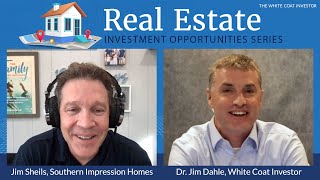
This is a YouTube video titled "Should I Be Scared Of Hurricanes with Florida Real Estate?" containing a conversation primarily between Jim Dahle and another speaker discussing the impact of hurricanes on real estate investment in Florida. They cover topics such as building codes, insurance challenges, and risk management strategies for properties built before and after 2004. The discussion is informative and targeted at investors considering Florida real estate.
Now, you're building mostly in Florida, so I don't think we can talk about Florida real estate without addressing the H word. Let's talk about hurricanes and what that means for investing in real estate in Florida.
Yes. So we've done lots of webinars on this, brought on some of our insurance experts. This is the big question. You know, remember I was in California investing for years. I got used to earthquakes, and now I had to come and deal with this big H word, like you said. And here's what I've learned. Not all properties are created equal. And I know I've talked about this. I've actually done some of the slide presentations with videos at the White Coat event. There is a big difference between a property built 2004 or newer and a property built in 1954. And I'll tell you why. In nineteen 2004, big hurricane came through Punta Gorda, Florida. Decimated it. My dad had relatives down there. Really sad. And the government stepped in and they changed the rules. They said, done. Okay, we're going to change this from moving forward. If you're going to build a new construction home, it's got to be built on higher ground with stronger structural design. So back in the day, in 1950s, Jim, you and I could build a house at two feet above sea level, let's say, which is, for common sake, very low. That's not a very safe amount. But today you have to build that up to 13, 14, 14ft above sea level, where we do. And as builders, I got to tell you, we complain like, oh, that's a lot of dirt to bring in. Dirt's expensive. And we whine and complain a little bit until a big hurricane comes. And, you know, the last hurricanes that have come through the last year, we haven't had any water intrusion from flooding, none. Because. And again, it's happened in our areas. We build in Fort Myers, we build in Punta Gorda. All these areas have had the direct storm hit, and we did not have any flooding or any major issues. The reason why is because we're on that higher ground with stronger structural design. And so when you're able to do that and couple that with. Although we're in coastal communities, Jim, there's a big difference between having a home a few miles inland from the coast or right on the coast. So, like, right where I live, Jim, as you know, I live 10 seconds off the beach. I'm on a small barrier island, 10 houses wide. I take a risk. I stay well insured. But my investment properties a few Miles inland, their insurance is much lower and take much less risk. So I always tell people, look, beachfront waterfront property is some of the most valuable in the world, but that also holds the highest risk. And so we don't focus on that for our build to rent model. We don't, we build in coastal areas, but a few miles inland we build stronger structural design that's required now. And instead of going at that old 2 or 3ft above sea level, we're now 13, 14ft above sea level. And that makes a huge difference not only to the results because we've always tracked them, sent out a lot of videos with some of our active white coat people who are very relieved on the last few hurricanes, especially in southwest Florida, to show that we had no damage. But we also get rewarded from our insurance companies. People are shocked to say, how are you getting insurance so cheap in Florida? Well, again, my house here, I was built in 2004. If you go down the road, Jim, on my little barrier island, there's a few cottages there that were built in 1954, 1957. There are maybe a third of the size of my house. Their insurance is seven times the amount because it was built differently and it's at 2ft above sea level where my house is at 414ft above sea level. Does that all make sense?
Yeah, absolutely. You know, even beyond insurance, even beyond hurricanes, I've heard a lot of people talking about difficulties getting insured in Florida. Are your investors having any trouble finding insurance for these properties in Florida?
Not at all. And that's been the funny question where when I hear this, I always say which properties and who are you? Because two people I've heard say they have trouble getting insured in Florida. One are the larger institutions because insurance companies say, woo, you guys own too much property, we don't want to take any more risk with you. But the other is people that are trying to buy older properties that don't fit what I just told you. They're in low lying areas, they're very coastal or close to the waterfront. That's where I've seen the problems. But with our make and model, and I think it was last month, we brought on the insurance expert we use for probably 90% of our properties. His company's been great. He explained exactly why there's no problem because insurance companies are about risk analysis and we've been through a good amount of hurricanes since we're in 12 different markets now for the last 10 years and we haven't had to make any large claims. So people. The insurance companies say, gosh, we want to invest with that group more. And so we haven't seen it with our properties. Have I seen it for the property I just described? A little cottage on a barrier island that was built in 1957. Yeah, you're going to pay 7x what I pay for four times the house. But that's on that type of property because the insurance company is all about risk, and they see that as a high risk for flooding and for notwithstanding wind issue.
The hosts of the White Coat Investor are not licensed accountants, attorneys, or financial advisors. This podcast is for your entertainment and information only. It should not be considered professional or personalized financial advice. You should consult the appropriate professional for specific advice relating to your situation.