The Behavior Gap with Carl Richards - WCI Podcast #382
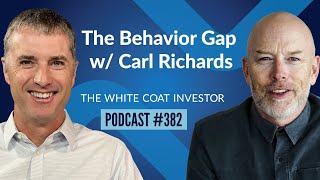
This is a YouTube video titled "The Behavior Gap with Carl Richards - WCI Podcast #382" featuring an in-depth English conversation recorded in 2024 between Jim Dahle, host of the White Coat Investor podcast, and guest Carl Richards, a certified financial planner and author. The discussion covers topics such as behavioral finance, the behavior gap concept, financial planning, risk management, and parallels between mountain climbing and investing. The episode also touches on the financial advisory industry and how individual investors can navigate it safely. The content is a conversational interview with multiple speakers including Jim Dahle.
This is the White Coat Investor Podcast where we help those who wear the white coat get a fair shake on Wall Street. We've been helping doctors and other high income professionals stop doing dumb things with their money since 2011.
This white coat Investor Podcast the Behavior Gap with Carl Richards this episode is brought to you by SoFi. Helping medical professionals like US bank borrow and invest to achieve financial wellness. SoFi offers up to 4.6% APY on their savings accounts as well as an investment platform, financial planning and student loan refinancing featuring an exclusive rate discount for med professionals and $100 a month payments for residents. Check out all that Sofi offers@whitecoatinvestor.com SoFi loans originated by SoFi Bank NA NMOS 696891 advisory services by SoFi Wealth LLC. The brokerage product is offered by SoFi Securities LLC, member of FINRA SIPC Investing comes with risk, including risk of loss. Additional terms and conditions may apply. Let's do our quote of the day to start with today. This one comes from Susie Orman who said a big part of financial freedom is having your heart and mind free from worry about the what ifs of life. That's really what it's about. Taking care of your money is just a small part of your life, but when you're doing it right, it becomes an almost non existent part of your life and you can focus on the things that really matter. Thanks to all of you out there for listening to the podcast. Without you, there is no podcast, right? You're an essential part of the podcast. Yes, we have guests. Yes, we have a host. Yes, there's certainly Megan Wendell working hard on the podcast, but we're not going to make this thing if you weren't listening. So thank you for being there. Thank you for your feedback and helping us improve this over the years. We appreciate you being out there and spending some time with us each week. By the way, if you're looking for an easy side hustle a little bit of extra cash, you might want to check out paid surveys. These are particularly good for many specialties. Most of those specialties that prescribe expensive treatments, but all specialties can get some surveys. Whitecoatinvestor.com survey is where you can learn about all of those companies. Thanks to the support of this amazing community. The White Coat Investor has been nominated as a finalist in the Business category for the 19th annual People's Choice Podcast Awards. Since one of our missions is for people to become financially successful, winning the award would be a fantastic achievement While helping spread the word about financial literacy. If you already voted to nominate the White Coat Investor podcast, please check your email to see if you've been asked to vote again. You have make sure to do so so we can continue to help as many people as possible. We've got a great interview today. We've got Carl Richards on today and if you don't know who he is, I'm going to introduce him momentarily. But he's somebody you ought to know about. His work's really made an impact, I think, on a lot of people, a lot of financial advisors, a lot of individual investors, and I think you'll appreciate hearing directly from him. We've actually been trying to get him on for years now and he contacted us after reading, get this reading, a write up I did and published on the website. Never ran it on the blog, but an article about a climb I did in the Tetons and it reminded him that he was supposed to come on the podcast with us. So he contacted us and we got him right on. And I think it's. I think it's just a great interview we had. I hope you enjoy it as much as I did. I'm excited to have our guest today on the White Coat Investor podcast. Our guest is Carl Richards. He's a certified financial planner, but that's probably not what you know him from. He probably isn't your financial planner. You probably know him from some of his books. He's written a couple of books, one of which is very famous. The Behavior Gap. Simple ways to stop doing dumb things with your money. But also one that I love the title of the one page financial plan, A simple way to be smart about your money. He's been on all kinds of places. He had a sketch, a sketch column kind of in the New York Times for a decade. He's been on Forbes, he's been on Oprah, he's been all kinds of places. Marketplace, Money. I actually first heard about Carl in a very introspective column he wrote. You probably remember this, I'm guessing. I think it was back in 2008, about the time you moved out of Las Vegas. And I'm like, well, this is somebody interesting I should pay some attention to. And I've been kind of following your work for the last 15 years. So I'm excited to have you on the podcast today. Welcome to the podcast, Carl.
Thanks, Jim. And likewise, like, the impact that you've made is really, really fun to watch. Like, just the compounding of that impact has been super fun. So thank you.
Yeah. So we're talking about all kinds of stuff today. We're going to talk about the behavior gap. We're going to talk about the financial advisory industry and society of advice and what real financial planners are. And we're going to talk about mountains and risk and some of the projects you're working on now because that's a love that we're, that we share. So tell us a little bit about what you're doing now. What is your career look like right now? What are you doing with your time?
Yeah, I don't know how to answer that question. It's funny because my kids are always like, how do we explain this? I'm like, I don't know. Just tell them that I get unmarked bills and giant satchels out the front of the house. Typically, to get out of the question, I just say I'm an author. But the. The truth is I just think of my career as a series of projects about trying to find meaning in money, to connect that and really to help people help myself. Largely, I think of my work as an adventure journal far more than I do self help. It's my own journey of trying to align my use of capital. And I can feel myself trying to even draw this for your listeners. If you would imagine a Venn diagram and if there's any Venn diagram police on the episode listening, don't send me an email. I've already gotten it. It's fine. It's just a circle sketch. It's not a big deal. So you think of one. There's some trauma involved with the Venn diagram police. One circle says your use of capital and capital has an asterisk and the asterisk says time, money, energy and attention. Time, money, energy and attention. So your use of capital. And the other circle says what's important to you? And trying to get alignment around our use of capital and what's really important to us. That's really what I think of as the work that I do. And then that work takes various artifacts. It could be a book, it could be a podcast. We work in a TV show. It could be a bunch of different things and it has different audiences. I think of it as the, like the humans and that's where the books go. And then I also do a lot of work trying to help financial advisors do the work that they need to be doing. And our industry, speaking broadly, the financial services industry is a mess. You don't need me to tell you that it's a disaster. But I'm still Convinced there's a core group of financial planners that I call real financial planners. And so that's another part of my audience is trying to help them do that work. So that's. That's essentially what I think of as my career right now.
You're not doing direct financial planning with any clients right now, is that correct?
No, I mean, I've got, you know, whatever, some friends and family, but I don't have any clients. I don't have a firm. I sold that firm back in 2012.
Now, one of the most interesting things about your work is so much of it is visual. It's sketches. I mean, your sketches have been like an art display, right, at an art museum, you know? And so why the sketches? Why that visual component? How'd you get into that?
You know, what's interesting is this started sitting across the table from a doctor. So one of my clients was an ER doctor, and his wife was a technical sales rep. So two very smart, really successful people. And I was never a doodler. Like, I didn't take art class. I took a pottery class when I was eight at the Kimball Art center, where I lived in Park City. But I'd never. I didn't think of myself as visual at all. And there I was, sitting across the table from these two really smart. They were friends, but they were also clients. And I was trying to explain a concept to them that I thought was really important for them to understand in order for us to make this important decision about their money. And I was getting nowhere. And I remember having the distinct feeling of like, wait, these are two really smart, intelligent people, and if I'm just getting blank stares, they're not the problem. I must be doing something wrong. And I thought I was good at explaining things simply and clearly, but I just couldn't. I was getting. And so out of an act, honestly, an act of desperation with those exact people. There was a whiteboard in the office that I was using. It wasn't even my office, my conference room. There was a whiteboard. I stood up, and I was like, no, like this. And I drew squares. I mean, you've seen the work. It's not hard. I drew squares and arrows. And I remember they say, there's name Dave and Diane. And I remember Dave was like, oh, oh, I get it now. And I remember thinking, like, what was that? So I sort of became addicted to that feeling of insight. So I did it again, and then I did it again, and I did it again, and I did it again, and then I started doing it in public. And then the editor at the New York Times said, hey, we love these. Would you do them for us? And I knew, I knew well enough to say yes to that. And so then it just has never stopped. And now I realized what it is, is I have this really intense desire to. I don't have a lot of mental ram, so I want to absorb a deep. I want to consider the nuance and the edge case of a problem, dive really deep into it, and then as soon as I can, my whole goal is to simplify it, figure out what is it that matters. And in that distillation process, there's some editing that goes on that I'll get it wrong. I might leave out nuance that was really important sometimes, and I often do. But when I get it right, I've sort of nailed the thing. So I almost think of it as like, if I had to have a souvenir of the learning experience, almost like a logo, I could wrap it up in this one symbol and then I can clear out all that mental ram to start with the next problem. So that's how they happen.
I love it because that's when you know, you really understand something, is when you can simplify it to its essential parts. You know, and the financial world in particular is so complex that people get lost in the details and they need that simplification. Give me, you know, I need a framework on which to hang the details, but too many of them are lacking that framework.
Yeah, and you've pointed to this in a number of places, that there's only a few things that really matter when it comes to money, like investing specifically. If you get just a few things right, you're as good as 99%. And most of what we hear in the financial pornography news, the financial pornography network, and the entertainment industry that goes along with it, most of it is just entertainment. But the stuff that is smart is about the last 1%. And you can spend all your time debating the 1% and then you miss one behavioral mistake. For instance, build the best portfolio ever created, ever. Misbehave one time in a decade and you may as well own CDs at the bank. So I would much rather get. If we can get you to 95% by investing in low cost diversified index funds, and you behave, you'll outperform 99% of your neighbors. So it's like the stuff that actually matters is relatively simple. Not easy, but relatively simple. When it comes to finance, the hard part is ignoring all the complex noise that distracts you and Thinking you should be doing more. It's so you get paid, paid really well, rewarded for being simple and lazy. And that's what I'm trying to get at. And you've pointed to the same stuff.
Yeah, it's cool because it's one of the few things in life where that's true.
I know doing this is usually not rewarded, you know, which is why it's so hard for people like you and your audience. Like, you're used to, like, the more effort I put into this, the more energy. Like, take an entrepreneurs are the worst investors in public markets on the planet. Real estate developers might even be worse because they're used to, like, if something goes wrong, I can get in there and fix it, get it rezoned, paint it, remodel it. And you're saying to that person, hey, that behavior will actually hurt you over here. And I think that's why it becomes so hard.
Absolutely. You've called it the behavior gap. I don't know if you coined that term or not, but certainly you've got the book that's called the behavior gap. Tell us what the behavior gap is.
Yeah, so it started, I'll give you the progression of it really quick. It started as a very simple concept and it's that if you look at the average investment and it sounds silly, but most of us don't. I know, I didn't get it. There's a difference between investments and investors. And an investment like if you open the newspaper, the old fold out newspaper, and you see an ad for a mutual fund that says this fund returned 10% a year for 10 years. So it averaged 10% a year for 10 years. That's the investment return. That's the return you would have gotten. If you put your money in at the beginning of that time period and you left it there, you didn't add or take any away. You left it there for the full 10 years. The problem is no one in *, no one but your audience. No one behaves that way. Instead, what we do is we put some money in. We read something in the financial pornography magazine that says 10 funds you should own now. We buy one of those, they do well for a couple of months and then they do what they normally do. They have just a normal cyclical downturn. And you wake up 18 months later and you're like, this fund has been terrible. And you pick up another magazine that you see that says something like 10 funds that sizzle and you sell your one and you buy the other one. And so now you've bought high, sold low, and you bought high again. And so what ends up happening is if you take the average return that investors earn, and I could give you lots of specific examples, but if you were to graph these two, you'd have a bar graph with two bars. One's the investment return. And you'd put a number on it, which I've stopped putting numbers on it because everybody wanted to debate the numbers and they'd miss the point. So you'd have the average investment return at, let's just say X. The average investor return is something below X. And that difference in the return, I just labeled that the behavior gap. It could only be due to behavior. I mean, minus transactions and taxes, like just all those things set aside for a second. It was due to behavior. And by the way, normal, like genetic human behavior. Like if something, if we are hardwired to get more of what gives us pleasure and security and run away as fast as we can from things that cause us pain. And when we buy an investment and it goes down, we perceive that as dangerous and painful. I don't really care what you tell me, if my hand's on a burning stove, I'm going to take it off. So it's normal behavior. I'm not making fun of the stupid humans. I could give you tons of examples of doing this myself. But that's what the behavior gap was was this idea that if you just held on to a mediocre an average investment and you just behaved well, you would outperform 99% of your neighbors. And so I labeled that the behavior gap. Now I've let it expand a little bit to any well intentioned behavior that produces a suboptimal result. And I could give you examples around spending and insurance and all those other things. But in finance, there are often well intentioned behaviors that feel like the right thing to do that actually produce a suboptimal result. And I would include those in the behavior gap.
Yeah, that'd be good to talk about some of those other examples because I've certainly heard the term most frequently in exactly the way you described it, that it's difference between what the investment is earning and what you're earning. And I don't know if this was your influence at Morningstar that caused them to start doing this, but they tried to calculate it, at least for a while. They were, you know, I'm showing the difference between the time weighted investment return and the dollar weighted investor return. And my recollection is they were showing gaps of 3 or 4% between those two.
Long term. Yeah. I think, look, this has been abused pretty blatantly by the advice industry to say like, this is how advisors add value. And while some of that is indeed true, I've also seen advisors are often the cause of. Because they're the ones watching all the time. Right. And so naturally human and they're trying to help their clients. Well intentioned. Trying to help their clients find new things and they change around. But I would say if you were to put a number on it, I always sort of average it out to 1%. Like, like there are examples of it being way more than that. There are examples of it not existing. It's hard because you, like I had this conversation with some really well known academics, Nobel prize winners actually. Like, if this was true, then we could trade against it. And we can't really find a way to do that. And so I don't know how to. I'm careful now to be like, this thing is absolutely exist and it's the proof of my value. I'm just saying anecdotally, like with every person I've worked with, I've seen this happen over and over and over with every person I worked with.
But you've been talking about this now for a decade, right? Two decades. We've now got all kinds of behavioral finance science out there showing these problems that we have, the way we think and how it applies to our finances, as near as I can tell, is not changing. Right. This behavior is persistent. The gap is still there. Why is it so persistent? Why doesn't the knowledge that it exists help us to decrease the size of it?
Yeah. Isn't that interesting? There was this, I thought my favorite line or two in Kahneman's book, thinking fast and slow was, and I'm totally paraphrasing here, but he said something in the introduction about how his hope in writing the book wasn't that behavior would change. His hope was that next time he did something silly, you'd know what to call it. Because he's like, I can't figure out how to get behavior to change. Now. I think this is because I think there's some things around awareness, just simple awareness that are really helpful, which I wish we would do more of in our industry. In fact, that's really my prime focus right now. But I also think the reason that it's so persistent is because we're relatively new at this game genetically. You know what I mean? The idea that you should do whatever the herd does around you is far More hardwired in us than you should not. So Buffett says. Yeah, I mean, he had two great quotes. The hallmark of our investment success is benign neglect bordering on sloth. That's one. Another one is I try to be greedy when everyone else is fearful and fearful when everyone else is greedy. That statement, oh, that's pithy and cute, right? Well, try it. It's much harder. So the market's up and you just got a bonus. And everyone around you, the tv, your neighbors, the financial pornography network, the radio, everyone around you is talking about how great the market is. We could use something even more specific like crypto. And we could go back to 1997, 98, 99. And I remember this. 97, 98, 99 was just like crypto for the technology market. Cisco and Microsoft and all of those companies going crazy.
Pets.com?
Yeah, yeah. And even getting deeper into the dot com stuff, right? And if you were smart, you would be like, this is silly, this is silly, this is silly, this is silly. The COVID of Fortune or Forbes had Warren Buffett. Has he lost his touch? It got harder and harder and harder and harder to not just say, you know what? I got to go with the herd. And so I think that wiring, herd behavior, taking the recent past, it's called recency bias. Taking the recent past and projecting it indefinitely into the future, wanting more of what gives us safety and security. All of that wiring is older than investing. And then there's so much counterintuitive. Like if you were to hire a new basketball coach, it'd be totally reasonable to look at their record and assume that that would at least persist. If you were to do something as simple as get somebody to remodel your kitchen, you would probably go look at the past projects they did and expect your project to be a little better. All of that does not work. In the last one. Entrepreneurship MBA 101, you have two divisions in your company. One's doing well, one's doing poorly. 101 kill the one that's doing poorly. Reallocate the resources. The one that's doing well makes total sense. In the investment market, that would be selling low and buying high. That doesn't make sense. So I think there's just wiring that's really, really persistent.
So what's the individual investor to do?
Yeah, yeah, it's such a good question. So I originally thought when I first found this, I was about to leave the industry because I could not get this right. I had the best training and it was like every 18 months. We were changing everything. I was like, man, that just doesn't make any sense. I mean, I was at the best firm. I had the best training. I'm not a dumb guy. I'm pretty competitive. So I was like, get out. I'm leaving. And then I discovered some of this research, and I was like, oh, it's not just me. And what the research told me was like, I could just buy the average. I could buy a mediocre fund. I could even buy a. Heaven forbid I could buy an active fund with a commission in it if I held on. I'm not saying you should do that, by the way. I'm just saying any one of those things, if I held on for 20 years, I would look around and be happier. So I thought it was just education. And then we get to this problem, the Kahneman problem we just talked about. Then I thought it was like, okay, if we link goals, the investment decisions to goals, maybe that will help behavior. And that helped. But what I found is us humans, we're really good at telling stories. So if the investment behavior is painful enough, then we'll change our goal. We'll say, nevermind. So I think the thing that individual investors have to do is get. Take the time to get really clear about why you're doing this in the first place. So you should be able to answer the question, why is your money invested the way it is? I've been asking that question for 10 or 15 years as a hobby on planes, trains, automobiles, everywhere. And the normal answers I get is, the really smart people will whisper, I read about it in the Economist. Other people will say, my neighbor told me about it. I read it on the news. And they may say, I work in this industry, so I'm going to buy this pharmaceutical company, for example. That's not the right answer. The only right answer to why you've built so intentionally designed this portfolio. The only right answer is, this portfolio gives me the greatest likelihood of meeting my goals. So you've got to know a bunch of things there. You got to have defined goals. And I think even beneath the goals is values. Like, if you're optimizing for freedom, that's a different portfolio than you're optimizing for wealth or influence or power. So if my statement of financial purpose, that's what I call this, my statement of financial purpose is time outside. Sorry, time with my family, mainly outside. Sometimes I switch that around. Time outside, sometimes with my family, that's just a joke. Time with my family, mainly outside, and service in my community My church. That's why. Well, then I can take that and say, okay, what would that look like? To operationalize that, put some framework around it. I'd call that a goal. But those goals are built on top of values. And then I take the goals, I say, okay, great, what portfolio should I have to help me meet those goals? Then I take the portfolio and say, okay, what investment should populate the portfolio? If you do any of those in the wrong order, you are on a treadmill to disaster. Right. Because if you pick the investments first, well, then they'll change and they'll do their normal thing and you'll be, ah, this was a bad idea. And why did I buy this? And then you're shame and blame, and then you're out. It's gotta be in that order. Values, goals. Sorry, Values, goals, plan, product. It's gotta be. And all of them are important, but the only one we ever talk about is the product. The whole industry's built on, like the whole industry's built around arguing, debating the merits of a plane, taking a plane, train, or an automobile on a trip before you've decided where you're going. Right. So that's what you do. That's what the average investor should do. Get a statement of financial purpose, define your goals, build a portfolio based on those goals, and then look for product to populate the portfolio.
So a real financial plan, that's what people. That's what we're describing. This is what the process of financial planning is.
Yeah. Done correctly. You're exactly right. That's why I'd use the word real.
Yeah, very cool. Now let's turn the page a little bit. You're working on a project or thinking about working on a project in the beginning stages of a project about mountains and risk. And I find this absolutely fascinating because this is. Time in mountains is something we both enjoy. Tell us what you're working on there and why you find it so interesting.
Yeah. I spend a lot of time in the mountains like you do, and a lot of that time is spent in uncertain environments and navigating that type of uncertainty where there's a set of objective hazard that you just can't get rid of. But you can certainly make some decisions to avoid terrain where you can limit your exposure to those objective hazards and you could even get it close to zero. Maybe the same as getting hit by a car while golfing or something. You could get it down that level. But most of the time when you're in the mountains, you're always playing with some Objective hazard that you can't get rid of. Being honest about that and then understanding. There's a core set of principles around navigating uncertainty that I Wish I'd known 20 years ago that are really fascinating to me. Because in the mountains, if you pretend, you can't pretend very long, the mountains are really honest. And you can't just say, like, you can't just chant to yourself that you're good at something and survive. You do that and you die. You actually have to have some skill, and you have to be honest about your skill and the hazards. And I think there's a lot. So much of what goes on in the markets and our money, we're just not even aware of the risk. There's some really interesting data around. How many years do you have to have? How many years of history does a mutual fund, for instance, how much track record do you have to have from a mutual fund to know whether or not that investment manager had skill? 64 years before I can even start to understand that. Well, there's no mutual fund manager with 64 years of history. Buffett doesn't even have 64. I mean, he's getting close. But there's no manager with 64 years of history. And yet we, in like three and a half months will make a decision based. So I find that the lessons I'm learning in the mountains are incredibly valuable for the markets and the way I invest. So that's why I'm engaged in that.
You live in Park City. I suspect you do some backcountry skiing. And I think there is very little else that can compare to this risk. Right. There's this risk underlying backcountry scheme of avalanche, right? Yeah, it's there. We know the factors that increase it. You know, new snow increases it. Wind loading increases it. You get up above 30 degrees slope, that increases the risk of it sliding. But the actual risk showing up is an on or off event. Either the slope slides or the slope doesn't slide. And. And I hate the sport for this one reason. Right. The one reason I hate it is the better the skiing, the higher the risk. Right. The steeper, the deeper, the newer the powder, the higher the risk. And I hate that about backcountry skiing. You can go out there and have a pretty darn low risk day that just. It's boring skiing. It's not that fun. It's low angle, you're stuck in the trees and the snow is four days old and it's a little sun baked and, you know, it's not that fun. And I think that applies to investing in some ways. You know that this risk, you want to push the edge a little bit, but you don't want to go over, you know, like the price is right. You want to get as close as you can to it without the slope sliding on you. You know, you want as aggressive a portfolio as you can handle without panic selling in a down market. But given any thoughts on backcountry speed and how it can apply to life?
Yeah. Well, first I would challenge you on it's not that fun. Like I started calling myself last season. Well, you know, the last two seasons here have been good. Two seasons ago was historic. Last season was still great. I started calling myself Dr. Low Angle and I just started farming low angle stuff. I was like, look, I'm not going to even put myself and I read the avalanche bulletin every morning. I've got a bunch of tech that helps with slope angles and understanding stuff, but I'm just not even going to put myself in the environment where that's going to happen. And I could tell you probably 10 stories from last season about oh my gosh, I'm glad we made that decision. And oh my gosh, we actually because I would do a debrief after every single I take my GPS route that we actually skied and I would compare it to what I said I would ski and then I would look at other things that happened that day and do a little debrief video for myself just to end the people we were with just to remind ourselves of it. And I could tell you a couple of stories about like oh my gosh, we got lucky. Which even as Dr. Low Angle, we got lucky. So that's the first thing I'd say. But the second thing I'd say is what's really to me, risk is an arbitrary concept until you experience it. And talking about getting punched in the face is completely different from getting punched in the face.
Another area of risk in the mountains is the concept of solo climbing. You know, people have seen free solo, right? And they've seen Jimmy Chin turn his face away from the camera as he's filming Alex Honnold on the, you know, the hardest part of the climb. And that's how I felt watching it, right. I just had to look away. I couldn't watch. It was the same way watching the alpinist, right. I don't know if non climbers can watch that in one sitting, but I couldn't. I had to put it down and I had to walk away. It Took me five or six sittings to watch that movie. Because when I'd see that drone footage of him 2,000ft up, you know, dry tooling some crazy climbing section, I knew how much risk he was taking. But every real climber, every real alpine climber does at least a little bit of soloing. You know, you have to on the approach to the climb or coming off it or you know, you cannot belay every step of a 4,000 foot mountain and still complete the climb in one day. Some of it must be soloed. And each climber has to decide what they are comfortable doing without a rope. And how they draw that line is fascinating to me. Watching what some people do versus what other people do. How do you think that sort of risk can apply in our regular lives and finances?
Yeah, I love that example. I think there are two types of risk when we're talking in this context. There's ignorant risk and there's honest risk. And ignorant risk is when you're just not aware. There's the unknown, unknowns. And that's where you sort of see people making silly mistakes. Like in that example that would be like we see this in the mountains near our home, the Wasatch Mountains, where people will be up and they'll be unaware and they'll get themselves into a situation where they scared and often end up really hurt or dangerous or rescued. And then there's honest risk. And we don't have the time to talk here about why does somebody take that kind of risk. Alex Honnold now is the most famous example. I think that's pretty honest risk. He knows, he knows exactly what he's doing. And I think when you think about things like leverage and leverage could be as simple as how much money you borrow for a home, certainly the investment markets, how comfortable you are in terms of what we would traditionally call an emergency fund. Some people are very comfortable with two months of liquid investments. And some people can't even imagine being even able to breathe without five years of liquid. But being honest about that risk, honest about that nature of risk, taking that with your eyes wide open, concentrated. And this would come up with some of your listeners opportunities to invest in the company you work for or in a stock that your buddy has some familiarity with because he's involved in the technology that's going into a medical device. Knowing that, what would be the implications of that going wrong? Sometimes I call this the overnight test, sorry, the overconfidence conversation. Like really having a. And this goes back a little bit to what we said earlier that getting punched in the face is different than talking about getting punched in the face. But at least talk about it. Like, what would happen if this went wrong? How would your. And this is the question I've asked. If you're thinking about making an investment, that you're just like, oh man, this is an opportunity. This would finally make a big difference and you're thinking about making it and it's going to be relatively dramatic shift in your portfolio. I love asking the question, let's assume this goes well. Just like you think goes well, what would be different about your life? Most of the time the answers are kind of around the edges. Like, I'd take an extra trip, I'd retire a little earlier. Like around the edges, it's not dramatic. Then you ask the second question, which is, let's assume that this goes terribly wrong, which is not out of the realm of possibility. Let's assume this investment goes to zero. How would your life be different then? And most of the time the answers are a little bit more dramatic, like, oh geez, I might have to work for five more years or oh man, I can't imagine. So I think just using that simple question, if it goes well, what would be different? If it goes poorly, what would be different? And then I love the third question to me, ask it very gently to yourself, is like, have you ever been wrong before? Just trying to elongate your definition of recent past. Thinking back to the good news with investing is it leaves a trail. And if you have a history of making these mistakes like most of us do, at certain point, if you have a history of understanding, you just shouldn't be soloing because you can't trust yourself. Here's an example. Mountain biking. I grew up mountain biking. We moved to New Zealand. And the mountain biking there is different. This is before enduro got really popular here. Enduro is crazy. I'm chasing my 16 year old son around with his friends and we're on big long travel bikes and these guys are 10, 15, 20ft in the air and I'm chasing them around. And I got off one day, I was like, what are you doing? If you fall, you don't bounce. These kids are going to bounce. And I wouldn't want them to fall either, but it could be catastrophic for me. And I had to actually say, I can't trust myself because there was so much muscle memory from riding when I was younger. I was like, I can't do that sport in that environment because I can't trust myself. And with investing, if you have a history of making mistakes. Just be honest about the risk and say, maybe I shouldn't be doing this anymore. Maybe I should hire somebody to help me. Maybe I should only stick to Vanguard S&P 500 funds. Like, whatever you do, put some guardrails around it. Because remember those mistakes, you only get one a decade. And if you can't, and if you can't do that, maybe you don't do it. It's okay. Like it's not un American to just buy CDs the rest of your life and take. What is it. Will Rogers. Don't talk about the return on my money. Talk to me about the return of my money. So many people I know in their 60s and 70s would trade just having all the money back from their investment. That's crazy, right? In a market that's done 10 to 12 historically abnormal highs over the last 30 years, I know a lot of people that would just trade their investment results for just having all their money back.
Wow, that's really an indictment of how we invest, the whole.
The industry, the whole thing.
Yeah. I like that bit about soloing though, because soloing, you know, so you. So you make it to the top, you make it back down, no problem. Awesome. You had a great day, so you feel a little bit better. But if you fall, right, the consequences are catastrophic. They're just, they're dramatically different, the consequences of success and failure. And a lot of ways that's, that's what investing is, right. If you just stick with singles and doubles and quit going for the home runs, you wouldn't have the possibility of falling off the mountain.
Yeah, I love thinking about that in terms of the difference between the probability of an event occurring and the consequence of the event occurring. And my first experience with this was on the Grand Teton that I know you love as well. And I was up with a friend of mine, I was leading. We were on an easy route that I'd done multiple times. He's literally a rocket scientist, like a PhD in nuclear science or something. And he was following me up and I hadn't put in a lot of protection and he was fine because he was following me up. So I was keeping him safe. But he made the argument that I wasn't safe and that if I had fallen and he was a little bit upset with me, he was like, that was irresponsible. And I said, there's no way I would have fallen. And we were over this 2000 foot black ice couler. And I was like, there's no way I could have fallen here. You'd have to jump. He said to me, well, but if you did, you would have died. And he was focused on the consequence, I was focused on the probability. And it's really interesting to think about that when it comes to investing. If you invest 2% of your portfolio and it goes poorly, that's a different discussion than if you invest 50% of your portfolio and it goes poorly. So knowing both, knowing both the probability and the consequence, that helps you determine what type of landscape you're making a decision in, and that helps you be honest about the risk instead of ignorant.
I'd love to spend the whole episode talking about climbing, but I wanted to make sure we spent at least a little bit of time talking about the financial advisory industry. You were the founder of the Society of Advice. I think maybe in its first iteration, it was something like the Society of Real Financial Advisors or something.
That's right. That's right.
But tell me why you founded that, why you think that's important. Give me your indictment of the financial advisory industry and maybe talk about how an individual investor can interact safely with it.
Yeah, it's interesting because, Jim, I've watched your work over the years, and you don't hold back, which is why people love you. And why the advice has been valuable is like, when you see something, you call it like it is. And I'll admit to occasionally being frustrated by that. But I've understood, I understand that the frustration comes from the fact that there's a bunch of truth in it. And here's the problem. The industry speaking broadly, is a disaster. And a normal human, even somebody in the industry, can't figure out how to navigate it. But a normal human outside the industry, it's impossible. Like, when you go to the Toyota dealership, you know darn well what you're getting into. You do not expect them to tell you that a Honda would be better. But when you go to people in the financial advice industry, speaking broadly, you don't necessarily know, like, you think you might be getting advice because it's couched that way. People even throw words around like fiduciary, when they shouldn't be throwing those words around. In other words, they have an obligation. So it's really complex. And so my frustration with the financial services, and I've got to be really clear here, my frustration with the financial services industry, broadly speaking, is that the incentives are a disaster. Most people aren't even very good at. Like, I think I could go to many financial services conferences and ask People calling themselves advisors, like, hey, calculate a mortgage. A mortgage payment for me. And they couldn't do that.
Right.
It's. It's a place where there's a bunch of people who should be selling shoes and are instead selling you investment products at first and now even selling you financial plans as a product. So I think we're on the exact same page there. And then the reason I started this Society of Advice is, and this is a giant, and. And you had to have listened to that. You have to get to this and. Or else this doesn't work for me. And there's a bunch of people who are really, really good at this. They're just really hard to find. I remember being frustrated with this in 2007, 8 and 9, and that's when I first coined the phrase the secret society of real financial advisors. Because it's like, there's a secret society. And when I mention them to, like, my. My journalist friends, they would look at me like I was talking about the butcher, the baker, the candlestick maker. Like, cute story, Carl. But there are. I know them, and these are crazy words. Honest people who are professionals, people who, especially when it comes to knit, like specific, occupational. Specific occupations and the financial. The unique challenges that specific occupations face. People who can save. I don't even know what the right number would be, a multiple of their fee every year because of the advice they give. That's why I started the Society of Advice. But the problem is they're really, really hard to find. And part of the reason they're really hard to find is there's not very many of them. To be honest, there's not very many of them compared to the whole industry. And when I say industry, I'm talking about insurance, banking, investments, cnbc, the whole industry. It's hard to find somebody who you would say, like, I'll send my mom to that person. That's how membership in the Society of Advice started was the question I'd ask is like, would I send Sharon to you? That's my mom's name.
The other problem is their practices are full.
Yeah. So that's a whole nother issue.
Right. The good ones, there's not enough of them.
The good ones have wait lists. I mean, there are a bunch of really, really good ones who just nobody knows about. And they're terrible at marketing because they're really, really good at what they do. And I'm convinced if people knew what they did, there would be a line outside their door. And for many of them, there is a line outside their door. So yeah, there's not enough highly trained, highly skilled, honest advisors. There's so many slippery slopes in the industry, so many misincentives, so many human behavioral biases that can get in the way. It's actually a really, really hard job to do well, but there are people who do it.
Yeah. The other issue, I was talking to Michael Kitces about this a few weeks ago.
Don't believe anything he says.
And the dilemma is that the industry, real financial advisors, they're very good at serving delegators. Right. They're very good at these people. They're like, I need a money person. I want someone to take care of this. I see the value, I'm willing to pay for it. And the resources are out there for the do it yourselfers. Right. They can come and read blogs like mine, there's lots of books out there, there's great Internet forums and subreddits and they can get the support they need to be a do it yourselfer. But there's this huge group in between which Michael believes is the biggest group. I think you may be right. He calls them validators, People that need a little bit of advice. People that need someone to tell them yes, you're doing it right. Or you missed this one point. And that is very hard group for the industry to serve effectively. Why is that?
Yeah, first of all, that's right. And there's some really, really good research that Michael's leaning on around that. And I think it's because most of the people that are in this industry for more than five or 10 years are making enough money that they don't want to try and figure out a different model. The model of. Because what you'd point to is either project. So the way you would. And I've told plenty of people this, that validator population, what you need is a check in every once in a while. Like, hey, I'm making a really big decision. Can you do some research on? So you need somebody who would bill you on either project or hourly. Like a project based or hourly. Well, that's a harder business model than what most advisors are running now. And most advisors who are good either have a wait list or are on.
Their way to one.
So when you just are making an allocation decision about how you should spend your time as somebody running a financial advisor, then you should be working with people who want to pay you to delegate this whole thing to you. And there are plenty of people who want that. And they're getting great value. I mean delegators are happy A delegator working with a real financial advisor is happy, thrilled. The way they describe their relationship, they're aware of how much they're paying. There's nothing hidden. They're thrilled with the trade. But if I've got a line of delegators waiting to sign up, for me, it's hard to make the argument that I should go do hourly based work. That's why now we're seeing that change, right? There's more and more hourly based planners. And it's a super frustration of mine, like yours, because not only is it validators or do it yourselfers who are high income, there's also this whole population of people who aren't high income that you could argue need advice more and aren't at least as much, but if not more and aren't able to get it. We've been talking about this for 30 years in the industry, probably longer actually, but I know as long as I've been around, we've been talking about it, how do we help? Because it's not, as you pointed out at the beginning, it's not getting any better. People's relationship with money and the results. They're having investment experience. Do I have enough money to pay for the car repair? You know, we've seen that stat. How much do you have saved for? None of those numbers are getting better. And I think that's an indict to me. If that's the job of the. Even more specifically the financial planning profession inside the big industry. The profession, if that's the job, we're not making a lot of progress. So. But believe me that that profession is thinking hard about that, trying to figure it out. And it's just a hard challenge.
All right, how can an individual investor, whether they're a validator or whether they're a delegator, how can they recognize a real financial advisor?
I knew this question was coming. It's impossible. So my editor and I, Ron Lieber at the New York Times, tried to write this column every year. And Ron actually wrote it one year. And what he wrote essentially was he said, I need to hire a financial planner. I'm going to write about the process. He hired a planner, an advisor hired an advisor. And I can't remember how many years, two or three years later, he got a note from the SEC about that advisor doing something bad. And so every time I went to write this column around a checklist, we would find counter, counter evidence. So I finally ended up with just this is what I would do. I would sign number one Is do they ask? Do they. And this should resonate with your audience. Do they diagnose before they prescribe? And thoroughly. When I go to the doctor, that same ER doctor that I realized I had to do the sketches, he was also my neighbor. And so when I split my head open, he took me to the emergency room and sewed it up. And after that experience, I was telling him about this problem of trying to find out who's a real advisor. And it's a longer story, but he essentially said to me, hey, last time you went to the er, what did you leave with? I was like, a little piece of paper. And he's like, could you even read? I was like, no, I couldn't even read it. He's like, what did you do with it? I was like, I went to a scary place with people with white coats and gave it to them, and they went behind the counter and they mixed things up. And then they came out and gave it to me. And I had to sign a form that said, yeah, if I grow a third arm, I won't sue anybody. And then I took it. He's like, why'd you do that? I was like, well, because I felt like I'd been thoroughly diagnosed. He's like, you didn't get a second opinion? You didn't Google the medicine? Don't click on images. You didn't do any of that stuff? I was like, no. So the first tell is. And listen, we also have to be careful here because the criminals know this too. But the first tell is, did they take the time to actually really listen to you? The first meeting or two should be about really understanding your situation, why you're there. Largely, nothing should come out of their mouth unless it ends in a question mark. If instead it's like, hey, Jim, I've got blue. Oh, you don't like blue? I've got green. If you instead, you feel like you're fending off car salesmen. Not to degrade car salesmen, but if you feel that way, leave. So that's step number one. Did they take the time to listen and hear you? Do you walk out thinking, oh, my gosh, that person asked me questions I'd never thought of before. Did you learn something about your spouse that you didn't know before about money? Those would all be signs of like, oh, that's interesting. I think you can start with cfp. I think it's a reasonable just. I know lots of great financial planners who are not CFPs. But I think if I was just in the public Trying to make a decision. I could make that cut pretty quick. I think if you want to, you could start with independent. I think anybody who could, you could ask them, can you put in writing that you're a fiduciary? Those are all. Again, I know plenty of people who can't do those things that I would send my mom to. But if I was looking from a cold start, cfp, independent, RAA and fiduciary would be a good start.
Yeah, it's difficult.
What would you do?
I mean, I've tried to do this right. I mean, we tried to have a list of advertisers and, you know, and I wrote a column once about the perfect financial advisor. And as part of that column, I had to confess that I couldn't find one. Right. I couldn't find a perfect financial advisor, that if I came up with this checklist of 30 things I think they ought to do or not do or whatever. There is nobody that meets every one of those criteria. And so every time we bring on an advertiser, it's, well, is it good enough? Is that okay? I don't love that part of it. But is it good enough that it's going to meet people's needs? You know, and so it's hard, you know, I mean, my mantra is good advice at a fair price. And sometimes it's really easy. You just start with the second piece, right? And you're like, no, they're not charging a fair price, so I'm not going to put them on my list. I wouldn't send anybody to them because it's obvious they're. They're charging a bad model, you know, that even good people couldn't overcome the incentives from. Or they're just going to be too expensive. There's people willing to do good work for. For similar clients for a third of the money, you know, and so that's. Sometimes it's almost easier to start with the price than it is to look at the quality advice. Although it feels like that's the wrong way to do it, right? It feels like the right way is make sure the advice is good because there is no price low enough at which it makes sense to get bad advice.
Yeah, I would tell you that one thing I would. This is one thing I did suggest is if you start with a price, you should be unashamed to say, wow, that sounds like more than I would pay somewhere else. Will you please explain to me? Can you give me some examples? Help me understand why you're worth it. Can you just Even hypothetically, walk me through. That's totally different than show me your returns. That's a really, really dumb question. Don't ask that question. And I can explain why, but it won't help you at all to ask an advisor to show you return. But that's a different question than saying, and so I find real advisors don't shy away from that exact direct, like, hey, explain to me the value here. And another great question is it's two parts. One is, explain to me exactly how you. Exactly how much money you'll make from working with me. And then, sorry, explain to me exactly how I will pay you. The client saying this, how will I pay you? And then number two, how much will you make from working with me? Because sometimes there's other incentives that you at least want to know about. It doesn't rule somebody out. But as close to the same as those answers can be, I think is a good sign if there's any difference between those answers, like, will you pay me this? And sometimes, like, do you go on any incentive trips? Do you. Do you get paid by the products that you place? Those are the kind of questions. As soon as those questions are, yeah, I get paid on incentive trips or the products I place, just ask for explanation. It doesn't mean it has to rule it out. But if they hide that, then it's like, yeah, there's enough to go interview other people. Or if they're. If they back away from that or you're not getting answers that feel clear. And here's the last thing I'd say about that. There is always going to be a conflict of interest, always when you're paying for services. So an hourly, you got a conflict. Why did it take so long? Do you know what I mean? We all have this conflict with our attorneys, so there's always a conflict. The difference to me between a real advisor and a not real advisor is that a real advisor is open and willing to talk about those conflicts, manage those, be upfront about those conflicts, because they're not hiding them and they're aware, like, I gotta manage this. Like, an AUM advisor gets paid on a percentage of assets. A conflict is, hey, I really want to pay off my house. I'd feel so great to pay off my house. Well, if you take the money out of the account and pay off your house, they get paid less. Well, a real advisor, understanding you, running the numbers for you, then understanding how you feel as well, would say, you know what, Jim? Based on, I mean, it may not make total optimized sense to pay off your 3% mortgage, but based on how the fact that you and your spouse will feel. Let's pay that off, if that's the right answer for you. And they'll even say, like, I want you to know, like, I may or may not get paid more or less based on this decision. That's not why I'm doing it. It's hard to manage. There's always going to be conflicts. Real advisors are open about them.
Yeah, I think that's excellent advice. And you just cannot work for money and not have conflicts for sure. Unless you're willing to do this for free. And precious few people are willing to do real financial planning for long for free.
I'm not sure that would be worth what you paid for it.
All right, well, Carl, we are pushing up against an hour on this recording. I think we probably ought to stop, but I think maybe our next conversation ought to be while walking up toward something for Dr. Low Angle or doing a ridge climb around here.
Let's make that happen for sure. That and tacos.
Awesome. Well, you've got an audience here. 30, 40,000 people, probably. What have we not talked about today that they ought to hear before we stop recording?
Yeah. Yeah. This is just a plea. The project working on right now called 50 Fires, it's a podcast about money and meaning. We're co producing it with the Magnolia Network. It's just a plea to, I think, so many of us, all of us. It's so easy to lose the plot and remember, money is just a tool. It's so easy in the society we live in, the culture we live in. And your listeners will all relate to this driven, successful. It's so easy to forget and end up having money. Slowly, insidiously sneaky. It's a sneaky little thing. Money becomes the end instead of just the means. And remember that it's settled doctrine at this point. Having sufficient for your needs so that you can focus on the things that matter is what matters. And for sure, the things that matter. For sure. We all know it's a cliche. At this point on your deathbed, the things that will matter to you are the time and the experiences you had with the people you love and the difference you made in individual lives. Not necessarily big difference, billboard difference, just the generosity you had with individuals. And I'm just continually frustrated with myself and with the culture we live in that we can't keep the plot, that this is just everything you and I talk about is just like a wrench in the garage that's all it is. There's literally a label next to the wrench that says money. And it should stay on that hook. You take it off when you need it, you put it back up. Because what really matters. What really matters is you and I walking up to a mountain. What really matters is walking in the mailbox with my wife each night. What really matters. Last story, Jim, Sorry. A couple years ago, we had the summer of our lives and I grew up. I didn't have a passport. I didn't even know. Like, our trips were to southern Utah, like in the station. Like, I didn't even know. We went all over the world. It was amazing. And I'm sitting at home with my youngest, with my son, who I can't remember how old he was, but young. And I was like, hey, tell me about the summer. What was your favorite part? And he was like, you remember that time we threw rocks in the lake? And I was like, what?
I thought you were going to be in a hotel pool.
Yeah. What about Paris? What about Australia? No, no, the rocks in the lake. And I just think the evidence is clear. That's actually the greatest source of lasting happiness. Not more stuff, not more numbers on a screen. So be a little reckless. Prioritize those over everything else. That's all. I would say that's really the focus of my work now.
Awesome. Great advice. For those who want to learn more about Carl, you can go to the Society of Advice. Probably a better place though is behaviorgap.com you can check out his books, the One Page Financial Plan and the Behavior Gap. And I'm excited to watch what else you're going to come up with over the years. And thank you so much not only for being on the podcast today, but for all of your work the last 10, 20, 30 years. We'd really appreciate it as a group, a society of people who are interested in finance. We appreciate your contributions to the field.
Cheers Jim. Likewise.
All right, thanks. For those of you leaving us five star reviews and telling your friends about the podcast, we had one recently from Rod who said truly life changing. To have all of this knowledge available to me is life changing. My life, financial and social will never be the same. Now that I have this knowledge, it will be a major player in my financial success. All of this inspired myself and a few others to start a finance interest group in medical school. Got us published in academia. Now I'm grant funded developing personal finance curriculae for my medical school. Thank you very much. Five stars. Wow. That's a heck of a review. Thank you so much for that. All right, as I mentioned at the top of the podcast, SoFi is helping medical professionals like US bank borrow and invest to achieve financial wellness. Whether you're a resident or close to retirement, SoFi offers medical professionals exclusive rates and services to help you get your money right. Visit their dedicated page to see all that SoFi has to offer at Whitecoatinvestor.com SoFi one more time. That's Whitecoatinvestor.com sofi loans originated by SoFi Bank NA NMLS 696891 Advisory Services by SoFi Wealth, LLC. The brokerage product is offered by SoFi Securities, LLC, Member FINRA SIPC. Vesting comes with risk, including risk of loss. Additional terms and conditions may apply. Don't forget about our surveys, right? Whitecoatinvestor.com survey this is for paid surveys. They pay you to take these surveys. They want your opinion. They value your opinion and your experience, and they're willing to pay you for it. So don't forget to check that out. All right, we've come to the end of this podcast again, but there's going to be more next week, so keep your head up, shoulders back. You've got this. We're all here to help you be successful and be able to put more attention on the things that really matter in your life, whether that is your own wellness, your family and those you care about, your patients, your practice. Let's get this finance stuff taken care of so you can get back to what really matters.
The hosts of the White Coat Investor are not licensed accountants, attorneys or financial advisors. This podcast is for your entertainment and information only. It should not be considered professional or personalized financial advice. You should consult the appropriate professional for specific advice relating to your situation.
More from Jim










Physician Takes a Youth Sports Team to the State Championship - MtoM Podcast #236
