The Radiologist Next Door Takes a Year Off - WCI Podcast #415
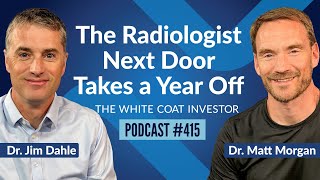
Radiologist Matt Morgan took a year off work after being inspired by the book Die with Zero. He and host Jim Dahle discuss how he prepared financially, what he did during the sabbatical, and what he learned about work and life balance.
This is the White Coat Investor Podcast where we help those who wear the white coat get a fair shake on Wall Street. We've been helping doctors and other high income professionals stop doing dumb things with their money since 2011.
This is White Coat Investor podcast 415. The radiologist next Door Takes a Year Off Today's episode is brought to us by SoFi, the folks who help you get your money right. Paying off student debt quickly and getting your finances back on track isn't easy. That's where SoFi can help. They have exclusive low rates designed to help medical residents refinance student loans that could end up saving you thousands of dollars, helping you get out of student debt sooner. SoFi also offers the ability to lower your payments to just $100 a month while you're still in residency. If you're already out of residency, SoFi's got you covered there too. For more information, go to sofi.com whitecoatinvestor SoFi student loans are originated by SoFi Bank NA member FDIC. Additional terms and conditions apply. NMLS 696891 all right, welcome back to the podcast. We have a fantastic interview today, one I've been looking forward to doing for at least the last year. It's a little longer than most of our episodes, but I think it's worthwhile and we didn't want to split it. So this one might take a couple of trips to work to listen to the whole thing, but I think it'll be worth it to you. Before we get to it though, our quote of the day comes from Roger Babson who said more people should learn to tell their dollars where to go instead of asking them where they went. And I love that intentionality. It's going to plug right in to our subject for today. And I want you to also know before we get into the interview that for a typical doctor or other high income professional, two of the biggest financial catastrophes worth insuring against are are disability and death. And that's why we keep a list of vetted insurance agents that will make sure you get the coverage you need without ripping you off. You can see that@whitecoatinvestor.com insurance and you might be surprised. You know, there may be other types of insurance you can save some money on too. Most stocks find they can get a lower price on their home and auto insurance through our partnerships, so be sure to check those out too. If you haven't shopped that around in years, there's chance that you're throwing away thousands of dollars A year paying too much for your home and auto as well. Okay, let's bring our guest on. He actually is literally the radiologist next door. So he's walking over here and we're gonna sit down here in the recording studio here at White Coat Investor headquarters and do this interview. I've got a very special guest on the White Coat Investor podcast today. This is a doc I've known for 26 years, since we were MS.1s together at the University of Utah. We were in the same med school class. This is Matt Morgan. Matt, welcome to the podcast.
Thanks.
Matt. I have often referred to you as the radiologist next door, and there are five or six docs in our neighborhood, but Matt is the one I've known the longest and the one I live closest to. I actually tried to buy his house once. I was biking around the neighborhood looking for our home and I biked up into the garage because I saw his house for sale on. And he gets out of the car and I'm like, matt, what's up? Because I hadn't seen him at that point for the four years I was in the military and three years I was in residency. And it had been seven, eight years since I'd seen you at that point. And his house was not for sale. But he did tip me off to the fact that the one next door was going on sale in about a month. And that's where we actually bought and have been next door neighbors for the last 15 years. But, Matt, tell us a little bit about your education. Obviously you graduated from the University of Utah School of Medicine. Tell us about your residency and what you've been doing since then.
Yeah. So born and raised in Salt Lake City, went to BYU as an undergrad, went to the University of Utah for medical school. And then I've always been interested in information systems and medicine, so it probably wasn't much of a surprise that I landed in radiology, headed off to Pittsburgh for my residency, spent five years there, and and then was recruited back here to the University of Utah and to another sort of partly entrepreneurial role at a startup. And I've been sort of doing that kind of thing since. Partly clinical, partly also a hand in industry.
Yeah. And the fun thing about Matt is that he has been my next door neighbor for the entire time that the White Coat investor has been going. He had a blog at one point. It was called First Habit. You can kind of see what he's got@mattmorganmd.com now. And he was also part of the inspiration behind WC Icon. We've been talking about White Coat investor stuff for 15 years. And I remember a conversation with Matt and he's like, oh, you should do a conference, people love conferences. And we were talking about putting on a conference at Snowbird just eight miles up the road from us. And our first conference ended up being a ski conference. It wasn't a Snowbird. They weren't actually available. We ended up going to Park City for the first WC Icon. So Matt claims to be the inspiration behind WC Icon and he does deserve some of that credit. He's been a WC Icon speaker, he has submitted guest posts. But I think this is your first time on the White Coat Investor podcast.
Yep.
So why is he on the podcast? He's on the podcast because he did something really cool, which I have found totally inspiring. And I've been looking forward to interviewing him on the podcast now for the last 15 to 18 months. But I wanted the experience to be complete before I brought him on. And so let me tell you what Matt has done, or maybe I should let you tell us what you've done, but just a very brief version. Give us the 32nd version of your last 15 months of your life.
Yeah, basically the summary is I decided to do a sort of self appointed sabbatical. So people are probably familiar with the idea of a sabbatical in academia, the idea that you have some period of time to do something different. I'm a clinical radiologist, I'm not on the tenure track, there's no formal way to do a sabbatical, but basically decided to make one. And I thought about it, I put it together, I made it happen.
Okay, so you're what, 51 years old, is that right? 51 years old. And you took last year off almost completely. It was a little bit of earned income in there, but almost completely off, almost like a down payment on his retirement. And I think that's totally cool and absolutely something that many of us out there in White coat investor land should be considering. But by way of introduction to this, a couple of years ago, I don't know, two, three, four years ago maybe you asked me if I had read Die with Zero. And I said no, I haven't. But I assume from the title that it literally meant Dying with Zero. And I'm like, oh, well, it's probably a bunch of strategies like using a reverse mortgage or using single premium immediate annuities so that when you're gone, your money's gone as well. And you told me, well, that's not really what the book's about. So why don't we start with you just kind of explaining the themes behind the book Die with Zero, and then maybe why it impacted you so much.
Yeah, Bill Perkins wrote this book, Die with Zero. A lot of people maybe heard of was published in the last several years. It's a little bit of maybe the continuation of the book that maybe a lot more people are familiar with, which is your money or your life. These are kind of. I like these types of books because they make you think about what it is you're doing and why you're doing it. Daiwa0 the main themes are that you've got essentially three variables. You've got the financial part, which your listeners are probably tuned into. You've got your health and you've got the amount of time left, health, time and resources. And if any of your listeners are a little bit analytical, you realize that there's gotta be a way to think through that, to try to optimize it. And optimize doesn't mean anything in particular other than fulfillment. And so he talks about fulfillment just being sort of the area under the curve. And if you don't pay attention to what you're doing, you just might do it wrong. And what's wrong, whatever you regret, there isn't a right way to do it. But he talks about how when he was in his 20s, he was working in sort of financial and banking and trying to really, you know, go up the ladder. And his friend, also in the same job, says, I'm going to Europe. I'm taking the summer, I'm leaving. And he thought he was crazy because he's going to have to come back, start at the bottom of the rungs. And so he didn't go. And then it's sort of the seeds of how he talks about how that window closed and that opportunity to. To be a young person in his 20s in Europe, doing things in a way that you wouldn't do later in your 30s or 40s, was passed. And so he regretted that. And his friend actually worked out that it didn't cost him much. So using that sort of as a metaphor, I started thinking about how that applied to me and lots of analogies. I think you can use a lot of metaphors in this way. So you talk a lot about asset allocation. You got equities and bonds and alternatives, and you have to figure out how much you're going to put in each bucket. And your career is an allocation. I mean, if your time overall is an allocation, you've got your career, you've got your family time and you've got your interests. So almost same similar three types of buckets. And I started to feel like I had my asset allocation way heavily weighted toward the equity side, so to speak, the job side, which for a lot of people, if that is your mission and that's where you get most or all of your fulfillment, then that's probably appropriately allocated. I just started to think that there were other buckets that were missing that were being sort of not attended to and that the window of time where I would be able to access those. Because again, in Daiwa 0, he points out, if there are things that you need your health for, it doesn't matter how much money you have. When you're 87, you're not going to do rim to rim Grand Canyon, for example, which is still on my list for this year. So basically it was a bit of a wake up call and something that just kept percolating in my mind of if I die with, I don't know, several hundred thousand dollars, would I gift that back to myself at 51? And I said absolutely I would. So that's kind of how I started thinking about it.
Yeah, I love the concept in the book about chapters of your life or phases of your life that you can do some things in earlier chapters that you can't do later. Right. If you've got a five year old child, they want you to read a book to them every night. They don't want that when they're 15. You've missed that opportunity. If you weren't around to read to them when they were five, you've missed it. It's gone forever. Likewise, if you want to go climb the Grand Teton, you're probably not doing that at 78. Maybe there's a few people that have waddled up there at 78, but for most people, this is something you do in your 20s and 30s and 40s and 50s. And there's all kinds of activities and experiences you want to have in your life that are available at younger ages and better stages of health that aren't available later, no matter how much money you have. So I love that concept that you have three limited resources. Maybe there's four too. As I think about it, there's money, there's time, there's health and there's motivation. And as you get older you get more money, but you almost always have less health and probably less motivation and you might not even have the time. We all know somebody that's been diagnosed with cancer in their 40s or 50s and was dead a year or two later. And so I love the idea of just being super intentional about the way you live your life. And this is one of the things I admire the most about you, Matt. You are the most intentional person I know you're super intentional about.
You don't look in the mirror very often.
And I want to hear your opinion about why you think intentionality is so important to creating a fun, meaningful, purposeful life.
Yeah, I don't know. It's something that I just think, obviously you have to think about things if you want them to happen. I am a big fan of mental models. I don't know if you come across that, but mental models are. Are these sort of shortcuts to kind of wisdom. They're things that people have captured. They're truths in some aspects. In science, maybe they're fairly concrete. But then there are financial mental models. It's all around us. And I've sort of felt like one of the primary ones that I sort of start the day with is that it's that we're all agents, so to speak. We got to do. We got to come up with what we want ourselves. It's not going to be the circumstances. We can't wait for the world to adjust. We would like things to be better. I think we should all hope that the world improves. But while we're waiting for that, we got to run the race that we're on.
You go to war with the army, you have.
Exactly. If you start with a premise that it's up to you, and then you think about that part of that involves some sort of design. I like design thinking in the sense that you define what you want. You create an idea about what it might be. You iterate around that, and then you test it and try things. And I think. I think there's a stackable mental model that I think is one of the biggest motivators for me and has had the most impact. Which is. First, you start with the Pareto principle. I don't know. Prieto discovered this idea that there's this 80, 20 rule. 80% of the results come from 20% of the inputs. And then you look around and you try to see how that applies to just all kinds of. All kinds of things. So you could probably think about, as you're building a business here, 80% of the results come from. It takes a while to figure out the 20%, but you hone in on those and you double down on the 20%. Another way to call or Another name for those are the vital few. You figure out what the vital few in your life are. For me, that's family experiences and just opportunities and fulfillment. So if you take the 80, 20 rule, you figure out what the vital few are and then you think about compounding and you just go after the things that matter most and you sort of discard the things that are sort of the trivial many. And you realize that that over time really creates a life well lived. And I don't again think that it matters what those are exactly. For everybody, it's that you ought to have thought about it. So for me, I think the biggest thing that I would regret is if I look back and thought, I didn't realize you could do that. It's a failure of creativity. It's a failure of thinking through something. There are a lot of different names for it. People are on autopilot or zombie mode or something because you just get culturally indoctrinated into a 40 or 50 hour workweek or something like that. And you realize in a fortunate position, if you have the means, you ought to ask yourself, why am I doing this? And if you can answer those questions, then you should keep going. If you, if you can't quite answer those, you ought to think about if there's a different allocation. So intentionality, I think is just making a plan and trying to make it happen. Yeah.
Awesome. A sermon on intentionality that I think we can all take to heart. All right, let's get into the nitty gritty here. I mean, I brought you on here to talk about this sabbatical this year you took off. But before we get into what you did during that year, let's go back to the beginning. I know Die with Zero provided a little bit of the inspiration here, but where did the idea to take this self created sabbatical come from? Tell me about your thought process and maybe even your discussions with your spouse about it.
So it would probably be misleading to think that I sort of came up with this plan and then it all seemed so like set up. The first thing I thought is, I want something more. As a radiologist, maybe you and er, you get this feeling like it's Groundhog Day, different people and it's important. And I love how you pat us on the back and tell us to keep our shoulders up because it's an important work we're doing. At some level I also felt like I was more than just the next radiology read.
Every job becomes an assembly line job after a while. You're moving widgets down the line, even if they're really important widgets.
Yeah. And so the idea was I need to sort of mix this up. If I keep doing this for the next, whatever, 15 years, until I decide it's time to stop, I will not remember one day from the next for a period of like 30 years, you know, interspersed with canyoneering once in a while with my neighbor. So basically, I just. I just wanted things that would make my life feel different in some meaningful ways. I actually started thinking maybe I should go work somewhere else. Radiologists are needed. It's a good time to be a radiologist. In fact, New Zealand wants radiologists to just come spend some time. Could be six months, could be a year. So I thought about that, looked into it, got in touch with an agency looking around at different practices, talked with my wife and started feeding the kids a little bit of, like, what would this feel like? What would you think?
Now tell them a little bit about your kids situation. You've got a few kids out of the house and a few kids still in the house.
And, yeah, emphasis on. I don't know if you're minimizing the idea of six kids is a few kids. So, yeah, three kids.
Not that unusual around here, but probably unusual where most of the audience is listening.
Yeah. And I think it bears talking or just planting the seed that my wife's never worked and we have six kids and I work in an academic setting. So that sort of sets up a few other parts of our conversation, perhaps. So what it came down to is that based on timing, my son was going to be a senior in high school. You know, you should probably do things that you think as parents are best for your kids. And then you're also just thinking, how hard will this be on everybody? And it just seemed like a year or six months was going to be too disruptive to pull off. I would have done it in a heartbeat. But my wife would have, you know, had to kind of figure out how to just live a life sort of on her own in a. In a different country. I mean, I'm sure it would have been interesting for her, too. But the decision was, is that that probably wasn't going to happen. And it was actually something she said that made me think about it. She said, what if we just stay here, but you just unplug? And I thought I had never thought of that. What if I don't have to go anywhere? What if I just exit and then do all of the testing of various ideas that I have while I'm Here, so I didn't have to leave again. So this starts to have implications for how's your job? Look at that and so forth. We can get into that as we want to, but I just thought it's like a staycation, except my goal was not a vacation per se. My goal was to allocate time to me to do things that I wanted to do. It's more of an autonomy question. People talk about burnout. I don't know what that all means. I think we all have different versions in our head. I don't think I was burned out. I just felt like I wanted more fulfillment and I wanted more autonomy. And you've told me before that you're essentially unemployable. And what that means is there is no employer that will agree to the terms that you would require in order to be their employee. I'm coming from being a complete employee in the sense of working in academic, medical center. You're essentially the cog in the wheel. And I was chafing a bit under having to say no to things. I don't know if people out there just want to think through this. How many times do you have to basically adjust or say no to things that you would do if you could? So, for example, we live near the mountains. In the winter, the lovely snow falls, and you don't know when it's coming. How many times did I have to say, see you later, everybody. Have a nice day on the slopes while I'm working. I don't mind working for them. I don't mind being the provider and. But it's doubly painful when they're skiing. When they're skiing and I'm working, and I don't want to do that every day. I just want the ability to sometimes say yes or more often. So this year became a chance for me to basically say yes to everything. Several things that came out.
Is there a movie out there with that theme or something like that?
I think so. But, you know, to be able to say yes to any trip, that was, you know, an option to say yes to being gone for an extended period of time. So, yeah, a lot of different directions there. But my wife was totally on board because, you know, we've been sort of on the same page for a long time, and this wasn't going to make her life any worse. We weren't having to go anywhere. So basically it went from maybe we need to leave in order to mix things up to why don't I just sort of take an exit and then Try to reenter and we can talk about that.
Perhaps the biggest change is you didn't go to work.
Right?
I mean, you didn't go to work something you'd been doing 5ish days a week for the last 15, 20 years. So let's talk about the preparation for this sabbatical, both the financial preparation and the non financial preparation. What did you do to get ready for 2024 when you weren't going to go to work?
Yeah, I think you can think of it in two ways. Preparation. Yes. There's certainly some nuts and bolts in true preparation. Some of it I would consider actually more enabling factors, things that enabled the option to actually be on the table. And those aren't things that you can, sometimes you can't do those slowly, those are drop by drop. So again, this is clearly going to resonate with some of the themes that you've espoused over the years. But the enablers were that basically I had been contributing to a nest egg to a point that it was now essentially, I don't know if there's a term for it, but the inflection point where it starts to produce more by quite a bit than what I was contributing year to year. At first it's all you and then somewhere the wind in the sails takes over and you just start to see that the amount that you're contributing year to year is actually a fraction of what it's doing day to day, even in the market.
Sometimes the phrase used for this is coast fire. When you can reach your goal if you keep working, but you don't actually have to make any additional contributions to the accounts.
So I think those are. So that's one milestone. So the idea that your nest egg, if you continue to let it go and you have a period of time left that you think it would produce the amount you need by the time you start to need to draw down. And people have to use some of the calculators and thoughtful process that they can find out there to figure out that number. Ish. And so that's a milestone to say I don't need to contribute to this anymore. The next one is that, you know, based on more psychological ideas and everybody talks about paying off your mortgage or not and the math says you shouldn't. If you've got a 2.75 interest rate like we had and the freedom says, absolutely, go ahead and pay that off. And that's what, that's what I decided to do. By 2018, 2019 had paid off our mortgage. So what that did was gave me a sense of freedom. There's no more sense of I have to maintain this engagement with this employer in order to fund my life. So by having a mortgage paid off and no longer needing to contribute 20 plus percent to retirement, that just created a way to create a slush fund or a growing fund of cash.
You reduce the monthly nut you need to create. And so that freed up some of your income to be in the slush fund.
Right. So the first couple years where those things came into play, we decided to sort of put that toward some updates on our house. So we let a cash fund pile up and then we decimated it with a way better kitchen. So we're loving that.
We love your new backyard as well. It's beautiful to look at.
So that was kind of the first thing that we did with our kind of arsenal of funds. But it felt good to just do that with cash the next. And again, not foreseeing what we were going to do, the slush fund again began to sort of accumulate. And I wasn't necessarily intent on getting that invested down to the penny. I was allowing that to sort of ride up into cash, knowing that if we wanted to do something, I would just need it on hand. So that coincided with some of our thinking around the sabbatical. And so again, we had a, an arsenal of resources. And I've of course, been watching my finances year to year. I know what it costs, what our monthly needs are.
I mean, you're good with money before, and for the last 15 years, you've lived next door to the white coat investors. So you're good with money, is my point.
Yeah, a lot of over the fence conversations and all of that. So. So yeah, we were then sort of ready to do something like this financially. So if you could call that preparation. Yes, but it was slow. It wasn't anything I could have done immediately if I had not kind of been putting the pieces in place to do it. So that's one piece of advice is if you want freedom later, you have to, you have to dial in early, and then those options just become available.
So your slush fund was enough to cover your family's living expenses. Now you don't have to pay a mortgage, you don't have to save for retirement. I know your student loans were refinanced when we came out of medical school, like 0.9%. I don't even know if you have five figures left of those now, do you?
No, it was, I felt like almost a badge of honor that I was Paying off loans at 0.9%. And so I let that ride for the entire time. And that actually, I paid my last little payment, like six months ago. Yeah, very cool.
But basically, you had enough slush fund to pay for everything else. You could cover it. You knew you didn't need income the whole year to fund your lifestyle, even with all the cool stuff you were about to do.
Right. It was not just funding. There are a few things that are going to be food and so forth, are going to be where you got.
To pay your property taxes, you got.
To pay your utilities. But yeah, we were going to be spending more and we were not in the workforce as much. Although, again, my goal was not to not work at all. So if we switch gears into the preparation of the. Of the job itself, basically what happened is I became an adjunct, so they rehired me back as a contractor. But in this case, I was able to just work at. They would say, when can you work? Isn't that an interesting and beautiful concept where the tables turn? And I just say, when I can.
So we're going to dial in on this because this is a key piece of this. We're going to spend some time on how you came back to the same job after a year. But before we get there, let's talk about the year, and let's just go chronological order. This was January to December. What do you do for a year when you never went to work?
Well, the first thing was the extended chunks of travel. We mostly planned around those two things. My wife and I both have loved just seeing other places, living in other places, cultures, people. It's not really about just being able to lay eyes on the Mona Lisa or run around museums or something. It's really about seeing, opening your. Your eyes, broadening your horizons. And so we.
Yeah, I mean, everybody says they want to retire so they can travel. And you had a down payment on retirement, a year of retirement, for lack of a better term. So you traveled. No surprise, right?
Yeah. So no surprise, perhaps, that we were honed in on New Zealand based on things that we just barely discussed about possible jobs there. I've never heard anybody say they didn't enjoy their trip to New Zealand. So that was our first check mark was, let's go to New Zealand. And so we like the idea of slow travel in the sense of. I mean, everybody may have a different concept of what that is, but it's not running frenetically from place to place, snapping photos and making sure Instagram knows that we were there. We just like the idea of a fairly slow pace and being able to kind of settle in and enjoy things. So we took six weeks and went to New Zealand in January and most of February. And I drove 3,000 miles. We did both islands from north to south, like 25 or 30 different places we stayed. We took one suitcase full of just camping gear, so two tents and sleeping bags and pillows and so forth so that we could be wherever we needed to be and just like open up the back and eat our ramen for dinner and, you know, just stay near wherever we were. So that gave us a lot of flexibility as well. So we just had a great time seeing all the places. It's mostly a place of.
So you're on vacation. You're on vacation in New Zealand for six weeks.
Definitely not doing anything besides just enjoying our time there.
Now you keep using the pronoun we. Who's we?
So myself, my wife and three of our kids.
Three kids, including the senior in high school.
Yes.
Who was gone for January and February.
This was part of his junior year, but yes.
Okay, this is junior year gone. You know, this is the big AP year. Everybody's taking these hard AP classes and it's the year to real dial down six weeks. I mean, what did they do for school?
So thankfully there was a little bit of tailwind, although it's mostly gone, it seems like in schools today from COVID and the idea that you could maybe do things in different ways than people had thought of before. So in this case, they checked in remotely, their teachers gave assignments. This was much easier in elementary school and middle school. High school was a little bit more challenging. Our oldest actually had to, you know, in some cases decide not to take a certain. I think it was maybe the AP history that he didn't end up taking. These are all trade offs. There's no way to do something and thread the needle perfectly. Some people would say, you know, is that worth it? And we thought it was. You know, like I think of my AP credit and as physician, you probably know this too. It didn't work for anything. I had to repeat all of the AP credit because med school didn't recognize it anyway. So there's the idea that you have to be some sort of high school superstar. And I think looking back, a trip probably was way more meaningful than some of the sacrifices. So the Utah has a fairly. At least the schools we were working with worked with us. They all, you know, the counselors thought it was like an interesting and amazing opportunity. We didn't get any. So school it would have been a lot easier with school to go during the summer, but a couple of things were that crowds are way more in the summer months to go anywhere. And so we didn't want to fight the crowds and the kids had things that they really wanted to do, camps and just community events and things.
Wasn't a school, it was the other stuff.
It was the other stuff. So they didn't want to. So we stayed here through the.
While everyone else out there is listening to this going, what are you talking?
Leave Utah in the summer. There's plenty to keep us interested and busy. So we stayed here.
Meanwhile everyone else out there is listening to this going what are you talking about? I go to Utah in the winter.
Yeah, well there's a summer playland as well. So we decided to again do a little bit of a more complex thing and actually leave for the second quarter of the school terms. So basically October through end of December.
And so 10, 12 weeks or so.
Yeah, it ended up being about 10 weeks. So we went to essentially went to Europe. I knew that that was something on. So this is all my bucket list. Ish. Not necessarily bucket list. Like I have a list but I had not done Europe. I had not been to a few places that I would have that I wanted to go to. So we set up basically an open ended excursion through starting in Spain and ending up in Vienna and ended up being around eight or so countries and about 30 cities. That sounds pretty frenetic. Some of it was sort of a bit of traveling here to there. But we spent a full month in Spain and three weeks in one location. So again the idea being to just settle in and get a sense of what it feels like to be there.
Now your senior didn't go on this trip.
Yeah, that was interesting. We actually swapped to one of our kids. So one of them that was in college knew she was coming up on a break where she was going to take some extended time off to do a mission. So she opted in to the trip and our senior looked at things, we talked through was his decision and he decided to stay here. So my wife's parents live nearby and my oldest son and his wife and their young new baby were living in the basement anyway, so there was almost like another mini family where he could go stay for that period of time. So we talked about a couple times a week, stayed in touch with him, encouraged him. That was hard for him and I'm still not sure if he knows which decision was correct. But he's heavily involved in music, loves a Lot of things that he was doing and that would have compromised a bunch of things that he was doing.
So six weeks in New Zealand, 10 weeks in Europe. You spent four of the 12 months off the continent. Yeah, it's pretty incredible, right? I mean, if most physicians out there think about, imagine taking four months and being off the continent in one year, it's just not doable for most people unless they do something like what you've done. Let's talk for a minute about travel though, right? This is something I've discovered. We're about seven years into financial independence and like a lot of people, we thought we wanted to travel a whole bunch. Well, one of us was, right. Right. Katie loves to travel. She could spend four months on other continents every year and be perfectly happy about that. In fact, probably would love it. I don't want to spend that much time traveling. What did you learn about yourself and travel and how much of it you eventually want to do when you are fully retired?
I think I'm probably more like your wife. I just like to be in novel locations. It again, doesn't have to be sightseeing per se. I just like living in a place where the day seems fresh and different and new and the vista is something I've never seen before. I don't know where that comes from. It just, you know, I certainly, you know, enjoy where we live. And it's beautiful. It just like anything for me anyway, it becomes rote. It becomes something that I just don't notice or don't appreciate. And again, maybe this is kind of a fundamental thing for me, but if I can't differentiate one day from the next, I don't know that I feel like I'm going to remember what my life was. And so travel for me sets up an opportunity to share. There's another thing from dialysis. Zero. You get memory dividends. Which dividends. All of everybody sits.
We're all into dividends around here at White Coat Investors.
So if you have memory dividends, that's where you get to enjoy it again later. And so for me that's like, do you remember when we were in Spain, do you remember that hike we did in New Zealand? Remember that 20 miler that we wondered if how it was going to work out and the weather was awesome. And so those are just highlight experiences. And for me, travel just uncovers those in a way that the day to day at home doesn't.
Okay, so if we brought your spouse in here and sat her down and asked what she thought about all this, what Would she say about this year?
I, you know, we. We came home, we tried to sort of glean what we could out of what, debrief a little, debrief a little bit. We went out to eat and she actually looked at me and said, that changed my life. So possibly especially the extended time away. So she's a stay at home mom, six kids. The pressures of that, the challenges of whatever everyone feels in the community, keeping up with other people, comparisons, all the things that people deal with, and to have that time away just, she says, just settled a whole bunch of, just kind of, I don't know, just the issues that you have in mid life, you know, whether that's sometimes physical, hormonal, whatever, and as well as just a sense of peace and being with her people, which is our family. So she came back just refreshed, as refreshed as I did. And we're both trying, you know, we both tried to write things down and see if we could, you know, hold on to things as long as we can. Because there's that knowledge that eventually it slips through your fingers and you kind of forget your perspective. It's like being on top of a mountain, seeing the valley, and then you're back down in the thick of it and you have to try to remember.
It feels like an experience. You should journal as you go along. Okay, let's change gears. All right. There's a whole bunch of people listening to this, going, that sounds awesome. I want to do that. And then they start thinking about their job, they start thinking about work. So I want you to go into some detail here about this interaction with your job. When you went in there and at some point you had to tell your boss, I'm leaving for a year, whether you fire me or not, it's up to you, but I'm going to do this thing. Tell us about that and how they accommodated you and what power you might have felt when you realized that.
You.
Were the rare thing in this relationship and what things are like now going back to that job.
Yeah, I think it probably bears mentioning that the different job markets have different opportunities. And so I feel fortunate to have experienced several timing issues, both when we graduated from med school with low interest rates, to have bought a home in 2009 when there was basically a market correction. And then in this instance, it happened to be a market where, where I had more power in the decision. So I started to hint at this idea that I might try New Zealand or something. You have to socialize your ideas so that they don't come so abruptly if you would like to maintain relationships and maintain opportunities. Burning bridges is the opposite, where you surprise somebody or it seems like you were thoughtless about maybe how you handled it first. You just want to be thoughtful. You want to start making that idea a possibility by saying, this is how I'm feeling. This is how I'm thinking. Thankfully, I think there's probably a receptive culture to the idea that you need wellness in your life and whether you're feeling that you need something else. That might not have been true 15 years ago, where people would just roll their eyes or think, my way or the highway, see ya. But both the market needing my skills at this time and a system that I think couldn't really argue with the idea that if you felt a need to make a change, then that's probably justified to. To maintain your wellness. So it was about a year in advance that I started talking about it. So they actually tried to make adjustments. Right. Like that starts to make people perk up a little bit. And there were some things where somebody asked me if I might want to be involved in this other leadership position or something. I think mostly dangling a carrot to try to get me engaged in something that I couldn't walk away from. And I think, fortunately, actually whether that was in good faith or not, I don't know. But it never materialized. And so I maintained sort of a free and clear. Other than showing up and doing my job each day, I didn't have any additional entanglements. As you might say, it's a little.
Harder when you're in charge of the department.
Yeah. So. So basically, I then started to say, I'm going to do this. And to your point, I think you have to have the. Pardon the term. But the fu. Money idea is that you're not asking permission, you're telling them. Because the minute you phrase it as can I do this? Then it's sort of the answer is no, that won't work for us. And it's like, so I had to be ready to say, you know, I've done 15 years in academic medicine. I've taught residents. I've done this. I've published things, I've experienced this whole gamut of this type of career. What if my second half of my career is totally different? And I had to try that on and think about, what would it be like to be locums? What would it be like to do teleradiology from my basement? You know, just leave those as options. Because if you're a negotiator you realize what's your next best alternative? And if you like it, then you're in a really strong position because they have to match what you want or watch you walk away. So essentially they said, okay, if you want to do this, we have a way that this could work out. And that was what I alluded to earlier. It sounds dramatic, but I had to resign my associate professor. I became an adjunct faculty, had to vote. I had to get letters to reapply as whether I. Because academia has its hoops and so forth. But it all sounded very. And felt kind of dramatic, like I was doing something like burning a bridge or something. But it actually set myself up to have this kind of freedom to do this. And then on the return trip in, I had to get letters and get voted on by my department again. But again, I think the enabler is that the market is just beggars can't be choosers. And in our situation right now, faculty recruitment is pretty tough. So I was holding all the cards. Yeah.
And in the end, those are all formalities. Of course they're going to vote you in.
Right.
They want you back.
Yeah.
And while we might not do that in my private group out of the community hospital, essentially it works the same way. You've got a known entity you're bringing back into the group. That's way better than trying to hire somebody new. I mean, the recruitment cost of finding a position these days might be $50,000.
Yeah. Oh, it's. I mean, in an academic setting, I know that people might even inflate things to make their point. But I think Stanford did a study to, for a person that's left and to basically pull in someone else. They thought it was somewhere close to a million dollars in all the ways that that costs the system.
Lost earnings.
Yeah. And the ramp up period, the finding a fit, the chance that there's maybe 70% chance or 30% chance that somebody actually doesn't stay. There's a lot of turnover costs. And so I just stepped back in as though I never left. I knew all of the systems and I think, yeah, they saw that as a win. Yeah.
And I'm sure that whatever six weeks of work you did during the year helped you stay up to speed. But did you feel like you'd lost a step when you went back or you just slipped right back in seamlessly?
Well, several of your listeners may appreciate we switched computer information systems while I was gone. So yeah, I felt a little bit off balance because of the tools that I was using, but that didn't take too long to figure out you've done that before.
Okay, so I deliberately put this interview off. We're doing this at the end of March. I think it runs in another month or something. I deliberately put this off. I mean, you live next door to me. We could have done this interview three months ago. But as I told you, I deliberately put this off because I wanted to ask this question during this interview. And that is, how has your perspective on this year changed in the last three months that you've been back to work?
Well, the first thing I just noticed because I think this year helped me learn what it meant to be more present. There's a lot of discussion out there about mindfulness or what it even means. I think we all kind of struggle to know if we're being kind of fully present in what we're doing. There's nothing like going away and coming back to help you taste it again. So the first things that I've noticed being back is just that I realized that I was discounting some of the good that is there. When your allocation is overdone and when you feel like Groundhog Day, you don't realize that there's maybe an iceberg underneath that is quite solid that you're just taking for granted. Having a year off also helped me understand that I do enjoy conversations with young, bright people in training that want everything I can give them in terms of helping them prepare for their careers. There's nothing quite like that where you feel that amount of responsibility and an opportunity to influence and to share what your experience has been.
So I think maybe you were taking that a little for granted.
I think I was, yeah. You just see another new med student comes through, another resident comes through, and you see it kind of as road and routine. It helped me kind of re energize and reappreciate that if I'm home and I'm reading a book or doing whatever, I'm not having that enriching opportunity. So it helped me realize that people are maybe more important than I thought they were in my day to day. Same is true for just full time working at home or something. I realized that I like the mix of having, sure, there's a commute, I have to leave the house, get there by a certain time. Some people want to just abandon that whole idea of having to be anywhere at any time. But some structure is useful, helps maintain a sense of purpose. And so it helped me sort of bring back that sense of why am I doing this again, the purpose that I Think we all put on our personal statements that was either completely sincere or mostly sincere. And then I do work with patients. I do see people. And I reconnected with that part. And so it really just helped me realize that I don't want to give up all of that allocation. I tried certain balances. You've written something that's like 115 allocations that are better than yours in a financial sense. There are probably 115 time allocations that are better than what I've described. But the idea is if you have something reasonable and you've been thoughtful about it, then it's probably going to be more successful than something that's haphazard and that you haven't even thought about.
Three months ago, when you came home from Europe, I talked to you and you told me I could die now and be happy, that I feel like I lived a good life and did the things I wanted to do in this life. Do you still feel the same way three months later?
Yeah, I thought about that since. So I actually use that as a mental image during that year. I thought about it as if someone told me, because I give patients. I happen to work with cancer, I tell patients that they have cancer on a fairly regular basis. I thought about. I'm not usually telling them they have a year to live. I'm not the oncologist or I'm not prognosticating, but I am giving them news that alters sort of. There's the before and there's the after of those sorts of those news items. And so I thought about this as a year to live. And I tried to live it that way, which was to say, saying yes to things as we've discussed. So when I got home, I really felt a real sense of peace in a way that I don't know that I've ever felt before, which is to say that I connected with the people that I love. I have relationships with all of them that I feel like obviously always could be better, but were not damaged and neglected, which can happen. And I felt like I had done things not because of a checklist, because I actually literally don't have a bucket list. But I felt like I had. I had reduced the resentment I'd had about not being able to try and do so. That probably won't last because I just think it's probably almost like a charge that gets diffused and then it will start to kind of.
The resentment meter is going to go back up eventually. Yeah.
Because I don't want to stop having ambitions to do or see or experience and there still more to do. But I had never felt before that moment that I could sort of die in peace, so to speak, and feel like I had left something undone. And I hope to maintain a little bit of that mentality going forward so that almost every day is just a mini opportunity to not leave things undone. But some of that has to do with, again, negotiating certain amounts of time and part of that year actually set me up to what I'm doing today, which is halftime, radiology and halftime with a startup that sounds familiar.
I really like that combination, by the way.
It was actually a trip that I took was one of my friends from residency that I otherwise wouldn't have done. We just went and stayed at a cabin and took hikes and talked because I hope everybody has somebody that they can just relate to so well. That is almost their sounding board. So we do that for each other. We went on some hikes and one of the things that came up was he said, if this because I. I've been in touch with this startup again because I was sitting at home writing a LinkedIn post about what I was doing this year, which was that I was on a sabbatical and I had a CEO of a startup that I knew from early days in my residency, who had also been a radiologist, but has gone on to start several companies, reach out and say, that sounds really great. And I said, hey, wouldn't it be interesting if I just came out and saw what you're doing? I thought of myself as a. A free intern or something. Maybe I'll just go sit in the corner and see what they do. And he said, why don't you consult for us? And so I started doing some consulting. And then when I was on this hike with my friend, he said, what if they would take you full time? Would you do it? And I hadn't even thought of that. And I thought, what if I use that as my sort of. What if I put that job actually as the main primary job and I let the clinical respond to that. The allocation that I decided in the end was 50 50. But that was just a new insight and I wouldn't have even considered that before. Yeah, it's a pay cut. They don't pay physician wages in business, really. But it's something that I would have thought I would regret if I didn't take that chance. It's working. As I mentioned, I've been involved with systems and technology this whole time, and I've felt like that is a point of Leverage that I don't often get to use as much as I'd like to. I thought, here we are in the age of AI radiology is sitting right in the middle of it. Here's my chance to be in the thick of it. And so I took that option.
All right, a couple of questions. Compared to the other questions, these are probably lightning round style questions, but expand on them as you feel a need or if a one word answer answers them, that's okay too. All right, so you took a year off in the middle of your peak earnings years, essentially off. I mean, you still work for six weeks or whatever. That has a cost. That cost is going to be compounded over decades. Was it worth it?
Yeah, I don't think that I've calculated. We're both analytical, but you take it to a degree that I don't. And so if you presented me with your best number of what that is, it might surprised me in that I know what it cost me to do that year. But compounded is probably higher. I would say, just like I said earlier, if you told me that I was going to die with some amount of money that I could have used to do this, I would have lent it back to myself. And so that's just a way of saying absolutely. I don't know that most people who take a risk and enjoy something ever regret doing it.
All right, second lightning round question. If they had said, no, you can't go do this, quit if you want, and said you're basically not coming back to this job, would you have still done it?
Yeah, we touched on this earlier. That's how it was framed in my mind, was I'm going to do this and if you don't like it, then we'll have to part ways.
Did you ever actually tell them that or was it just kind of. They could see you were pretty serious.
I think probably the middle ground, which is a softener, is the idea that sabbatical is a word that people understand, at least especially in academia. So by phrasing it that way, it never had to be sort of a my way or the highway. It was, I want this, I need this, and I can't qualify to do it officially through the university, as some people can that are in this kind of tenure role. But the concept was digestible and didn't come to needing to really hash out the what if don't come back or so forth.
One of the best things I like about this is you've just had a test run on retirement, a down payment on Retirement, whatever you want to call it. And I'm curious how your view of what you think your retirement will look like has changed in the last 18 months. Are you likely to retire earlier or later? Are you likely to do something different during your golden years than you thought you would have 18 months ago? How do you view retirement now compared to before?
Yeah, I'll say before, even last. Back into pre Covid and so forth. There was a time where I was a little bit caught up in this kind of. I don't think quite fire per se, but this idea of get your ducks in a row and get your pile, and then I don't think quite fire per se, but this idea of get your ducks in a row and get your pile and then you can walk away and do something else. I think I was at least mulling that over for a while. Maybe it was just because it was part of the zeitgeist of the time, but as I've sort of been through this experience, as I've related that you can walk away and do something else. I think I was at least mulling that over for a while. Maybe it was just because it was part of the zeitgeist of the time, but as I've been through this experience, as I've related the interest that I've had in what I'm actually doing, realizing that the allocation just needed to change, but it wasn't actually the component. I didn't want to drop that investment. I just wanted less of it. So I foresee that retirement would be just a continual change in that allocation of how much I spend working. I recognize that radiologists, and maybe ED is another one, you can sometimes dial that. You can titrate your involvement. Not everybody can quite step in and step out. If you're a pediatrician or something and you've got all your patience, maybe you have different ways of doing it than I'm not aware of. But I foresee kind of a glide path. And I thought at some point that I wanted to retire earlier than normal, but I think, why would I? If I get to keep doing fulfilling things and if I have enough opportunities to do other things, then that might just be the perfect balance.
All right, well, somewhere out there, somebody's listening to this. I think we're over an hour now. They've been listening to this, and they're like, that sounds awesome. I want to do that. I want to do what Matt did. What advice do you have for them? They're 45. They're 50. They're 50. Five, they've taken decent care of their finances and they want, you know, maybe they're not ready to completely be financially independent, but what advice do you have?
The interest that I've had in what I'm actually doing, realizing that the allocation just needed to change, but it wasn't actually the component. I didn't want to drop that investment. I just wanted less of it. So I foresee that retirement would be just for them. Yeah, I think it just makes sense to start with a vision. It has to be something that motivates you, that makes you smile, that makes you think that could happen. Again, thinking backwards and reverse engineering what it would take to do it. You've got to think through some logistics. You got to think through what is my employer like, what is my family situation like right now, what, what are my opportunities, is the market ready for this sort of thing, or would I be likely not to be rehired if this were that kind of situation? So I think you just have to look at the horizon that you see and start to organize around how that might look. I think you need to have a backup, essentially, as we mentioned about negotiations, you need to have an alternative that you actually consider a viable and possibly even one that you would be close to preferring if that were necessary. And if you can basically line up your financial side, line up your family side, and line up kind of the job aspect, then I say give it a try. It could be life changing.
Well, that's pretty awesome, Matt. You've done something that's incredible. I mean, maybe we should have run this out on the Milestones to Millionaire podcast because it's such a great accomplishment that should be celebrated and used a.
Continual change in that allocation of how much I spend working to inspire others.
To take control of their lives, to live intentionally, maybe to take a sabbatical, whether they're in academia, where that's normal, or kind of this semi academia kind of slot you were in, or whether they're practice like I am. But I think it's a super cool experience and I'm really excited to have had you on the podcast and to share that with the 30,000 people out there that I think can benefit from the experience that you've had. So thank you so much for coming on the podcast.
It's great to be here. Fun discussion.
Okay. That was a lot of fun. I am so impressed with Matt. I have been for many, many years. I've known Matt for almost three decades now, and he's always been impressive to me. But one thing he has always been is intentional. He decides what he's going to do and that's what he does. And I'm sure when he started talking to his bosses at work, they could sense that they know him. He's been working there for 15, 16 years or whatever. They know he's very intentional. And when he starts talking about taking a sabbatical, it wouldn't take them long to figure out that he's really going to take it, whether they want to or not. But what I loved about this thing is you don't have to be gone the whole time, right? You don't have to travel the world for a year on a cruise. You don't have to quit work completely. In a lot of ways, this is a lot like retirement. It's not all about travel. It's not all about no work at all. It's being able to say yes instead of no. It's being able to read and think and spend time with people you care about. I just think it was pretty awesome. It was a great example to me of what my life ought to look like now, right? I mean, I've been financially independent for six or seven years already, and that's what my life ought to look like. I ought to be able to say yes as often as I can while still being able to find purpose and meaning in my life. So he's been a great example for me and I'm grateful he came on the podcast and I hope you enjoyed getting to know him as I have. He has certainly had influence on the messaging and the work done here at the White Coat Investor over the years, and I'm grateful for that. So I was very pleased to be able to feature him on one of my favorite podcast interviews ever. As I mentioned at the beginning of the podcast, SOFI could help medical residents like you save thousands of dollars with exclusive rates and flexible terms for refinancing your student loans. Visit sofi.comwhitecodeinvestor to see all the promotions and offers they've got waiting for you to One more time, that's sofi.com WhiteCodeInvestor SoFi student loans are originated by SOFI bank and a member FDIC. Additional terms and conditions apply. NMLS 696891 don't forget about our insurance resources. You can check those out. Whitecoatinvestor.com insurance if you can insure against a financial catastrophe, you should and disability and life can be financial catastrophes. Also check out our partners there that we have for auto and and property insurance. These days and see if you can save yourself a few thousand dollars a year while still having the same or even better coverage. Thanks. For those of you leaving us five star reviews a recent one came in this one from Woof755 who said. Essential Financial Podcast Dr. Jim Dali has been looking out for docs for well over a decade. He provides evidence based and influence free advice in order to help docs get their finances in line. Absolutely essential. Listen. Five stars. Appreciate that review. Woof. Keep your head up and your shoulders back. You've got this. We're here to help. We'll see you next time on the White Coat Investor Podcast.
The hosts of the White Coat Investor are not licensed accountants, attorneys or financial advisors. This podcast is for your entertainment and information only. It should not be considered professional or personalized financial advice. You should consult the appropriate professional for specific advice relating to your situation.
More from Jim










Physician Takes a Youth Sports Team to the State Championship - MtoM Podcast #236
