WCI FEW Live Virtual Event 9/11/24 - Christine Benz of Morningstar
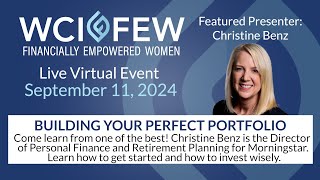
Christine Benz, director of Personal Finance and Retirement Planning at Morningstar, speaks at a WCI FEW live event on retirement planning. The discussion includes updates on Jim Dahle's recovery from a climbing accident and promotion of a financial literacy event for women.
Foreign.
I am sure that most of you have heard about Dr. Dali's climbing accident. But for those of you who may not have heard yet, he had a pretty serious accident at the end of August and thankfully he is on the mend and on his way to what we expect to be a full recovery. But we just wanted to give Katie Dolly a couple of minutes to let us know. Just give us a little update on his status and how he's doing and I think everybody would be happy to hear about that.
So let's and we want to thank you for just all the comments we've received the prayers on Jim's behalf and we're really grateful that he's making a remarkable recovery and one that he's alive. It was a pretty serious fall, but could have been been much and just.
Like last year, we're going to be hosting another few happy hour going to be on Friday, February 28th, which is my birthday. So come help me celebrate. And much more importantly, gather with like minded women who are remarkably different but who really all share the same goal of bettering their lives, strengthening their financial literacy and building community. And I know that we talk about WCICON a lot around here, but it is a just a really incredible experience and not many doctors have people to discuss financial challenges with. And I, I think that you all understand that simply by virt of you being here. And I've just found that spending time with those who truly understand and who really want to talk about it and learn together is one of the most important parts of wcicon. And it's my favorite event of the year. And I know that you'll learn so much, you'll meet incredible people and you really will have an amazing time. So we have a special discount for our few members. So from tonight until the 19th you can take $200 off your registration. So go to wcievents.com you can get all of the information about the event on the website and then at checkout use code FEW200 just F W200 for that $200 discount. So we hope to see so many of you there. All right, that is it. That's enough out of me. Let's get to the good stuff. As always, please put any questions that you have in the chat and we will collect those. And after Christine's presentation we will do a little Q A and see if we can't get those answered for you. So we are extremely lucky to be hearing from Christine Benz tonight. She is the director of Personal Finance and Retirement Planning for Morningstar Inc. She's been in, she's been on the WCI podcast, She's been a keynote speaker at WC Icon. She's an author several times over, including her latest book that comes out next week called how to retire 20 lessons for a Happy, Successful and Wealthy Retirement. Christine, thank you so much for being here. Let's just turn the time over to you.
Well, thank you so much Megan and thanks to all of you for assembling tonight. I apologize it looks weirdly moodlet here in my house. It's actually really bright but for some reason everything's looking kind of very dark and dramatic. So I just wanted to give a little background on that. Thank you all for joining tonight. I have been working on financial planning, investments, retirement planning for about 30 years now and I've gotten super interested in the retirement planning part, specifically the retirement decumulation. So that's what my new book is about. It's about the financial and non financial decisions that go into whether, when and how to retire. The interesting thing is I have been an investment specialist for most of my career, but as I've I would say gotten to be of a certain age where retirement is a relevant topic, I've been thinking more about the non financial aspects of retirement, like where we live, who we hang out with, what we do with all of that newfound free time. And so I wanted to make sure that my book weaves together boasts the non financial and the financial aspects of retirement. I've loved seeing your comments rolling in about what you are happy about, the financial goals that you've been able to accomplish. I loved seeing people funding 529s paying off houses, retiring and so on. It's just really gratifying to see that people are finding that they're seeing the fruits of their labors. So I did prepare a presentation tonight. I'm going to go ahead and share my screen. I would like to take your questions though and hear from you about what you have questions about. Because you know as much as you try to sort of pitch your presentation in a certain zone, you're never quite sure how much people know, how much they don't know. So I will definitely welcome your questions at the end of this presentation. But I'm going to get into sharing my screen here. I'll talk about building a portfolio, the importance of starting early, which of course you've all heard a million times. I'll talk about the importance of having goals as the underpinning for how you invest. There was recently this kind of vogue in the investment Advisor space where everyone was talking about goals based investing and I kind of thought to myself, oh my goodness, what else is there really? You need goals to invest to inform how you invest. So I'll talk about the importance of having goals and how those translate into specific asset types that you might want to invest in given your proximity to wanting to hit those goals. I'll talk about the role of time horizon, the role of life stage and human capital when determining how you invest the assets that you're able to set aside. I'll talk about why I think it's so important to keep investment selection as simple as possible. We have a lot of data at Morningstar that point to the value of using very simple building blocks in your portfolio. They're attractive for a couple of reasons. One is that broad market index tracking funds tend to be very inexpensive. So it's a great way to reduce the drag of costs on your portfolio. And then another reason why I would point people to very simple portfolio building blocks is that when we look at investor behavior and we can kind of examine how investors time their purchases and sales, what we see is that with simpler, broader investment types, people just do better. They tend to do less, kind of zooming in when the market is scaling new highs. They tend to exit less when the market is exploring new down territory. So there's a behavioral benefit to keeping your portfolio building blocks simple as well. So I'll delve into that a little bit. I'll talk about tax selection. So what type of investment account that you use for your various investments. And of course this will get back to your goals. If you have shorter term goals, you probably wouldn't want to use a retirement account where you will pay strictures, taxes and penalties to get out early. On the other hand, if you are investing for the long haul for your own retirement, it does make sense to take advantage of those tax sheltered vehicles. So we'll talk a little bit about selecting among them and using some ancillary tax sheltered vehicles as well, like health savings accounts after tax 401ks as well I think can be attractive, especially for high income earners. And then I'll share a little bit about investing and saving for near term goals, how the types of assets that you would want to have are completely different if you have a shorter time horizon. So if your goal is to buy a vacation home within the next three years or pay for college in five years or whatever the case might be, you'd want to have a different looking asset allocation than is the case for your own retirement portfolio. So this is just one of many slides that I'm sure you've seen that illustrates the importance of starting early. And so you can see three different individuals with different retirement savings, start date, one at 25, one at 35, one who waits all the way to age 45 to get started. What you can see is just this huge difference at age 65 in terms of ending balance, that the person who starts at age 25, even though he didn't invest that much more in terms of his total contribution, has a whole bunch less at the end. And of course, there are many slides that illustrate this same phenomenon. But the bottom line is that, yes, how many years you've contributed and how much you've contributed matters a lot, but so does the time value of your money, the compounding that you're able to enjoy on your investments. So the longer you have for that compounding to do its work, the better off you are. So I'm sure you've heard a million different exhortations to get started early. But this slide just illustrates the value of that. This next slide shows, and someone actually had this in the chat before we're getting started, someone said that their investment gains are actually larger than their own contributions. And it's kind of an interesting phenomenon that I think this slide illustrates nicely. You can see that in those early years, especially like the first 10 years of savings, the individual's own contributions were the lion's share of the portfolio's gains. But then with the passage of time and with investment compounding, the gains do the lion's share of the lifting, and the investment contributions matter relatively less. And this is one reason why for people who are early in their savings careers, if they encounter a bear market, it's not a big deal, because the losses that they encounter are fairly insignificant relative to the additional contributions that they'll be making. When someone gets closer to the end of their investing time period, or if you get closer to drawdown in retirement, what happens with the market, what happens with the investment returns matters a lot less. So I think this slide is a helpful illustration of that. How your contributions matter the most in the early years, and of course, what you have the money invested in, but in the later years, the investment gains are the more dominant force. This is something I like to talk about in the context of women and investing. And of course, I would guess for healthcare professionals, it's a little bit different. But one thing we see is that when we examine women's earnings, we see that we peak in terms of our earnings a little earlier than our male counterparts. So women there are peaking out kind of in the late 30s, early 40s period, whereas for men, you can see that it just goes up and up and up. And I had a conversation with the financial expert Jean Chaty for my book. We talked about what women need to do differently for their retirement plans. And I asked her, so why do we see this persistent gender gap in terms of income and certainly lifetime wealth? And her point was incredibly blunt. She said, I blame childcare. And I think that's what we're looking at here on this slide, that women are in some cases pulling back from work to attend two children, and that in turn inhibits their ability to invest. And that in turn as well inhibits their lifetime earnings. So this is an interesting dimension of it as I've examined the data on the differences in terms of men's and women's lifetime wealth. I do think it boils down to not the fact that women in some cases invest a little bit less aggressively, but it's really this lifetime earnings gap and child care, elder care are the key contributors to that. So it's important to get started early. Obviously, you've heard this a million times, but it's also important to understand why you're investing and to be thoughtful about identifying the specific goals that you're investing for. I think for many of us, we may just sort of have a sense that we amorphously want our net worths to grow, but it can be super helpful to pinpoint what your goals are. So I created this investment pyramid several years ago, but the idea was to help guide people's attention to where they should be spending their time if they're thinking about their investment program. And at Morningstar, we spend a lot of time sort of at the tippy top of this pyramid talking about investment selection. And of course, it's important to not pick bad investments for your portfolio. But when I sort of think about what are the most important factors, I would put that at the top. I would put having goals and identifying goals, quantifying and prioritizing the goals as really is at the base of this pyramid, it's the foundation for everything. So you could do a lot of things right at the top of the pyramid. But if you haven't spent enough time articulating and prioritizing your goals, it doesn't really matter, in my opinion. So I like the idea of putting pen to paper, getting out a spreadsheet, and really looking at what are your short, intermediate term and long term goals. And Getting quite specific about them, thinking about what they'll actually cost, looking if you're funding college, for example, looking at what college will cost, looking at what retirement will cost, using some sort of a retirement calculator. I like the idea of getting quite granular. And then from there you can kind of move up the pyramid. Think about how much you want to target in terms of your ongoing savings to help achieve those goals. Then you could think about your asset allocation or what sort of investment types to use for that portfolio. Think about managing your own behavior in terms of creating a portfolio that you can really stick with for the long haul. And then you can move on to smaller, more sorts of activities like managing for tax efficiency and minding investment selection. So most of us throughout our investment careers have multiple goals with multiple spending horizons. So over the short term, everyone needs that cushion to absorb emergency shocks. The size of that cushion I think is pretty individual dependent, but certainly higher income earners should target, I would say, not just the standard three to six months worth of living expenses, but you'd probably want to be thinking about more like a year's worth of living expenses. And you're just setting the funds aside in cash, keeping them accessible. The idea is that you are protecting yourself against unanticipated job loss, or maybe it's job loss that you or job change that you're directing. But the idea is that you're building yourself a nice cushion. I would say for single income households, I'd also want to be veering toward the higher end of that sort of three months to one year range. It seems like you'd want to be reaching a little higher, especially if you have dependents in your household. If your spouse does not earn an income or if you have dependent children, you'd probably want to be reaching to the higher end of that range. Home down payments, second home down payments, dreamtrips, anything that you would want to achieve within say the next one to five years, those would be sort of short term goals, intermediate term goals I would put in the five to ten year range. That might be home upgrades, college funding, and then long term goals. Of course, for most of us it's retirement savings and then legacy planning for children, other family members, charities where we would like to set aside assets for them when we're gone. So those would be the three main time horizons that I would think about. But in terms of your own individual goals, it's obviously very individual specific. This is, I think, a good juncture to kind of step back and think about what you're trying to achieve. Many of us know we want to retire at some point, but we tend not to put too fine a point on these other shorter and intermediate term goals. And that's where I would really spend some time looking at and quantifying what those goals might be. And once you do determine what those goals are, that's the thing that will help inform how to invest the assets. Because your proximity to needing those funds is a key determinant in how you invest the money. So if you are thinking about a goal that is 10 years or more into the future, you can afford to have most of those investment assets in stocks. Stocks have the best growth potential, the best long term return record of any of the major asset classes. Classes, but over shorter time periods. If you kind of dial in to any time period of under 10 years, what you see is that stocks are not especially reliable. They can be volatile in the short term. And so what you want to avoid is having your stocks be in a downdraft when you actually need your money. And that's the thinking behind having cash assets, having bond assets in your portfolio which do a better job of staying steady. Their long term return potential is less, but they do a better job of staying steady over the short term. And so that's one reason why if you have a goal that's close at hand, you should probably hold a component of cash, hold a component of bonds, and as you get closer to the goal date, you'd want to reduce the risk in the portfolio, gravitate more toward cash investments and away from anything that entails any potential for short term losses. So you want to think about your time horizon to reaching that goal. You also want to think about the duration of the goal. So college funding versus retirement funding, I think are a really neat illustration of that. With college funding, the drawdown period, and of course it depends on how long you plan to be in school or how long your kids will be in school. But the drawdown date is pretty abbreviated, right? Even if you're in med school, it's not going to be decades on decades. It'll be a shorter time period than that. Whereas if you're planning for your own retirement and you're planning to retire at sort of a traditional retirement age, you'd think about the drawdown period being like maybe 25 or 30 years or even longer. So you would need to invest differently. Given that the duration of those spending goals are different that that portfolio that you have set aside for your child heading into college, it needs to be de risked Quite dramatically once he or she is in high school in anticipation of college. Like, yes, you might have enjoyed nice investment gains from stocks early on in the investing horizon, but as you get closer to needing the funds, you'd want to reduce risk in the portfolio. And the portfolio as it approaches that college date should be closer to cash and bonds and hold very little in stocks at that point. On the other hand, with your retirement funds, you'd want to have a more balanced asset allocation. So you'd want to have more cash and bonds for the early years of retirement and then take risk off or then have more risk in the portfolio for those later years of retirement. And you may not spend from the portfolio in exactly that sequence. There may be great performing years for stocks early in your retirement, but the idea is that you're building a bulwark of safe assets as retirement approaches. That if stocks fell early on in your retirement, you would be able to pull from the safer investments and leave your stock assets intact. So time horizon to goal, duration of goal, duration of spend down period, and then the flexibility that you have with that goal, that can also help inform how you invest the money. So again, getting back to the 18 year old who's getting ready to head off to college, probably not a lot of flexibility with that goal date, that if you told your child that, oh, you know, I'm thinking we may need to wait another three years or something like that for you to start school, it's probably not going to go over super well. On the other hand, you might have goals like second home or something like that where you are willing to wait it out to, you're willing to wait out market downturns in order to have your funds set aside. So that's in the mix as well. How flexible you are with respect to the goal, how willing you are to defer the goal date, and that in turn can help inform how much risk you take as well. This is a slide that I wanted to display to just illustrate why so often we hear that our portfolio should start out very aggressive in stocks and then become more conservative as we get closer to our retirement dates. And so this is just with respect to our retirement portfolios. But our life stage is a truly crucial input. And the key reason is that when we are younger and just embarking on our careers, certainly if we're highly educated like all of you are, you have a ton of human capital. It's probably your most valuable asset. It's most definitely your most financial, most definitely your most valuable asset. And your financial capital is relatively small alongside that, that human capital. So your earnings power, your human capital, is the biggest share of your total wealth. Your financial capital is probably a small share when you're just starting out. It might even be negative if you have heavy student loans when you're starting out. But that human capital, that earnings power, is your greatest asset. And so the idea is, when your human capital is such a rich and stable asset, you can afford to take more risk with the portfolio. You're not going to have to tap it anytime soon because your human capital should provide you with good earnings for a good part of your life. And then as you get closer to retirement, as you move into, say, your 50s, you want to try to move into more conservative investments. And the basic idea is that human capital could get interrupted. And maybe it's self selected. Maybe you just decide at some point that you just do not wish to work as hard as you were working earlier your career. Maybe there's something that forces you out of the workforce earlier than you might wish, such as a health condition, parental health condition. Whatever the case might be, it makes sense to de risk that portfolio because our human capital is getting a little bit more risky. Our ability to earn that income into perpetuity is being called into question a little bit. And so we want that portfolio to step up and be more conservative. So that's the basic intuition behind why so often when you look at what we call glide paths for retirement portfolios, you see that 90, 95% of the portfolio might be in stocks early on. That's because the human capital is a great, a great asset and it's inherently kind of conservative and reliable. Whereas when we move toward retirement, our human capital is getting a little more sketchy. It's becoming a little more stock like. And so our portfolio needs to become more bond like, it needs to pick up where that human capital might leave off. So that's the basic idea there. That's one reason why I often counsel older adults. And even though you love stocks, they've been good to you throughout your investing career, you really need to de risk this portfolio a little bit because we're not quite sure exactly what will happen in that future. And you want to have assets that you can draw upon if you need to. This also gets back to that point about emergency funding. I would argue as we move through our lives, as we move into our 50s and beyond, it makes sense to maintain on an ongoing basis an even larger emergency cushion, because we all know just more things can happen that, yes, we might have other Assets in the picture, like our home equity, might be a resource that we could tap in a pinch. But we'd also want to make our investment portfolio a little bit more conservative as the years go by heading into retirement. Which is not to say that you'd want to entirely de risk that investment portfolio. You absolutely do need the growth potential that can come along with stocks and certainly the inflation protection that comes along with having a stock heavy portfolio. But you also need to have some of the safer investments. So I've largely been talking about what we call risk capacity in the context of how to position a portfolio. So this is like how to think about your time horizon and how to use that to inform how you position your portfolio. If you have a long time horizon, you should be able to take more risk as your time horizon shrinks. That suggests less risk. Another related concept is just how you feel about losing money in your portfolio. And yes, you should theoretically be able to say, well, that's not really as important. I should be able to sort of look at the odds and use that to inform how I invest. And I would argue to the extent that you can try to be quantitative about it and not worry too much about how you feel about portfolio losses if they're just sort of in that theoretical zone. If you're not close to spending from your portfolio, do that. But the fact is we're all human beings and many of us feel deeply uncomfortable when we see our hard earned assets lose money. So I would say that risk tolerance, which is a sort of how you feel about big losses in your portfolio, deserves at least a seat at the table when thinking about how to position your portfolio. And I would say giving a little bit of attention to risk tolerance is probably not going to change your investment mix hugely. I wouldn't say if you are deeply risked risk averse, I wouldn't say you should have sort of a 5050 stock bond portfolio, but maybe you're like 80, 20 versus the 9010 that I would recommend for other people who are just starting out their careers. So give a little bit of attention to risk tolerance when thinking about how to position your portfolio. I think it deserves at least a seat at the table because the last thing, thing you want to do is find yourself in a position of incurring steep market losses in your portfolio. And being one of those people who says that's it, I'm done with this, I'm going to sell everything and just move to cash, which, which I know is, is a safe bet. And we see this at market Inflection points. People do this again and again. We haven't had a big bear market in many years, so it probably feels a little less familiar, maybe more of an abstraction. But we see this again and again, this pattern where investors chase returns when the market is going great guns, as it has for several years now, really the better part of 15 years. And then they tend to take risk out of the portfolio and retreat to cash when the market falls. So don't be that person. Understand your risk tolerance and make, I would say, marginal adjustments to the portfolio accordingly. So just in terms of specifically thinking about how to invest for various time horizons, if your time horizon is truly short, I would keep the funds set aside in cash. And the good news is that cash investments, the yields on cash investments, I'm sure you've been paying attention to this because we have seen interest rates going up over the past couple of years in part to combat inflation. The yields on safe investments have come up a lot. So it's not that difficult to earn, say, a 4.5% return on cash investments these days. Right now that is nicely, comfortably ahead of the current inflation rate, which is about 2.5% as of the most recent reading. One question is, so what are these cash investments? And these are short term iou, short term borrowings that provide interest payments to invest investors. And they're often covered by FDIC protection. So that means that, that your funds are actually guaranteed up to the FDIC limits. So I think the current limit is, I believe it's 250,000, but check that it is based on your deposits per institution. So if you're someone with a lot of cash investments, you can spread your funds around among different institutions and still qualify for those FDIC protections. But that is effectively guaranteeing your funds against losses. So yes, inflation will come, take little bites out of your purchasing power. But if, say, someone at the bank absconds with depositors money, the fdic, which is the Federal Deposit Insurance Corp. Would step in and make depositors whole in that situation up to the limits. And that was something that came to light with the Silicon Valley bank failure. I guess that was in March of 2023. It was this financial institution that a lot of people in Silicon Valley did business with. And what we found is that many people were sort of just not paying attention to those FDIC limits. So you had a lot of depositors who had way more than what was guaranteed in the bank. And so they weren't necessarily protected. I think ultimately they were made whole. But it's A risk factor to watch out for if you do have funds set aside. A large sum of funds set aside in cash investments. The best cash yields will typically be found on high yield savings accounts. Those are typically offered by banks that do not have a bricks and mortar presence. They may, but they may not. CDs are also a terrific place to keep cash investments. The thing to know about the CD of course, is that you the CD has a maturity. So if you need to break into those funds before the CD matures, you will typically pay a penalty. So CDs pay a higher yield in exchange for that lack of liquidity. If you need your funds on an ongoing basis, you're better off using a high yield savings account. One resource I would recommend here would be a would be Bankrate.com which helps you shop among different institutions, different accounts offered by different financial institutions. So that's a good resource. You can also look to money market mutual funds. One thing to know about money market mutual funds is that even though they have a great convenience factor and that your funds can live side by side with your investment accounts, they are not FDIC insured. So that's an important consideration. I have cash in a in Vanguard's money market fund. I generally trust the firm and I think Vanguard has a lot of reputational risk riding on its cash accounts. But I do not have FDIC protection with my cash account. So that's something to keep in mind. You may want to kind of blend your different cash accounts that perhaps if you have longer term cash savings, maybe CDs would be appropriate. If you have accounts where you need a lot of liquidity and you want that FDIC protection, you might look at a high yield savings account. And then if you want funds living side by side with your investment accounts so that you can make your regular contributions, that is a good use for the money market mutual fund. One thing to know about cash accounts is that there's a fair amount of uniformity among them. So it's definitely a red flag if you see incredibly high yields on offer. Several years ago, in fact, during the I guess it was the great financial crisis in sort of the 2008 period, there was a money market mutual fund that actually ran into trouble. And lo and behold, prior to it running into trouble, it had among the highest yield available. So higher yields can often be a sign that there's much higher yields can often be a sign that there's some risk taking going on and how that portfolio is assembled. So definitely ask questions if someone's promising a very high yield on cash investments. Ask what are the risks that are going on here that are allowing this yield to be so much higher than prevailing cash yields. Another thing to know about cash is another is a reason not to overdo them is that cash yields are completely ephemeral, that they are very much dictated by whatever is going on with interest rates. Currently, as I mentioned, yields have gone up because the Federal Reserve has been increasing interest rates in an effort to tamp out inflation. But the Fed has signaled that it's going to lower interest rates before too long. That'll push down on cash yields. So you'll be buffeted around by whatever the prevailing yield environment is. That's the case for bonds too. But cash yields tend to be immediately and directly affected by whatever's going on with the current interest rate climate. So moving off that time horizon that is very short, like two years where you'd want to be in cash investments, if your time horizon is more in that intermediate zone and that I would say like two to ten years spending horizon. So if you think you'll need your money in fewer than 10 years, bonds are a good bet in that situation. So if you're building a portfolio for say a 10 year horizon, you'd probably want a combination of some cash and some bonds. So bonds are just longer term IOUs that provide interest payments to investors in exchange for being able to use your money, use their money. So they're a lot like cash, but they are not covered by FDIC protection and they're not guaranteed. So you can't find an FDIC insurance bond investment. What you are getting with bonds is that you are getting higher yields than cash and lower risks than stocks. So they very nicely occupy that intermediate term zone. Another thing to know about bonds is that there are all different maturities for bonds. So they're very short term bonds that are just a step beyond cash investments. And those are considered quite low risk. And then there are bonds that are longer maturity bonds that have significant volatility associated with them. And in some respects they're more like stocks. So businesses issue bonds, but so do governments and municipalities. In the US bond market, the US government is the largest issue issuer of bonds. US treasury bonds are the largest share of the US bond market. Municipalities. So state and local governments also issue bonds. The nice thing about municipal bonds is that they are free of state income tax and federal they're, they're free of federal income tax and state income tax if you buy a bond issued by your home state. And there are some states that, that like Illinois where I live, that actually tax income on their municipal bonds. But most states offer a tax break if you're buying your home state's bonds. And this can be particularly important in high tax states like California and New York. You can find mutual funds that are focused on bonds just from that state which enable you to pick up that federal tax break and, and the state tax break as well. So municipal bonds can be a really nice fit if you have non retirement accounts, so just a plain old taxable brokerage account, you have non retirement accounts and you are going to be paying taxes on any income distributions. The nice thing about municipal bonds, and you can find municipal money market funds too, is that you will not pay the federal income tax and you may not pay the state income tax on that income. So it can be super attractive, especially if you're a higher income earner. Mortgages and other loans get bundled into bonds too. So that's a very big category in the bond market. Basically baskets of mortgage backed bonds get bundled into, into bonds that in turn get sold to investors. Or baskets of mortgages, I should say, get bundled into bonds that get sold to investors. So two key considerations to keep in mind for bonds, one is the maturity. So how long until you get paid back. Obviously the longer it's going to take for you to get all of your money back, the riskier that bond is. On the other hand, those very short term term bonds that are just sort of a step away from cash, those are considered less risky. There's just less that can go wrong, right with the issuer from the time you make the loan, which is effectively what you're doing if you are buying a bond from the time you make the loan to the time you get paid back. So maturity is one of the key things to think about. Credit quality is the other key thing. So how likely is it that the borrower will meet its interest payment? So I mentioned the U.S. government is the largest issuer of bonds in the U.S. it's also the highest rated creditor, the highest rated borrower in the bond market. Because people assume that there are lots of things that the government can do if it hits a jam. It can borrow more money, for example, to help pay back creditors. So the US Government is a AAA rated issuer. Many corporations are also AAA rated, but not at that same tier as the US Government. And then you have lower quality corporations, lower quality entities that also will issue bonds. And the issue with them is that they are maybe a little less likely to be able to pay people back, so they have to pay higher interest rates to those borrowers or to the lenders than is the case for the very high quality borrowers. So in terms of the best all purpose bond options, I'm definitely on team bond fund versus going out and buying a basket of individual bonds. And the key reason is that by the time you assemble a portfolio of bonds that is adequately diversified across credit qualities, across the maturity spectrum and so forth, you're probably building something that looks a lot like a bond fund. And you can find bond funds that are very inexpensive. There are index tracking bond funds that would just track a bond market index like the Bloomberg aggregate bond Index, that are very, very inexpensive. So I would argue that it's, that's a way to simplify your life and you can generally do so very inexpensively. So in terms of best all purpose bond options, I would look to, if my time horizon is say shorter than five years, I would look to a high quality short term bond fund. And then if I have a slightly longer time horizon for my money, I would look at maybe a 5 to 10 year time horizon. So longer time horizons. Stocks are a good bet in this situation. Stocks are ownership stakes in businesses. So in contrast with cash investments and bond investments, where you're loaning these entities your money, you're expecting to get paid back and you're getting some interest along the way. Stocks are ownership stakes in the business. So you might get some growth in your investment over your time horizon. And you might also get some dividends from the company who has issued the stock. So a dividend is kind of like bond interest. It's kind of a payment that the company pays you on an ongoing basis to keep you engaged with staying invested. So some key considerations when looking at stocks would be how big is the company? And sometimes this is called market capitalization. That means the value of all of the shares outstanding in the market. So many of us know, we all know that the big cap companies like Apple and Google and so forth, those are what we call mega cap companies, Very, very large cap companies. But there are also mid sized companies and smaller companies. Mid sized companies and smaller companies tend to have a little bit more risk associated with them. Not always. There are some phenomenal small and mid sized companies that are just very stable businesses. But large companies generally have more diversified business lines, things they could fall back on if one of their business lines runs into trouble. So market cap's a key thing to think about. You also want to think about what type of stock it is. So at Morningstar, we categorize stocks in three main categories. 1 is what we call value oriented companies. These would be companies that don't have great growth prospects, but what they do have going for them is that they're trading cheaply relative to the rest of the market. So a lot of big financial stocks fall in the value column. Energy companies, things that are just stable businesses with maybe not a lot of growth potential. Those would be value companies. Then at the other end of the spectrum would be growth oriented companies. This would be Apple and Google, the fast growing tech companies, some of the biotechnology companies with a lot of exciting growth potential. These are fast growing companies with exciting growth prospects. But they typically are well recognized as such in the market. So they're expensive. And that is the risk factor with value comp. With growth companies. With value companies. The risk factor is maybe this thing isn't really going to grow. If it's a truly troubled business, maybe it'll, you know, go out of business altogether. With a growth company, the prospects, the growth prospects are well established. The risk is, is it just too expensive? Am I buying Nvidia, for example, today at a very lofty price? And then value companies kind of, I should say blend companies fall between those two poles. So blend companies, a great example would be like consumer staples companies, Procter and Gamble, which makes I think Pampers diapers. Pampers are Huggies, Bounty paper towels, big pharmaceuticals tend to land in that blend column. So these are companies with a balance of value and growth characteristics. Does it pay? A dividend is another consideration. A lot of retirees especially like dividends because it's kind of that bird in the hand that you don't have to worry about how well the company grows as long as they're paying you on an ongoing basis, the dividend, that's a key attraction. And then finally you'd want to think about what sector a company operates in. I've kind of shorthanded some of the different sectors and the various characteristics that we ascribe to them. But a key thing to think about is that there's a whole category of kind of cyclical sorts of businesses that will be very beholden to what's going on in the economic cycle. So like big industrial companies, for example, would tend to be in bad shape in a recessionary environment. Environment, on the other hand, things like pharmaceuticals or Proctor and Gamble, which I mentioned, would tend to be more stable kind of recession resistant companies. People still need diapers and paper towels no matter what's going on with the economy. So those are key considerations. For stocks. Here, here. I would say index and mutual funds are a good place to start for your stock exchange exposure. I know many investors do dabble in individual stocks and we have a huge research team that focuses on individual stocks at Morningstar. But I think for most investors, using good, broadly diversified mutual funds can be an incredibly effective way to build a stock portfolio. I'm a big enthusiast for what are called index funds, which are just going to buy a broad basket of companies and not try to pick the winners. And the big advantage of index funds and a subset, exchange traded funds is that they tend to be quite inexpensive relative to mutual funds that have some sort of active manager managing them. This is just something I talk a lot about in my work, especially with respect to retirement decumulation. This is a look at the bucket approach to assembling a retirement portfolio. And the basic idea is that you're using your time horizon to inform how you invest based on your proximity to needing your money. So for people who are approaching retirement, I think it makes sense to kind of think about this framework when trying to decide which investments to invest in. Keep it simple with investment selection. I've mentioned this a couple of times. One thing that we have a lot of data on at Morningstar is how active managers, whether active stock pickers or active bond pickers, have done relative to broad market index tracking funds. And what we see when we look at the data is that the active managers have not made a particularly great case for themselves relative to those passive index funds. And it does vary a little bit by category. US Large company stocks is a tremendous place to use index funds. The data are a little bit more nuanced in the realm of bonds and in the realm of non US Stock funds. But if you build, say a three fund portfolio of a total US Market index fund, total non US Market index fund, and total bond market index fund, and then maybe a little bit of cash, I think that's a completely effective, attractive portfolio. So this is just a slide that shows success rates by category for active managers. And what you can see is that it's not that great, especially for those US large cap funds. And I'm happy to make these slides available for anyone who would find them helpful. Just a little bit more on index fund funds and the virtue of index funds. So this is just a little bit more on index funds versus exchange traded funds. And some of you might have heard about ETFs. ETFs have been grabbing market share from index funds for a couple of decades now, but it's really kind of accelerated over the past several years. Both are baskets of stocks or bonds or some other security that trust track a given market benchmark. Increasingly we're seeing some active funds, active index, active ETFs get into the mix. But most of the assets that are in index funds and ETFs are in passively managed funds that just buy and hold stocks and bonds in proportion to their weighting or value within a given market benchmark. So if you look at say a US Total market index today, you see at the tippy top, Apple, Facebook, Google or Facebook is meta. Now you see those big tech names well represented at the top of the portfolio and then smaller companies are down toward the bottom. And the same goes with the bond market. If you buy a total bond market index fund, well you better like US Government bonds because that's what you're getting at the top of most portfolios. They're weighted by market value of the outstanding stocks or bonds within that index. So they're pretty similar in traditional index funds or exchange traded funds. A couple of key differences though. Exchange traded funds you can buy and sell throughout the trading day. Whereas if I buy a mutual fund say tomorrow, I'm going to have to wait until the end of the day for the price price for that fund to become fixed and then my trade will go in and be be made the following day. So there's a little bit of a lag factor. I would argue that if you're a long term investor and I would urge you to be long term investors, that shouldn't matter that much to you. But ETFs do have that nice mechanism that allows you to execute your trade and see it executed within a trading day. I think that's one of the reasons why exchange traded funds have gotten more popular. And the other key reason is that they tend to be a little bit more tax efficient than index mutual funds. So index mutual funds are also a very tax efficient choice because they're not doing a lot of trading themselves. They're just mirroring whatever's going on in the market benchmark. Same thing with exchange traded funds. But exchange exchange traded funds have a couple of additional tools which I won't. It's a little bit too in the weeds for this conversation. But they have a couple of additional tools in the toolkit to make them even more tax efficient for a taxable account. So this doesn't matter if you're investing in the confines of an IRA or some sort of a company provided retirement plan where you're not Paying taxes. As long as the funds are in the account, you're not facing a tax bill from that account. But if you have non retirement assets in say a taxable brokerage account, that's where ETFs exchange traded funds can be a really nice thing to consider. You'd want to think about like a broad market equity index fund. When it comes to bond investments. There really is no great advantage to exchange traded funds there because the bulk of the return you earn as a bond investor is coming through your income. So even though the ETF does have that ability to defer or negate the taxable capital gains, it still has to pay you that income on which you owe tax. So there's not necessarily a tax advantage to a bond exchange traded fund. It's mainly in the realm of stocks. These are just some sample portfolios for people just starting out. You can see that they are mainly equities, 95% equities, just a little smidge in bonds to take the edge off. And in this particular portfolio I've included a little dash of small cap value exposure because there's been a lot of research that points to the value of having some investments in smaller company value stocks because they behave a little bit differently than the broad US market. And this portfolio also includes what are called developed markets, non US stocks, as well as emerging markets. So developed markets would tend to be like the UK and France and Germany, Japan developed market and emerging markets are markets that have less investor protections, they just tend to be more volatile. So there are official entities that classify markets as developed or emerging. MSCI tends is the biggest entity that makes those decisions. So China, for example, is an emerging market and the largest emerging market, as is the case with a lot of Latin America, a lot of emerging Asia would fall into the emerging markets column as well. So if we were to go even more minimalist, say we wanted to be quite hands off with the portfolio. You could look at a portfolio like this if you were just starting out. So 95% stock still, but you're just using that total market index ETF to give you that equity exposure. You're getting both US and non US equity, small, medium and large size companies just in a single shot and you're calling it a day and then you're just owning the bond market for the fixed income exposure for people mid career. I think you could argue for still maintaining ample equity exposure because you still have that high human capital that we talked about. But you'd want to start adding in a little bit of safer investment. So you'd want to enlarge that fixed income position. And I should say these portfolios would all be for people who are investing within the confines of some sort of a tax sheltered account. So either an IRA or a company retirement plan. Because the bond investments in particular would tend to be tax inefficient. If you wanted to hold a similar sort of portfolio in a taxable account, you would swap in a municipal bond fund. In place of the total bond market index, which is fully taxable, all of your income from that fund is going to be taxable. So for people later in their career, I would think about a more balanced sort of investment mix still majority equities, so a 60% equity weighting and 40% bond. But the de risking is definitely happening in earnest. So that would be a minimalist sort of portfolio. Again for a tax deferred account. Just a few short term portfolios. On this slide what you can see is if the time horizon is less than five years, you've got most of the portfolio in stocks and short term bonds, maybe a dash of intermediate term bonds. I've included both tax deferred and taxable sample portfolios here. These are some intermediate term portfolios for tax deferred and taxable portfolios. You can see because the time horizon's a little bit longer. So here we're talking about a six to ten year time horizon. They have a larger share in those intermediate term funds because the return potential is slightly higher. The volatility will be a little higher, but the return potential is a little bit higher because the time horizon's longer. And, and the need to overcome inflation is more important over that longer time horizon. So prioritize tax sheltered vehicles. I'll just zip through this really quickly. Traditional tax deferred accounts, Roth accounts, taxable sort of non retirement brokerage accounts, after tax 401k contributions can all come into play if you are saving for retirement. And then you might also look at single purpose tax sheltered vehicles. So health savings accounts, college savings accounts would come into play, but again they're single purpose vehicles. Health savings accounts. The only way you can earn all of the tax breaks that come along with HSAs is to spend the funds on healthcare. And same with college Savings accounts. Secure 2.0 has a provision that allows people to to roll over unused 529 funds into an IRA. But that's relatively new. So consider and prioritize the tax sheltered vehicles before moving on to taxable accounts or after tax 401 s for your own retirement savings. I don't think we have time for this and I want to leave time for questions. You can read these. I think they're fairly clear about how the tax treatment of these various accounts work. And I've got some books here at the end, but I will stop my sharing here. I'm happy to make these slides available to anyone who would like them and would love to tackle a couple of questions.
Fantastic. Thank you so much, Christine.
Thank you.
Wonderful. Really appreciate your ability to take what can feel like an extremely complex and overwhelming topic and bring it down to earth, make it make sense. That was so, so great. So let's just jump right into Q&As, Katie. Dolly is going to help with that. And let's just see if we can work our way through those. Katie, are you good to go?
Thank you. Thank you so much, Christine. We have loved having you.
Thank you.
Just giving this presentation. First question I have here, it says, do you recommend spending more of your money rather than saving it once you were getting within 5 to 10 years of retirement? And I would assume this is at the point that you're financially independent?
Yeah, it's a great question. And yes, I would say so. Mainly because one thing I find in working with a lot of retirees is that for people who have built their identities as kind of savers, as investors, that transition to spending can be very, very difficult. I can't tell you how many times I've been out speaking to groups of older adults and I'll have some person clearly in his or her 80s, say proudly, I just spend 3% of my portfolio a year. And I look at them and I think, well, gosh, I hope that is a good quality of life for you, but you're probably really underspending relative to what you could do. And I just think there's this mental hurdle for a lot of people that to spend an appropriate amount. So I love the idea of kind of practice spending a little bit in those years leading up to retirement. And I would often say, or I would also say that for people who are getting close to retirement and maybe want to continue working, one thing to think about doing is to spend even more in those years, even if it means that you aren't putting as much into your retirement accounts because it's just a great time to enjoy the fruits of your labor. And the greater good is that you're continuing to earn an income and that you are probably forestalling taking Social Security. You're forestalling portfolio withdrawals even if you're not saving as much in the portfolio, it doesn't matter that much. Especially if your wealth is at a level where you are feeling like you're financially independent, are on the cusp of it.
Excellent. Next question. Can you speak more on why an ETF is a tax advantage in a non taxable account?
Yeah. So ETFs are kind of a subcategory of index mutual funds. And index mutual funds are themselves pretty tax efficient. And so the reason that both tend to have fewer taxable events is that they do not distribute their, they don't make any changes to the portfolios, they just sort of mirror what's going on in the portfolio. So there's not a lot of buying and selling going on. You don't have a fund manager saying, oh, I've owned Apple for 10 years, but now I think it's expensive, I'm going to sell it, reduce my position. Well, the implications of that is that the gain is taxable and has to get distributed to all the shareholders, the gain on those appreciated Apple shares because the index tracking fund is just tracking the index and not making changes like that. Those taxable events tend to be fewer and few and far between. And then another reason why ETFs would tend to be more efficient still than a traditional index mutual fund is that when ETFs have large shareholders who want to get their money out, ETFs are able to give them shares of companies in kind, so they're effectively able to distribute highly appreciated securities to shareholders to get them out of the portfolio. And so that's been another reason that ETFs have tended to be more tax efficient than index mutual funds. So there are just some neat features that allow ETFs to take the index fund, which itself is a pretty tax efficient format, and make it even more tax efficient, if that makes sense. Yeah.
Thank you. All right, next question. Do you recommend saving for parental care similar to college saving, when you know your parent may not have as much funding as they will need?
It's a really good question. I think this is a pretty individual specific question where you would obviously want to use your wherewithal and how you're feeling about your retirement savings as the starting point that I wouldn't necessarily embark on a parental, say long term care fund, which is probably the main thing we're talking about here, probably wouldn't embark on that until I felt really comfortable about my own wherewithal with respect to retirement savings. And the other thing to think about is just make sure you're Thinking through the levers that your parent might have. One thing we know about older adults is that they tend to own their homes at a higher percentage than the general population. So unlocking home equity by downsizing or something like that may be a thought for your parent. But I would say for older adults who do have, or for people who are working and do have a lot of financial wherewithal, it's a lovely thing to think about, to think about setting aside some long term care fund to help fund care for the parents.
Yeah, that's great. And I think also understanding what the laws are for your state as far as spending down assets, qualifying for Medicaid, you know, what, what's available out there. So that's great.
Yeah, that's an important point. Yeah.
Next question. Since we haven't seen a bad bear market, it's hard to know your risk tolerance. Besides actually living through a big bear market, any other idea how to figure out your financial risk tolerance?
There are a number of different questionnaires that will help you home in on risk tolerance. I can't think of a good one off the top of my head, but there are several online tools that you can use as a gauge. And I would say a recent reference point would be the COVID period where in March 2020 we did have a very dramatic downdraft in the stock market. The tricky part of that and why it's maybe not a useful reference point is that a we all had so much going on during that period and healthcare professionals more than anyone, I think we're probably not paying a ton of attention to their portfolios during that time. You can use as a gauge. And I would say a recent reference point would be the COVID period where in March 2020 we did have a very dramatic downdraft in the stock market. The tricky part of that and why it's maybe not a useful reference point is that a we all had so much going on during that period and healthcare professionals more than anyone, I think we're probably not paying a ton of attention to their portfolios during that time. And the other thing is that it was very abbreviated that the market recovered very nicely in short order. So I don't think it's as useful as it could be in terms of being a reference point. I would point people to using some sort of online tool to gauge risk tolerance.
Okay, thank you. Next question. Do you recommend we have the same asset allocation in all of our retirement accounts, especially when starting out?
I don't see a reason not to. Just in time and the other thing is that it was very abbreviated, that the market recovered very nicely in short order. So I don't think it's as useful as it could be in terms of being a reference point. I would point people to using some sort of online tool to gauge risk tolerance in the interest of simplicity. So if you are thinking about, if you.
Okay, thank you. Next question. Do you recommend we have the same asset allocation in all of our retirement accounts, especially when starting out?
I don't see a reason not to just various tax sheltered pools of money, 401ks IRAs and so forth. I don't see why you wouldn't just go kind of calibrate the asset allocation for each of those portfolios along the same lines or in the similar ballpark. One sort of mitigating factor would be what the choice set is in each of those investment pools. So a great example would be say you've got a company retirement plan that is not that great. But in the interest of simplicity. So if you are thinking about if you have various tax sheltered pools of money, 401ks IRAs and so forth, has a stellar core stock index fund that's available with a very low cost, well that might be a reason to say, okay, I'm just going to forget the foreign stock fund, forget any bond exposure for that portion of the portfolio. I'm going to think about that being the equity heavy piece and then use bonds and foreign stocks over here. So that might be one reason to, to run things a little bit differently. But for many people in the interest of simplicity, I think it makes sense to, to to sort of have the asset allocations be relatively similar across those different pools.
Thank you. Sorry.
Sure.
Kids like to come in.
Are we getting questions from.
Yes, we do have some more questions. So what's the recommendations for people who have coast fire or cut down to part time at an early age, say the mid-40s? Would you change your recommendations for investment?
Well, I do think it depends on how you are drawing upon the portfolio and what your kind of anticipated spending rate is from the portfolio. I think there the bucket strategy can be helpful in terms of informing how you're positioning, using your own spending to inform how you would invest across the asset classes. But I would say it'd be relatively similar. One thing I often hear about is fire people kind of using research that has been done for sort of traditional retirement age people for very early retirements. I think that's risky. I sometimes hear people repeat back to me, oh, I'm just using the 4% guideline or something. And I think to myself, well, gosh, a lot of researchers, myself included, have done work on safe spending guidelines, but mainly we're looking at 25 or 30 year time horizons. There hasn't been a lot of work done on longer time horizons. So I sometimes get a little bit nervous about people talking about using traditional, you know, sort of 4% style spending on a very long time horizon.
Okay, thank you. Another question here. What do you think about using box B O X X, the Alpha Architect 1 to 3 month box ETF for the cash portion of the portfolio?
Yeah, some of our analysts have looked at it. I think there are some attractive features and I believe there's a tax efficiency benefit. I have to say I haven't looked at it super in depth. My bias is towards simplicity and I think that perhaps there are some liquidity constraints on box as well. I'm not 100% sure, but that would be something to think about if you're someone who needs your cash reserves to provide ongoing living expenses. I think you would want to be a little bit careful there. It's probably not the best tool for you. My bias is more towards just sort of a standard high yield savings account paired with maybe a money market mutual fund of some kind. But that's just, I tend to think like this is the low risk portion of your portfolio. Don't necessarily gun for additional features, but that's just kind of my bias.
Okay, thank you. Here's a question talking. It says I get the human capital versus financial capital. But would you say that is really bimodal? Because if you have way too much capital, you're really investing for your children, which is a much longer horizon. So would you invest differently if you're beyond financial independent, you're really investing for the next generation?
Yeah, I love that question. And yes indeed you would. So that slide I showed earlier that looked at how you would want your financial capital to change with your human capital. It, it is a different ballgame if you are thinking about investing for a bequest. So I like the idea of people having kind of a fourth bucket, if you will. So maybe your cash, bonds, stocks, those are your buckets for your own retirement time horizon. But maybe you're setting aside additional funds, whether for charity or for, for a bequest and you would want to invest them more aggressively than would be the case for funds that you expect to spend down during your own time horizon. So great question. It's, it's really helpful to think about being that being the. Probably the most aggressive bucket in your portfolio.
All right, next question. Is there a benefit to buying municipal bonds of another state in a taxable account?
Well, diversification is one reason why I don't know that I would go out of my way to buy, buy say California bonds as an Illinois resident. But in terms of my personal portfolio, in our taxable account, we hold broadly diversified bond funds that buy bonds from a bunch of different states. And the beauty of that is that you get that diversification, that states obviously have different fiscal situations, some healthier, some unhealthier, that you would have that diversified basket of different states. I can't think of a good reason why if I'm, say, a Nevada resident, that I would go out of my way to buy California bonds. And the other thing I should have mentioned in the context of municipal bonds is that there's not a free lunch there, that there is a reduction in the income you receive in exchange for this great tax break. So if you look at like a U.S. government bond and a California issued bond, you typically would find a lower yield on the California bond because the assumption is, okay, this is a California resident, they're getting a tax break on that. So the yields are calibrated accordingly. So municipal bonds would tend to have lower yields than a comparable bond that is a taxable bond, if that makes sense.
Very excellent question about your book. Will your new book have an audiobook released with it?
Yes, it will. In fact, they were recently sent me the sort of auditions for the actors who will. One who will play me, one who will play the people I interviewed. So yes, it will have an audio companion. I know it's in the works, but I'm not sure exactly when.
Okay, excellent. Here's a question saying, you know, if you've already maxed out all your contributions from your W2 job and you have some limited 1099 income, how much do you need to really be making to make it worthwhile to open a solo 401?
Katie, that's beyond my expertise. I'm sorry, I just.
No worries.
That's fine.
Okay, next question is. My financial advisor is advising me to move my entire portfolio to the First Franklin Income Fund as I get ready to retire. Would you recommend this?
Well, I actually know that fund and it's a good fund. It's been solid for many years. I think we probably have it rated as a medalist. Expenses are a little higher than I'd like to see. It's a bundle of various income producing securities, stocks, bonds, maybe some convertibles, heavy contingent of non US in the portfolio as well. My thought would be, if your advisor's putting you in one fund, I would be looking for a lot of bells and whistles elsewhere in my plan because the advisor is getting off without doing a lot of work for you in terms of constructing your portfolio in a customized sort of way. So that would be sort of my question. If we do this, what's the value add for me, for me from this relationship? Because this feels pretty turnkey to me in terms of what I'm getting. So that would be a comment that I would have. It seems overly simplified to me. And the other kind of smaller bore issue related to all in one type funds like that is that ideally you would have some opportunity to pick and choose where you go for your cash, especially when you are, you know, in retirement, that ideally you would have stocks, bonds, cash, and that you could pull from whichever basket was most opportune based on what was going on in the market. If you have an all in one fund like Franklin Income fund, or even a Target Date fund or a really good balanced fund, you can't say, hey Vanguard, hey Franklin, I just want to sell my stocks today, leave the bonds there. You know, whatever the case might be, you can't do that. You, you don't have that flexibility that you would have with a portfolio with, with more moving parts in it.
Okay, thank you. All right, one more question for you. What do you think of Fidelity's separately managed accounts that mimic certain index funds, but they claim to be more tax efficient? Sounds like maybe similar to those ETFs.
Yeah.
There's a growing interest in doing tax efficient portfolio management. This has been a big area of emphasis for a lot of advisory firms where they're moving into what are called like custom index funds. So they're essentially giving you all the market exposure, but they're doing selective tax loss selling here and there in order to reduce the taxes that are due on any gains that are racking up in the portfolio. So I will say Fidelity is a very good index operator and tends to be a pretty serious practitioner of things like this. I haven't looked too deeply at what Fidelity's offering is here, but they tend to be fairly good at this sort of thing. And it is an interesting idea where with this sort of custom index, custom managed basket of securities, they're able to do the tax loss selling periodically. I would just be very clear on what the expenses are to make sure that it, that any tax gains are not being fully offset by whatever expenses you're paying. So I think that's an important piece of due diligence before anyone looks at any sort of service like is excellent.
Well, thank you so much for answering those questions. We're, we're running out of time, so we're going to wrap it up here and but we appreciate you coming on.
Thank you. Just like Katie said, that was fantastic. Thank you all for your wonderful questions. We will definitely send the slides around to all of you along with the recording of the presentation in the next week or so. So watch out for that. As a reminder, please join us at WCICON at the end of February. You get that $200 discount discount off your registration from now until the 19th with code FEW200. So go register, sign up, get all the information@wcievents.com our last item of business is our giveaway and we're actually super excited because we are going to give away three copies of Christine's new book, how to Retire 20 Lessons for a Happy, Successful and Wealthy Retirement. So head over to the Facebook page as usual. Tell us something you learned from tonight's presentation. We're going to choose the three winners at random at the end of the day on Friday. If you don't do Facebook, as always, you can email us your answer as well and we will get that taken care of and we'll get you entered. As always, please email any questions, concerns, thoughts, or anything else to few@WhiteCoat investor.com and in an effort to be respectful of your time tonight, we're going to forego the breakout groups. We are so happy that Christine was willing to stick around and answer all of your questions herself. So thank you so much for being here. We just love this community. We love watching it grow and we're just so thankful that all of you keep showing up and we will see you all in January. Have a fantastic night, everybody. Thanks so much.
The hosts of the White Coat Investor are not licensed accountants, attorneys, or financial advisors. This podcast is for your entertainment and information only. It should not be considered professional or personalized financial advice. You should consult the appropriate professional for specific advice relating to your situation.
More from Jim










Physician Takes a Youth Sports Team to the State Championship - MtoM Podcast #236
