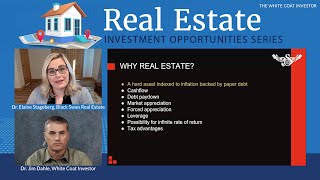
This is a YouTube video titled "Why Should I Invest in Real Estate?" containing a detailed monologue explaining the benefits and strategies of real estate investing. The speaker discusses concepts such as cash flow, debt pay down, appreciation, leverage, and tax advantages, aimed at educating viewers about real estate as an investment asset class. The content includes a disclaimer noting that the hosts of the White Coat Investor are not licensed financial professionals. The video was created in July 2025.
Why real estate? Of all of the various types of investments available, why did we choose real estate? And it really came because we didn't have that model to go to in our own family to look to for financial wellness. And so we asked successful people who were a generation or two ahead of us, and we found there was a very consistent story that these folks were investing in real estate. They might say something like, you know, well, I'm an attorney and I make my income there, but really I'm then shuttling that income over and I'm building this real estate portfolio. I'm a physician, but I'm shuttling that income over into real estate. And so we committed very early on in our marriage that we would do that, that we would earn income from our jobs and then shuttle that into real estate investing. And when I think about real estate, I think of this sentence. Real estate is a hard asset indexed to inflation and backed by paper debt. So what do those clauses mean? A hard asset means that real estate is something real. It's something you can put your hands on. It's sticks and bricks and electrical wire and plumb plumbing fixtures, and the dirt that's under it indexed to inflation means that as inflation goes up, rents typically go up. And the value of real estate also typically goes up because real estate is valued often on replacement costs of how much does it cost to buy those sticks and bricks and electrical wiring and plumbing materials to rebuild that building? And then real estate is backed by paper debt. And so what that means is as the value changes over time, the debt doesn't go up. So the bank doesn't call and say, I know last year when you acquired that apartment building and we loaned say $8 million on it, but it's worth more now, so you actually owe us more on the mortgage. Mortgage continues to go down with that debt pay down. So those three clauses together. Real estate is a hard asset indexed to inflation and backed by paper debt. I think really describes why real estate investing is such an attractive asset class. And then inside of real estate, there's multiple different wealth drivers. Cash flow is a big one. Cash flow, just in summary, is all of your income and then take all of your expenses out and how much is left over at the end of that month. I think of cash flow as a defensive metric. I really strongly believe in investing in cash flowing properties so that that property takes care of itself each month and pays for all of its expenses. Debt pay down means that as you're making that mortgage payment each month, the mortgage is going down. And you're building equity. There's. In real estate, there are opportunities for two types of appreciation. The first is market appreciation, which is the value of that property going up over time. And then the second is what is called forced appreciation. So that's when someone goes into a property and they do either physical renovations, management improvements, almost always a combination of both to force up the value of that property in a shorter period of time. And that's really been a cornerstone of our investing philosophy over all of these years. Real estate is also a very interesting investment class because of the ability to use high quality leverage to get high quality mortgages on these properties, where you tend to have a relatively low interest rate, a relatively long period of time that you can borrow that money. And then the investor is earning returns on the entire value of the property, even though typically the investor only puts about 20 or 25% of their cash into the property. And then the bank carries the rest in terms of a mortgage. And then there's also the possibility for an infinite rate of return. So what that means is you can acquire a property, increase the value of it, go back to the bank and get a new mortgage on that property, and in doing so, pay off the original mortgage and then recoup the invested dollars from the down payment and the renovation costs such that you can then own that property in perpetuity with none of your original capital invested in the deal. And there's few other asset classes where you're able to continue to own an asset despite the fact that you've recouped all of your original investment. And you'll see, through our journey of scale, this has been a critical part of our investing journey because when we were using our own capital, we, you know, we didn't, we didn't have such extraordinarily high incomes that we could just keep buying property after property, property with our earned income. So instead we took our investment bucket, acquired a property, renovated it, improved it, did a cash out refinance, and then used those dollars to buy the next property and the next property and the next property. And then that's also the model we have in one of our private equity funds. And then real estate also has really considerable tax advantages. So kind of in a nutshell, the IRS wants to incentivize society to create food and to create housing. And so there's all sorts of tax subsidies and other tax advantages in the tax code for farmers. And then there's all sorts of tax advantages for people who create housing through depreciation and other parts of the tax code that make it such that dollars earned through real estate investing are relatively tax efficient, especially compared to, say, dollars earned through earned income like at a W2 career.
The hosts of the White Coat Investor are not licensed accountants, attorneys or financial advisors. This podcast is for your entertainment and information only. It should not be considered professional or personalized financial advice. You should consult the appropriate professional for specific advice relating to your situation.