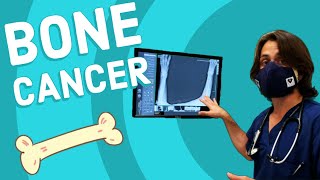
Dr. Lara (Dr. Lera Clone) presents a veterinary case of an older Labrador named Marty with acute forelimb lameness. She explains suspicious radiographic findings (a lytic/lucent lesion in the distal forearm), recommends a core bone biopsy (10–13 gauge) for definitive diagnosis, and reviews likely diagnosis (osteosarcoma), prognosis (often poor), and treatment options (amputation ± chemotherapy or palliative pain management).
Chapters
Hey guys, this is Dr. Lara. Today I'm here with Marty and Marty is an older Labrador retriever. And so Marty is coming in because she had a sudden history of limping on her front right leg. And so in an older lab, that's something that's very, very concerning to me normally. And the reason I say that is because one of the first things that comes to mind whenever I have an older, larger breed dog is bone cancer. And so bone cancer, if it's in the front leg, I'm going to use her left leg. Just because her right leg is painful. The bone cancer typically is going to be in this area. I know, you're such a sweet girl. So like in the wrist area or it's going to be in the shoulder area over here. And so when I went ahead and palpated, which means just kind of put pressure on her forearm, she was actually pretty uncomfortable for the amount of pressure that I put on her. So usually when we see that on a physical exam and we have that history, what we do is we go ahead. If you do have bone cancer as potential for your cause of what's going on, X rays is going to be the next thing. So what we're going to do is we're going to go ahead and we're going to go ahead and take a look at some X rays that we did on Marty. And so if you look over here, this is Marty's forearm. Okay. This is her wrist and then this is her elbow. If you guys look right in this area right here, this is an area that is highly suspicious of some sort of cancer, infection or something like that. Now when I go ahead and pull up this next shot for you, you'll be able to get a better idea, comparatively speaking, what the legs look like and what they should look like. So you can see here we have this what we call lucency or lytic lesion, essentially you can see that it's more like a blackish and that's kind of like a see through versus when we look over here, the bone structure is much, much, much more dense. And so normally when we have bone cancer, it is going to be like I said, much closer to the wrist. So this is something that is actually out of the ordinary and something that isn't the usual case. So what we're going to have to do is we're going to have to do what's called a core bone biopsy, where we actually stick a large gauge needle, probably like 13 gauge or 10 gauge needle through this and we collect samples of it now when we send it off to the lab. Bone traditionally is more difficult to put through the process of preparing for histopathology or looking at it under the microscope. So it can take up to two to three weeks for the lab to prepare it. And it is typically more expensive. So don't be surprised if your veterinarian says, hey, it's going to be X. And if you've looked around online or something like that and you see that the cost is more expensive than what you found, it's most likely because the other price that they're comparing is to a normal tissue biopsy versus a bone biopsy. If this does end up being bone cancer. The most traditional bone cancer, osteosarcoma, is not a good prognosis. Typically it is very aggressive and usually amputation is one of the treatments that is recommended, plus or minus chemotherapy, plus or minus some other alternative therapies as well. So otherwise if you guys decide not to do any sort of treatment, then all we do is pain management and that's going to include some anti inflammatories, something like gabapentin and or turmeric tramadol and just figuring out what really works for her to provide the most pain relief and the best quality of life. If you guys have questions about this particular topic, please leave it in the comment box. If you found this video helpful, give us a thumbs up. If you know somebody whose dog is going through this and you think they need to see it, please share it with them. If you guys have any questions, just let us know. Be safe. And PS Bone cancer in cats typically is much different than it is in dogs. If you want a video about that, just leave it in the comments. Thanks.