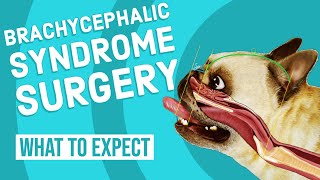
Dr. Lera Clone walks through recovery from brachycephalic surgery on Giovanni, an English bulldog. Expect two weeks of healing with most improvement by then, some blood in coughing or drool is normal, and you'll need to keep your dog calm, use a cone, and give trazodone plus omeprazole for a month.
Chapters
Hey guys. Dr. Lehre here today. I'm here with Giovanni. And so what we're going to be talking about is what to expect from your dog, in this case an English bulldog, on what you'll see after a brachycephalic syndrome surgery or elongated soft palate or stenotic nares, whatever. Alright, stay tuned. All right, so Giovanni came in today because he has what we call brachiocephalic syndrome. So he has an elongated soft palate. He had what are called stenotic nares. And so this is something that we've done a video on before in regards to what the condition is and how we go about it. And so what I'm starting to realize is that people have specific questions about what to expect after anesthesia. So this video is going to be more about that. If you have questions about what the condition is and the treatment, you can go to our other video on what brachycephalic syndrome is and more in detail on the treatments and that kind of stuff. So in regards to Giovanni, he did have the elongated soft palate performed. And so one of the things that you would expect after surgery would be you should see a reduction in the amount of noise that's occurring. That being said, you still may hear a different noise. And so the reason being is because they just had surgery done and the surgery is going to cause some swelling, which is totally normal. And so that's kind of what. What you should expect. The other thing is you. It'll take about two weeks before the patients are completely healed. And you should probably see the most significant and most dramatic and what we would think the complete results of the procedure. That being said, you may notice some coughing with some blood in it that's totally normal and also some sleep sneezing with some blood in it. You may or may not be able to notice it, but Giovanni did have surgery on his nose to go ahead and open up his airways as well as on his elongated soft palate. And so of course, whenever we're doing surgery, we're typically cutting until there's fresh tissue. So coughing with some blood is totally normal. Shouldn't be like a lot, it should just be small amounts. Same thing with the nose. Sneezing with the blood is totally normal. Now the other thing to be aware of is that we will want to keep them calm for two weeks. Now, Giovanni is going to be sent home with trazodone today, which will be used to help keep him calm. We don't want them to be too sedated during this process because we don't want them, their airway to collapse. So Trazodone is something that's right in the middle. He will be going home with Daramax. Daramax is not a sponsor, but that's the non steroidal anti inflammatory choice that we use when patients are recovering from this particular procedure. You'll also notice or you may not be able to notice that he is wearing a harness, he is not wearing a collar, and even if he was wearing a collar, it would be fine for him to wear it. But we don't want anything putting pressure on the airway during those two weeks. We want the airway to be as safe and free from pressure or stress as much as possible. That being said, the other thing is that we don't want any, we don't want them engaging in any activity that's going to cause increased respiratory rate or increased stress or anything like that. So like if, if they see somebody and that person typically, typically gets them excited, you'll want to try and keep that person from coming over the house for the next two weeks while they're healing. Assuming it's not the actual owners. You won't want to get them riled up just because again, you don't want to really put any stress on that airway. And you want that airway, you want to give that airway time to heal. The other thing in regards to recovery is food. So food, you may need to go ahead and give them soft food for two weeks. Some dogs will do fine with dry food. It's gonna be, that one's gonna be a case by case basis and that's gonna be something that you'll kind of feel out. The other thing that you'll want to take into consideration is you don't want to give them large amounts of water during the recovery time because dogs, some dogs will tend to gorge on water and that will make them more prone to vomiting up. And we really don't want vomit coming back up into the airway or in that area because that tissue is still sensitive and we want it to heal. And of course, if there's vomiting, there's some acid in that stomach contents and so that's not going to be ideal for healing. The other thing, especially with bulldogs, is that we normally dispense omeprazole, which is a proton pump inhibitor that is an acid reducer for 30 days. Most dogs that have upper airway disease usually do have some sort of reflux and it could potentially even be secondary to the airway disease. So we want to go ahead and try and minimize, again, any sort of acid that's going to be potentially coming up and not allowing that tissue to heal as best as possible. You can see that Giovanni is looking at one of our hospital cats. Her name is Figment. She's just hanging out, making sure we're doing everything we're supposed to be doing. Other than that we've talked about, you know, again, just kind of recapping. We've talked about making sure that they don't get excited. We've talked about soft or wet food. We've talked about water consumption. We've talked about also it's okay to see some blood when they cough or blood when they sneeze, or even some blood in the drool because that's of course part of the mouth. And then the other thing that you would want to take into consideration is he is going to need to wear a cone, ideally for two weeks. That's because he's got stitches on his nose and that is something that we do want to heal. If he scratches it out, it's not going to be the end of the world, but it is something that's just not going to make it for an ideal recovery process. And if you guys have any questions about this particular topic, please leave it in the comment box. If you found this video helpful, please give us a thumbs up. Subscribe, subscribe and share. If you know anyone who needs to watch it. Thanks for watching and be safe. Bye Bye.