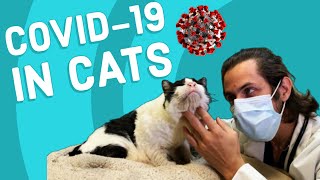
Dr. Lera Clone explains that cats can catch COVID-19 and transmit it to other cats through the air, while a Science study found ferrets could be infected but didn't spread it that way. A zoo tiger also tested positive. If you're sick, keep distance from your pets and wash your hands.
Chapters
Hey, guys, Dr. Lariat here again, follow up to our three previous videos about COVID 19. As you can see, you know, we are at that point now here in Heron Lake Samuel Hospital, where we are pretty much out of surgical masks. And so we have now had our team members make some reusable masks with filters in place. Obviously, the other thing that is in evidence that we are experiencing, experiencing the lockdown of COVID 19 in 2020. There's my half up, half down, man bun. As you can see, salons are now closed. And even if they were open right now, not somewhere I would be going. So the biggest update as of right now is the infection of cats with coronavirus, or COVID 19. Most recently, we had a tiger initially get infected at the Brock Zoo from a human transmitting the virus to the tiger. And after they went ahead and tested that tiger, other lions and larger cats at the zoo did start developing clinical signs for COVID 19. There was a study that was published in the journal titled Science. And this is a study where they were going ahead investigating which animals are susceptible to COVID 19 and which ones are not, also trying to determine whether or not the virus can be spread from animal to animal within the same species. And the main purpose of that study was to go ahead and determine which animals. And I'm vegan, and this is something that is, you know, tough for me is the animals that they're going to use for the studies to try and come up with vaccines, they have and will continue to euthanize other animals. I know, I'm sorry, the. These animals, when they collect the samples and harvest the tissue to find out where the virus is going. The purpose, what they ended up finding on this study was that ferrets, ferrets and cats, by the way, are very, very similar. When we give vaccines for ferrets, a lot of the times it'll be a similar vaccine to cats, if not the same vaccine. And sometimes if people are in a pinch. Just to give you an idea of how similar cats and ferrets are, ferrets can be given cat food, although there is some specifically ferret food out there. If you're in the pinch, you can't get ferrets cat food. Now, the ferrets in the study were who were inoculated with COVID 19 did develop the virus replicating or reproducing in different parts of the nose, the turbinates and that kind of stuff, but they did not spread it to the other ferrets through the air. So it wasn't Necessarily that they were able to pass it through micro droplets. Cats, on the other hand, were able to spread the virus from one cat to another cat by airborne transmission. And so this goes back to one of the first video, if not the first video that we made on COVID 19, where we talked about how we weren't sure if your cats were going to be able to go ahead and get sick from the virus. Dogs, as of right now, really do not show much likelihood of being able to get sick with the virus, nor do they have a big enough virus load to act as a reservoir to go ahead or a vector to spread the virus. With cats. Cats, we don't know if they are able to go ahead and act as a reservoir, transmitting the virus from the cats to the humans. And so, but I would say that there is a higher likelihood that that is going to be possible. I'm not saying it's going to happen. So we're talking about maybe like a 2, a 1% chance to a 2 or 3% chance. These are just hypothetical numbers. I'm not pulling them from any sort of studies. That being said, it is not recommended, I repeat, not recommended to abandon your cats. You're not going to abandon your family members if they get sick. That's what they are to. So what is important is to go ahead and make sure that you are doing social distancing with your pets if you happen to get sick. That means hand washing, especially after interacting with the cats. It is something that you don't want to share. Any sort of plates, spoons, kissing them on the face, that kind of stuff. Those are just things that are putting yourself at increased risk for no reason. If your cats have not been exposed to anyone and your cats are strictly indoors and you are following the quarantine, then the odds of your cats having coronavirus or COVID 19 is extremely low. If your cat is starting to show clinical signs, it is extremely important to let your veterinarian know. This is something that we have yet to deal with at Heron Lakes Animal Hospital, but it is something that I anticipate we will most likely end up seeing in the future. And that is going to be an interesting situation because the animals will potentially be at an increased risk for us as the humans to potentially get Covid. Because where did the animals get it? They probably got it from one of their family members, and that means that the family members have to come. So we as the veterinary staff are going to be at an increased risk of getting COVID 19 at the end of the day, like I said in one of the previous videos, most likely everyone in the world is going to have to get this or at least 70% of the population is going to have to get this particular disease. It's going to have to run its course. Hopefully by the time that the majority of people are starting to get it, we have found ways to treat it successfully without losing a lot of lives. This is our cat, Patches here. He is an older cat and he's sometimes a little crotchety. So that's why we go ahead and we want to be cautious with him. But the word that you will hear is something called fomite. That just means that the cats, animals can act as a, I guess a place for you to get the virus. The chances of this are very, very low. Somebody would have to sneeze our cough on their hand or expel some sort of secretions on the pet's hair. And then that pet would have to be around somebody fast enough or in a short enough time frame where the secretions do not dry. That person would then have to go ahead and touch that particular area and then touch their face to potentially transmit the virus to themselves and have the patients or my patients or pets act as a fomite. The numbers that I've heard is something in the neighborhood of a 10% transmission rate for fomites, not for pets. So that being said, just be aware that this is not going to be a 10% transmission of cases from pets to humans. We do not have anything documented as of right now. At the end of the day, be safe, use proper social distancing and also know that you want to go ahead and you want to have proper hygiene. If you guys have any particular questions about this video or any of the newer information that's coming out, please leave it in the comments. More than happy to go ahead and talk about it. This is an area for us to share, not for somebody to be right. People are going to end up being wrong a lot of the time with this particular disease. This early on, it is called practice for a reason. We do not have all the answers. We are constantly learning. So as of right now, be safe, take care, subscribe and if you know somebody that you think needs to see this, share it with them. Thanks for watching.