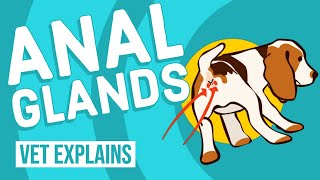
This content was created by Dr. Lera Clone. This content was uploaded by Dr. Lera Clone. This is a YouTube video titled "Dog Anal Glands | Vet Explains" created on September 22, 2022. It features Dr. Lera Clone explaining the function, issues, and care of dog anal glands, including signs of problems and how to express them, with a focus on smaller breed dogs.
Chapters
Hey, guys, Dr. Lara here. Today we're going to be talking about super exciting and not gross. Maybe a little gross. Anal vans. What are they? Why does my dog spin in circles on the ground? And why does it smell like dead fish? Stay tuned and we'll get into that momentarily. All right, so what exactly is an anal gland? Yes, anal gland. All right, so in dogs. This is Ginger. Sorry, before we go ahead, I'm gonna take her on a date, buy her a drink, and then we'll go into this. But I've known ginger for 10 years now, and she does puts herself in weird positions on my pillow, right in my face. So I think we're beyond that. So it's okay. She's consenting to this. So dogs have anal glands, and it's kind of right in this area right here and here. And so what normally happens is these glands are glands that contain this material. And it's an oil based material. It smells really gnarly. And what I anticipate, most likely it was used for in the wild was to go ahead and mark their territory. Now you might say, oh, urine marking the territory. The urine is also water based. So there's a possibility that that might get washed away with some rain or something like that versus with rain or the anodes. The anal glands are less likely to get washed away because of that oil base. So I anticipate, most likely it was something that could be used potentially for marking their territory and then also to go ahead and scare off any larger animals that might be trying to prey on them. You know, they go ahead and express their glands and they're almost kind of like skunk glands is what I would think would be something that you could compare it to. So now what exactly? How do they work in regards to the inner gland? So normally those glands sit right there, and when the dog squeeze, hopefully you're not squeezing that hard, because if you are squeezing that hard, you might get a hemorrhoid, eat more fiber. Some green vegetables, green leafy vegetables. Those are really good for you. Maybe even some canned pumpkin. That's what we recommend for our patients is Metamucil or canned pumpkin. When they squeeze to poop, usually what will end up happening is they will express those glands a little bit themselves and it'll go on their poop. Now, if your dog is maybe not expressing their anal glands very well, or if their anal glands are blocked or clogged, then what you might see is you might see that your dog is licking back here a lot, chewing a lot or they might be dragging their butt on the ground. So e can see if you can get me dragging my butt on the ground. Okay. So essentially they're gonna look like this, doing like a little like dance move and then dragging and kind of like that. That's exactly what they're going to kind of look like. And so they're hoping that. Excuse the tangling myself up in the. In the lavalier cord or the microphone cord. They're hoping that they can try and get some relief by putting pressure on their butt to go ahead and express those glands. Now, it's something that is going to be much more common in smaller breed dogs. Smaller breed dogs are going to be more prone to having problems with their anal glands because. And I'm going to put Ginger down just because I think she wants to get down. Don't get tangled up. I know. I know you're going to get tangled up. I know you're getting tangled up. So real life scenarios, we're filming this live. Live. So smaller breed dogs are prone to this because that gland has a little tube that empties out into right by the butt where the butt opens. And so that tube on the smaller dogs is much smaller. So it's much easier for any sort of chunky material, thick material, in the anal gland to then go ahead and clog up that duct or that tubing. Versus in a larger breed dog, you're going to have a big, bigger tube. And so it's going to be harder for that gland to produce a material that's actually going to cause it to get clogged. Okay? So get your minds out of the gutter. I'm not doing this. This is more about going ahead and clearing the duct. I don't want you going anywhere where I'm not intending. All right, now, how often should you potentially have your dog's glands expressed? Typically, that's going to depend on how the glands are being expressed. So there's typically three ways that we talked about. One is going to be naturally. Two is going to be doing an external expression, which a lot of times groomers will only do an external expression. I have yet to find a groomer who does an internal expression. And so what they do is they just kind of like grab right by the butt and they'll squeeze that. That doesn't always necessarily express the glans completely. So don't get on your groomer if they're not doing internal expression. Now, we at the veterinary hospital and almost any veterinarian or veterinary technician, what they will do is they'll go inside the rectum and they will actually milk the gland and express it. And that's going to be the best way, A, to feel if the gland is completely empty and B, also if there's something funky with the gland, like if there's a mass in there or something like that, that's going to be the best way to go ahead and express it. Now, how often should you express it? Typically, I might say anywhere between four to eight weeks. For dogs who are going to need it on a regular basis, you're going to need to go ahead and be very cautious because if you don't express it and it does get clogged, if it goes on long enough, the gland can actually rupture, splat on your. No, not on your face, hopefully not on your face. And that can be something that's really, really painful for them. They will normally end up doing that butt dragging. They'll be chewing and then all of a sudden out of nowhere you'll notice, but you'll notice blood leaking by the butt. And so that is typically going to be a clear cut sign that they most likely had an anal gland rupture. Okay, so that's pretty much what an anal gland is. If your dog's anal glands are full, what signs to expect, how we go about expressing the anal glands and how often the anal glands should be expressed. Okay? Otherwise, if you guys want us to get into a video of ruptured anal glands, leave it in the comment box. And just a question just at the very end, which dogs have most anal gland issues? Is it small dogs, is it medium dogs or is it large dogs? Or like when I used to be in school, all of the above or none of the above? You let me know in the comments and we'll go from there. Thanks for watching and have a blessed day.