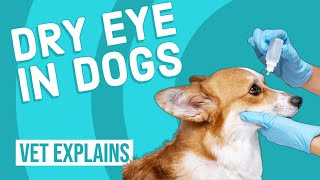
Dr. Lera Clone explains dry eye in dogs using a patient named Miles. A Schirmer tear test showed asymmetric tear production (6 mm vs 17 mm). Treatment typically involves topical cyclosporine or tacrolimus, which take about 6 weeks to work, and often requires lifelong therapy.
Questions this video answers
Keratoconjunctivitis sicca.
Right eye: 6 millimeters; left eye: 17 millimeters.
Cyclosporine or tacrolimus (sometimes combined).
About six weeks.
The parotid duct (salivary gland) can be transposed to the eye area in rare cases.
Chapters
Hey, guys, My name is Dr. Lara here at Heron Lakes Animal Hospital Today. I'm here with Miles, and the topic of the video today is going to be dry eye. Stay tuned and we'll get into that shortly. Hey, guys, my name is Dr. Lara. So the video of. The purpose of the video today is to talk about something called dry eye, or kcs. KCS stands for keratoconjunctivitis sicca. And what that's fancy for, again, is dry eye. So typically, dry eye is something that you will notice. Your dog will start having a lot of eye boogers. And it happens as a result of this gland that sits right in this area right here. And that gland produces a lot of the nutrients and the lubrication for the cornea and that kind of stuff. And so if that gland is not working the way that it should, then what will end up happening is you'll start noticing that the boogers will start going ahead and accumulating. One person, some people might think, well, if he's not producing enough tears, then why would you start seeing boogers more? And the reason being is because the boogers start to become thicker. And so as the boogers start to become thicker, then it's going to be more obvious to see them. That being said, it is something that is usually medically managed, and it is something that is usually something that is acquired. There are a couple of different forms. There's a neurologic form that can be tied to trauma or cancer to the nerves that affect that particular part of the body. It could be a result of inflammation. So in Miles case, Miles actually has allergies going on right now. And so that's something that could potentially be impacting it. I have seen cases where this is temporary versus something that is permanent. And then there are even sometimes some medications that could actually cause this particular condition. Sometimes the results are permanent, and sometimes the results are temporary. Just depends. As you can see, Miles is trying to chew his leash, which is why I'm playing with him now in regards to diagnosing the condition, the way that we typically diagnose the condition. If you can grab me one of the little strips just so I can show people what those strips look like. Essentially, what we do is, what we do is we go ahead and we stick these little pieces of paper inside the eye, literally. And so what we'll do is we'll get one of these pieces, we'll stick. We'll pull the lid, the bottom lid out. Typically, you can go ahead and hand it to me. I See here? And so what we'll do is we'll typically go in there, and then if you go to the camera, you'll let me know as I get into the picture. So I don't know if you guys can see it. So there's lines and numbers on this. And so we should be getting to about the 15 mark or the 20 mark. And this little thing right here, that's where we actually fold it and put it into the dog's eye. So this is something where that little mark that you saw on the piece of paper, that's an ink. And that ink will go to the part where the tears stopped producing. Usually it should only be about a minute before we get to that point. If it's taking longer than that to reach the 15 mark or the 20 mark, then that means that they're not producing enough tears. In Miles case on his right eye, which is the one with the patch, he only produced 6 millimeters worth of tears, versus with his left eye, the one without the patch, he's actually producing about 17 millimeters worth. Now, the other thing is, when we go ahead and we put these patients on the most common medication, the most common medication is cyclosporine or something called tacrolimus. It's one or the other medication. Sometimes people will combine the two medications. These will take about six weeks to kick in. And on top of that, it is something that can sometimes cause irritation. So if you notice that your dog is having more redness after the drops or something like that, it is something that could potentially go ahead and be caused by the drops that you're actually putting in the eye. So be aware of that. That being said, when you bring him back to the vet for a recheck, make sure that it is something that you haven't put any sort of drops in his eyes the morning of, just because you don't want any artificial lubrication or liquid in. In the eye, when we're retracting to it. In the rare cases where they don't respond to any of the drops or anything like that, we might be able, you know, some people might actually pull some stuff from the parotid duct, which is a gland that sits in this area over here. It is not meant for the eye, it's meant for the mouth. But what ends up happening is they go ahead and they put this tube that comes in right in the eye area, and they. If you want, you can go ahead and take Miles just because I think he's ready to go home anyways. There you go, guys. Say bye to Miles. Thanks, Miles. They're great. Come on. You want to go see mom and dad? So, yeah. So it's something where we can go ahead and there are some surgical options, but the surgical options are very limited. In the past, we used to have some people, or veterinarians in general that thought that it was okay to cut out the third eyelid or for other procedures where the gland would be sticking out. That is not recommended at this point. That's a treatment for cherry eye. If you do end up having to have your dog on this medication, it is very likely that it is going to be lifelong. So keep that in mind. Other than that, like I said, it's going to take about six weeks for the medication to potentially kick in and to see its full effect. So be aware. And if that first medication doesn't work, then we may have to switch to a different medication and wait another six weeks after that. Okay. If you guys have questions about this particular video, please leave it in the comment section. If you found this video helpful, please give us a thumbs up. Subscribe. If you know somebody who needs to watch it, share it with them. Thanks for watching and be safe.