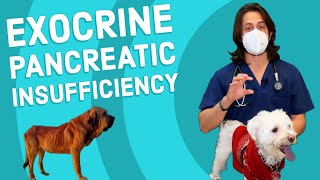
A veterinary educational YouTube video by Dr. Lera Clone using a case (Milky Way, a six-year-old male Maltese mix) to explain exocrine pancreatic insufficiency (EPI) in dogs. The video covers clinical signs (weight loss, poor appetite, soft stool/diarrhea, thin body condition), diagnostics (bloodwork, X-rays, ultrasound, specific blood tests: TLI/PLI, cobalamin, folate), causes (congenital atrophy—common in breeds like German Shepherds—or acquired from chronic pancreatitis or cancer), treatment (B12 injections, probiotics, pancreatic enzyme supplementation warmed/mixed on food ~15–20 minutes before feeding) and prognosis considerations. It also notes concurrent intestinal parasites in this case and that EPI requires ~90% loss of exocrine pancreatic cells to manifest.
Questions this video answers
Six-year-old Maltese mix (Milky Way).
About 90% of exocrine pancreatic function/cells must be lost.
TLI (trypsin-like immunoreactivity), PLI, cobalamin (vitamin B12), and folate.
Intestinal parasites.
About 15–20 minutes.
Chapters
Hey guys, Dr. Lera here today. I'm here with Milky Way. Milky Way is a six year old Maltese, mixed male. And the topic of today is going to be what we call EPI or excrin, pancreatic insufficiency. I know it's a mouthful. It's going to be talking about what it is, how to diagnose it, how to treat it and what the prognosis is. All right, so Milky Way came to me because mom was saying that he had had a history of weight loss. He wasn't really doing well, he was kind of having a picky appetite. He started having some soft stool or diarrhea. And so when he came to me, we did some blood work to see if there was anything going on. We did some X rays, there wasn't anything obvious there. And so we went ahead and started him on some anti diarrheal stuff. Metronidazole, sucralfate, provable, the usual stuff. I mentioned that in our blood in the stool video then we weren't finding anything there. And he's very, very thin. It's hard for you to tell based on his sweater. And so we went ahead and did an UL ultrasound. When we did the ultrasound, they didn't really see anything on that. But when I had been consulting with the internal medicine specialist before the ultrasound and then the internal medicine specialist who did interpret the ultrasound images, we were concerned about a potential malabsorption disease. So malabsorption is essentially the body is having difficulty going ahead and absorbing the nutrients and, and the minerals and the vitamins. And so that's what extracurrent pancreatic insufficiency is, or we'll just call it EPI from this point in the video out. Now, the pancreas, what it does, amongst many things, is it produces these enzymes which help break down the food. So that way the food can be the minerals and the vitamins and the nutrients and all that good stuff can be absorbed by the body and utilized. And so the most common cause of EPI is what we suspect to be a genetic cause. And it is something where the certain cells or the astronomer cells of the pancreas are atrophied. And that is typically something that we will usually see in younger breed dogs. German Shepherds are the poster child for the, for this particular condition. And so that's the most common thing. Now the other thing that nor we will see is when dogs develop this later in life. Usually on average, dogs who develop it later in life are, they're Usually four years old. Milky Way is a little bit older. And so some of the things that can cause that would be cancer or chronic pancreatitis. So pancreatitis. If you guys haven't seen our pancreatitis video, pancreatitis is just an inflammation of the pancreas. We don't know what the necessary cause is. But if there's inflammation going on with the pancreas, the cells of the pancreas are being damaged. And so then that can lead to having those cells that produce the digestive enzymes being pretty much wiped out. For patients to have EPI, they need to have about 90% of those function cells gone. That's the same in humans. So the way that we diagnosed it was a special blood test which we check what's called the tli, the pli, the cobalamin and folate. And those are nutrients that go ahead and are. If they're not being absorbed or if they're having a malabsorption disease like this, they're going to be pretty low. So one of his values was low, and it was diagnostic for him having this particular condition. On top of that, he also had intestinal parasites. So that only made the situation worse. When I went ahead and did was during my exam, on the multiple days that he was coming in for the different tests and that kind of stuff, he had some diarrhea. And when he had diarrhea, the diarrhea looked pretty much like undigested food. And even though I had an inkling or an idea that it was, or that EPI was on my differential list, that kind of like, almost solidified it for me because I was like, that looks exactly like it would if it was just going in. And that's one of the other things that you can tell if you have a dog that or cat that has epi, usually it's going to be the same volume of poop coming out as food going in. And a lot of the times the poop will look the same as it does going in. That wasn't the case with Milky Way. Mom did not mention that. But later on in the disease, it did end up being that way. So now what we're going to be doing is we're going to be starting him on some B12 injections just to kind of support his immune system. We're going to have him on some probiotics to go ahead and help repopulate the flora of the GI tract, because sometimes they can have some sibo, which is a imbalance in the gi flat in the GI tract. And then what we are going to do is we're putting him on some digestive enzymes that will go ahead. We put them on the food for about 15 to 20 minutes beforehand, mix it all up, let those enzymes break down the food so that way when he eats it, it actually can be absorbed. If you guys found this video helpful, please give us a thumbs up. Subscribe and if you know somebody who needs to watch it, please share it with them. Thanks for watching. Take care and be safe.