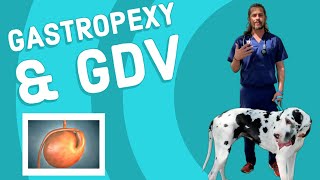
Dr. Lera Clone explains gastric dilatation and volvulus (GDV, “bloat”) in dogs: pathophysiology (stomach distention and twisting), emergency interventions (tube decompression, trocarization, emergency surgery), and the preventative surgical option gastropexy. She discusses risk factors (large/giant breeds, meal/drink habits, raised bowls), prognosis drivers (tissue necrosis, reperfusion injury) and practical recommendations (perform gastropexy during spay/neuter or around 8–14 months if done separately). The video also notes mortality estimates, cost considerations, and that Nationwide’s “Whole Pet with Wellness” product may cover prophylactic gastropexy.
Questions this video answers
Layla — 4-year-old female, intact (not spayed), Great Dane.
Reported mortality between 10% and 45%.
About $131 per month for the Nationwide "Whole Pet with Wellness" plan (as quoted for this patient).
Approximately 8 to 14 months of age.
She states mortality increases about 10-fold when necrotic tissue is present.
Chapters
Hey, guys, Dr. Lara here. Oh, my God. Where's my map? Oh, no, I'm outside. Just kidding. It's been a while since we've made a video without a mask, so figured we would go ahead and take advantage of the beautiful day today. I'm here with Layla. Layla is a four year old female, intact, which means she's not spayed. Great Dane. Now, Layla, the topic for today is something called gastric dilatation volvulus, and we call it gdv. Some people might call it bloat. So essentially what ends up happening with GDV is dogs will go ahead and eat food, specifically larger breed dogs, the stomach will get really full, and then the stomach will end up turning on itself and cutting off the blood supply to the stomach. Now, there are different variations to this. Sometimes the stomach can just get really full or filled with air and that kind of stuff, and that's just gastric dilatation. The volvulus is the part where it becomes very, very dangerous and very problematic. Now, with that particular condition or those conditions, there are a couple of things that can be done. One thing that can be done is a tube can be stuck down the throat into the stomach to try and decompress the stomach and then see if the stomach can rotate off of itself. The second one is where sometimes veterinarians will go ahead and they will poke a hole through the stomach wall, the abdominal wall, and into the stomach to go ahead and try and decompress it that way. And then the other thing is we would have to go to emergency surgery where they go ahead and open the dogs up, untwist the stomach, evaluate all the tissue and see if all the tissue is healthy and that kind of stuff. Now, the reason that this is dangerous and potentially deadly, anywhere between it's been reported between 10 to 45% of dogs who get this die. And so the reason that that can happen is because the blood supply gets cut off to the stomach, and then the stomach and all the tissue below where the blood supply has been cut off starts dying. And then that just sets off a chain reaction of events that ends up leading to damaged kidneys and major organ failure. Now, one of the things that can be done to go ahead and prevent this, or the main thing that can be done to prevent this is what's called a gastropexy. Now, what a gastropexy is essentially is we go into the stomach or into the abdomen and we make an incision along the certain part of the intestine and the stomach and Then we go ahead and we make a similar incision along the side of the wall on the inside of the abdomen. And we go ahead and we place those two bleeding edges together and we stitch them to each other. What ends up happening is those bleeding edges will heal together and then the stomach will end up anchoring to the side wall. And so then you don't have to really worry so much about the gastropex, about gastric dilatation, volvules. Now you've pretty much gone ahead and prevented that from happening in the future. The other thing is that when we do this particular procedure, typically it is something that I recommend to when the dogs are either being spayed or neutered, because it's something that typically the surgeons can go ahead and do in one anesthetic episode instead of having to have two different anesthetic episodes to go ahead and take care of this. Now, some of the things that we've noticed recently that can cause the dogs to be more prone to GDV or bloat. You can have dogs, typically males, if they're eating large volumes of food in one sitting, or if they only eat once, also if they do have raised bowls, that's something. Or if they drink large quantities of water all in one sitting. Those are things that do seem to predispose dogs, regardless of the breed, to the bloat or GeV. Now, the other thing that I want you to know is this is something that is more commonly seen in large breed dogs like Rottweilers, Labradors, boxers, that kind of stuff. And then the giant breed dogs like Great Danes, Neapolitan, Mastiffs, German, you know, Akitas, Shepherds, Akitas, those kinds of breeds. The other thing that I did want to let you know is so just a couple of things to be aware to give us indications of how the dogs are going to do when they are in surgery. If we get to them early enough, then what we will do is we will be able to go ahead and we will be able to see, evaluate all the tissue and see if the tissue is what we call viable, meaning that there's been no necrotic tissue developed or none of the tissue has died off. If the tissue, if there is tissue that is starting to die, then that does increase the chances of mortality or death. Increasing it, I think, by 10 times versus a patient that does not have any sort of necrotic tissue. The other thing that sometimes we have to be aware of is when we go ahead and we untwist that stomach, what we can be concerned about is what's called reperfusion injury. And what that means is the blood will start flowing back through all that tissue. But now all that, all those cells that started dying and that kind of stuff, the blood will go ahead and start pumping that through the rest of the body. And then that could lead to potential damage and complications and that kind of stuff. So that's something that we definitely have to be aware of. One of the other things that has been kind of a myth and has been busted in regards to being a cause for bloat is giving your dogs really cold water or giving your dogs ice. That is not something that is known to cause gastric spasms or stomach spasms, which would then end up leading to gdv. If a dog drinks way too much warm water, they're much more likely to go ahead and get GDV as a result of that, rather than eating ice or drinking really cold water. Really the biggest thing that you would have to worry about with eating ice is if they go ahead and fracture their, you know, potentially fracture their teeth. That those are, you know, the most common things that I usually like people to know. The cost is going to vary from place to place. Obviously, you know, doing the gastropexy preventatively before anything is wrong is way less expensive than it is if you have to wait till it happens and it's on emergency. Number one, the patients are not stable at that point. So then we have to go ahead and have to deal with trying to stabilize them. Two, if it's happening after hours, odds are then you're going to be charged an emergency fee. So if you can, it is recommended that you go ahead and have this procedure done when you are having your dog spayed or neutered. The other thing is, if you are not going to get your dog spayed or neutered, I would most likely look at having the procedure done probably between 8 to 14 months of age. The other thing that I did want to let you know is there is one insurance as of right now that I am aware of that does cover what we call gastroplastics. And that particular insurance is Nationwide. It's offered by Nationwide and it is a product called Whole Pet with Wellness. It is something that you would have to go ahead and call Nationwide and ask them about it specifically as to how much it would cost. I think for her at this particular age, they said it was going to cost about $131 a month. It is a comprehensive insurance that covers almost everything. So if you can swing it, I highly recommend it. But that is an insurance that does end up covering that particular procedure if it was something that might make it easy for you. Other than that, if you guys have any questions about this particular video, leave it in the comment box. If you found this video helpful, please give us a thumbs up. Subscribe and if you know anyone who needs to see it, whether it's friends, families, or even maybe rescue groups, share it with them. Thanks for watching. Be safe. Make sure to wear your masks. It.