
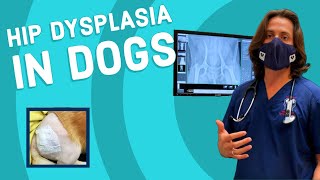
Dr. Lera Clone uses a golden retriever named Belvedere to explain hip dysplasia in dogs. The video shows what normal and dysplastic hips look like on X-rays, then covers three treatments: total hip replacement (expensive but fastest recovery), femoral head ostectomy with physical therapy, and early screening to prevent it.
Questions this video answers
3.5 years (three and a half years old).
About 30% coverage.
About $7,000 to $12,000.
Femoral head ostectomy (FHO).
About five to seven times per week (daily or nearly daily), one to two hours per session if done at home.
Chapters
Foreign. Doctor Lara here today, the video or topic for discussion is hip dysplasia. So we have Belvedere. And belvedere is a 3 and a half year old male golden retriever who was coming to me because he wasn't feeling well, he was acting weird. And so when I see that, you know, mom had said that he wasn't jumping on furniture, which is not normal for a three and a half year old dog. That might be something more common in a dog who is maybe like 7, 10, 9 years old, a geriatric dog versus a young dog like Belvedere. The other thing is that she was saying that he needed to be picked up into the car. And so even though he was still roughhousing with his brother, who's a Newfoundland or what we call a newfie, and he was still willing to play with him. And so when I did my physical exam, I was doing an orthopedic exam to see if I was able to find an area that was painful on me. And when I did it, I was able to find an area that was painful on his lower back when I was pushing down. That led me to believe, hey, the pain is in this area. And so then the next thing was, is it potentially his hips? And so typically what we'll do is on a dog who had, when we're checking for hip pain, I'll grab the leg and I'll pull it back kind of like that. And if the dog's had any sort of hip pain, a lot of the times they're gonna be painful when I pull back that leg. Now the other thing was he was also painful on his other leg as well. So that led me to say, hey, we need to go ahead and do actions. So we went ahead and we did X rays on Belvedere. And so this is Belvedere's hips. Now, one thing I'm going to do is I'm going to flip to another dog who has what we call normal hips. And so you can see right here we have kind of like almost like an hourglass shape where it kind of comes in like this. You can see the socket of the. The femur or the hip or the leg is in the hip or I guess the plate. This is called the acetabulum. And so it's clear, very clear that there's a net on this versus when we go ahead and we look at Belvedere's. So now he almost looks like a football player who has no neck. He looks like a linebacker. And then the other thing Is it doesn't look as smooth on here, and it doesn't seem to be sitting in the. The socket as well as the previous X ray. And so right here, we're only getting maybe about 30% of this bone sitting in the cut, per se. So what we ended up doing was I consulted with one of my experts that I surround myself with, and we said, hey, he does have hip dysplasia. We do need to go ahead and do surgery. Now. He does have two bad hips. A lot of the times, if you go ahead and do surgical correction on these particular patients, you only have to do one hit because they'll actually do really, really well after they have the first hit done. Okay, now, the treatment of choice for this, once you get to this point, is a total hip replacement. A total hip replacement. What they'll do is they'll come in, most of the time, they remove this part of the femur, and then they implant a metal femoral neck, and then they actually have a metal plate or acetabulum right here. And so that will actually go ahead and provide. It's essentially the same thing as a human who gets a total hip replacement. This provides one of the fastest recoveries. It is something that is pretty expensive. We were calling some of the local surgery centers here, and the one place that does do it, they were charging between 7 to $12,000 for that particular surgery. It is not something that can be done at any hospital, but it has to be done at very specific hospitals, because the level of sterility that needs to be done or happen at that particular facility, especially for total hip replacement, is at a whole other level. And that's why so little places actually do it. The other thing is, you usually are going to want somebody who has done a lot of these, so that way they know, you know, what to expect in terms of complications and what they can do to try and prevent it. Now, if you have a dog or if you're not in a situation where you can spend 7 to $12,000 or you don't have pet insurance, then the next thing that we will normally do is what's called a femoral head osteectomy. That's called. We call it an fho. And so what we do is we come in here and we cut off this part of the femur, and then the body will act and we remove this. And then the body will usually create a rubbery joint when doing this. Now, what that looks like is this. So this is actually Belvedere's hip after he had surgery today. And so you can see this part of the femur is missing. And so this is something that when we do this, especially in bigger breed dogs, it's really, really important that we go ahead. And you guys are really good with physical therapy with your dogs. So that's something that you're going to be doing probably at least six, five to six times a week, if not seven days a week. And it's something that's most likely going to take at least an hour to two hours out of your day if you want your big dogs to have a great recovery. Okay. Now, that being said, you know, if you can do, if you can't do it, but you, you can't do it yourself, but you can afford to take the dog to your veterinarian or to a rehab specialist, they can go ahead and they can do the physical therapy for you. They can go ahead and make sure that it's done the way that it's supposed to be done. And also they can adapt it based on how uncomfortable or comfortable your dog is with the physical therapy. Now, other thing that you want to know is when you're doing physical therapy, it's crucial that your dog is medicated at least an hour before doing the physical therapy, because you want those pain meds to be on board to help them to be able to do the physical therapy. Now, one of the things that usually that we do to diagnose this, in the past, we used to do what's called olaface certification, where you would have certain radiologists go ahead and take a look at X rays of dogs. This was already at 2 years of age. And typically what they would do is they would say, yes, they have hip dysplasia. No, they don't have hip dysplasia. The issue with that is now you actually have to start cutting bone. And your options for treatment and prevention are much more limited. The dogs have usually already developed osteoarthritis or arthritis at that point in the hips. If you do something which now we have something that the University of Pennsylvania vet school came up with, it's called pen hip. And what they do is they have a technique where they have a device where you stretch the dog or try to pull the dog's hips out of the joint as much as possible, and then they measure the distance between the hip and the bottom of the plate. And so what that does is based on the numbers that they have and those kinds of things, they, they can tell you at a very young age, we're talking months Whether or not the dog is going to have hip dysplasia. And if the dog, if you can diagnose it anywhere between five to eight months of age, you can do something called a gps, which is a juvenile pelvic symphyostomy or something along those lines. And what they do is they essentially make an incision right along the pelvis right here, and they get an electrocautery and they'll go ahead and they will zap this particular area right here. And what that causes is it causes the hips to kind of turn over a little bit and it helps to keep the hips or the ball in the socket. Because the biggest thing that leads to hip dysplasia is that you have a loose or what we call laxity in the hip joint that then ends up causing the femur to move around all like that and then wear abnormally and cause all this inflammation and wear down the cartilage. There is another procedure that's done between 6 to 12 months of age where now what they're doing is they'll cut the hip in two different spots. That is something that can help to prevent this from progressing. But that's usually only done at specialty facilities, not usually done at general practices. Okay. We did, like I said, the FHO on Belvedere today. And so mom is on board with doing physical therapy. What we're going to do is we are going to go ahead and make sure that mom comes in at least once or twice a week, and we will go ahead and we will show her what it is she should be doing and also gauging how well he's handling the physical therapy. If you guys have any questions about this particular topic, please let us know. One other thing that just came to mind is that it's going to take about between two to maybe four to six months for the dogs after this particular procedure to recover completely. So that way that they've gone through all their physical therapy and now they're regaining normal range of motion. A lot of dogs are going to live a pretty darn normal life with this particular procedure. So if you can't do a total hip replacement, don't feel bad. If you didn't catch it early enough, don't feel bad. You can still provide a lot of relief for these patients and they can live a really great quality of life. So like I said, if you found this video helpful, please give us a thumbs up. Subscribe. Share. And if you know somebody who needs to see this, please share it with them. Thanks for watching. Have a great day and be safe.










