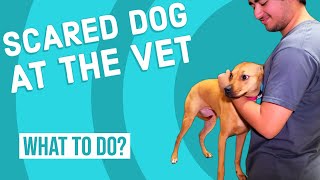
Dr. Lehrer examines Millie, a nervous dog, while showing how to calm anxious pets at the vet. Give gabapentin or Xanax at least two hours before the visit, use the owner's hands during the exam, and skip the high table. When head-shaking hits 6 out of 10, a short-acting steroid injection can help.
Questions this video answers
At least two hours before the event (or several days beforehand for some supplements/medications).
Around 6 out of 10 (a typical cutoff to recommend steroid injection).
Hey guys, My name is Dr. Lehrer. I'm here in Heron Lakes Animal Hospital. Today I'm here with Millie. Millie is a mixed breed dog. And Millie is coming in today because she is having some skin issues. And so what normally happens with dogs who have skin issues, we do a couple of different tests just to get an idea of what exactly it is that's going on. The primary purpose of the video today has to do more with dogs who are nervous. And so when you look at Millie, Millie's tail is down, it's not lagging. She's not giving us real direct eye contact. She's looking away, she's looking to jump off the table. And so sometimes dogs will do better when they're away from their parents. And sometimes dogs will do better when they're with their parents in a situation like this. One of the things I like to do when I'm doing my exams, if the owners are okay with it, is I'll actually use the owner's hands as my hands. So that way I can take a look at what's actually going on. And it causes less stress for the patients because at the end of the day we want to try and minimize the amount of stress because every time that they come in here and they are stressed out, it ends up being adding to the history of them having a stressful experience. Now one thing that I will tell you is if at all possible, sometimes we try to avoid putting them on the table, on a high table especially because it does make them a little bit nervous. There are some different things that you can do for that. I think we had talked about it in one of our previous videos. Something called Zylkene is a natural product. You could look at something like thunder jackets, which is, you know, no drugs. We could look at something like Gabapentin giving it before they come in, or some sort of Xanax or Alprazolam as a generic version of it. Whenever administering any sort of medications, at the very least you want to give it two hours before coming in to the anxiety producing event. Otherwise, sometimes you may actually want to give them the supplement or the medication for a few days beforehand. So we're going to go into our exam right now and I'm just going to give you some examples to see what it is it would look like when we have the owner using their hands for my purposes. Okay, so I'm going to ask you to do this. I'm just going to ask you to lift the lip. I want you to go all the Way to the back of the mouth as well. And when you're in there moving her lip around, it also allows me to kind of do what I need to do because she thinks it's your mouth, your hands. So perfect. So we're looking all the way to the back. Now let's do the same thing on the other side. Good girl, Millie. What a good puppy. Oh, my goodness. All right, and then I'm gonna ask you to just pull back the eyelid so we can take a look at the whites of her eyes. Perfect. Let's do the other one. Perfect. All right. And then what we're going to do is we're gonna leave Millie's ears alone because she's not bothering her ears. Right. She's not scratching her. Our other dog tends to lick her ear, so we think something might be also. Is she scratching or shaking her head? Shaking her head. Okay, on a scale of 1 to 10, 1. Not at all. 10 all the time. How much is actually shaking around? 3, 4. Okay. So normally my cutoff for shaking a lot is about a 5 or 6. Typically a 6 out of 10 is what I recommend giving a short acting steroid injection to reduce any sort of inflammation while we wait for whatever the antimicrobial is that we're using, whether it's ear drops or antibiotics for the skin to help reduce those clinical signs. So now typically what I'm going to do is I'm just going to go ahead and listen to her lungs and her heart. Dad's going to be petting her, making sure she doesn't jump off the table. Very important as one of the owners to make sure that your pets jump, don't jump off the table. So typically when we are doing the exam and we're feeling the belly on some dogs, this could be a very, very nerve wracking part of the exam because that's a very vulnerable spot. Notice how highly tucked her tail is as I'm coming in here to palpate her belly and then I'm also going to palpate her lymph nodes on the back end. Again, this is another vulnerable situation where some dogs do not like their back ends messed with. So when you're working with a vet or if you have a pet who's nervous, these are just some different things that we can do to go ahead and reduce the stress in the sit. Lastly, when we go to look at her ears, question for you. Is it worth the stress for us to go ahead and take a look at her ears since she's not scratching Or I'm fine with that. You're fine with the single ears. Okay, so let's see. What we're gonna do is we're gonna try and take a look in her ears. I like to call this brave. Some people like to call me, call it stupid. So we'll see how this goes. This is live, no editing right here. So if you hear me scream like a little girl, I'm going to need her to be right here. That's going to be real authentic. Let's see here. Okay. And so I'm not jamming this thing all the way in her ear. I'm just putting it in just enough for me to be able to take a peek inside your ears. Okay, we're almost up here. Almost up. Okay, so you can see the ear is nice and smooth. Pale pink. She did fantastic during that time. What a good girl. Okay, so if you want, you can take her off the table. So, guys, that's pretty much what it looks like when we are going ahead and dealing with a dog who's nervous. You can see she behaved extremely well. She didn't try to bite. She didn't even lift her lip. That doesn't necessarily mean that they won't try to bite when they're acting like this. You just need to work with them, be patient with them. If you're patient with them, then that really helps. We could have rushed this exam, thrown a muzzle on, and done what we needed to do. If you look at her now, you can actually see her tail's wagging. She is panting a little bit, but panting is something that can be a sign of stress as well. But she's actually smiling, so thanks for watching, guys. What a good girl. Millie. See how her tail isn't tucked between her legs? Yeah, she's really. She's excited. She is still a little nervous, but her body posture has changed completely. If you guys found this video helpful, please give us a thumbs up. Subscribe and if you know somebody who needs to watch it, share. Thanks for watching and have a great day.