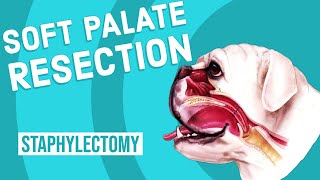
Dr. Lera Clone explains soft palate resection for brachycephalic dogs with shortened airways. The procedure removes excess tissue and improves breathing; ACVS recommends doing it early. Post-op swelling is common, and some dogs need a temporary tracheostomy to breathe.
Questions this video answers
April 15, 2020.
30%.
The American College of Veterinary Surgeons (ACVS).
Chapters
Hey, guys. Dr. Lehrer here. I'm here with Yesenia. And as you guys can tell, this is obviously during the 2020 COVID 19 pandemic. So I'm wearing my pink colorful mask and I have my hair in a half up, half down style. It's because of the lack of places to get a haircut as of right now safely. So. So the video, the topic of the video today, I'm gonna put the cone back on Yesenia. But the topic of the video today is going to be soft palate resection. And so when we go ahead, dogs who have smashed faces, with a fancy way of calling it is brachycephalic, those are dogs that are more prone to something called elongated soft palate. And so what happens with an elongated soft palate, I will show you guys. But dogs that are prone to that are dogs like English bulldogs, French bulldogs, pugs, American bulldogs, sometimes any of the dogs that you see that have smashed faces, those are the ones that are going to be more prone to. You're all set. Ya sang. Okay, thank you. So what I'm going to do is I'm going to show you. This is an issue that sometimes you'll see in dogs. And it is something where there are different ages where this can happen. The American College of Veterinary Surgeons recommends now that you have airway or brachycephalic airway surgery done on your dogs sooner rather than later. Before it was recommended that we waited until the patients became clinical, which means they would be super out of breath and they would be like. And it would be something that was very, very pronounced. Now what ends up happening is the thought process is that we will go ahead and we will actually do this procedure earlier on. And the reason being is because as they are breathing really hard to go in and out and get the air and in, it pulls on the tissue in the airway and therefore causes potential swelling on that tissue that will therefore lead to more increased effort, the tissue getting more swollen, and therefore potentially chronically staying larger than it should be. So the hope is when we do this procedure earlier on, that it will go ahead and prevent this from happening. Now, Yesenia had a soft palate reduction, and she also had a everted laryngeal saccules procedure done. And she also had what was called a stenotic nares procedure where they open up her nostrils. And so right here in this particular video, we're going to show you what happens when we go into the dog's mouth. And so this up here is the soft palate and then this over here, right, this is the epiglottis. So this is the airway. And so when you breathe, you go in and you have this. Now, this right here is going to be the soft palate of a normal dog. And then this is going to be the soft palate of a dog with an elongated soft palate. And so you can see it prevents the epiglottis from closing and protecting the airway. And so typically, what we'll do is we will make the cuts right here and here. This is just a side view, and we stitch that closed. And so then that allows the air to flow more naturally. There isn't as much difficulty. And it also allows the epiglottis to close properly, so that way you can go ahead and protect the airway. Now, one of the other things that sometimes could potentially happen in some of these dogs is if we go ahead and we have. Let's see here, stenotic nares, nostril stenosis. So anatomy and function. So what ends up happening with these dogs is they have this. This is what the anatomy looks like. And so when the dogs breathe in, they have all this anatomy where the air comes in, it gets moisturized, and all that kind of stuff. And so I'm going to show you the nostrils of a dog. So you can see right here, this is a dog where the nostrils are closed, and then this is a picture of what the nostrils look like afterwards. Now, each dog is going to differ because that's going to depend on how aggressive each surgeon is. Some surgeons, I've seen them where they only do this, and then some surgeons, they feel more comfortable opening it up even more to make it even easier for the patients to breathe. So that's really going to depend on who's doing the procedure and how comfortable they are without the procedure and how aggressive they're comfortable doing the procedure. The other thing that will happen sometimes is something called everted laryngeal saccule. So now those are these little pockets on the inside of the throat. And what happens sometimes is when they're breathing in and out super hard, those pockets get pulled inside out. And so what ends up happening is now you've created even more drag in the airway, and it becomes there's even more space, more, less space in there for them to breathe. And now it's that much harder for them to breathe. So what I typically tell people, it's like breathing through a snorkel or trying to breathe through a straw. It's really, really challenging. So when we Go ahead and we open up the airway from the saccules, from the nose or the nostrils and also from the elongated soft palate. That typically will make it a lot easier for them to breathe and also less likely to have heat exhaustion or heat strokes. So Yesenia had this procedure done. Today, 30% of brachycephalic dogs or English bulldogs are going to be prone to having complications like having so much swelling in their throat that they will need what's called an emergency tracheostomy. That's tube that we put in their throat and it's only temporary. In worst cases scenario, we usually will have it in for maybe three days. A lot of the times we will have it out for within 12 hours. And that's just to allow the patients to be able to breathe and to be able to go ahead and allow the swelling to go down back to a normal state. It's not something that is typically permanent, but it does require with some of these bulldogs for them to go ahead and be supervised overnight by a doctor. That's going to depend on each case. Some of the dogs, they're going to need it. Some of the dogs are not and like I said, it's about a 30% chance. So the majority of them are not going to need it. Okay. If you guys have questions about this particular procedure, please leave it in the comment box. Now the other thing I do want to let you know is you can't, you do not want to take too much off of this. So if the person who's doing the procedure takes less and then has to go back and revisit it, then what will end up happening is they may have to go back to it in the future. It's better that they do that than they take too much. So I would recommend that you not get, try not to get upset if your dog has to have a follow up procedure because they didn't take enough. If you want to go ahead and make sure that they get the right amount, go to a surgeon who does a lot of these and who is very comfortable with it. Otherwise, if it's somebody who's not doing a lot of these, I probably wouldn't recommend it. Okay. Otherwise, if you found this video helpful, give us a thumbs up, subscribe and share with somebody that you think needs to see it. Thanks for watching, be safe and take care of yourselves. It.