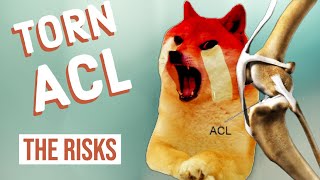
Veterinary surgeon Dr. Lera Clone (Heron Lakes Animal Hospital) explains cranial cruciate ligament (ACL) rupture in dogs using a case example (Dolce, a 6-year-old pit mix who tore her ACL ~11 months earlier and had surgery plus stem cells/PRP). She reviews ACL anatomy, the typical gradual degeneration mechanism, diagnostics (drawer test; arthroscopy/MRI required to visualize ligament), and treatment options: surgical (TPLO, TTA, extracapsular/intracapsular suture repairs) and non-surgical (supplements, cold laser, stem cells/PRP, knee braces). Key facts mentioned: 40–60% contralateral tear risk within 18 months; a 2016 study of 13 dogs with partial tears reported ~69.2% complete recovery after stem cell+PRP (assessed by arthroscopy); and nocita provides ~3 days of local analgesia.
Chapters
Hey, guys, My name is Dr. Lehrer here at Heron Lakes Animal Hospital. And today I'm talking to you about what's called cranial cruciate ligament rupture. That's also known as an ACL tear in a dog. And so right here we have Dolce. Dolce is a 6 year old pit mix. And so Dolce tore her ACL about 11 months ago. And so she had surgery to repair it. And she had some stem cells and platelet rich plasma. We can talk a little bit more about that in the future. And she went ahead and came in for limping today. We're about 11 months out, as I said. And so she's limping in the other leg. And so one of the things that you guys have to be aware of is that there is a 40 to 60% chance that if a dog tears an ACL in one leg, that they will tear it in the other leg in the next 18 months. And so what I wanted to do was I wanted to talk to you a little bit about cranio cruciate ligaments or ACLs, and how that works and some of the different treatment options. So Dolce, you can go back. Thank you for your help today. You were such a good girl. Yes, you were. Yes, you were. She's very calm. Thanks a lot. And so for the treatment of torn acl, most commonly people are going to talk about surgical correction. And so there are three surgical options for a torn acl. One is going to be what's called a tpll, and the other one is called a tta. Those are the two most common and they are normally performed in larger breed dogs, medium to large breed dogs. The real difference between the TPO and TTA is there are no studies that say that one is better than the other. They both require cutting into the bone, but the TPLO is one that is more invasive. And so it's thought that the patients who have the tta, that is the one that's less invasive and they seem to recover faster. Okay, number two, number three, since those two are the first two, there's one called an extra capsular repair, or so what they do, or an intracapsular repair. And what it is, is they will actually use a suture or a stitching. It's kind of like a really strong fishing line to support the knee joint. And so when you have a tear in the acl, what normally happens is this is a video of typically how a knee works. And so you can see this is actually the ACL or The cranial cruciate ligament, and this back here is actually the caudal cruciate ligament or the posterior. And so what ends up happening on these dogs is this is something that most likely does not happen like this. Just because it was a sudden, strong, awkward movement. It's thought that this is something that happens over time. It's unnecessary wear, an awkward angle, maybe if the hip is off, which then potentially leads to the femur being off, which then leads to the knee being off. And so then that puts unnecessary torque on that ligament. And eventually, after over a long period of time, it will either partially tear or will tear altogether. And so when you have, you know, a partial tear, this is, you know, probably what it'll look like. So you'll have just a little bit, little piece of tear in that. And you can see that this right here still helps to prevent what's called a drawer. So the drawer happens when you have a complete tear. And so a complete tear in the ligament, it breaks like that. And then what you'll see is you'll see the knee joint slides. And it slides kind of like a drawer. And so this is typically what a veterinarian or surgeon is going to try to use to confirm that your dog does have a completely torn ACL or does not. It is not possible to see a torn ACL on X rays, nor a CT scan. You would need either some sort of arthroscopy, which is putting a camera into the knee joint, or you would need to do an mri. The issue with doing an MRI is that you're going to have to put them under general anesthesia, and usually you're able to evaluate the patient's knee joint or evaluate them for a potential drawer without having to put them on anesthesia. Catch. Larger breed dogs have a lot of musculature, and so they may need to be sedated when checking that particular drawer. Not all veterinarians are comfortable evaluating patients for that drawer because that's a very, very subtle move. I personally am not comfortable with it, but I do work. I have, I want to say, four surgeons that I work with that are very comfortable evaluating whether or not there indeed is actually a drawer. And like I said, for those larger breed dogs, they will most likely require sedation to go ahead and evaluate if there is a drawer. Now, when you look at potential treatments for, you know, we talked about the three surgical treatments. There are non surgical treatments. You could potentially look at putting them on some joint supplements. You could look at doing cold laser therapy. You could look at potentially doing stem cells and PRP therapy. And there is one study that's come out in 2016 where they saw, I think, 13 dogs that had partially torn ACLs. Out of those 13, nine of them, all 13 of them had stem cells and PRP therapy and 70% or 69.2% had complete recovery from the partially torn ligament after having stem cell therapy and prp. The way that that was identified was they did do an arthroscopy. So it was required for them to go back on the general anesthesia to evaluate whether or not the integrity of the ligament was fully recovered. A lot of people will ask if knee braces are good for dogs. That's something that's relatively new in veterinary medicine. And the other issue is that they're very popular in human medicine because they seem to be working relatively well. The issue in dogs is the angulation and how the dog's knee joint works is different. So it's hard for us to be able to extrapolate and say, hey, in human medicine they're able to use these knee joints and dogs, they'll definitely work. We don't know that. So as of right now, we're trying to figure that out. If you guys have any questions about anything that I've discussed, let me know. One other tidbit which just came to mind now at the end, if your dog is having some sort of ACL repair like a TTA or a tplo, one of the things that is important for pain management is something called nocita. Nocita is a local anesthetic that lasts for three days and they do use it in human medicine. They call it something else, but it's the same exact drug and it works really, really well. I'll talk to you guys a little bit more about that in another video in regards to the pain management and how to handle a craniocrushiate ligament or ACL surgery. Alright, if you guys have any questions or concerns, let me know. If you found this helpful, please give us a thumbs up and have a great day. Thanks for watching.