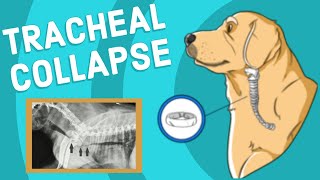
Dr. Lera Clone explains collapsing trachea in dogs, where the cartilage rings supporting the windpipe weaken and collapse. It mostly affects small dogs under 15 pounds between ages 4 and 14, causing cough and sometimes breathing trouble. Treatment ranges from cough suppressants and steroids to tracheal stents in severe cases.
Questions this video answers
Most commonly between 4 and 14 years of age.
Dogs about 15 pounds (≈6.8 kg) or less are most prone.
Chapters
Hey, guys. Dr. Lara, today I'm here with Ruby. Ruby is one of my dogs and she is a, if you haven't seen her before, she is a what we call a cavapoo. And she is a mix of a toy poodle and a King Charles Cavalier spaniel. So the topic for today is what we call collapsing trachea. Now, what the trachea is, the trachea is the windpipe of the dogs. Cats, humans, we all have it. And the trachea or the windpipe is made up of what we call these cartilaginous rings that are in the shape of a C. And what they do is that cartilage provides structure and some shape to our windpipe so it doesn't just like fall down on itself. And so with collapsing trachea, what ends up happening is the cartilage in the rings tends to weaken. And so what will end up happening is, depending on the severity of the collapse, it can collapse just a little bit, a little bit more or all the way. When it collapses, it does elicit or cause the patients to cough. And so that's something that typically dogs may be born with it or, you know, so the ages can range anywhere from most commonly between 4 to 14 years of age. It is also something that is common in very small breed dogs. So Chihuahuas, Yorkies, toy poodles, Shih Tzus, Malteses, the list goes on. Typically, I would say anything that's 15 pounds or less is most likely going to be very prone to this particular condition. Now, the other thing that norm, or the next thing rather, that we would go ahead and discuss is, okay, well, what are some symptoms? Well, if you notice that your dog, when you're walking your dog and your dog is pulling on a leash and you notice that they start coughing, that's a potential sign. If you go ahead and you're rubbing your dog for whatever reason and you kind of just rub their throat a little bit. So that is typically the test that I will do to go ahead and determine if dogs have a windpipe. Now, granted, if I do that same same thing to myself, I do elicit a cough on me. But what I have noticed is if I go ahead and do a tracheal palpation on larger breed dogs, I almost never, if they have a healthy windpipe, can never elicit that kind of response. So in regards to the other ways to confirm the diagnosis and also to get an idea of what kind of collapsing trachea, because collapsing trachea can happen in different spots. It can happen Just in one spot. It can happen in multiple spots. And the way that we break down the trachea is between the extra thoracic, so that means outside of the rib cage, and then the intrathoracic, so that means once the windpipe goes into the rib cage. Now, this is all considered an intrathoracic trachea. And so there are different spots where that can happen. X rays is one of the ways that typically we will be able to go ahead and see the collapsing trachea. Sometimes it can be a little bit more challenging to see on X rays, depending on the different patients. And so that is something where the next thing that we would most likely do is we would do what's called a fluoroscopy. Fluoroscopy is something that is essentially. It's kind of like a video X ray. It's not something that's typically going to be available at all practices. We have access to it because we do happen to have a company who does mobile CTs. And in that same. That same equipment can also be used for fluoroscopy. So that's something that's very helpful for us. The history is very, very important for us in regards to helping to get a diagnosis as well. Now, in regards to the different things that you can do to treat the collapsing trachea, so there are some different medications that can be used. Some cough suppressants could potentially be used to help. They could also be using some steroids to reduce the inflammation on the windpipe. Any sort of little thing once they have a collapsing trachea is gonna elicit a cough response, and that's just gonna make it that much worse. Something called bronchodilator. So that's something that helps to open up the lungs and help to reduce the cough reflex and that kind of stuff. It is something where you do have to be careful with the bronchodilators, because sometimes it can actually cause the patients to become agitated, can cause an increased heart rate. So that's something that we want to go ahead and be careful with. A lot of times we will start with a lower dose, and then we will typically work our way up to a higher dose. The drugs that typically we will use will be theophylline. And then the other things that we can do is you can also use something called Adequan. Adequan is something that's supposed to help with the chondroitin as well as the glycoaminoglycan. Those are some big words, essentially. Those are some things that help to make up the cartilage in the windpipe. And so we want to make sure that we support the body as much as possible by that. Now, in some cases where patients have a really severe tracheal collapse, they can potentially be a candidate for what we call a stent. And so what that is is a surgical implant where they put it into the windpipe and they go ahead and prop the windpipe open the whole time. The issue with that is that those patients are still going to cough, but they're not going to be in respiratory distress because these pat that have really bad collapsing trachea sometimes can turn blue because they're not getting enough oxygen. And so that is something where, when we have, you know, when the patients are really, really bad, at that point we can consider doing the tracheal stent. Again, it is not something that is done very casually. It is something where only a select number of patients will do or are good candidates for it. Otherwise, we typically medically manage these patients. One of the other things, or one of the last things to be aware of, is a lot of times there are different things that can make the collapsing trachea worse or that are tied to collapsing trachea. So obesity is one thing. You don't want to have any extra weight on your dog, so that's super important. Endocardiosis, so that is tied to inflammation in the heart. Periodontal disease. Now, these two are actually tied together in humans. They have been shown that people who have periodontal disease are prone to heart valve infections. So we really want to go ahead and minimize the amount of periodontal disease which the smaller breed dogs are super prone to. So if your dog has collapsing trachea, it's that much more of a reason for you to really stay on top of your dog's dental health. Otherwise, you know, there are a couple other things that the dogs are prone to with collapsing trachea, but that would be something that you want to go ahead and talk to your veterinarian about to help make sure that you guys are all on the same page and you're doing everything possible to keep your pet as healthy as possible for long as possible. If you guys found this video helpful. Yes, we're finishing up. I know, I know. If you guys found this video helpful, please give us a thumbs up. If you have any questions about this particular topic, please leave it in the comment box. And if you know somebody who needs to watch this video, please share it with them. And if you guys want to help us out, go ahead and just take care of yourselves and take care of your fur babies. Thanks for watching and have a great day.