Business Roadmap to 1 Million 12-Month Scaling Blueprint
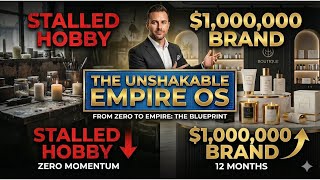
In this solo presentation, Toby Potter (The Unshakeable Investor) walks through a step‑by‑step 12‑month roadmap designed to take an artisan product business—specifically a candle, scent, and lotion brand—from zero revenue to $1 million in sales. He begins by framing the challenge of relaunching a long‑standing hobby‑turned‑business and explains why starting from a clean slate simplifies scaling. The plan starts with a Day‑1, 90‑day launch phase that defines the product line, establishes a “category of one” positioning, and builds an immersive e‑commerce website featuring video storytelling, testimonials, and DIY kits. Potter stresses that customers buy value, not sales pitches, and that a frictionless checkout is critical. He then outlines a robust paid‑media strategy: creating 14‑20 targeted social‑media ads, running 3‑7‑day A/B tests with modest daily budgets, and iterating on the best‑performing creatives. Next, he details the construction of a high‑converting landing page with a clear call‑to‑action, emphasizing that ad traffic is useless without conversion. Throughout, he repeatedly returns to the concept of becoming a “category of one” – a differentiated, affordable‑luxury brand that investors find attractive. Finally, he notes that once the acquisition engine is running, the business is positioned to attract capital for further growth. The video ends with a call‑to‑action for viewers to engage.
Chapters
Hey everybody, Toby Potter here, The Unshakeable Investor. I had a student or a partner the other day that came in and wanted us to work with her on a startup business. Now this is a business that she's had for many, many, many years, but it's been more of a dream, more of a thought, more of a hobby than it ever was a business. But she's so passionate about it, she doesn't want it to die. She came to us and said, can you help me relaunch it? And so I, uh, we had a consultation with her and put together this roadmap. And so I kind of wanted to show you how we work with businesses, whether you're a startup, whether you're existing, um, you know, zero to, to a million, $500,000 to $5 million, it really doesn't matter. But what does matter is that the roadmap fully understands where you're at, what the bottleneck and the restraints are, and how we can remove those so that you can get to that next level. This is a really good example because there are so many people out there that have had businesses, had these dreams, had these passions, but really never understood how to launch them successfully into multimillion-dollar industries. Even though they know it's possible, even though the market demands it, they've never really been able to, uh, create that infrastructure to facilitate it and to excel. So I'm going to go through this real quick and show you kind of the outline and the blueprint that we created for her to get her launched from really zero. So it's going to be a 12-month A 12-month business roadmap that's gonna take her from zero revenues to $1 million in sales. Okay, and this is, this is kind of what we're working with and how we're structuring this. So I kind of want to go through you as to, to show you how we can really jump into it and create all the elements that your business needs to have that success. And it's, you know, it's even easier when there's a clean slate. One of the hardest things to do is take an existing business and change the dynamics in that business to get it to scale. Most of the time there's a business owner that stands in the way. Most of the time there's a high, uh, mid-level executives and so on and so forth that really stand in the way of changing their day-to-day environment to be able to scale. These are one of the easiest because we build it from a clean slate. It's like taking— we're building a house And you take a plot of land, a piece of dirt, and we can custom build it exactly what we want as long as that blueprint fits on that footprint. When you go to an existing house and you want to modify it and enhance it, make it more valuable, which we call a fix and flip or rehab, it's a little harder. It's a little more strategic, and it does take a lot more orchestration to, to get it to that high-end valuation. Can be done, it's just not as easy. So I really like working with these the best. So the first thing that we're going to do is we're going to sit with her on day 1 and we're going to put together a 90-day plan. Okay, and in that— oh, that was terrible. All right, let's try this again. So on day 1, We're going to do a 90-day plan. All right. There we go. All right. A little slower comes a little cleaner. Smart boards aren't that smart. And in this 90-day plan, we have to fully understand what the launch is going to look like. What the launch strategies look like. And in that, has to— when we take something from zero to the hero, it has to be perfect. You have to come out of that gate at full throttle. And everything has to be clicking on all 8 cylinders. So the 90-day plan to launch strategy is where we sit down and we fully understand, we map it all out. Again, like building a house, we've got a pile of dirt over here. We have to have architectural designs. We have to have engineer structures. We have to have the mechanicals, the electrical, and the plumbing strategies. We have to fully understand how that house is going to function properly and all the components and elements that go with it. Building a business is the exact same thing. So we're gonna— look at our first 90 days. What is the first 90 days going to look like, and what's it going to take to get this thing launched? So the first thing we're going to do is on that 90-day launch is we're going to look at— so we have to establish— we'll just say Category A. Establish her product line. Okay, now her products are real simple. Number 1, candles. Number 2, scents. Ah, it's not a D. Number 1, Candles. Number 2, Scents. And you can tell that's candles. Maybe you can't, I don't care. And then number 3, Lotions. And the cool thing about this is, is all this ties together because all of this has fragrances. And all this can be aromatic or it can be— I just went blank— therapeutic. So all the stuff that she does can be, can be a combination of whether we're doing aroma candles, scents and lotions, or therapeutic. As you know, one of the biggest products out there today is essential oils that really work with a multitude of things, whether it be just scents and a diffuser or or if they're therapeutic to put on your bodies and stuff like that for healing. You can put all that into this and have a, an amazing affordable luxury product that goes out worldwide. So our demographics of clients is not limited either. This is open to the whole world. That's what's so awesome about what's going on today. The next thing we're going to do, once we understand the product line, what they look like, and all the variables of that, Then the next thing we're going to do is we're going to go in there and build— you know, there we go. Bear with me. Build her website, okay? And in building that website, we have to make sure that we convey a full message. So important. This is the first point of contact that any and all people will see is your website. And without establishing that website with the right product line, the right imagery, the right clarity, it gets lost. Because we don't have a storefront. We're not a Bed Bath Beyond. We're not a Body Works. We're not anything like that. So you can't come in there and see the product firsthand, smell it, all that, you have to be able to go to a website. But within that website has to create that same environment. The consumer must fully get that engulfed experience just from the website. So when we build that website, we need to make sure that we've got it done properly to bring the value of the product to the consumer through visualization and testimonials. And in that website, we also need to understand that it's going to have an e-commerce Because you have to have a point of sale in our— so the e-commerce transaction point of sale. And then more importantly, we have to have testimonials. And in that video, one of the most amazing things about this, this business was that we have do-it-yourself kits that she's going to be able to promote. And that if you want to, if you kind of a hobbyist in candles and you want to create and build your own candles, which is kind of fun, you can get a do-it-yourself kit. So she'll show you how those do-it-yourself videos are, are in a video, show you how to do it. And then we just package it up and ship it to you. So the video has to be telling stories of how-to. Okay? So in that, you're fully understanding how does she make these? What, what separates this product from the Neiman Marcus? What sets this product apart from Bed Bath and Beyond or Body Works? What makes this a category one? And everything you do, You have to fully understand you are a category one or what makes you a category of one. Because if not, why would somebody come to you and not go to your competitor? And in the video, telling the stories how to creates this category of one. How does she make it? What makes it unique? What is the process that ensures it's good quality? Here's something that I've been in sales since I was 6 years old. And what I've learned over the years is very simple. Nobody wants to be sold anything. Does not matter what it is. Doesn't matter how valuable you believe it to be. Nobody wants to be sold anything. But what everybody will do 100% of the time is will pay for value. 100% of the time people will pay for value. Whether it's a watch, whether it's a shirt, whether it's jewelry, jewelry, cars, clothing, it doesn't matter. Quality people will pay premium price for value. And so this videoing shares the value of the product which sets it apart from everybody else. That's what's so profound about it. So when we build the website, we have to have the e-commerce point of sale and it's got to be smooth. This is one of the things you will lose 75-80% of your clients if this is is not a smooth transaction. If their ability to place an order is not smooth, you will lose them. And we can all relate to this. How many people here use Amazon? I use it. I mean, I'm like a frequent flyer on Amazon. In fact, if Amazon doesn't show up within like a week to drop something off, I think they've lost my packages. Whether I've ordered or not, I think they should just show up and say hi. But one of the things that we all understand, the reason why, Uber, the reason why Amazon, the reason why multiple e-commerce sites have so much traffic and volume is because it's so dang easy. You know what you want, you put it in the search bar, it pops up, you search through the product you like, you get the best reviews, the best detailed information, you select it, put it in your cart, continue to proceed to order, and it's done. It's so simple, it's like it's free. So same thing with Uber. You jump in the car, you pull up your phone, you click where I'm at, where I want to go. It gives you a car, when it'll be there, you select it. The car shows up, you get in, they take you to the destination and you get out. It's easy. You don't have to worry about having a wallet. Don't have to worry about how much it's going to be. You already know. And because Uber created that frictionless, But sticky mentality, they have soared to billions and done away with public transportation for the most part. In all websites, that has to be the same thing. It has to be the same thing. You have to be able to share a message, have full transparency of the value of the product, and then have smooth transactions in checkout. Videos are powerful. We're doing one right here to share and to show you the process. Not that I need you to build this business, but to show you how we work with our customers. And I could put this in a ad, I can put this on social media in a digital, but the video shares with you more of the transparency and the humanization behind it all. And that's what everybody wants is how human is this, how authentic is it, how realistic is it. So enough of that. So then we're going back to developer website, point of sale, and then once that's done, our next thing is going to be able to, um, Okay, we need to create at least 14 to 20 social media ads. Here's what we know out of 30 years of being in the business, being in, uh, as a CEO and an owner of a multitude of businesses, and more importantly, in today's market. Social media ads are the most powerful form of advertisement, but if you only do 2, 3, or 4 ads, you are only scratching a tenth of a tenth of a tenth of the surface. You have to put at least 14 to 20 ads out there because there's so many different demographics of clients— men, women, young, old, various reasons. And when you're having this many different product lines, whether it be candles, whether it be scented candles or be therapeutic candles, whether it be just the regular house scents, the diffusers, or therapeutic, whether it be lotions for skincare, for anti-aging, for scar healing. In this, because you have this many different products, you have to make sure that you're reaching an entire demographics of clients. Now there is this— you can't do a shotgun approach for the whole world trying to just grab everybody that you can. You have to have a specific demographics, but that's where the website comes in and triggers to those individuals. But the ads have to be so broad that it's reaching the millions of clients that are looking for what you have. So you're gonna create 14 to 20 different social media ads, and we're gonna run a 3 to 7 day test on those. So inside that So within that, we run an A/B test and we see which one, because we'll allocate $200, $300, $400 a day on those 14 ads, and we'll see which ones. Because the amazing thing about Facebook, TikTok, and Instagram is it sees the activity and starts funneling money towards the one that's performing the best, gets the highest views, the highest interactions, click-throughs, and all that. So that's what's amazing. And we run those A/B tests and the ones that aren't working, we pull them out. The ones that are working, we keep going. But then we take that content and we modify it and change it up to enhance it. And that's what's so amazing about that. So we create the ads, we run our A/B testing, and then more importantly, once we're in that, then we go into, uh, establish Establish a powerful landing page. Okay, now this landing page is where the rubber meets the road. So it doesn't matter how many ads you have out there and how many views you're getting on them. It's now where the conversion comes in, and this is where businesses suffer the most. Every business suffers on two things. One is they need more clients and they need more capital. This is what we do to help you out. We create a platform, a strategy, and infrastructure to number one, get you more clients. But as you're getting more clients and your growth begins, now you're set up for capital injections, whether it be from a bank, from a private investor, a high net worth individual, Doesn't matter. But once this engine is running, now you're ready to go and present to a partner to inject capital, to grow you to the next level, to do more marketing, to hire more staff, just to cover overhead in itself. But this is where you have to be. And regardless of how the ads are performing, if they're not converting then it doesn't matter. Your landing page is the next major part of this strategy. Doesn't matter how great your product is. It doesn't matter how unique you are. If the consumer cannot get to you or get to the product, you lose all sales, and then you lose time, energy, and money. So we have to establish a powerful landing page that converts, okay, that converts. And so within that landing page, um, there must be a strong, strong call to action. Okay, and that's probably the biggest thing that most people miss is I've got these ads going out there, I've driven them to the landing page, but they really don't know what to do next. And with a product like this, it's very simple. But when you're doing various other things, we're too afraid to ask for the sale. We're too afraid to have the consumer commit. And this is where a lot of things, it just doesn't resonate on the landing page. Once we establish the landing page and all that, now we're going to go into the next step. And this is with all this to finalize. Oh, why does it do that to me? You can't slow down on this thing, telling you. Are we a category of one? And that's what's so important, what sets you apart. And so when we build all this out, We're gonna internally evaluate. We're gonna run our own A/B testing on your product, on your presentation, on the website, on all the marketing, and have you been able to separate yourself from all the other competition and all the other noise? Doesn't matter what business you're in. You have to understand you're not the only brainchild of this world. Your business is not unique to— for the most part. But you can become unique within your own industry, and our job is to assure that we've created this category of one environment for you. How did it— oh, just put a big circle. That sucks. I thought it would really circle it up, but it didn't. That's what's so important about that is to completely understand why would people come to you? Why do people want to do business with you? Why do people want to choose you over somebody else. And especially if we're going to be— which we didn't talk about this in here— right up here, this is a— oh, this is an affordable luxury. And the S didn't work. These right here are affordable luxuries. These, some of these may be because of therapeutic, but 99% of this is an affordable luxury. So why will people want to spend money on your product versus somebody else's? And this is where we want to make sure you're a category one. In all businesses, you have to become a category one to scale and grow. And this is what investors love. More so than anything, if they can see a very strong, powerful business that's got an immense infrastructure, but also you become a category of one, heck yeah, they're gonna invest because they want to be a part of that. They want to be in that, that growth and all that. And then once we understand all this, then we close out and then go to work and building it. So if you have any more questions, do me a favor, subscribe, like, share, but DM I want to know more in the, uh, in the bottom of this, and I'll reach out to you. Talk to you soon.










