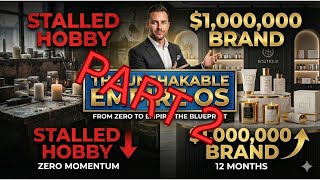
In this video Toby Potter, the Unshakeable Investor, outlines a concrete 12‑month plan to take a candle and body‑product startup from launch to $1 million in revenue. He first recaps the 90‑day launch phase—building a website, product line, demographics, ad campaigns, landing pages, and ensuring inventory and distribution are ready. He then breaks down the revenue targets by product line: luxury candles ($300k), DIY kits ($200k), "Wine and Wax" workshops ($150k), corporate/bridal/event packages ($150k), membership subscriptions ($120k), wholesale/boutique distribution ($80k), and digital education courses ($50k), totaling $1.05 million. Potter stresses the importance of a unique, affordable‑luxury product, balanced inventory, and reliable supply chain to avoid costly stockouts. He describes an integrated upsell funnel where each product feeds into the next (e.g., candle buyers move to DIY kits, then workshops, then memberships). He outlines KPI tracking (weekly, monthly, quarterly) and the need for architectural planning of the business structure. The video ends with a persuasive call‑to‑action: viewers are urged to like, share, comment, and DM for a free 30‑45‑minute consultation and a free business outline.
Chapters
Hey everybody, Toby Potter here, the Unshakeable Investor. Last week we talked to you about taking a startup business from zero to $1 million with a 12-month plan. We went over all the ins and outs of setting up a 90-day launch, going in there, building their website, setting up their product line, setting up their demographics and developing the website, developing the ad campaigns, developing the landing pages, and making sure that the infrastructure is 100% ready to launch in the first 90 days. Today we're gonna go over as to how we're going to get them to $1 million in sales over the next 12 months. So I'm gonna share this with you and hope you can understand how we can do this and how we do this with our clients. So the first thing we're gonna do is how do we get to $1 million in sales? What— with our product line. So we go in and we do an analysis with the client on their products. What makes it unique? What makes it an affordable luxury? How this is going to resonate with the audience and what kind of demand is there? Which is so important. What demand is out there and why are people willing to pay for it? So the number one product that we look at, our number one bestseller, is going to be the luxury, luxury candles. Okay, so in the luxury candles and body product, this is going to generate on an annual, in the first 12 months, this will generate revenues of of $300,000. That is our goal. That is our target market. Okay? So, ah, you know, can only do so much. So it is 3— and somebody's calling me. So $300,000 for that luxury candle. Okay, the next thing that is going to be our next number one, our next highest selling item, which is I think will take off instantly, is the do-it-yourself kits. So we have the DIY kits, and with that we're looking at just somewhere in the neighborhood of $200,000 in annual sales. Okay. Real quick, real simple. See, the do-it-yourself, I think when you can customize your own product, whether it be the lotions, whether it be the aroma scents, whether it be the candles, therapeutic or aroma, I think those are going to be a gangbuster. And to me, I believe that number is extremely conservative and extremely low. The next line item is going to be your workshops. So, as we talked about, coming in and doing workshops. So, basically, these would be your, uh, get a glass of wine and let me— let's make candles, let's make scents, let's do this. You get 20, 30, 40 women predominantly in there and they love this. I mean, this is probably one of the most prominent things going on across the United States. These little wine and workshops. And so these workshops, we're gonna call these Wine and Wax. Wine and Wax. Wax. So Wine and Wax workshops. They're going to generate roughly in the neighborhood of about $150,000. In annual sales. Okay. So we've got the $300,000, which is the luxury candles, our number one item. You've got $200,000 on the do-it-yourself kits that we put together, package up and ship out. Then we jump right into the monthly workshops where we set 20, 30, 40 women up or people, don't have to be women, but you set them up. They come in to an event center. We all get a glass of champagne, glass of wine, whatever, and we make candles together. We make scents together. These are so much fun. Takes about an hour, hour and a half, but the networking, the reputation, the word of mouth referral, this is gold. Um, from that, then you start getting into more of the corporate products, corporate situation. So when we look at the corporate— ah, there we go. Corporate, um, corporate bridal. And events. Now these are all custom deals. So corporate businesses setting up scents, candles, or doing gifts. Bridals— holy cow, what a huge demand with today's wedding event event planners. You get with 2, 3, 4, 5 event planners in an area, in, in every area, This will be gangbusters because they can give those away as gifts. They can have them as centerpieces. It's, it's predominantly one of the fastest growing things out there. And then different events, corporate events, uh, uh, you know, various things coming about. You create these into packages to bulk sell them out. Uh, that's going to generate roughly about another $150,000. Okay. And then you go into memberships, monthly subscription memberships. So memberships are going to run you and you can have two levels. You can have a VIP membership to where they get expedited shipping, they get discounts on shipping, they get free gifts every month because they're in the VIP situation. They get a free, the first right of refusal on things being launched, new products, new scents going out. They get to see it first. So there's lots of things you can do and you can upsell that. So you have just a standard And then you have the VIP. And so the standard, uh, and in that combination of, we're looking at somewhere about $120,000 in annual revenues in that sector. All right. Um, and then you go into smaller deals, which you've got wholesaling, You know, wholesaling is going to be set up— hold on. So when you're setting up the wholesaling situation and boutique distributions, these are going to be very small one-offs and very small, but you don't have to spend a lot of time on them because they'll be pretty much the average stuff, nothing customized. More bulk, that's going to generate you somewhere in the neighborhood of roughly— we estimated it around $80,000 annually. And then the last thing is your education, digital education and tutorials, buying courses. So this is what I really like. Digital courses that will be able to do tutorials, training, so on and so forth, so that you can do this at home. Like I said on the last video, when I was 3, 4, 5 years old, my mother loved making candles. She loved the smell. She loved doing it. It was a hobby for her. It was a lot of fun. It was therapeutic. And as a kid, I enjoyed watching her do it. So with the digital courses, You know, we're looking at somewhere between $50,000 to $60,000. We're going to go conservative with the $50,000 number. But with that all totaled up, when you run that whole total, we are close to $1,050,000. So there's your plan of product step by step allocation conservatively, getting you to $1 million in 12 months. And this is how we do that. Um, as I mentioned, the first thing we're going to do is go in there and set the foundation. We're going to set that 90-day plan, or in the first 90 days, establish product, making sure we have a unique Category 1 product, making sure we fully understand the supply of that product. It doesn't do any good to have the world demanding it if we can't get it. And we definitely don't want to throw a product out there that we can't control receiving. So we need to make sure that we have good inventory. I've seen so many e-commerce companies lose their shirt because they couldn't get supplies. They had to then spend extra or more money just to get it to satisfy the orders. So that first 90 days is so critical to the success of this. Being able to look at all the products, all the different strategies of what we're doing and being able to orchestrate how that product is going to be demanded, how we're going to get it packaged, how we're going to get it shipped, What is our trade secrets in that? We got to make sure we have the right distribution center shipping this stuff. You can lose your butt. So the first 90 days is so critical. Now that we know what— and this one, so this is our candles. Okay, so, so this— once we understand what this does for us, on each product line, we need to make sure that the inventory is accurate. The other thing that we see that people do is they put too much in inventory. They got warehouses full, millions of dollars of inventory because of that fear of running out, and then it goes bad or a disaster happens and they lose it. So there's a fine balance. This is what's so important when you're doing a startup business because you don't know what you don't know. And when you do that, you're guessing at everything. And when you're guessing at everything, you're throwing caution at the wind, and that's high risk. You might as well go to Vegas and throw $100,000 into the craps table. So want to make sure that you fully understand how we got the Million Dollar Stack, how we set that all up, and how this plays out. And once— now that we understand this, now that we know our whole demographic, our entire structure is built architecturally, it's architecturally laid out. Now we go to implementation. Now we go into putting all the structure together. We got to know where we're going to store this, where we're going to build it, where we're going to— all this. So all that comes into play next, and then we launch. And this is what our goals are. Our goals are all these products here across the board, making sure that we fully understand how each one is intricately woven into the next one, because each one of these can lead to another. So my candles leads to the do-it-yourself kits. My do-it-yourself kits leads to a workshop. My workshop leads into, oh, We're getting— I know somebody's getting married and I love this. And you create all this situation. So these are upsell items. One client can be purchasing through 3 or 4 different options here. And we haven't even talked about all the other variables. We have the candles and the lotions and the scents, but holy cow, there's so many moving parts of opportunity there because somebody who loves our candles may all of a sudden say, you know what, I love that scent on that candle, but I don't need any more candles. I just want the scent. So then they do the diffusers and we give them just the scents. So now they're on a membership that's now being able to just get a monthly drop of the scents for their diffusers. There's so much opportunity here, but these are the things that we lay out. We architecturally design, we mastermind with you And then we start setting these KPIs. We start establishing this, and then we launch. We measure weekly, monthly, and quarterly. So if you want to learn more, you want your business to grow just like this business is getting ready to take off. Do me a favor. Like, share, comment. But more importantly, DM me. I want to know more. And I'll send you a booking link so you can book a call. Because see, here's what's so awesome about this. We can book a call just like this lady did. We can book a call within 30, 45 minutes. We get a full understanding of where you're at, where you want to go, what you want to do, and we'll give you this outline. If you like what you see, then we can implement the program. But the call is free, the outline is free. We do all this because we want to see you succeed. I've already had my success. I've already built my business. My turn now is to help you achieve the same. So book a call. It's free. The outline is free. Whether you use this or not, I don't care. What I do care about is whether or not you succeed in your business, whether you're able to grow it. So I'll talk to you soon. Like I said, like, share, comment. Let me know you want to book a call and we'll get you set up. Talk to you soon.