Toby Potter | Growing Your Business With Capital, Clarity And Structure Before You Hit Burnout
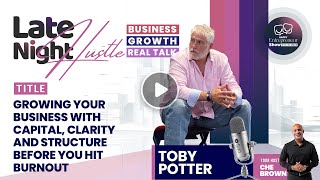
Dr. Toby Potter, who's helped 7,000 business owners secure $1.8 billion in loans, says most companies earning $500K to $5M annually fail to grow because founders won't step back. He teaches an "owner-absence test" to check if your business survives without you, then restructures companies to attract investors.
Chapters
It's a great day. My name is Che Brown, the Happy Entrepreneur, and welcome to the Happy Entrepreneur Show, the number one business development and revenue-focused late night show in the country where we are on a mission. And our mission really is to empower. Our mission is to inspire. And our mission at the end of the day is to provide you, the hardworking entrepreneur, with all of the resources that are necessary to execute that big, big, big, big, big vision you have. For the people you were called to serve. In this episode, we have the one and only Toby Potter. He's in the building. He'll be talking about, really, at the end of the day, how you can really grow your business. Hmm, let's see how that works. What's going on, Toby? How you doing?
Hey, Shay, thank you so much for the, for the opportunity to be here. You know, it's amazing what you're doing with the community, what you're doing with business owners, and, uh, it's just such an honor to be here and to help represent and to help influence and, and You know, be a part of something so big and so great that you're doing. It's just such an honor, buddy.
Thank you so much, man. I appreciate that. And thank you to viewers. Thank you for tuning in, by the way, because you have choices and you choose to be with us. So this will be a good use of your time. Um, before we get started, Toby, I know the number one question on people's mind, and I hate to jump right into it, has to be, why are we talking about how to grow business? So the question is, why are businesses struggling these days just to be profitable? Just to grow when they have, well, AI, so they should be able to snap a button to get all the answers. They have social media so they can go anywhere, any place, doesn't cost them anything. They can be at home and reach the world. So I know it's gonna be a crazy question. Uh, I hate to put you on the spot, but why are small businesses struggling these days, man, to be profitable? What's holding them back?
Well, Shea, that's a great question and every small business owner, every entrepreneur that we work with and we coach has the same story. They're visionaries and they're not operators. You know, as an entrepreneur, as a business owner, we have visions, we have aspirations, we have goals, and we can see where we want to go. And it's easy to do at a certain level. But once you hit a certain level of growth without structure, without support, without systems, You fail and they fail every time. Now that's if the economy is good. If you go back to, uh, 2012, 2014, 2017 and '18, man, you could throw a rock and make money. It didn't matter what you were doing, you were making money. The economy was great, real estate was amazing, interest rates were low and banks were just throwing money out the door. Since COVID that's all changed. 2022 rates went up. Uh, since the election, tariffs have come into place, cost of material, cost of labor. Uh, people are a little more restrictive on money spend. So small businesses are fighting tooth and nail for the same market share. And so if you don't have the right structure, the right strategy, the right support, it doesn't matter how big your vision is. It doesn't matter how hard of a worker you are. You're going to fail each and every time because you're going to have one month of great success. So So here's what we see all the time, Shay. Business sucks. So the owner jumps in and he's now working 12, 14, 16, 18-hour days. He's dialing for dollars. He's meeting with the customers. He's resolving all the issues. He's wearing all the hats. And all of a sudden, business starts growing again. And so then he steps back, thinks his team that's not well structured can maintain that momentum. And it falls, then he jumps back in. So it's a roller coaster of revenues and it's not scalable. Most small businesses do one or two things, if not both. They run out of capital or they burn out. And this is what we see every day in the small business. And we're talking small business, we're talking annual revenues from $500,000 to $5 million. And those are the sweet spot of tribulations and trials and heartbreaks.
Well said. Ladies and gentlemen, we'll get into this background. I know some of you are wondering, who is this guy Toby speaking? As famous as he is all over the world, you may have no idea who he is. Some of you in the kitchen right now saying, I like what I'm hearing. Somebody might be in the office right now and this is making sense to them, or maybe you're driving down the road. Wherever you are, we'll get to that in a moment. But I've got to ask him the question and then say, Toby, you know, if you had an opportunity right now to share maybe 3 simple steps that someone could use for a business structure, let's call it that, that would help them, I'll say eliminate some burnout. So that's important. You mentioned that 3 times as well as maybe grow the business. Now it's unfair because many of you are different places, different spaces. Okay. But I'm going to ask them the best. If you say, hey, here are 3 things you want to look at as a business owner, um, what would you say in terms of structure so we can understand what that is?
Yeah, absolutely. The first thing we have to evaluate, Shea, is if the business owner was to disappear for 10, 15, 20 days, would the business collapse? And if the answer is yes, that is the first thing we have to fix. No business can grow when the business owner has to run the business. A business owner such as myself, we're visionaries. All we're supposed to do is paint the picture and then have the team, uh, run the operations. So the first thing we do in evaluating is if the business owner stepped out, would the business fail? If the answer is yes, then we know the first thing we have to do is build a support system underneath them. Get the right butts in the right seats. A visionary, an owner has to be an owner and he can't be the janitor. He can't be the guy that's swinging the hammer. He can't be the jack of all trades. He has to be the visionary. And what I use it as, he has to be the chief fireman. So in fires, we have firemen, and then you have captains, and you have chiefs. And the chief never handles the hose. He stands back and he sees and watches everything. And when something major happens, he makes major life decisions. But all the lieutenants and all the sergeants and all the other rookies, they do their part so that the chief can just kind of make sure that it manifests correctly. And a business owner has to do the same thing. And if he can't just stand back and only deal with life-altering decisions, then we have to redesign, re-architect his business so that that's all he's dealing with. He can put out the big fires while the little guys are putting out the daily nuances and the noise that businesses have. Mm.
I love that. And as, as you were speaking, I think this is a good time to slow down and then we'll speed back up. Um, folks can read your bio. Okay. They can go do that and Google you and all that wonderful stuff. But would you mind slowing down and really answering two questions? Ladies and gentlemen, he can, he can handle two questions. Trust me. Number one, what's the backstory, um, that really led you and what was the defining moment in your life where you said, you know what, helping business owners get capital, which we'll get to helping business owners avoid burnout, which you've talked about, um, that, that became your jam. So, you know, the question, what's your backstory, man? And what was that moment you said, this is my jam.
Yeah. So real quick, um, 2008. So I had built an immense real estate company, uh, a RE/MAX franchise, a title company, and an appraisal company back in the early '90s through 2008. And 2008 financial crisis came, and, and we were doing $100 million a year easily. I lost it all. I lost it all. Um, lost my home, lost my cars. Um, had a wife, two kids, was jobless. And after you've ran a business for 15 years, you can't just go throw a resume on a desk and get hired because you have no skill set. So I couldn't find a job. And when, as I started climbing back up over the, over the years, I made a vow that once I, and I knew I would rebuild, once I rebuilt and put true systems in place so that would never happen again, my vow was to help every business owner out there do the same thing because I don't want anybody to go through it. And I wish I would have had somebody like me to guide, direct, and mentor. And then 2015, I founded the companies that we have today and grew it up to be in the National Private Lender of the Year in 2019, Inc. 5000 Top 100 Fastest Growing Company in 2022. Been on multiple stages. I speak worldwide, helped over 7,000 individuals and have funded over $1.8 billion in loans. And so knowing all this and doing all this and being all through that, the fires, I know what works, I know what doesn't work, and I want to share that with every person that needs that help. Not motivation, not hype, not fluff, but true battle-scarred driven practices that ensure success and profitability.
Right on. And you talked about capital and a lot of business owners and they're leaning forward and say, whoa, he deals with capital and I need capital. I'm going to break it down for Shea Brown. Cause it's probably just me. Um, what does capital really mean? So we understand when you talk about people getting capital and that's in the title, I know that. And number 2, again, a 2-part question, ladies and gentlemen, but he'll be able to handle this. Number 2, what does it mean to be capital ready? And like, you know, how does someone even know to even capital ready?
Yeah. So that's probably the biggest bottleneck in all businesses. Every business needs capital for expansion. I don't care if you're doing $1 million a year, $5 million a year, $10 million a year. Jeff Bezos, at $80 million in debt, still needed capital to continue running when he was building Amazon. Um, every business needs capital, but the number one question is, are you capital ready? And so we work with As you may know, and you'll see that I work with Kevin Harrington, who was the original shark on Shark Tank, and we've created our own mini shark company to where we take these smaller businesses. Number one, work with them so that if the owner was to step out, the business still ran. Because if, if, if that isn't in place, nobody's going to invest in the business. If, if, if it's a one-man show, there's no reason for me to put money into it because if something happens, to that owner, gets hit by a bus, has a heart attack, decides to quit working, my money's gone. So we set up a, a capital-ready structure that says no matter what, no matter who is sitting at the helm, the ship will still go on in the right direction. And you have all the structure, the employees, the staff, all that working as a unified organization. Once that's established, you're now capital ready. Even— and it doesn't matter if you're profitable or losing money, that doesn't matter. What matters is, can you grow? Can you scale? And that's what investors look at. And so they look at it and they say, okay, will this run with any smart, intelligent individual at the helm? Not just the, the original founder, but can this structure now operate with anybody in that seat? And if the answer is yes, now it's capital ready. And then we start working with you Putting pitch decks together, putting all this in place and getting you in front of whether it be the Sharks, whether it be in front of family offices, high net worth individuals, banks, whatever it is. But I can tell you right here, right now, out of the 7,000+ people we worked with, 6,999 of them were not capital ready before we met them. They thought they were. They said, oh, look, we're doing, you know, we're profiting $500,000 a year or profiting $1 million a year. The business is good. You're in the right market, you've got the right vision. But the problem is when you look at the day-in, day-out activity, it's a 1, 2, 3 man show and you can't invest in that. You have to invest in a structure. You have to invest in an organization. Here's a great example, Shane. If I, if I went and bought a Ferrari engine and I brought it to you and all you had was a go-kart chassis, and we put that engine on that go-kart chassis, was gonna take it down to Indianapolis and race it. Would you put money into that? No, sir. Right. It's not in the right structure. It's a great engine. We know it'll go 200+ miles an hour. We know that the engine is there, but the chassis, the structure won't support it. And the problem is the minute we get up to 200 miles an hour, that chassis is gonna explode and it's gonna crash and burn. Businesses are the same way. And this is what we work with. We dissect it. We look at everything day in and day out, minute by minute, hour by hour, and find out where the bottlenecks are. And 87% of the time it's the owner. Not that they're wrong, they're just too involved. And it may be because they haven't made the right hires. So we work with them on finding the right talent, putting the right butts in the right seats so that the owner can be the owner again. And the visionary to grow the business. Because a true entrepreneur is a talented individual that sees every opportunity that comes across their desk. They— our minds work differently. And so, but if you're so deep in the weeds putting out the fires of the day-to-day nuances, you miss all the opportunities. They pass you by. And that's why the business doesn't scale.
I love it. He talked about scaling, talk about growing, talk about the business owner not being there. Certainly a different perspective, but you're also sharing what the lenders want to see. And you said it so many times over and over again that it runs without you. I mean, that's the Shea Brown remix on this whole thing, but you know, you've been— go ahead. You, you've been through collapse. You've been through reinvention. Um, what's one lesson that you've learned on this helped you rebuild faster that you would pass on to another entrepreneur that's watching right now?
So, so the number one lesson, Shay, that I've learned, so I've, I've been through the crash of 2008. We rebuilt it as I told you, was Private Lender of the Year in 2019. That's a national award. But then COVID hits in 2020 and shuts our industry down. And I thought, you gotta be kidding me. Made it through that and then came out and was Inc. 5000 Top 100. So I've been through turbulence, I've been through battle scars. And I've risen to the top every time. And the one thing that I've done this— well, two things. One is I trust in my Lord and Savior. I know that he is in control of everything I do. He is my pilot. He guides and directs, and he is my CEO. And number two, don't quit. If you don't quit, you can't lose. That is an absolute fact.
Mm. Always keep going no matter what. You know, you've had a lot of mentors along this journey of life. I'm sure you work with a number of different individuals. You watch more movies. I'm sure, or read more books than you can remember these days. And 10,000 hours, I mean, what a joke. You can do that scrolling on a phone now on the weekend. But if you had to step back and say, you know, Shay, here's one of the best pieces of advice that's ever been given to me, just one of the pieces of advice that you're going to pass on to someone watching right now. Um, kind of unfair again, but what would it be and why?
You know, wow, that is a tough question. You didn't prep me for that one. Um, You know, Shay, I think the best advice that I've ever gotten was this quote, and I use this quote on stage, on almost every stage I get on, and it's, "The decisions you make will shape your life, but the life you want should shape your decisions." And when you really think about that, when you really analyze that, that is so profound. We— and Zig Ziglar says this better than anybody— we are exactly where we are because we chose to be here. Where you are, where I am, where the listeners on here, we're exactly where we are because we made the decisions to be here. Now the question is, is that decision mirroring the life you wanted to have? Does that decision, those decisions you made yesterday, get you where you wanted to be today? And if not, then we got to make different decisions. And what we help entrepreneurs, business owners do first and foremost is we go back to the day they dreamt of having this business. We say, tell me what that looked like then. I know what it looks like today. I know the chaos. I know that the noise and all this stress, I see it. What did it look like the day you said, I want to start this business? Paint that picture for me. And so we get them back to the moment of their why. And when you can get back to your why, we can get back to the root and the heart and the passion that started it. Most entrepreneurs lose it because of stress, chaos, disappointments, financials. They lose their why and now they're in survival mode. But if we can get them mentally back to their why, rekindle that fire with inside them, we can build a structure that will support their true vision of what they wanted to— that business to be. If it's the right business.
I love it, by the way. And, um, my next question is going to be along the lines, what do you look for when you're looking to collaborate with another business owner? Some folks have a scarce mentality and they're like, hey, I can't share what I know because someone else may benefit. It's got to be about me. But I think about, uh, Brenda Wood, who kind of put us together, by the way. And shout out to Brenda Wood if you're watching, by the way. We appreciate you. What an amazing, generous human being that you are. Um, just fantastic. But what do you look for? I guess for you, Toby, what do you look for when you're looking to partner or collaborate? So two-part question. Number one, collaboration. You hear that word, what does it mean? What do you hear? And number two, when you're looking to collaborate with another business owner, what are some of the characteristics you look for?
So that's, you know, that is probably the first thing we look at is compatibility. Um, I, I'm, I'm a business owner. I'm an entrepreneur. I've been an entrepreneur over 40, 35 years. I started out when I was 5 years old, um, and I don't work well with others a lot of times. And it took me a long time to recognize what the bottleneck with me was, and it was me, because I was afraid of having to do something somebody else's way, which then didn't make it mine. And so when I learned this coming out of the 2008 crash, that's why we lost everything, because I was too stubborn and too thick-headed. But when I came out of the 2008 crash, I had to humble myself. And so what I look for now, to answer your question, is does this person really want to be helped? And is their vision bigger than them? Because if the— if number one, if they don't want to be helped, they just want, you know, a magic wand waved and all the problems go away, that ain't going to happen. But number two, if it's all about them, then we can't scale it. Because we have to remove them. We have to be able to say, you're just the legacy. You're not the company anymore. You're just the icon that started this vision. And it's got to be bigger than you. Where is it going to be in 5 years, 10 years, 20 years? And if it's all about you, then it won't get there. So we look at compatibility. We look at, are they looking to grow a business that will leave a legacy? Are they just trying to get rich today? That's probably the biggest characteristics we look at immediately.
Hmm. I love it, by the way. And one of the things that I love that I saw was just you being unshakable, man. I thought that was just amazing. And you think about collaborating, you think about working with other folks, at least you stand on what you believe in, which is super incredible.
Yes.
Um, as we come down the homestretch, I'm curious first, um, before we get into how people can contact you, What do you enjoy most about what you're doing these days? You seem to light up. You seem to be having fun. You seem to feel good. It's got to be tough when folks can't get the money, but what do you enjoy about what you're doing?
Transformation of lives, Shea. You know, you mentioned Brenda Ringwood. Her and I, we met 8, 9 months ago, and the collaboration there was unbelievable because we both have this passion. We have this fire. To change lives. And, you know, I wrote, I wrote a book called The Unshakeable Self, and this book is all about the transformation, the daily disciplines of mental, spiritual, and physical disciplines to be able to withstand and overcome any storms of life. But I, what I've been doing for the last year, 24/7, is building structure and strategies to transform lives. I want you to have everything you've ever wanted in life. I want you to enjoy all the fruits and all the spirits and all that's in this world, because it is amazing, the blessings that we have, the blessings I have. And we all are entitled to those same blessings. We are all entitled to have everything this world has to offer. And so when we get lined up with that individual or that business or that firm that has that same passion, it just is so much fun. It's, as you said, I've heard you talk many, many, many times and you've heard it said, The day you don't have to work to accomplish what you want to do is the day you quit having a job. You know, when you get fired up and go and do something that you truly enjoy, you're no longer doing a job. Now you're doing a service to humanity. And so it's important that we— it's also sad. We see so many businesses who just can't weather the storm. They give up and they had such an amazing passion, an amazing opportunity, and we just weren't there in time. And so what I love is getting in front of the right people and being able to transform their lives, get back to their why. It's so important for them to understand their why. Let them feel it again and then inspire them to help us get in there now. And that's what's— and it's so fulfilling. It is so unbelievably fulfilling, Shay. It's just, it's remarkable.
Agree 100% with you, by the way. And I love the title, Becoming Unshakeable. But what I really liked was that subtitle I saw that one day can change your whole life. And as an entrepreneur, we live for that one day, that one deal, that one opportunity, but you're making it configured that and saying there has to be a system. So it's happening every single day. It's consistent, predictable, reliable revenue when your business is running and you're not there. Final question, uh, what type of clients are you looking to work with these days? And, um, how can people connect with you? They're watching, they're listening, they're saying, whoa, I like what I'm hearing. Is there a website? Where should I go? Where do I find this guy? I mean, you know, they, they, they're watching now, so tell them. Yep.
So number one, the, the type of clients we look for, as, as I mentioned, we were looking for people that are compatible, that really have a passion and a vision for their business to be bigger than just them, to create a legacy. And it doesn't matter what demographics. It doesn't matter, you know, male, female, 35 to 60-year-old. Our demographic of the business is at least $500,000 a year annual revenue, up to $5 million. That is our sweet spot. And, and, and it, and, and again, it doesn't matter what the business is because the structure strategy is exactly the same across the board. And I, I, I've owned about 30-some businesses, uh, in, in the last 45 years and they all work the same way. So, um, the systems are there, the place is there. And, and to find me, the easiest way to find me is go to Dr. Toby Potter.com. That is my main website. You can see all my history, all my staging, all my accolades, my full resume, and you can then contact me and we can get together. We're also doing a webinar tonight, which is perfect timing. I don't know. Well, yeah, tonight, January 6th at 6 PM Central Time. And this is rolling out this program to— we have over 535 people right now registered for this event tonight. So we're excited, we're stoked. But to find me, uh, go to booktoby potter.com.
Love it. Thanks so much for being on the show, man. We appreciate it. Got to have you back again soon, Shay.
Please don't hesitate. I love this, man. And, and Brenda has sung your praises. She's talks nonstop about you. So I want to get to know you. I want us to do more things and I want to help you build your community.
Thank you so much. Because I believe that one day can change everything. I love it. I love the unshakable mindset. Uh, certainly a belief that we all need to have, myself included. So thanks so much. And thank you to viewers. Thank you for tuning in, by the way, because without you, well, we don't have a show, by the way. So I never get tired of reminding every night at 11:00 PM Eastern Standard Time, no matter what's going on in your life, whether you're doing really, really well, as Toby was just talking about, you're going to that next level, be capital ready, or you've been hit with the punch that you never saw coming. The one thing I do believe is that today is a fresh start. You can start all over again and you can get going. With that being said, make it a great day, everyone. And we'll make some good things happen. We connect again next time. God bless Toby and keep doing God's work. Peace, everybody.
Thank you.










