Cellular Nutrition: The Big Bold Health Journey of Dr. Terry Wahls | Episode 12
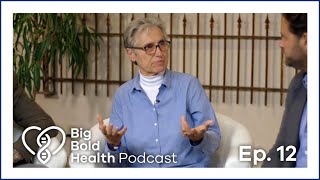
This is a podcast interview (Big Bold Health) featuring Dr. Terry Wahls with hosts James Maskell and Jeffrey Bland. Dr. Wahls describes her personal medical history (diagnosed with multiple sclerosis in 2000), her progressive decline and dramatic recovery after adopting a diet-and-lifestyle intervention (Wahls Protocol) focused on cellular and mitochondrial nutrition, and the subsequent shift in her clinical practice. She summarizes prior small safety/feasibility studies showing functional improvements in progressive MS patients, describes ongoing and planned larger/quasi-experimental studies comparing the protocol to standard drug-based care (with blinded assessors and biological measures), and discusses implementation in resource-limited settings (VA, rural Iowa). The conversation emphasizes health-as-function, cost implications of MS drugs (~$50,000–$100,000/year), challenges in clinical acceptance, and public education/teaching strategies.
Chapters
Hello, and welcome back to the big Bold Health Podcast. And have we got a great episode here for you. We are here with one of the biggest, boldest characters in the functional medicine space and in health creation space. Welcome to the podcast, Dr. Terry Walls. Great to have you.
Oh, so glad to be here.
And Jeff, I know you're pretty excited about this one.
Well, let me just add a quick parenthetical. So Dr. Wahls is an absolute example of what we've been trying, in my case, I guess now, for four decades to get people to understand of taking charge of your health and being bold about it and being willing to not be deterred by a diagnosis, but to look forward to how you're going to get the most out of your genes to put that diagnosis in the trunk and forget Dr. Walls is that person.
Absolutely. So let's just start off. If you're one of the very few people around the world who doesn't know the story, hasn't seen the TED talk, hasn't seen Dr. Walls or read her book, why don't you just take us back to the beginning?
First of all, shame on them.
But, yeah, take us back to the beginning. Give us the overview for those people to catch us up to date, and then we'll. We'll get into some more big, bold stuff from there.
Yeah. So 1980, I started having face pains. And then in 2000, I was diagnosed with multiple sclerosis. Being a conventional internal medicine doc, I went up, saw the best people I could find. Cleveland Clinic, took the newest drugs, went steadily downhill. 2003, I'm so weak, I needed tilt, recline, wheelchair, continue to go downhill. 2007, I'm getting to have brain fog. I'm on the verge of being forced into medical retirement. Fortunately, I've been reading basic science, ancestor health principles, and. Thank you, Jeff. Functional medicine. I integrate all three, create a diet and lifestyle program that, to my amazement, utter amazement, got me out of my wheelchair. Now, mind you, I'd had 27 years of steadily worsening face pains, seven years of decline due to multiple sclerosis, four years of recline wheelchair, and now I was able to bike 20 miles. So I radically changed how I practice medicine. And then my chief of medicine encouraged me to get a case report written up, which I did. Then he brought me back and said, terry, I want you to change your focus of your research and you want me to do a safety feasibility study. And I said, well, I don't know how to do that. I'll get you the mentors. So we did we did. Our safety study showed that others could implement my protocol. Others with progressive Ms. Had remarkable improvements in quality of life and half of them had clinically meaningful improvement in walking ability. And then we did another couple small studies, again very positive. Now we have a much larger study going on and we are getting ready to launch a quasi experimental study. That's very exciting. So it's radically changed how I think about disease and health. Yeah.
Can I say something just real quickly here? And I'm going to say something that may be inflammatory and if you disagree with me, please do. I know you will because you'll speak your mind. But I think what you've identified for me is the tyranny of diagnosis. Oh, yes, that diagnosis. When you get a label, you know, what is ms? It's a neuromuscular disorder, but it's not directly tracked in terms of severity to neuritic plaques. You know, you can't actually say, oh, those plaques are related to this severity of the symptoms you're going to have, because there are people with plaques that have no symptoms. There are people with few blacks that have lots of symptoms. And so there's something else going on functionally that's systemic, that presents itself to the neuromuscular system. And then we put a name on it.
You know what is really funny, Jeff? So I radically changed how I practice medicine. I was asking less and less about drugs and more and more about diet and lifestyle and addressing those at my VA clinics. And my chief of staff calls me and says, you know, hey, Terry, people are really getting upset with you because you're doing the same thing, intervention for everyone. You just can't do that. Now, fortunately, I've been warned that this might be coming up. So I brought with me a stack of papers and we went through them as I was sort of going through the science and I was like, but you know, John, we all have mitochondria, we all have cell membranes, we all have cells. That's the stuff I'm focusing on. I'm fixing the cells and then I'm watching people closely to make sure that they aren't over medicated if their cell physiology improves. And so he became supportive. And then over time at the university, I was clearly an oddity. People really didn't know what to think back in 2008 and 2009. But now in 2019, they're like, damn, you are a brilliant visionary.
Well, you are. You're big and bold.
And so people now are mirroring my conversation that, yes, cellular health matters, mitochondrial Matter and improving cellular nutrition is where it's all at.
And so I just want people who are listening and watching and hearing from the voice, the experience, to recognize that this construct that you're talking about, that health is more than the presence or absence of disease. It's. It is related to the function of how our body is doing its work in the environment in which we find ourselves. And that function will produce then our phenotype, which could be well or not so well. Powerful concept.
You know, back in medical school, I certainly remember being taught that disease begins with biochemistry not happening correctly. So I was taught you make a quick diagnosis, you go write the newest drugs, and we're going to fix the biochemistry with drugs. And what I learned reading the functional medicine basic science was we could do that by thinking about the food and that we could alter NF Kappa B&P PR gamma through food as opposed to pharmacologic approach.
And what you've done is so brilliant. Not only your own experience, which is just there's the best teacher is experience, but then the way you've captured visually using your videos, your blogs, your Instagram accounts, in which you're bringing to life through the color of food, through working in the soil, through showing how we are part of our ecosystem in real, dramatic, emotive, personal, humanistic ways.
You know, I love that I had a lovely recent post on Instagram. I'm sitting out in front of my brain, very brown lawn now. I was in the midst of a drought and say, okay, so my lawn is now brown because the grass is dormant, because it's lacking key nutrients, in this case water. Our cells will do that too. When they're lacking key nutrients, they survive by going dormant and they don't function very well. And then we'll develop all sorts of dysfunction, which will lead to symptoms. If I get enough symptoms, I have a diagnosis. But if we just go back to feed, feeding ourselves that key nutrients, they begin to wake up and start functioning. And people love that post. And they're like, God, you teach so clearly.
You're so good at the analogy. You're so good. I mean, I love watching your post because you're bringing color, you're bringing life, you're bringing vitality into the learning experience.
And what helped me so much, Jeff was one of my key teachers at Iowa, was whenever you interact with your patients, at the end, always ask them, what did you learn and what are you going to do? And so I did that with my vets, my many former vets. I always say, what did you learn? What are you going to do? And so I got a lot of feedback on how to teach effectively because if they didn't learn anything, I had not chosen the correct metaphors. And so they taught me how to speak in concrete visual terms that people could relate to, whether they're farmers or gardeners or, or factory workers or sports aficionados, because they had to have concrete terms they could visualize.
Exactly. And that's, I think, the power of Dr. Wahls, because you are speaking a language into where it needs the most. It's the information deficient population that hasn't had access to this information in ways that they can grok, they can understand, they can absorb. And you do it so beautifully. And I'm always reminded that it takes a very special skill to, to translate your personal experience, both your medical experience, but also your medical training and background and pursuit of excellence as a doctor, and then to translate that into consumer ease so that it empowers people to make these changes.
And then on the other side, when I'm teaching my medical students and my fellows, you know, I'm talking biochemistry and they of course think I'm talking about the newest drugs, they'll all know better. So we have to talk biochemistry, Biochemistry, biochemistry. And then say. And I was talking about broccoli, by the way.
Yeah.
So it absolutely has to be steeped in understandable science so that my college of medicine still lets me have privileges and thinks that I'm brilliant and lets me do the research. So yes, I have to keep bridging both.
So I'd like to just ask a quick question, and that is, I know that you just presented a course that had a complex audience. Probably there wasn't just one type of person in your audience, but yet you were just able to speak effectively into a broad group of individuals using your experience. But then this, you talked about a similar. Yes.
Yeah. So this is my mission. So every year we have this big seminar and this year we had 300 plus folks, a mix of patients and a mix of health professionals. And I teach them the concepts that I used, diet, lifestyle, and I teach at CME Quality. But I also at the same time simultaneously translate into metaphors that the public can understand.
Yes.
And some of these folks, or we're gonna have a little more brain fog because they still have fairly active disease. So yes, I work very hard at that. But people love it.
That's what I'm saying. I mean, this is. You wanna talk about big and bold, what you're doing exactly is what we're aspiring to do. In this series of podcasts, we're trying to bring this construct of the advocacy of health that we don't need to be apologists, we don't need to be in the dark corners of the room, we don't need to be second tier to those of the aficionados and the super specialties. We can say our piece with strength.
And what I learned taking care of my vets with complex chronic diseases. And when I ran my lifestyle clinic, I got the most seriously ill from the general medicine clinic and from the pain clinic. I said, you know, give them to me. I won't give them drugs, but I'll take care of them. And what I saw was by addressing their nutrition, addressing their detox pathway, teaching them a stress reducing practice, and having them eat these radical things known as vegetables, and giving up processed foods that we improve their health, their quality of life, their hemoglobin A1c's improved and normalized, their blood pressure has improved. We had to keep reducing back their pain meds, reducing back their blood pressure meds, reducing their diabetic meds. And then pretty soon I was giving reports to the chief of medicine, the chief of the pain clinic every quarter, and then to the chief of staff and the hospital director every quarter because they were like, wow, what are you doing? Next thing I know, VA central office is calling. I'm like, oh dear God, am I in trouble now? And they came out to see what we were doing and they were very impressed and ended up giving us a grant to expand our staff because we were just so successful. But the bottom line that the VA began to see was the simple strategies I was using. Creating health using basic primary care labs and basic concepts was the most effective treatment for pain, the most effective treatment for diabetes, the most effective treatment for high blood pressure, the most effective treatment for the autoimmune diseases that people were seeing before and by the way, for their cognitive decline.
So now we are talking about the domain of health, not the domain of a disease with a name and an ICD number.
So creating health by using things that we have literally thousands of studies for that this is really all about health behaviors. It's all about these radical things known as vegetables. It's all about these radical thing known as a stress man to a plant, about the radical thing known as moving your body, about the radical thing known as sleeping, that helping people address those step by step, by actionable step, getting them motivated. We had lots of things that we did in terms of knowing what you Want your health for strategies for creating resilience. So people would take on the work of changing their dietary habits and changing their daily habits.
Powerful.
Yeah, I know. I've referred to you as the unstoppable Terry Wahls on the functional forum just because I see what it's taken to get there. I know one of the things that I hear living in California and then before in New York, is that people think that this kind of health is not accessible to most people because they're not close enough to whole foods. Tell us about your experience doing this in Iowa.
Remember at the va, in my therapeutic lifestyle clinic, the people I saw were on disability living on food stamps. And so I did this in group clinics, and I taught people how to implement these concepts in rural Iowa, with rural Iowa grocery stores, and implementing this on their food stamp budget. We had cooking classes, we had skills classes, teaching them meditation strategies, movement strategies, and we saw health transformation after health transformation. So if people say they can't implement the Wallace Protocol because they don't have whole foods, I'm like, well, you know, the farmers in Iowa can do it living on food stamps, so you certainly can. But you do have to learn how to cook. I mean, that is the key thing. It's very important that we teach you how to cook.
And tell us about, like, how. You know, I know this hasn't always been, like, an easy journey. I know particularly at the beginning, there were a lot of people that were like, please tell Terry Walsh to be quiet.
Yeah, yeah, it was true, you know, and I got warned by my chief of staff that, you know, people were complaining. They. I looked at my charts and I was not practicing the standard of care. But as I said, I brought my papers down and went through the science, and then I won them over. I did learn that I'd be very careful. How I documented in the record that I was improving cellular physiology, that I was not diagnosing treat or cure, but I was simply trying to work on improving cellular function and health overall. And I was addressing health behaviors and.
How magically the disease went away. Gee whiz.
It was just an accidental byproduct. But by making that change, I was focusing on cellular physiology and improving health behaviors. Now, my partners were all comfortable. Everything was fine. I put those disclaimers up whenever I give my public talks. Say, work closely with your primary care doc before you implement anything. And they'll have to monitor your medication use closely, because if things go well, you'll need less and steadily less and less.
So could I ask You a question for the average viewer of this podcast. They probably are not familiar with the expense of the drugs that are now being used to treat Ms. Could you give us just a kind of a ballpark as to what we're talking about for expenses?
$50,000 to $100,000 a year. That's for the drugs. And then the drugs, once you start on them, coming off them becomes very tricky because you can get a rebound, a flare. So that has to be done in a very, very thoughtful and careful way. But we certainly have observed in the VA people with serious autoimmune diseases on these very expensive drugs. We optimize their health through diet and lifestyle and then can very slowly, carefully wean the drugs away.
So when people say this is not a cost effective way to do patient management, I guess, at least in this example, we would say that's not true.
Absolutely not. Yeah. You know, and I would like to mention that we have a new study that we will soon be launching. It's a quasi experimental study where we will try and answer the question, could the therapeutic diet and lifestyle without drugs be just as effective as these drugs costing 50 to $100,000 at turning off serious autoimmune conditions? But there are no, you know, as, you know, head to head studies comparing the two. But I'm going to answer that because I'm unstoppable. So. And our neurology department is actually very, very excited about this. We will, and I've raised hundreds of thousands of dollars to pay my staff to do this study. So we will be taking newly diagnosed Ms. Patients who've been offered the potent drugs, who said no, they would rather use diet and lifestyle. We will train them on basically the Wahls protocol and we'll compare them to newly diagnosed Ms. Patients who will get standard of care by the Ms. Clinic at the University of Iowa. And we'll use blinded assessors. So we'll measure quality of life and then measures of walking, thinking, vision and ocular coherence, tomography and MRIs and blood, urine, stool. And then we will compare baseline in 12 months at the two groups.
And how are you going to measure compliance? Because some people may say, well, they may.
Oh, yeah, yeah. So that's a great question. So remember, we're going to have urine and blood, so we wouldn't be able to measure gluten in their urine and in their stool. So we'll know are they gluten free or not. We'll also do a number of dietary assessments to know what they're eating. Or not. And I do fully expect, because the University of Iowa is getting more and more excited about my work, that hopefully my neurology colleagues are saying, you know what? Yes, take the drugs, but you really ought to get this great book called the Wahls Protocol, and you ought to read it and think about eating more vegetables. And some of those patients will. So some of those patients following the standard of care, are going to end up implementing my diet.
That's the problem, isn't it? Yeah.
So, yes, that's a confounder. And all I really need to show Jeff is, is diet and lifestyle equivalent.
Yeah, Yeah.
I might end up showing that it's better, but it's going to be hard to show that it's better if it turns out the drug people also end up following my diet, which they may, more and more of them will because my research, my value is getting to steadily rise. But if I show that they're equivalent now, people all over the country in the world who have a serious autoimmune problem can feel much more comfortable. Like, you know what, I've read those package inserts. I'm afraid of the drugs. I'm not afraid of vegetables. I'm not afraid of exercise and meditation. I'll do diet and lifestyle, and I'll do close follow up, make sure that that really can turn off my serious autoimmune problem. Because it's not that I'm saying you can't take drugs. There may be some people who are ill enough that they'll require both. But even my neurology colleagues at the University of Iowa tell me that you have three months where you could safely be looking at the drug list and thinking carefully about do I want to take those drugs or not? So they could go all in on diet and Lifestyle for the 100 days, come back to see the neurologist, say, you know what, this is a really big decision. I got to think another three months, I've not had any relapses. I'm feeling really good. So they come back in another three months and they still haven't had any relapses. They're feeling good, they've had another mri. And neurologist has to say, well, you know, it's better. There are fewer lesions. And the person say, you know what? I think I'll wait another six months. And if they keep doing well without relapses and their MRI lesions are disappearing, then they never have to take the drugs. And my conventional neurologists are admitting that they're having more patients that are taking that route.
I bet that's true. But you know, you've raised a very interesting, important question now and that is how this has effects on shaping both medical curriculum, medical standard of care, medical reimbursement. I mean, this is a disruptive innovation, right, that has a trading health. Yes, well, yes, that's right, absolutely. And that's why we call this big bowl health, because the construct of health, ironically, even though we call it a health care system, is really a disease care system. And when you introduce health, it's disruptive.
And when I hear our political discourse about we have to control the health care cost and all the political conversations about how do we do this, to me they're missing. The question is why do we become so ill? How did we miss the fact that we allowed the food industry to become so distorted? How did we allow our food, water and air become less clean? And how do we allow the recreational industry to create addicting activities so that we become less and less active? And so that contributes to the poor health. And it's going to be very hard to unravel because of the challenges with our political system. So it's going to require people to do what I'm doing. What you're doing. What you're doing is we have to teach the public directly. The public is going to have to learn that it's really up to them to eat these radical things. No.
Do you dream of the day when TEDx will take away their disclaimer and this say, actually this is real science?
No, no, I dream of the day when I'm going to be on the big TED talk.
Yeah, you should be on.
And that will tell the whole story all over and then it will have 20 million views.
No, totally. You know, I was just, you know, one of the things that Jeff and I are working on is just thinking about like measuring this term of health.
Right.
So you're giving them all the vegetables and the cellular health is improving. You know, I know when you're probably first at the beginning of your journey to reverse ms, there were some disease specific markers that you were looking at that you wanted to get down in retrospect. Now, what are the health markers that you look for to know? Like is this person improving?
Well, you know, when I talk to the public, I tell them that I pray for their benefit, that they have some biosensors that rear up and become more active when they're more inflamed. For me, I am so blessed and that my trigeminal neuralgia turns on and I have incapacitating pain for others, it's paralyzing anxiety for others, it's joint pain for others, it's gut, whatever. So we all have biosensors that tell us that we have. My chemistry is doing well, I'm great and I have plenty of energy, plenty of mental clarity. For the people who are really attuned to their biosensors, they'll do a much better job of following these diet, lifestyle if they're not so attuned. It's going to be a huge struggle and depending on your disease state, you'll have different blood tests that I could monitor or late findings on an imaging study. But we all have biosensors. But you have to get your health fairly cleaned up so you can recognize I'm in low inflammation, low oxidative stress, My chemistry is doing well, I have plenty of energy. If I had some gluten today, in six hours my face pain would be on, my biosensors would be active and I'd be having incapacitating face pain. So when I do my public talks, I tell everyone, you should pray for biosensors that will give you feedback.
So I'd like to share just kind of close one of. I know literally countless positive responses you've gotten from people who have followed the Wahls protocol. So my dear colleague who is manager of our operations in our little business, our little company, our information company, she has a daughter, a very, very sharp woman in her late 20s who got a diagnosis of trigeminal neuralgia, really serious and was so disabling that she was going to have to go on permanent work release and disability. And she started to go, she came over and we had a discussion, said I'm going to sleuth this, I'm going to find out more about this. She found your walls protocol, she dug in, she's a big gardener, she has her own garden. It reminds me a lot of your videos. And she has completely managed and has completely gone away. She was going to be on very high doses of tegretol and other kinds of things which now she is not taking anything. So she came over the other night and she said, so when you were talking about being big and bold around health, I can stand up and say in my 6 foot 2 frame that the difference between aspiring for health and the fear of trying to treat disease is like two different realities and I'll select health. So I think what you've given people is that option and it's unbelievable, powerful gift. So thank you.
Thank you.
Beautiful moment here at the Big Bold Health Podcast. You know, we've been looking for the biggest and boldest female leaders in health creation and there is no one like the unstoppable Terry Walls. I'm excited to see, you know, what happens in the next 10 years. I know the last 10 have been an incredible journey for you. Now the next 10 super excited to bear witness to it and facilitate however I can next March. I know there's a big book coming out, right?
Yes, yes, yes. So we've revised the Wahls protocol and I talk a lot more about resilience and talk more about all the exciting stuff with fasting and how much the research has progressed in the five years since the previous book was out.
There's a lot more to learn, but so many great starting points here. I hope that Terry's story is as powerful to you, the listener. If you have questioned your own ability to be big and bold in assertion with your health, hopefully that is no longer a question. This has been the Big Bold Health Podcast. If you want to tell us what health means to you, go to bigboldhealth.com you can fill it out there. But in the meantime, it's been myself, James Maskell, Dr. Jeffrey Bland, and the unstoppable Dr. Terry Wahls has been the Big Bold Health podcast. Thanks so much for listening. We'll see you next time.
Sa.









