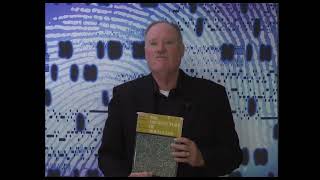
Jeffrey Bland briefly introduces and praises the book The Architecture of Molecules (Pauling & Hayward), describing how its illustrations and explanations trace atomic and molecular structures up to complex biological molecules like hemoglobin. He frames the book as a metaphor and historical touchstone for modern personalized lifestyle healthcare and functional medicine, emphasizing the unifying principle that structure determines function across scales from atoms to societies.
Chapters
So I'm holding a very important book for me, and this is a book authored by a mentor that's important for me and probably hundreds of thousands of other people, Dr. Linus Pauling and his colleague Roger Hayward back in the 1960s. The title of this book is the Architecture of Molecules by Freeman Press. And it really is a very, very interesting symbol for everything that we believe and have followed through with as it relates to personalized lifestyle, healthcare, the functional medicine model. Why? Well, in this book, as you page through it, it really defines, with photographs or sketches of the structure of molecules, starting off with the simplest of atoms, the hydrogen atom, and then moving up into crystal structures that were part of Linus Pauling's early work with X ray crystallographer, and then moving from there to covalently combined atoms to make up molecules, and then ultimately ending up with an extraordinary discussion of complex molecules of life, such as hemoglobin, the protein hemoglobin and its interrelationship with sickle cell anemia, the first molecular disease that had ever been defined in a classic landmark paper in 1949 by Dr. Pauling at Caltech at the time. And why is this such an important book? And why does it symbolize the start of this whole revolution that we're engaged in Today in the 21st century medical systems biology era? Because it really defines the importance of structure and function and how they're interrelated at every level. At the subatomic level, at the atomic level, at the molecular level, at the molecular assembly level, at the cell, at the tissue, at the organ, organ systems, whole organism and society, and maybe even the cosmos itself, all tied together by understanding structure and its function. And therefore, there's a unifying principle that goes beyond just atomic structure or molecular structure. When we talk about structure and function, it can be organizational structure and function that leads to appropriate governments, appropriate politics, appropriate economies, appropriate even family relations or individual relationships. When we get structure and function of relations, relationships in synchrony. So I think this is a very, very powerful metaphor, this book, for a general phenomena that I know that Dr. Linus Pauling and his wife Eva Helen stood for much more than just molecules in and of themselves, but rather the principle of how structure and function are so intimately connected. And as we work towards improvement and refinement in the way people get along with their planet, it really comes down again to how asking the questions about our structure and function properly aligned very powerful and a very interesting part of our evolving story.