Creating Healthy Kids: Meet Katie Wells, Founder of Wellness Mama | Big Bold Health Podcast Ep 13
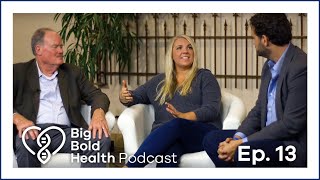
Katie Wells, founder of Wellness Mama, talks about her journey from illness to building a wellness platform. She covers practical health measures for kids: sleep, heart rate variability, time in nature, and breathwork. The conversation also addresses rising pediatric chronic illness and a shift toward health promotion instead of disease treatment.
Chapters
Hello and welcome back to the Big Bold Health podcast. We are making health personal. And in this series Dr. Bland and I are speaking with a number of female leaders in the health space who are taking on big and bold topics. And so we are super excited to have Katie Wells here. She is the founder of WellnessMama.com, one of the biggest children and mothers wellness sites on the on the Internet. Katie, great have you here.
I'd like to say it's great to have you too because now I really feel totally outnumbered in skill from the new generation coming up to tell us how we really should manage. So I'm looking forward to being a participant in this discussion.
Well, thank you guys for having me.
Yeah, so I guess the first thing I wanted to share, I would love to just share a little bit about your own journey of what got you into making the blog initially and then also just to reflect on how the world of creating healthy kids has changed since you started. Because it seems like we've almost as a society come 180 and I'd love.
To get your thoughts on it.
I agree. I wish I could say this had always been a mission for me. I've always been very driven and I, since a young age wanted to change the world, but had this idea that I was going to do it maybe through politics or through law or through changing things that I saw wrong in the world and in college had a health crisis of my own. And I realized at that point if you don't have your health, you don't have the ability to change anything and started researching. My background at point was in journalism. And so I started researching my way into health, trying to find my own answers when doctors couldn't give me answers and started delving into the world of nutrition and alternative health and realizing there were other answers besides the conventional ones. But unfortunately, it took me getting really sick before I had the motivation to learn that world. And it sounds crazy now to say that, but 15 years ago it was a revelation to realize what we ate affected us more than just calories because that was the, the thing I had been taught my whole life was that it was just calories. And so I felt like it opened this whole new world for me. But it was a long journey as well, because that was a whole new thing I had never learned. And I had pushed myself so hard through high school and college. I tell people now, if you want to get autoimmune disease, pretty much be really stressed all the time, eat really crappy food, don't Sleep enough. And that's pretty much what I did for a bunch of years. And when I got pregnant with my first, that was the straw that kind of broke the camel's back, so to speak. And I catapulted into autoimmune disease. I didn't know it at the time, but it began this journey of research. And I realized as I started researching that so many women were going through a similar parallel journey and also looking for answers. This is now almost 13 years ago. And I just had this really compulsion I had to share what I was learning because it was new at that point. Thankfully now, like you mentioned, it's so much more mainstream and the things that were so obscure and I was driving two hours to buy grass fed meat on a black market is now in Whole Foods. So it's gotten so much better since then. But I felt like it was kind of trailblazing a whole new world at that point.
Yeah. Can I say something real quick? First of all, wow, what a great, great story. And the way you captured that in the economics of language, that was just very powerful. And I was, as you're speaking, I'm thinking that there is an interesting thing about being a woman that men will not share. And that's at least in this present technology and that's having children. So you think about having children, not only the stress of caring for nine months a child, but the fact that you actually have a foreigner inside your body. Right. So if your immune system is a little bit tipped, already on alert and now you have a child, even a male child is even more of a foreigner than a female. But both of them are presenting new antigens and new information to the immune system. And all these hormones are going at levels that you never have in, certainly never in a male body would you ever experience those levels of hormones. So the labyrinth that a woman experiences through pregnancy and child rearing is a extraordinarily dramatic physiological stressor that she can learn something from. And it sounds like you really learned a really powerful lesson. So I think a lot of women who are considering getting pregnant and having children need to be considering, you know what that means in terms of an influence on their immune system. So their prepared as they go in with resilience.
Absolutely. I think what you just said is so key and it's a kind of a dual thing as well, because you're right, there's so much that goes on hormonally and immune system wise. And it's really important to prepare for that. Like we now know to prepare Many months in advance of pregnancy is optimal to really get your body ready. But I think the beauty of the lesson as well as women is to learn how strong we are. And then that's. I've loved that quote on Medulla as well. The secret is not that birth is hard, but that women are strong. And I think, you know, pregnancy and birth teach us that. It kind of awakens this innate wisdom and strength you maybe didn't know you had until you go through that process and realize this love that's so powerful for this tiny being you haven't even met outside of your body yet. And it gives you, at least for me, it really gave me this drive to fight for that generation. And when my oldest was six weeks old, actually at the follow up appointment from having him, was sitting in the doctor's office for hours waiting to see the doctor. And I had read through pretty much every magazine in the waiting room and I got to Time magazine and it said, for the first time in two generations, the current generation of American children will have a shorter life expectancy than their parents. And just holding that tiny baby, it just hit me like a ton of bricks and kind of like I jokingly call it my hold my beer moment. Like, this is not going to happen. I don't know how, but we have to change this. And I realized in the next few years after that that I think moms especially are uniquely positioned to change that because not only are we birthing and raising the next generation, but we control so much of the purchasing power in our country and the decision making power. And I think if you really like awaken and get moms on board, you have a chance at shifting culture within a very short period of time. Because moms are just powerhouses.
Absolutely. Can I just make one comment what you just said? Because I've been very worried as well since that New England Journal of Medicine article was published a number of years ago by Olshansky at the University of Chicago on the fact that we're now seeing children born that will not live as long as their parents, which has never happened before in the history of the United States. And so I think all of us who are kind of looking at the futures and asking why, then we start looking at autism, we start looking at adhd, we look at all sorts of things that kids are now having much more frequently than previously. It's not just better diagnosis. Their actual numbers of these children are increasing in percentage. Then we ask the question, okay, what is limiting the life expectancy so that these children not Live to be as old as their parents on average. And it turns out that it's death to drugs. This is the singular major contributor to. And I didn't realize this until recently, and this has now come out in a number of medical publications that, yes, that we are changing our lifestyles and there are certain things that are undercutting our physiology, some of which may be behavioral in their effects that then relate to the drug addiction, narcotic drugs and overdose and premature death, which, as you know, 30,000 deaths in just a matter of a few months is never heard of before when the age group that we're seeing it. So I think that these are social dynamics as well as physiological dynamics, lifestyle dynamics. All these things are woven together. And I think you're totally right that mothers are the. Are really the guardians of how we're going to fight back against this craziness that we're seeing. Yeah.
I just want to pick one thing you said there, Jeff, is. It's just that there's a. I don't think men have a moment, like a rite of passage moment where things change.
Right.
You could just go along and things would kind of be the same. But that moment when you have a child, it's like a break in the psyche. You have a chance to take action from a new story. And you've obviously been providing a different story on the blog and website.
So.
What'S been the sort of.
The.
Journey to commune with these women who just kind of had this transformational shift and are ready to maybe listen to information they might not have been ready for just before they had their kid?
Yeah.
I think we're thankfully at a wonderful time and I know that you see this in your work as well. People were ready for the message. There was the perfect storm of products being available and the marketing starting to change. But it was this groundswell of people looking for their own answers. And I think. I don't know what triggered it, but people being willing to look for alternative answers and not accept the status quo anymore and to really challenge research on their own. And I think that's a beautiful thing when people are willing to step up and do that on their own. And I also think what you said about community is huge because we know the statistics. We know that having solid relationships and community is more important than not smoking. It's more important than exercise. It's truly solid relationships are one of the most important things we can do for health. And I think that's another thing we have lost in the past generations and that we're seeing this new groundswell and reinvigoration of communities, both local communities based in the same geography and also communities based on needs and interests. And I see that in the mob world so much, whether it's moms with autistic children bonding together and helping each other and supporting each other or whatever the case may be. And I think that's the beauty of technology. People always like to complain about problems with technology. I think we also, in the mom world, we see it used so beautifully in these women just, you know, raising up and being warriors for each other.
Yeah.
How do you have there been ways that you've looked to like really facilitate that, to sort of take these women at the exact moment when they, when they need this transformation and introduce them to other people that are just like them. And I'm sure on your platform there's there's moments of cross pollination.
Absolutely. So there's kind of like micro silos that happen both on the blog related to topics, whether it be in the comment section or in emails related to follow ups sequences, but also with social media. Again, it has its dark side, but for moms it's become a really like a connecting point. And so in the Facebook group we have these micro groups of moms with special needs children or going through their own health struggle. My background was Hashimoto's. There's a lot of Hashimoto's moms in there. And so people who have kind of found their tribe through a shared struggle, which is part of the journey of so many movies and books and everything. It's that shared struggle that really connects us. And I love that technology lets us find our tribe, even if it's not in our local area, but it's online.
Oh. So I think again, you're just throwing out really pearls of wisdom. This is really rich. So as you know, in the disease world, there is this organization on the Internet, patients like me that has become extraordinarily well used and robust. The two brothers that started it. But it's really all disease focused. And I've always thought, you know, you could turn that in the big bowl health sense, you could turn that same communication into the same advocacy of wellness. People like me. Right. It wouldn't have to be just disease people like me and people with common kinds of chronic issues that relate to life balance, you know, nutrition, things that can be managed without the necessity of the latest drug that's come out or the latest physician remedy. And I think what you're doing is an analogy to patients like Me. But in the health promotion space, you're being big and bold. Really exciting. That's tremendous what you're doing.
Thank you.
So I did happen to notice that you're wearing an OURA ring, and I've had one in the past. Jeff, I think you've got one too. So for those people who are watching at home, you know, Oura Ring is a. Is a device. It was primarily created for tracking sleep, but it now has different measures. So why did you. Why did you start wearing it? And what were you hoping to get from it?
Yeah, it was an interesting question. So I resisted any kind of biometric device for a long time because the Fitbit or the different wrist ones. First of all, I hate having things on my wrist other than a scrunchie. And there's a lot of EMFs at different levels that retract from that. And I just didn't want to have something transmitting on my body all the time. And the Oura Ring was the first one I found that lets you operate in airplane mode. So it's not transmitting anything until you put it on the charger if you don't want it to. And then it can sync. So it's basically just like if your phone was in airplane mode, but even in airplane mode, it's tracking your sleep, your activity, your movement. And one that's really important to me right now for biometrics, which is hrv. And I know there's a lot of really relevant data about this right now, but heart rate variability is kind of the measure of the distance and variability between your heartbeats. So most people think their heartbeat is kind of very common. And it's actually can be very. There can be a lot of variability between the heartbeat. And it turns out statistically that heart rate variability is one of the most correlated things to longevity and reduced risk of all cause mortality. So it's one that I've been trying to track recently. And I've put the OURA Ring up against a couple of other more expensive HRV devices and it seems to be really detract.
Yeah, well, I should give you a high 10 because that's exactly what I did. I'm a techno nerd, have been for decades. And I did the same thing. I went out and bought all this stuff and did a comparative test end of one experiment. And I came up with the same result, that the most simple way of routinely measuring with reasonable accuracy and reproducibility HRV is the OURA Ring. And so that. And as you said very, very clearly, HRV heart rate variability. You know, you say you might think that the simplest heart rhythm would be absolutely rhythmic, as you said, and no deviation. And I always point out that the actual, the simplest heart rate is a flat ekg. So that is really simple. And that's not an alive person. So the more complex that your heart rhythm is, the more metabolic flexibility it has, the more adaptation it has for resilience. So the fit trained athlete has a much more, as you said, robust variability in between rhythms and a capacity to accommodate change. And I really follow the same thing very closely. And looking does it really match up with when I'm doing 30 hours in the plane going from Australia to Zurich, what happens to my HRV and my aura? And it really does track very closely.
Well, and I love that it gives you tangible things that you can measure and see a result. Because I think sometimes in health we guess we take supplements, we hope they're working, we add new exercise. We hope it's having a change. This lets you really see it almost in real time. And I love that it's, for me, really reinforced that often the simple free things are the most beneficial. Things like sleep and deep breathing and exercise make a huge difference in hrv. And just having that and tracking it. I've taken my HRV from the 40s to over 100.
Wow.
Because I now can see it and measure it and I have friends who are like 100, 800. So I feel like I still have some work to do. But it's great to have that metric to measure.
Yeah.
Jeff, I don't think we could have landed upon a guest that's more aligned with what we've been talking about all the way along. Because ultimately, you know, the goal of what we've been trying to do here is to try to think about measures that, you know, that are a reflection of health and not a reflection of relation to disease. Yes, it's going to prevent disease, but how do you know what you prevented if it never came? And so, you know, ultimately, you know, there's some great stuff in that. I'm glad that it's led you to those.
Those.
Have there been other things that you've learned from that that have then been, like, applicable to a wider community that you've shared through the newsletter or otherwise, you know, lessons that you've learned from the hrv?
Yeah. And one I've talked about so much recently. For years I put off like meditation or deep breathing or anything that was related to that because I thought I can just power through. I'm very Type A. I don't need relaxation. I can and I. It's really made me understand how much our emotions do come into play and how much we have to deal with that side. And also the actual benefit of just taking time each day to deep breathe and to be in nature. Like that's what's been fascinating. I've written about this quite a bit. I see a noticeable difference in sleep and HRV when I get up and get outside within 30 minutes of waking up, even if it's a cloudy day, just get outside in the sun. And there's a lot of scientific reasons, it's the light hitting certain receptors in our eyes that triggers circadian cascades of hormones and all these things. But it has a measurable difference on my oura ring. And then I'm motivated to keep doing it or spending 10 minutes a day doing alternate nostril breathing or 4, 7, 8 breathing. Things that are simple, don't take any time or cost any money hardly. And they make a huge difference in your hrv. And to me that measure with the correlation to longevity and reduced risk of disease, it's also just about that living longer for my kids and being able to fully engage in this life and be around for my family. So to me that's like the best goal is to move toward that. Like you guys talk about, move toward health, not just the fear of disease, but really like optimally being able to lean into life and to health.
This sounds like the manifesto of big bold health, doesn't it? I mean you're our greatest ambassador of what we're trying to communicate. So thank you because I think we've been somewhat as a society apologetic about health. And rather than making a strong statement saying no, I'm not just tethered to the disease model. Health is not just the absence of disease. Health is a vitality of resilience and ability to do what I want. And it's very personal because what I want for my health may be different than even my brother or sister. You know, I have my own definition of health. So how do we establish what that is and provide the tools so the person can achieve that objective? And that's a very different model than doing your blood test and saying, well, you don't have a disease so you must be healthy.
Absolutely.
So the women that really the people could be women or men that communicate with you through your multi different media, are there certain kind of clusters of questions that most commonly you are dealing with or is it across the whole.
Spectrum of questions we really get a lot. I think, like you mentioned in the beginning, women when they go through pregnancy, have so many hormone and immune potential things that can arise. So we do see a lot of moms who have either thyroid issues, postpartum, or some type of autoimmune disease, or we'll see it manifest in the child. And I know all those statistics are on the rise. That was again, part of my journey, reading all these rates of disease that were going to be on the rise in our children. But I also, I love the message you guys talk about so much. And I think I see that very much in our world as well, is these moms. Even if that maybe that particular struggle is the catalyst for them learning about health, once they really start to dive in and they realize all the benefits, they bring their whole family in and it becomes a mission and it becomes about health. And that's when it's really just beautiful and transformative. And then you have these amazing mom warriors who are changing the culture.
And there's a lot of fear instilled in parenting. I would say, like, from general, how do you look to sort of work with that, but sort of instill sort of action from a different kind of wellspring than fear.
I think for me, it goes back to the messaging and the writing and the approach that we take in every article. Early on, I made the decision that I wanted every piece of content someone could land on to be a simple and positive answer to a single question. So whatever they're searching for in Google, they would be able to find it and it would would answer that question, but in an uplifting, positive way. And that's part of our mission and manifesto at Wellness Llama is that we are fiercely positive and protecting of an optimist mindset within the community and supporting each other. Not having that judgment, mom shaming like that doesn't fly at all in our community. So I think hopefully we've curated that atmosphere, but also we're giving them the tools to move toward the positive outcome, not focus on the disease. Because I realized early on, if you did the research, you could make a case for anything being dangerous or killing you. I could write about the problems with broccoli if I wanted. You know, like, so if you delve into the fear, it becomes a very dark world. Whereas if you delve into the positive and provide a roadmap that is focused on that, it's a really beautiful journey, even if there's struggles along the way.
So here it is. She just stated eloquently, wellness like me, not, not the patients like me. Wellness like me. How do we aspire to the positive attributes that are within everybody's book of Life? In our 23 chapters, half are written by our biological mother, the other by a biological father. Within that is a manifesto for exactly what you're talking about. The expression of full fledged function which we call health. So, wow, good on you.
Do you feel in general like I know that the natural health movement and the like use of natural health strategies for disease has certainly grown right in the last 20 years, but you could say that the kids are sicker, right? In general, it's not like looking good. I mean, how do you maintain that sort of optimistic energy in the, in the face of, you know, massive increase in chronic pediatric illness, like, you know, untethered amount. Like what, what are your. When, when people come with that sort of attitude to the blog, have you found ways to like turn that around, help them see it from a different perspective?
I think yes, I think it's stepping stones. I think it's also baby steps and meeting them where they are to begin with because like I said, I think a lot of people get into this world because of fear. Certainly when I was going through my health crisis, I was afraid and I was trying to find answers and it wasn't until I had dealt with that acute part that I was able to look beyond that. So I think answering people's questions where they are, but then also just slowly bringing them into the positive from there. Yeah, I think that's going to be an important question. I think we're also seeing a bell curve because I think in the beginning stages, at least what I saw of natural health, people were kind of trying to use it as a natural alternative to pharmaceuticals, but like targeting symptoms like let's take this particular vitamin or supplement to target this particular symptom, which might help with an acute thing in the short term, but long term you're still not addressing the body as a whole and you're not certainly in that case addressing the emotional and spiritual and all the other aspects that really do come into play. Like I said, I resisted that side for years and thought the emotions didn't matter until I realized just how profoundly they do. And so I think hopefully that's the next wave that we're going to see. And I think you guys are speaking to that as well, but turning more towards that whole body, whole life, whole lifestyle approach rather than just shifting to a more natural method of treating the acute thing. And I think that hopefully will be really Helpful, but I think we're still on the journey there.
So again, as I'm listening and I'm absorbing, I'm having this emotive experience. So you're really affecting me in a very positive way because I believe the system that we call our healthcare system, which we actually know is a disease care system, it's pretty good at that. Is a fear based system. It's all around, no one wants to hang out with disease. You really don't want to even talk about disease. Everyone's fearful of disease and then they get their diagnosis and it's like putting a stamp on them. I'm now the, whatever the name of the disease is and I'm going to live that out. I'm going to the Internet and see what that means and whatever that is, that's who I am. Now the other model is the model that you're describing about, which is really the model that's inherent in every one of us. It's the other side of the equation saying within that set of opportunities, as dictated by my genesis, is the opportunity for all of my bliss genes to be turned on. If I put my genes, if I read my book of life in the right environment, I'm going to read adventure and love stories. I'm not going to read Greek tragedies. And I think that takes a fear based model and it turns it into an uplifting model of success and aspirations. And I think you're doing a fantastic job of that. And that's really the essence of big bold health where we're sick and tired of being apologists to the well, you're healthy because you don't have a disease model which really doesn't wash in terms of how people see themselves every day in terms of their function.
Absolutely.
So you've obviously created an incredible platform with wellness Mama. Do you. You've got five kids. I know that keeps six kids. So is there a, is there a political light at the end of the tunnel or is there another career budding after this?
Well, actually, I'll say it here first. I realized there was a gap in products that I wanted and I was making a lot of these products for myself for decades and I published all the recipes on the blog and I got tired of making them in my kitchen and I realized a lot of other people might be as well. So later this year we'll be releasing completely non toxic personal care products for families. But turning the idea on its head, I know you've probably heard the statistic that 60% of what you put on your skin, you absorb into your body. So rather than just not putting bad stuff on our skin, obviously completely non toxic and natural, but also putting the beneficial things in, so you're putting beneficial things in your skin and your hair that then can be absorbed and used by your body. So it's been a really fun project to delve into that and I'm excited to share those with the world. But I don't know about politics. I'm a little bit too private of a person, I think, for that.
Well, we really appreciate coming here and sharing and obviously it's absolutely mission critical. And part of the reason why Jeff and I are doing this is because we've got to sort of drag the thing kicking and screaming in the right direction. I know you're playing a big role in it and I know that there's millions of mothers and kids and families around the world who benefit from it. So thanks so much for being here and sharing so clearly. Jeff, I think we hit the nail on the head with this one, right?
We really did. And we can't thank you enough for your advocacy. And I mean, you're the personification of what we mean by big bold health and what's you're doing. So all we can say is keep it up and we're behind you.
Thank you. Thank you guys so much for having me. This is fun.
Yeah, it really has been.
So this has been the big bold health podcast we are making Health Personal in a world of disease. We've been with Katie. Well, she is the founder of WellnessMama.com you can find out all of the stuff over there at her website. In the meantime, check out bigboldhealth.com let us know what health means to you. Thanks so much for listening and we'll.
See you next time. Ra.









