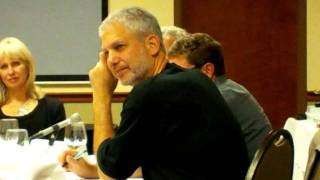
Dr. Jay Lombard argues that modern healthcare has lost direct patient contact to forms and labs, replacing relational care. He says people change behavior to avoid pain or seek pleasure, and that listening to patients and lifestyle medicine can shift how we practice.
Chapters
Something that I try to stress to.
Residents in training is the key component of communication and listening to the unbiased.
And completely open way of hearing from.
A patient's perspective what actually they're suffering.
From, as opposed to us trying to.
Contextualize it in our categorical post dimensional models of disease.
And I think we're really at a.
Very critical stage in medicine right now.
For those of us that are, you.
Know, have been in academia recently, I.
Think that we can all sort of with dismay talk about what we see.
At least what I see personally is.
Almost an autistic life Healthcare delivery system, which a physician almost that are completely dissociated from patient contact histories and review systems are given by ancillary health practitioners, not by physicians themselves. Forms are filled out with questionnaires and.
Lab tests are looked at and MRI.
Scans and radiological procedures without any real.
Involvement interaction between a patient.
I'll have to read something that our.
Moderator, Jeff William had said many years.
Ago actually, which really struck me as.
My first year of residency, which was.
That.
We'Ve taken the sacredness out of.
Medicine and that sacredness of healing is.
About the relationship itself between the physician and patient.
We can't neglect that. I think what, you know, where we.
As a society, not just in healthcare.
And I think in all aspects of.
Our current society, is that we think.
Of problems being one dimensional in terms of how to fix them. And this is obviously a recipe for disaster. And lifestyle medicine, I think offers us.
The to change a paradigm to look more at a patient centric way of intervening.
The last thing I want to say.
About is I'm a neurologist and the.
Brain is one of my favorite organs.
Not the only one.
But.
You know, it's very often if.
You think about change and how difficult.
It is for people to change behavior and really behavior change occurs really only in two ways. One is to avoid pain or to move towards pleasure.
And if we hold down that basic.
Principle about how our brain operates and.
Use it to improve compliance or ways.
Of engaging our patients in more healthy lifestyles, I think that principle helps long.