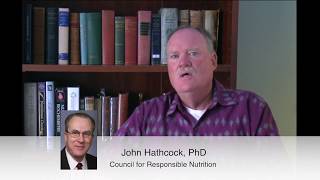
Jeffrey Bland remembers Dr. John Hathcock, who died in April 2019. Hathcock pioneered the tolerable upper intake levels for vitamins and minerals, shaped dietary supplement safety standards, and led the Council for Responsible Nutrition.
Questions this video answers
April 30, 2019.
May 16, 2019.
Chapters
So I'm Jeffrey Bland and I'd like to give a moment of really attribution and historical precedent to the work that Dr. John Hathcock has contributed to the field of nutrition and nutritional supplements. Unfortunately, we lost John April of this year, April 30th of 2019. And he was a tremendously important figure in our field that I think symbolizes much of what's gone on over the last 30 years in the field of nutritional supplements. I first met John when he was an academic and a member of the Food and Nutrition Board, really focusing on establishing the dietary reference intake of various micronutrients. And John was a very open minded scientist and a person who really wanted to explore the pluses and minuses or the puts and the takes of dietary supplements from an academic position. Being an open minded guy, he also recognized as a pharmacologist that everything has a toxicity level. Air and water at some level can be toxic. And so his construct was what are the safe intakes of vitamins and minerals that one could have as a range of intake beyond just that which is listed on the back of cereal boxes as RDAs? And that led into a very, very interesting body of science that really John developed and pioneered as it relates to tolerable levels and upper limits for dietary supplement intake and really reframed the whole field. And for me this goes back really to the founding of the Council for Responsible Nutrition. I had the fortune of knowing and actually being mentored by Bill Thompson, who was the CEO of the Thompson Vitamin Company, which was at the time in the 70s, probably the most dominant and well understood nutritional supplement company in consumer health food distribution in the United States. And Bill felt that there needed to be a trade organization that would represent all the authentic players within the nutritional supplement arena to really talk about areas of common concern and common communications with the public and with the government and regulatory bodies. And he was instrumental then in pulling together this organization called the Council for Responsible Nutrition. It was very important because this came on the heels of Senator Proxmire and his work on behalf of trying to protect of dietary supplements that were being challenged significantly back in the 70s by the Food and Drug Administration as potential drug like substances that needed regulatory oversight, like you'd regulate drugs. The Council for Responsible Nutrition therefore undertook the kind of task to bring the level of communication and science that relates to both the safe use and effectiveness of nutritional supplements to the general public and regulatory bodies. It was through that then that later John Hathcock was approached by the CRN and was asked if he would be interested as he moved out of his appointments and moved into this next phase of his career, if he would take on the responsibilities being the overseer of the science that underpinned the Council for Responsible Nutrition and the Dietary Supplement Consortium. He did that and did it extraordinarily well. And in fact, until really 2009, over those periods of nearly 20 years, he served in an extraordinary meritorious way. His work and his legacy I think is kind of a record of how the industry of nutritional supplement providers has grown up and has become more professional. He has authored many, many papers and articles and been in charge of plenary sessions and government bodies both domestically and globally. On the dietary supplement issue, I was recalling one paper that I thought was indicative of his contributions entitled Exploring the benefits and challenges of establishing a DRI like process for the Bioactives in Food. These go beyond vitamins and minerals, but into the phytochemicals that have bioactivity that should again also be part of the portfolio of dietary supplements that have safe and effective dose ranges for them. So John's reach and his vision was very very broad. And when I look at his list publications, it's like an encyclopedia of activities. A review of calcium supplements in cardiovascular disease risk niacin chemical forms and bioavailability review of supplements ignoring evidence based nutrition to promote tighter regulations Nutrition and Codex. He got the codex to take up this topic in much more, I think scholarship and information focused perspective. Under the law, FDA must grant different standards for new dietary ingredients and food additives. These are all titles of articles that he was involved in publishing. Highest observed intake definition, regulatory uses and provisional values he authored. Now turns out to be several edited version of Nutrient Toxicology, a book that really talks about the safe effective intakes of various nutrients, benefit risk assessments of virtually all the fat and water soluble vitamins. Many articles he published, even things like cod liver oil, vitamin toxicity, respiratory infections and vitamin D intake expanded to use the tolerable upper intake guidelines for nutrients and bioactive substances. So you can see his reach and impact on the field was dramatic. And I think what for me it really talks about is the important evolution and growing up of the dietary supplement industry. Rather than rely upon anecdotal and testimony really going to a much more sound fundamental science perspective, there have been those that have really championed the science that underpins authentic use of dietary supplements. I learned this lesson very early on from Bill Thompson who I think was a very strong proponent of this back in the 1970s. But there are many now responsible companies that have emerged in the dietary supplement industry to really take up the gauntlet and to move this field forward with more research, more demonstrated science, more review of safety, and more really founding a foundation for a substantive go forward for these bioactive substances we found in food, for which the difference between food and drugs starts to lose a little of its meaning, because these are substances that we find in food that have distinctive effects on human physiology and can improve function. So I want to just give again a note of shout out to Dr. John Hathcock, for all of his many years of contribution to the field and the symbolic way that it really has kind of birthed the future development of this science based dietary supplement industry.