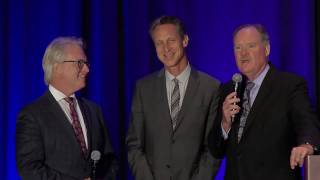
Jeffrey Bland, Mark Hyman, and Patrick Hanaway discuss building a Functional Medicine Center at Cleveland Clinic around five pillars: clinical care, research, education, community health, and fundraising. They argue that measuring patient outcomes like symptom improvement and activation, not just traditional clinical trials, is how functional medicine scales.
Chapters
Well, we're here at the fourth annual Thought Leaders Consortium of the Personalized Lifestyle Medicine Institute. And I'm here with my two colleagues and cohorts that are really involved with transforming medicine through their work at the Functional Medicine center at the Cleveland Clinic. And they just finished giving what I thought was one of those presentations that we'll look back years later saying that was when the change started because they started quantifying the value of a systems approach through functional medicine on the chronic disease. So let me start. Mark and Patrick, thanking you both for an incredible job. So, Mark, tell me a little bit quickly about what led you into the confidence that you can actually get this done at the Cleveland Clinic.
Well, I really believed that building this within the healthcare system was not a realistic idea. And Toby Cosgrove basically convinced me through the strength of his will that Cleveland Clinic was a place of innovation. It was a place of collaboration. It was a place where he was willing to support, with real money and real operational support, this model to test it out. And I called his bluff and created a vision and a proposal that included five pillars. Transforming clinical care through a clinical center of excellence. Transforming research through innovative systems research and cost of care and value creation and measuring that outcomes. Transforming medical education, population health and community based medical care that decentralized and democratized healthcare and building a philanthropy movement within this that allows us to scale this. And I thought he'd say, you know, that's a nice idea, see you later. But he's like, okay, when do we get started? It was a huge vision that I think was able to be catalyzed because of the strength of his will, because of the nature of Cleveland Clinic, which is really a place about innovation and collaboration. And because it's sort of outside the academic healthcare world, it's really about clinical care and patients first, which is a very different environment than this sort of rarefied era of academic medicine. And through that combination of factors, we've been able to do what I never imagined possible, which is really create the seed for health care transformation.
Well, I agree. And the way that Patrick, you define it through various metrics that are being analyzed now in a year, outcome. Tell us a little bit about the process for you because this has been huge to kind of develop the first really quantitative or semi quantitative metrics of outcome.
Well, as Mark said, I'm just a family document, you know, so I'm looking at problems, simple country doctors, but you being able to take the principles of functional medicine and saying, well, we know that our patients get better and we have some idea from anecdotes that the costs go down. So how do we begin to gather that data? How do we look at outcomes? In a way that's looking at their symptom score, that's looking at function, functional medicine. Oh, now we look at function. That's the outcome that everyone wants to measure with the NIH promise scores and things of that nature. And how activated are our patients? Are they ready to be able to make change? So often what we do is giving people hope that they can make a change. So we're going to see that in our randomized trials that the people who are in the control group aren't making changes and the people who are in our group are making changes because we give them hope. So we've got the outcomes and then it's looking at gathering that claims based data and it's not easy to do. The insurance companies don't want to give you the data because they're afraid that you're going to back engineer and figure out what their contracts are, you know, but we can de identify it sufficiently to say, well let's just, we just want to see what the total cost is. Don't you want to do that as well? They're beginning to need to do that with the Accountable Care act and ACOs. So because reimbursement changes are occurring, the focus has changed from process to outcomes and to focus on value.
And I think both of you just so beautifully described this new system that moves away from the only standard for identifying efficacy being the double blind randomized placebo controlled trial, to looking at a value metric that really defines the success of the system, which is a whole different way to look at this from a patient centered perspective versus kind of a population based perspective. So this value thing that you've come up with is brilliant.
Well, I mean, I think we are at the same time we're looking at very detailed analysis of biomarkers and biobanking and looking at randomized trials. We need to do that work and it's essential. But we don't believe that that's going to change people's minds. As you once taught me years ago that medicine, that's Max Planck says advances one funeral at a time. But, but what we believe is that money drives behavior and it drives reimbursement and it drives the kinds of care that are being done. And if we can actually change the conversation and change the narrative from this sort of proof of the concept through science of the mechanisms and the detailed RCTs to proof of the concept of value creation, which is better outcomes at lower costs, then we can back engineer what we're doing and the black box of functional medicine. But everybody's going to want what we have if we can show we can get better outcomes at lower cost, and that's going to be the leverage that's going to allow us to transform healthcare. That's really why we focused on it at Cleveland Clinic. Right.
Look at the RCT, you know, developed in 1963, is to say, let's change one single variable and keep everything else the same. That never, ever happens ever in clinical practice. So let's take clinical effectiveness and drive it to a point where we're measuring value.
Well, I can't tell you how much I'm just so excited. I can't see straight with what you two presented. It's the paradigm shifting moment that we've been looking for. There's a lot of hard work ahead, but someone has to pioneer the first spades in the road ahead. And you've certainly done that. And on behalf of not only the functional medicine community, but, but healthcare in general, thanks a million.
Well, Jeff, we wouldn't be here without you and how you've inspired us. You know, I was thinking about it this morning that, you know, the word guru means teacher, and you've been our guru and this whole community's guru for decades. And it's very, very powerful, inspiring, and we are deeply grateful to you.
We see farther because we stand on the shoulders of giants.