The Future of Health: What Should We Measure? | Big Bold Health Podcast Ep 2
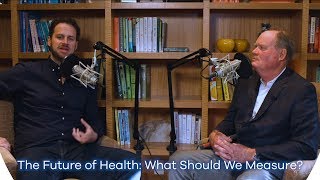
A conversation between James Maskell and Dr. Jeffrey Bland about the evolution and future of health measurement. Bland uses the Theranos story to illustrate risks of overpromising technology, explains why measuring health (prognosis/function) differs from diagnosing disease, outlines four analyte categories (inorganic salts, organic chemicals, proteins, infectious agents) and four functional domains to track (physical, metabolic, cognitive, behavioral), and points to emerging technologies (e.g., genomic sequencing) and consumer tests as part of a growing health-measurement movement.
Chapters
Hello and welcome back to the Big Bold Health podcast, Making Health Personal in a World of Disease. Today, we are going to be talking about measuring health and diagnostics. And you know, I imagine, Jeff, that in a parallel universe to us right now, the Big Bold Health podcast is actually hosted by Dr. Jeffrey Bland and maybe Elizabeth Holmes as a big bold health people changing the world. You know, the Theranos story has been in the papers being sort of at top of mind for anyone who's interested in the facilitation of health creation. And so as we, as we get into this conversation about diagnostics, I thought maybe we could start there. You know, what was it about the Theranos story that was so compelling to so many people for so long?
Yeah, I think, James, that this is a wonderful case history for where we are, where we're going, and some of the opportunities that are before us. The aspect that measuring things in our blood can give us insight into the status of health of the individual has been a long standing principle within clinical chemistry and within medical diagnoses. And it may not be well understood by most people that in the early days of medicine in the United States, the concept of taking your blood and analyzing stuff in it to see how you were doing was not usual and customary at all. In fact, the chemistries that we used to do those tests were not really that available. The first group in the world to actually do these routinely were this group in Minnesota, way up out in the middle of nowhere, Rochester, Minnesota, the Mayo brothers, who thought that these developing concepts of chemistry, which in the early part of the 20th century was still kind of a, a new concept of applying chemistry to biology, that the measurement of stuff in the blood, chemical stuff in the blood, could be very important in developing a prognostic understanding of the patient's status of health or disease. And that was really what kind of differentiated the Mayo Clinic from all other clinics in the United States, maybe even in the world at large. And they gained a reputation because they were isolated up there on the northlands of Minnesota. They could kind of do this and they developed a reputation and people started coming to them, hearing about their reputation, and it being became more and more of a, of a growing theme in which later that kind of clicked over to become a standard of care, which people said, well, really measuring some of these things in the blood is very important, like blood sugar, to get a definition of diabetes. Remember, the early diagnosis of diabetes prior to the 20th century was tasting the urine. Really? Yes, tasting if it was sweet. Now, that wasn't a Big attraction for most clinical chemists in those days.
They outsourced that to the nurses.
Exactly. So, you know, the advent of chemistry really was a step up in terms of both the specifics and precision, but also getting away from having to taste urine for sugarness sweetness. So the bottom line is that this concept of measuring things, chemicals became a very important diagnostic determinant that underlies most people's general health screening. When they go in, they'll have their blood taken and a whole family of different, what are called analytes will be measured. Now with that as a, as a concept, then people started saying, well, what else can we measure? Because it turns out that we have 35,000 genes in our book of life. But those genes code for more than a million different proteins which are found in our cells, tissues and our blood. Each one of those proteins may have some diagnostic characteristic that would be of interest if we knew about them. So this is a rich field of discovery and investigation. So all sorts of people, clinical chemists, immunologist, all sorts of different fields of discovery, have been trying to understand what these things are that float around in our blood, what they mean in terms of how our body is functioning in terms of health and disease. With that as a kind of a background, then people have said, wouldn't it be wonderful if you could develop a technology where, whereby just taking a finger stick of blood in that single drop, so microliters of volume, very small amount that you could analyze an infinite number, well that's an exaggeration, but a large number of different things and you would know what they meant. Well, if you could do that, if that technology were to be developed as a breakaway new age technology, you can imagine it would both reduce the trauma of having your blood taken because you don't have to puncture the vein then and take a bigger volume of blood. Secondly, it would make it accessible to be done in all sorts of places because you don't need a trained phlebotomist or a blood taker to puncture the skin of your finger and take one drop of blood, so it make it much more accessible. Third, it would make it much more convenient if you could measure many things in that one spot of blood and therefore the cost should come down to significantly making it more accessible to all sorts of different, less advantaged individuals so that they could better get diagnostic care. So there are all sorts of extraordinary values that could come from that technology. And then lo and behold, this brilliant wunderkind of an individual dropout from Stanford, Elizabeth Holmes, who has a Personality second to none in terms of personal self affirmation, decides that this technology can and will be developed under her reign, her role watch. And that it will be finger stick technology. It'll be accessible to everybody, it'll be inexpensive, it will measure everything in one spot of blood. It will be done quickly and in fact will produce a machine that can go in every home. It'll be so inexpensive that everybody can become a diagnostician and follow serially their health throughout their life and become their own personal master of their health. Wow, this sounds like a company I'd want to invest in. Right? And lo and behold, a lot of people did raising, you know, not an inconsiderable hundreds of millions of dollars of investment capital. Now what happened? Well, what happened is we have to be very cautious sometimes between our aspirations, our dreams, and then the application of that in reality, in delivery and execution. The challenge that you have when you're trying to measure from any single bit of blood in one instrument, all these different things that you want to measure is that you have four different kinds of things you want to measure. And just from a clinical chemistry point of view, let me just tell you what they are. You want to measure simple salts like potassium, magnesium, sodium, iron. So these are inorganic elements. There's something relate to all of those, like iron with anemia, sodium and potassium, relative to your kidney function. So these are important to measure. Then you want to measure what are called organic chemicals, things like glucose, or things like uric acid, or things like urea, things that we know are associated with organ function. These chemicals of which there are literally thousands of different chemicals. Then there's the third category, which are proteins, right? And think of all the kinds of proteins we have. These are proteins or enzymes that regulate metabolic function. So if you were to measure liver function, you might want to measure enzymes that are unique to the liver that get, if the liver is damaged, it would be released into the blood and you'd make measure them as analytes like AST and well, various enzymes that are liver specific. Then the fourth category are infectious organisms. You'd like to measure things like viruses or bacteria. Now if you examine the technologies that are required to measure each of those different four categories, they're very different technologies, they have different conditions upon which they're measured, different pHs, different temperatures, different, all sorts of things. So to put them all in one test and to do it on one drop of blood, that's no small challenge, maybe not impossible, but it's extraordinarily challenging. So with that, then what happened with the Theranos example is that this is a really an example of over promising and under delivering. And would it have been able to have been delivered in time? I think the answer is potentially yes, over time. But the difficulty is that the, the compression of the commercial world to try to make commercial product and try to make it profitable and try to return on investment to venture capitalists and other investors that felt that this was going to be a quick return to success really put undue pressure on the company that should have been in a research mode for some longer period of time and they should have also qualified that they're not going to be able to run every test on a few microliters of blood. If they would have then been able to qualify properly their results, it could have been a sustaining growth company, I believe. But it exaggerated the opportunity and it produced then its own death knoll through its own activities. Now the problem for all of us in this field is that there is a spreading effect when you have something that's that prominent and that investment worthy that disillusioned so many shareholders and gets the government involved and major distribution systems like Walgreens that have become disillusioned in Safeway, that you then start to have a color about all other technologies and people get very disillusioned and they say I've heard that before and I'm not going to be interested. I think that's a shame because there are extraordinarily robust new technologies that are developing all the time that will help move us towards that goal to make the testing much more inexpensive and readily available. Let me give an example to show you the good side of the curve. The good side of the curve would be genetic testing. You know, when I first got involved in the concept of deciphering the genome as a practical assessment tool or technology, you probably know the first human genomes that were deciphered that led to the Rose Garden discovery with President Clinton at that point saying that we've now deciphered the book of life. It was about $3 billion to decipher the first genome. Well that's not very commercially practical. Over however, with the so called Moore's Law, which is found in computing that you have an exponential increase in the power of technology over time. What we've seen that Moore's Law can be applied to the genome testing. And so the cost per analysis has gone from a billion to a million to 100,000 to 10,000 to where now I've had my full genomes deciphered which Includes both the A coding and non coding region. Mean the dark matter of my genome has been analyzed for under $1,000, and it's going to come down, presumably to be around $100 to get your genome deciphered. Now, how is that being done? Well, the development of technologies that we never had, the knowledge would even come about with young new minds that are evolving new ways of looking at how to decipher the human code based upon methodologies that were not available even five years ago. So that's a very exciting example of what can happen if we have the patience and the. To allow these technologies to be developed and to have the proper proof of concept. So will we get to the point in the lifetime of people living today where we can have a very robust, simple way of using blood spot analysis for determining all sorts of analytes? I think the answer is yes. Will it be everything that Theranos talked about? Probably not. It probably won't analyze everything in the world from a single drop of blood. But we will be seeing, and are seeing already, technologies that allow us to interrogate not just the presence of disease, but the presence of health and function, which helps us to measure not our disease characteristics, but our health span. Our health span. That's where we're going. Yeah.
What, what are the, you know, one of the things that, that sort of, I think, stop the architecture of health creation from occurring is just the fact that there's not as many numbers.
Right.
There's not as much quantification of these kind of things. And, and ultimately, I think quantification is something, you know, we've spoken, continuous glucose monitoring and that kind of thing. What do you feel is the quantification of health that is going to be necessary for this to stand by itself and say, hey, this is a legitimate way of understanding health.
Oh, boy, that is a really fantastic question. You've been thinking about this, I can tell. That's really insightful. So the way that we have used the diagnostic tool of measuring stuff in the blood or in tissues of the body or in saliva or in urine, is to look at the presence of things in those biological samples that are indicative of a damaged organ. I mean, a disease. So these become indicators of disease. The first analyte, the first substance that was measured in the blood that was generally accepted in medicine that didn't analyze the damage of an organ that is a disease. Let me ask you, do you know what it is? Glucose. No. Because glucose measures diabetes. Right. So I'll help you. It is cholesterol. Think of Cholesterol. Is there a single disease that is diagnosed by seeing elevated cholesterol in your blood? The answer to that is no. Cholesterol was the first substance that general medicine accepted as being important to evaluate. That has nothing to do with the diagnosis of disease. It has to do with the prognosis of potential disease. Let me set that in for a moment. This is a very important demarcation in the way that we use this kind of testing. In the past, testing was always used to evaluate the presence of a disease with the addition of cholesterol to a standard blood test. Now suddenly, it was to assess the risk to a disease, Cardiovascular disease. Right. There is no disease for which cholesterol elevated is diagnosed. It tells you about the potential of a disease. Now, why that's important is that that moves us from diagnosis to prognosis, and that moves us from disease to health trajectory and health production. So what we are witnessing right now is a very interesting transformation in asking the question, what are the things do you want to measure in the body's fluids that would help us to understand the trajectory towards dysfunction? And well, before you get to disease, that's a measurement of your health capacity so that you can measure that serially, meaning over time, and you can be a benchmark as to how you're engaged in a health creation program.
It seems to me that you have to start with the end in mind. So with Theranos, the thing that jumped out to me from the book was that we had to start. She started with the end in mind, which is first of all, the big vision. Right. Being able to get everything from one drop of blood. And the second thing was just how sort of comical it was that it had to fit, had to be this size. Right. That was like the focus of it. It seems to me that projects that start with the intention to be able to measure what has previously not been measured with a vision towards understanding the complexity of prognosis and health is a starting point for a project that could yield the kind of results that you're probably talk about is going to be necessary for this next era.
Yeah, again, you're speaking about this book, the Bad Blood, which really is a history of the Theranos rise and fall. And again, I think you chose a good example with that story because the Theranos example was really trying to talk about early diagnosis, making earlier diagnosis, like earlier recognition of when you might have cancer or heart disease or diabetes. That's all meritorious and valuable, but that doesn't really tell you about health. The next Stage, which is the stage we're involved in right now and is the focus of the Big Bold Health podcast, is what do you really need to measure to understand the presence of health in the individual, meaning their function. And as we said, the function is really broken down into four categories. Their physical, their physiological or metabolic, their cognitive and their behavioral psychological function.
So for people who are listening at home, who want to get a sort of a heads up on this and a head of the game, maybe they're a biohacker, maybe they're people who have been faced with some disease, have come out the other side of it and are now ready to think in this new way. What are some of the sort of like basic things that fit into that category right now, today?
Yeah. So let's start with physical functioning quickly. Physical functioning, strength, flexibility and endurance. Are there simple ways to assess those? You don't have to go to a doctor's office, don't have to do a sophisticated kind of machine testing. And the answer is yes.
Can you do 40 pushups?
That's right. There's a step test. There's a different ways of examining very easily your cardiorespiratory function with minimum exercise. There are ways of examining your flexibility like reach testing. There's ways of looking at your, your strength by as you said, like push ups or pull ups. So that, that's one way that we can start assessing that and we can track it over time to see if we, if we're improving. The second would be metabolic. Are there ways that you can examine your metabolic function? And the answer is yes, that now there are many direct to consumer labs that are providing various very inexpensive panels of tests that allow you to examine things that would show whether you have insulin resistance or risk towards poor insulin signaling or you have inflammation central features that give rise to understanding your health inventory. Third of which is cognitive. There are cognitive tests now on the Internet that you can test your short term memory and your ability to do pattern recognition. And lastly is behavioral and psychological testing. Tests are available again. Once again, pen and paper tests or computer algorithms, digital tests that allow you to understand your behavior relative to certain opportunities for function and health. So we are witnessing the emergence of a new big bold health technology. Not a disease technology, a health technology. And we're going to be spending time at Big Bold Health in this podcast, going through and chronicling this revolution to make this accessible to our users so that it will not just be some esoteric conceptual thing out there in the blue sky, but actually deliver, delivered as a value to individuals so they'll take charge of the most important thing we own, which is our health.
Absolutely. I'm really excited to get into some of this because I feel like at this moment in history, there's almost something unusual that has to happen to propel people to want to participate in it. But ultimately, what we're looking for is a moment where this is just the norm.
That's exactly right. And I think that any shift of the general zeitgeist of a population undergoes those transition, doesn't it? The early adopters, then you got a lot of naysayers. Then the naysayers start to say, well, hold up, maybe that's not as wrong as I thought. And then later they think, they come and say, well, no, I always believed in that. It's always been part of my belief system. And I think we're in that middle transition. We're beyond the early adopters, the biohackers. We're into the kind of, how do you take these concepts that came out of these early adopters and translate into the more general health conscious consumer so that it ultimately becomes a standard of identity for all individuals that people have equal access to, independent of their socioeconomic status or their ethnicity or their cultural belief systems, that they have access to things that will revolutionize their ability to achieve good health.
Beautiful. Well, that is something that is going to be available to more people. I'm excited to be chronicling this with you. We're going to be talking about biohacking. There's a number of other topics that will be coming soon on the big Bold Health podcast. But I hope that for everyone who's listening, that the Theranos example can serve as a warning signal of how good ideas can sort of go a little bit wrong, but that ultimately those ideas are moving us in a direction that is going to be beneficial for all of us and mankind. So this has been the big Bold Health podcast. Been great to be with you here. Dr. Jeffrey Bland, myself James Maskell, thanks so much for listening and we'll see you next.









