Vitamin K: Exploring New and Important Research
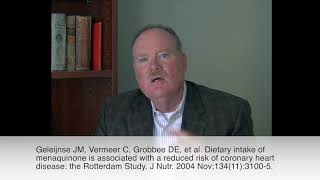
Jeffrey Bland reviews vitamin K's roles beyond blood clotting: K1 from leafy greens, K2 from natto and liver. New research links K2 to arterial calcification, bone health, and insulin sensitivity. Schurgers' work shows K2 deficiency can preserve coagulation while damaging other functions; suggested intake is 300-500 micrograms daily.
Chapters
Chance favors the prepared mind. You probably remember that was credited to Louis Pasteur when he was asked how did he come up with a concept that bacteria or microbes can cause communicable disease? And that was his answer. And I've had such an experience myself as Chance favors a prepared mind concept. Just recently, unfortunately, associated with an accident my wife had, falling, breaking her leg. And, and as a consequence, really thinking about bone healing and osteoblastic activity and nutritional support very deeply, which led me into thinking about all the various nutrients that are involved with that process. And lo and behold, I had the opportunity during the same period, Chance favors a prepared mind to share the podium with arguably one of the world's leaders in vitamin K research, Dr. Leon Shugers from Mesterach University in, in the Netherlands. And that opened up a chapter of review for me and advancing my knowledge that I wanted to share with you about this extraordinary vitamin, this fat soluble vitamin, vitamin K. So you probably know that it was discovered really again in the Netherlands in the early 1920s. This was the time of the great age of discovering vitamins. And it was discovered that if you took fat and completely removed it out of the diet of rodents that they started bleeding spontaneously. And so the question was, is there something in the fat that leads to proper coagulation? And through extensive studies and eventually doing some powerful chemistry in collaboration with an investigator in the United States, the two of them then finally decided that there was this small molecule that they called vitamin K for coagulation in Dutch, starting with a K, and that that was the principal role of this material was to be involved with this complex process that we call clotting, this very interesting part of cellular physiology. Well, that was a very important part of the story that started in the late 1920s and has given us the reputation that the dark green leafy vegetables contain this vitamin K material and that we need to have adequate levels of it in our diet in order to properly promote proper coagulation. But now we recognize that the biochemical process by which vitamin K does its work can be generalized and it's called pleiotrophic, meaning have multiple effects on other functions in the body beyond that of blood clotting alone. And this leads to an interesting chapter, the story that I wanted to share with you, because now, as we've seen from Dr. Sugar's work, and I'm looking here at some of his extraordinary data in a mutant mouse model in which the, the mouse is not able to properly utilize vitamin K, they have not only a clotting disorder. But more interestingly, they have disseminated calcification of their arteries. And so they develop kind of an atherosclerotic disease. So now we start to think of vitamin K having effects on heart disease as well as on coagulation. And then further studies show that if we look at, you know, at this more in detail, we find that vitamin K is also related to the necessity for proper bone formation. So it seems like there is a calcium component to this story because calcium is involved with clotting of the blood, calcium is involved obviously with bone formation, and the infiltration of calcium into the arteries is associated with atherosclerosis. And so what Dr. Sugar has found, and this is, you know, some really powerful work that when you look at, in the so called Rotterdam study, you look at individual who have arterial calcification, that there's a very strong correlation with vitamin K insufficiency, not deficiency. They still have adequate blood coagulation parameters, but they have increased calcium going into soft tissue. And there's a comorbidity of osteoporosis, meaning they're losing calcium from bone and it's going to where you don't want it to be, which is in the arteries. And they still have adequate blood coagulation. How can that occur? Well, that's part of what Dr. Bruce Ames helped us to understand in his concept of the triage theory in which he, in studying vitamin K, said, you know, the body has this process which it will preserve the function of a vitamin for the most critically important things for the immediate life of the organism. And in the case of vitamin K, it's that of coagulation. If you don't coagulate, you spontaneously bleed and you die. So his concept in the triage is that it would increase cases of vitamin K insufficiency, not deficiency. You would maintain adequate coagulation, but you would compromise other roles that vitamin K plays, like in proper protection of the artery system and in bone mineralization. And now it's even gone on to say it has effects also in cell replication and the potential of cancer and also maybe even into type 2 diabetes and insulin sensitivity. So we're starting to see a much more dramatic role for vitamin K than we previously recognized. Now, let's talk quickly about vitamin K, because it's a vitamin that has multiple forms, just like does vitamin E, and it exists in vitamin K1 form and vitamin K2 form. Vitamin K1 form, phylloquinone, is found principally in the dark green leafy vegetables, very high in things like kale and spinach. And then you have this vitamin K2 form which is slightly different in the side chains or the moieties that are stuck on onto the naphthaquinone ring and those have different bioavailability and imparts different kind of physiological characteristics to vitamin K. This K2 then comes in things like natto, fermented soyou're probably familiar, has some of the highest levels of vitamin K2 found in any food. We also find it in liver as well. And in cheeses you'll find some smaller amounts as well. So real cheese. So what we're saying is that there can be a different physiological function between vitamin K1, which does a lot to promote proper blood coagulation, and vitamin K2, which seems to have a very important role to play in these glutamic acid proteins that can become carboxylated under the agency of vitamin K to regulate calcium flux and keep calcium out of soft tissue and put it where it should be in hard tissue of bone. So how do you get adequate vitamin K2? Well, you need good microbiome because some of that is produced in our gut by specific types of bacteria and you need to have the proper dietary intake. Most people are not eating a lot of natto, so you hope you have a good microbial production of K2 or you need to take it as a supplement somewhere in the range of 3 to 500 micrograms. As a K2 supplement it can be another source. And I think it's important to recognize that you can be adequate in K1 and vitamin K status to maintain your blood coagulation. So that doesn't appear like you have a vitamin K problem, but actually have not enough vitamin K in the K2 form to actually regulate these gala proteins that I've talked about that are important for arterial function, bone, insulin and even cell replication. So that's what I learned and of course now can be applied obviously to the treatment of my wife as she goes into her bone healing phase. But I think it has a very, very important role to play in many of our thinking about not just vitamin K itself, but the whole nature of fat soluble vitamins and the triage theory, how the body may protect against deficiency, but still there could be other functions that are not adequate as insufficiency, that an increased intake would then help as an insurance policy to maximize function. So that's the vitamin K story. And it was very interesting to me to have chance favoring the prepared mind with my opportunity to really meet with Dr. Sugars and know more about this important story. Hope it helps you in the vitamin K story.









