100 Cold Emails to NY Times Writer at 22 — Simar Bajaj (Harvard, Oxford, Stanford Medical School)
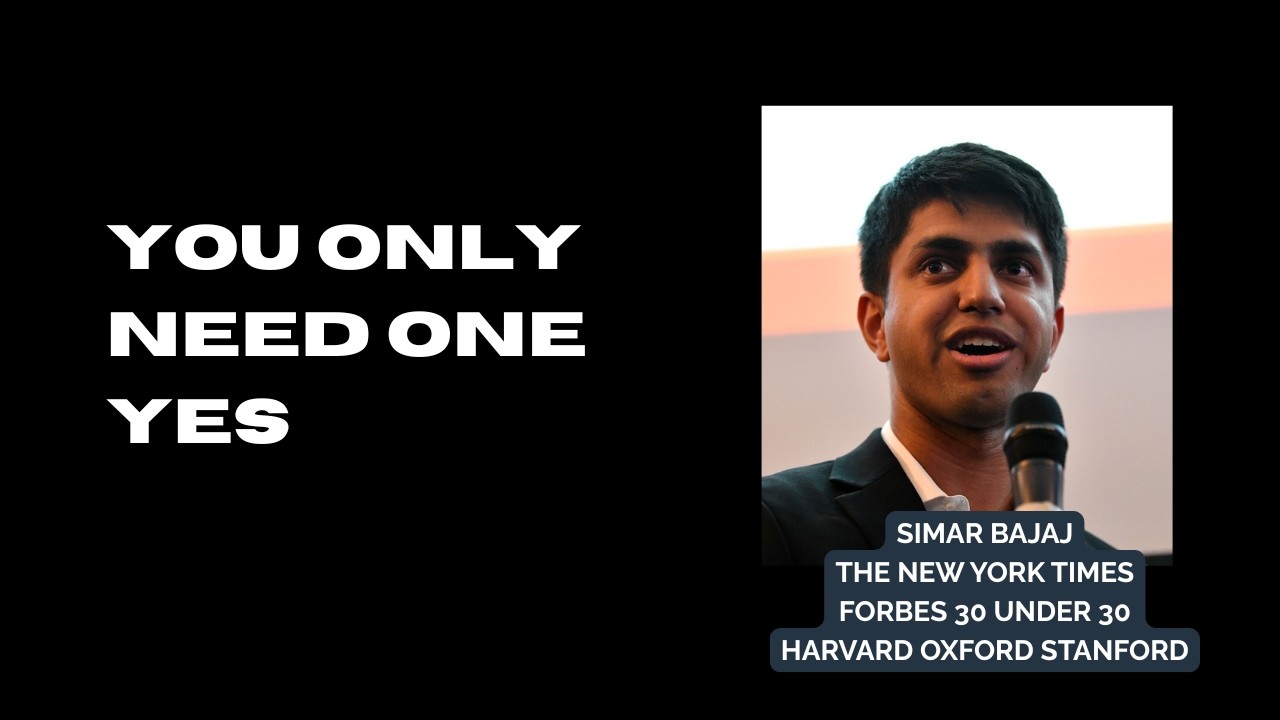
Simran Bajaj, a 24-year-old who has written for the New York Times and published peer-reviewed papers before medical school, sent 100 cold emails as a high school sophomore to land a cardiovascular surgery research position. He learned narrative journalism from Michael Pollan and now sources stories through Reddit, TikTok, and patient networks, building pieces around scenes and dialogue rather than raw data.
Chapters
A big part of being resilient is the willingness to try over and over again, the willingness to fail and bounce back. And today's guest, I feel like, is the definition of resilience. Not only is he the youngest guest on my podcast so far, but he is extremely brilliant and has a motto that we should all live by. It only takes one yes. So stay tuned for my interview with Simran Bajaj. He is already an accomplished health journalist at the tender age of 24. His curiosity, conscientiousness, and the desire to help people through medical writing is so inspiring. And he's going to tell us how he got the opportunities to become a New York Times health writer and to publish so many papers. And most importantly, to be able to have the privilege to tell the stories of those who may not be otherwise heard, all before he even graduated from college. Hi, welcome to the MindBodySpace podcast.
I'm Dr. Juna, your host.
This is where you're going to get your science-backed information that keeps us resilient and well.
Recently, I've been working really hard on Relax to Soar Resilience System.
It's an analog planner, actually. a system that will help you cognitively offload all of those microhabits you need to stay well. And it's based on over 10 years of experience teaching at schools like the Juilliard School, NYU School of Medicine, Columbia Law School, and as well as tens of thousands of people online. You can head over to mindbodyspace.com/store, check it out, and order it today. It has 6 months undated, and you'll get email support to get you started on your biggest goals and even your smallest goals.
Welcome back. Hi, Simmer. How are you? Thank you so much for coming today.
I'm great. Thanks so much for having me, Dr. Bobby.
Of course, of course. And we know each other from a prior conversation.
Right.
So I want to start with asking you about how you got started with your interest in healthcare in general, and also about journalism and healthcare, because I know your uncle— you were telling me your uncle's a radiologist like I am, and he kind of got you started being interested in medicine.
Exactly. He said he was in the Air Force and he was deployed to Afghanistan around when I was 9 years old. And it was one of those things that I was just terrified. I was like, my uncle's gonna die and he's going to this war zone. I'm not gonna see him again. So what he did to try to like deal with my emotions was, okay, we're gonna Skype every week. And he would tell me a little bit about what it was like being there, how he'd be taking care of US Air Force personnel and NATO members, but also Al-Qaeda and Taliban personnel. And to 9-year-old Simran, that was just like, did not make any sense at all. I was like, why are you taking care of the bad guys? That makes no sense. And his thinking was that, look, as a doctor, my goal is not to judge if you're good or bad, it's to take care of you. And politics of what to do with you, that's gonna be decided by someone else later. And I think that there's still confounding to me and so amazing to me that I was like, I wanna be just like my uncle. I want to be a doctor like him. So that's how my interest in healthcare came about. Interest in journalism was a little bit later on. This was in college where I was trying to fulfill the English pre-med requirement and I was looking for the least painful way to do that. It turns out there was a class called Narrative Scientific Journalism.
Hmm.
And I thought, okay, this sounds not so painful. I applied for it. We were fortunate to get in and it was a 12-person seminar taught by Michael Pollan, who's this incredible famous author. And I just fell in love with it. I thought it was amazing. I thought, There was something about being able to write so freely, right? Research is so— the writing is so prescriptive and it is so— it's always boring. But journalism was— there's also no rules. You could have fun with it. You could communicate in all sorts of different ways. And it was that class that inspired me. I spent the summer after that freelancing and very fortunate it worked out. Very fortunate that that sort of helped me realize that not only did I want to do it, I could do it.
Whoa, wait a minute. So let's reel back. You had a 12-person seminar with Michael Pollan?
Yeah.
I mean, I love him. He had that quote, Food, not too much, mostly plants.
Basically, yeah. I love that. The most simple nutrition advice you can get.
I love it. So you had this seminar with him for a semester. What did you learn in there? I'm so jealous. Wow, that's incredible.
There was a bunch of opportunity, right? I think he's a really great professor. Really what I learned was just how do you build a story? There's the lead section. How do you grab someone's attention immediately, especially in this attention economy? How do you end a story in a way that isn't just summarizing everything you've written before, as we're often taught to do in school, but with something that is Propelling people onward, leaving them with their perspective. I mean, it was those basic building blocks of journalism about scenes, dialogue, and making things evocative that was really helpful. I mean, the idea of the class was really that fiction writers, they're incredible writers, right? They get to play with all sorts of tools of storytelling. They get to weave a beautiful story. Can you bring those same elements and tools to nonfiction as well, to journalism as well?
So you show up for first class, you can't hide in a 12-person seminar. So was it mostly about you guys writing and then having an assignment?
How did that go? For me, it was a mix of sort of reading really excellent pieces of science journalism, right? So for example, one project in the class was each of us had to choose our favorite piece of long-form science journalism, interview the author, then sort of speak about the article, speak about how the author conceptualized it based on our interview. So I chose a piece by Joe Gualande on cost syndrome, got to speak with him for 15 minutes, learn a little bit about how he conceptualized the piece. So that was one of the parts, right? You become a better writer by analyzing, thinking, And sort of learning from great writers. And then a lot of it was sort of putting our own sort of drafts to bear and then workshopping that in class. So I wrote a piece about stigma during the COVID-19 pandemic and sort of worked— workshopped that through the class and then eventually published it.
Amazing.
Atul Gawande.
Atul Gawande, yeah. Atul Gawande, he's an endocrine surgeon. He wrote this book, Checklist Manifesto, basically on this idea of the surgical safety checklist, right? And the idea is there's many parts of it, but when you're in a surgery, you wanna make sure you're operating on the right person. You wanna make sure it's the right organ or the right limb. You wanna make sure there's all these basic things. That sounds basic, but the reason this matters is because people have made mistakes, right? People have operated on the wrong person, sometimes the wrong limbs. Sometimes they haven't washed their hands. Sometimes the wrong surgeon's in the wrong room. This is just a basic checklist taken from sort of the airline industry where they do something similar. They do all their checks. It's remarkable because it helps reduce errors. It helps improve outcomes. And this is true across the world. So, Dr. Barney's book was really helpful in terms of emphasizing the importance of that and spreading it to a much broader audience. And I think he played a big role in also even conceptualizing the surgical safety checklist to begin with.
I mean, I love that book. That was one of my favorites. And I used to do a lot of biopsies, and I'm sure he had a lot to do with this, but it was then enforced for every single procedure. The person had to say their name, and then they had to actually tell us which side we were biopsying of their body. I mean, there have been cases, unfortunately, where the wrong kidney out, or the wrong leg, or the wrong side of the brain. So it sounds so stupid, but it's so incredibly important.
So important.
And what did you learn from him when you spoke to him?
I mean, I think it was really about that piece and just how he was drafting the piece. This was Cost Conundrum. So this was during the Affordable Care Act time, or right up into the lead-up of that. And his piece was basically looking at why do costs vary so different across the country? Why in this place in McAllen, Texas, are these doctors charging Medicare these sky-high rates?
Mm-hmm.
So it was less about sort of many universal truths, although I appreciated just the opportunity to meet him, but more about how does he think about starting the story with this How does he think about unfolding it in this way? It was a very technical discussion, it sounded like.
But like you told me last time in our conversation, you were talking about even when you're writing about something like health, you do need to tell a story. Both of these giants and New York Times bestselling authors, they told you the same thing. They said that go in with a story first.
Right. Because we're human beings, right? Human beings relate to other human beings, right? When we think about data and statistics, they're wonderful, but they don't connect us. That's not our natural language, right? We don't speak in numbers. We speak in words and stories. We speak in anecdotes. And do you hear about this person? It's why a politician says, well, I was meeting with the taxi driver in Brooklyn and he told me XYZ things, right? Like, why is this politician talking to you about taxi driver payment instead of like the statistics about that, right? Because they know that the person, the interaction, that story will pick up your ears in a way that no numbers can. Statistics can bolster an argument. It can bolster anecdotes to show that's not just one of one, but it's something about how do you weave those 2 together and lead with a story? Because that's what touches people. That's what touches their heart.
Mm-hmm. And I know you did a lot of scientific writing too. You have first authored, I don't know, 90 papers. Is that correct?
Yeah.
Is my memory right?
I don't remember that.
That's insane. And you're only 24, right? And you did this during a lot of it during college or in between?
Yeah. Most of it during college.
Okay.
That's insane. And I think we talked about, did you never go to class or something?
I did go to class.
You did go to class, but you didn't do a lot of extracurriculars. You were busy writing all these papers for like peer-reviewed actual medical journals.
Is that right?
I did some extracurriculars.
Insofar as I was the president of the World Health Conference, and I sort of worked with the different sort of clubs on campus, like the Institute of Politics Health Policy team. But for me, it's just writing. And I think part of the reason I've been fortunate to publish so much is because I really love to write. For me, it's something that I find fun and invigorating, right? In the way that someone might go out on a Friday night and find that fun and invigorating. I am nerdy. And for me, writing a paper, putting together that argument, weaving it together, It's just delightful. I mean, it's energizing.
That's awesome. And, you know, I was just watching a documentary last night, um, on Martin Scorsese. Are you a fan?
So there's—
I don't know of any.
Oh, he's done all the gangster movies, like the master of these classic movies. I think you would really enjoy it because it's all about the storytelling. And, and at one point he had really bad asthma as a kid, so he would look out his window and like his window had panes on them, window panes. And so everything he looked out at on the street was a scene in a movie. So he learned How to Tell Stories. It's a very interesting documentary. I'm so interested in people. Yeah, people like you, somebody who knows what they want to do from a very young age. That is, to me, is fascinating. Can you speak a little bit about the fact that I know your parents immigrated here and they kind of leaned on you for translation or just figuring things out on your own? Can you tell us a little bit about that and how that influenced you into this investigative journalism and medicine now? Because you're going to medical school.
I am, I am. I was starting in lesson 1.
Oh wow.
Yeah, no, my parents, I mean, they immigrated from India and for them, right, this was a new country and this was not their first language, right? So for me, I often took on a lot of responsibility in terms of helping navigate them, helping sort of navigate through certain appointments and whatnot. I remember vividly I was applying for this school, it was middle school, and they, for some weird reason, they required a parent recommendation, right? What parent is gonna say a bad thing about your child? But anyway, they required a parent recommendation. So I wrote my mom and dad's recommendation for myself, right? Which sounds almost absurd, but it's because sort of they trusted me to write a better recommendation than they trusted themselves, right? So it's one of those things where they gave me a lot of responsibility in a way that I think I really appreciate and learned from because I had the opportunity to make mistakes and get things wrong and learn from them and learn from them in a way that was not overly punishing or overbearing, right? It was just sort of taking accountability. And I think that was just immensely helpful.
So 10-year-old Simmer, what did you write about yourself to recommend you for the middle school?
Could not tell you. I mean, it's probably terrible. It's probably like, Simran's the greatest and you should take him into school. But no, it was, I mean, it's an absurd story, but it was something that English wasn't their first language. They weren't comfortable writing English. And my mom and dad, they had an email they were sending to their bosses. They wanted me to proofread it and sort of just make sure that it sounded all right because they sort of skipped my middle school. Like my sort of as 6th grader or 5th grader, I was able to help them with that.
That is so incredible. And I mean, I love the way you see it as something that is kind of almost like something you learned from rather than a burden.
Yeah.
You know?
I know what you mean. Because I think for many sort of children of immigrants, it can sometimes feel like a burden. It's a lot of responsibility. It's sometimes all-consuming. For me, it just sort of, I guess I felt one of two things, right? One is that I was helping my parents out, right? They did a lot for me, right? This is sort of almost minimal I can do for them. And two is just like what I felt like kind of in awe, right? 5th grader, 4th grader is getting this opportunity, right? I felt like they trusted me and really respected me. So I was like, yeah, bring it on.
You're just like, here, sign right here on the dotted line. That's a lot of power.
I agree.
That is awesome. So let's talk about your process of— wait, before we go into that, I did want to touch upon the fact that you're so resilient, you know, especially with the childhood that you had and just being so interested in taking on Responsibilities. And then you also told me something very interesting about how you started to do research. I think it was in high school, right? Tell us about how you got that research position.
So, I was a sophomore in high school, and I'm looking left and right, and my friends have already done research the past summer as freshmen. And I'm like, wow, I'm falling behind. I, I have not done any research. I don't know what research is. I better get on this. So, I cold email 100 doctors at Stanford and sent terrible cold emails, like god-awful. But what I do What I do during the cold email is if I'm emailing an anesthesiologist, I say, I've always been interested in anesthesiology. If I'm emailing a heart surgeon, I say, I've always been interested in heart surgery. So everyone, I've always been interested in their field. And anyway, most people don't respond. A couple people say, sorry, no, I don't have a position. Then one person, a heart surgeon, says yes, and he lets me come do research as a 16-year-old. And I sort of study cardiovascular surgery. I study cardiovascular surgery education. I make a database and am able to analyze that. And I mean, it was a really great example of right time, right place, where there's the right mentors in place, there's the right project. They gave me sort of the responsibility to take it. Then as a senior in high school, I am presenting first author research at the Society of Thoracic Surgeons and the Academic Surgical Congress.
Amazing.
And it was the most surreal thing in the world. There's no— when you sign up for the conference, there's no option for undergraduate, let alone high school student. So it was an unbelievable honor to have that opportunity, but really it's testament And to the mentors who trusted me to take that step and take on a project for myself.
But I want to point out that you say right place, right time, but honestly, you sent out 100 emails, so you kind of made that opportunity for yourself.
But I think that's the general truth, right? I think you're only going to get right time, right place if you give yourself opportunity to be in the right time and the right place. Like, for none of them, right, it wasn't the right time, right place, right? I only needed one yes. And that's sort of how I thought a lot about sort of life and opportunities. Whereas, like, yeah, of course it hurts when people don't respond to you or say no to you, but it's something where, like, the alternative is just not having any shot at all.
But I think when you send out 100, you probably don't get as hurt if some of them don't reply.
Yes, this is true. You've also reduced it to a task.
Yes.
Something like you put your heart into every email.
And my version of cold emails back then, because we didn't do email because I'm much older than you, I cold called research labs in New York City.
Oh.
To get a summer job. And I ended up with one of the most famous neuroscientists, Dr. Rodolfo Llinás's lab. And that's how I got that job. Not because I was some genius or anything. He did ask me a question. He's like, what do you want to be? Do you wanna be the sharpest metal? He was so intense. He was so intense. He's amazing. I'm gonna send you Eye of the Vortex that he wrote. You're gonna love it.
Thank you. I mean, I think there's something where at this stage, right, when I was a high school student or even as a college student, what could I offer them? It's not like I was gonna be the brilliant mind of tomorrow who would be able to answer their problems they're having in the research. I could offer them my tenacity. I could offer them my effort. And I think sort of at some level, cold emailing or cold calling is a good signal of that, right? Someone who is willing to put themselves out there, right, across hundreds of emails or hundreds of calls.
Amazing. I did say that I would work for free and they ended up paying me. So that's another, that's another one that I did not expect, but that was great. But you are, I think, a brilliant mind. So I do think that you have a lot to offer, but you're being very humble. So when you look for a topic, you've, you've written a few New York Times articles and I read You had one of them which was so touching about lung cancer and the stigma of patients who have lung cancers. I never ever thought about people being ashamed of their disease, even though like doctors are very famous for being ashamed of being sick. Nobody will ever admit that they're sick. So when you look for a topic like that, how do you come upon that? Is it something you look for? Is it something that's just a question in your mind? How do you come to that topic?
I mean, usually for pieces like that where I feel like I'm breaking news, I'm writing something that hasn't been written about in the media. For me, it comes from just speaking to a lot of people, speaking to patients, speaking to doctors, piecing things together. Because it's not always that people are yelling and screaming in my face or like saying it so loudly or so clearly. Oftentimes, bits and pieces here, and I'm trying to piece together the story, seeing that, okay, this is not just one person's anecdote, but I'm hearing it again and again, right? Mm-hmm. I mean, I've been interested in the stigma of lung cancer for some time because, of course, lung cancer is tied to smoking, but people are often blamed then for their disease, right? They're sort of seen as sort of morally culpable or responsible for being sick. I've always been interested in that. But it's one thing to study in academic interests, one thing to talk to patients who are telling me how they didn't think they were deserving, right, that they didn't think they deserved treatment. Wow. It's one thing to talk to doctors telling me how their patients who come in dressed all in pink or telling their family they have breast cancer because they want to feel sympathy, they don't want to feel blamed and shamed. So it's through that and like just hearing a little bit from certain sources and then seeking out further, right? Talking to people and saying, hey, what are some examples of moments where you felt shame or stigma related to your disease? Has that happened to you? So it unfolds gradually in that sense. Like for that story, I spoke to about 20 long-term patients to understand their stories and see that this is truly a pattern. This isn't something I was imagining or thinking up in my head.
Interesting. Okay, so you get a topic like that and then you find people to— how do you find the people to interview?
Yeah, that's the mix. Sometimes you find them online, sometimes kicked off Reddit.
Wow.
Sometimes, and in this case it was through sort of speaking to sort of lung cancer survivors and asking them, who are your friends? Who do you think would be willing to talk to me? Who do you think sort of might have a good story to share with me? And every story is powerful, but then some patients, they're really able to tell you about it in personal ways. Not everyone is ready to share the story, especially for this stigmatized disease. So it takes someone who is brave enough to share that Wow, you're still doing cold emails really because you're looking for people Reddit and TikTok.
So you go on TikTok and look for people who are talking about their lung cancer experience or?
Yeah, it might be lung cancer. It might be on TikTok. For example, I've talked to interviewed a woman who had sort of lost 100 pounds on one of these GLP-1s that had loose skin and she had spoken about it on TikTok. So it was because the problem with some of these things, right? I write a lot about stigmatized diseases or blame and shame. Okay. People aren't ready to talk as we mentioned.
Yeah.
In turn, how do you find someone who's willing to talk? If they're someone who has shared their experience on Reddit or shared their experience on TikTok, it's a signal, right? They're open to being quoted, open to sharing their story. So that's why I sort of turn to some of these sort of public communities because it gives me that insight into— it's a little bit less cold, right? Because I know that they're sort of open to sharing.
I'm really fascinated by that. I did not know that that's how you got some leads. That's really cool.
Sometimes. Yeah, yeah, sometimes.
And then other times you call researchers and surgeons or medical professionals and then you have an interview with them on the phone. Exactly.
I interview them on the phone and maybe at the end of the interview I ask them, hey, are there any patients of yours that might be willing to talk to me? And they have to, of course, get consent to connect us. But it's one of those things that I think getting access to experts is often very easy, right? To patients, it's always harder because, of course, we have very important privacy protections in the US.
Yes.
So there's a question of how do you find someone who is, one, willing to share, and then two, get their contact information?
So did you start off with the story— so you said it evolved, but did you start with the story being about blame and shame around lung cancer, or did it evolve that way?
This was sort of the initial dream about lung cancer, but it was something where I wasn't starting from scratch. I had already written several stories on lung cancer. Some of these sort of threads had been sort of being pieced together across my several other lung cancer stories. And then this story was one I've been seeing this pattern, this trend. I want to weave this into its own sort of manuscript and its own story. So for me, it was how that came together. Sometimes it starts with a doctor telling me, hey, look, I've been working on this thing. I had an experience. Sometimes it starts with a cold email to me, right? That some researcher or some PR professional emails me and says, Simran, I learned about this thing. I think it's really interesting. Would you be interested in learning more, covering it? So, it comes from all these different sources. Sometimes it comes from, I read an article and they have mentioned something fascinating in one line, but just didn't get the chance to explore it. So, I was like, this should be explored further in a totally different article. So, the ways ideas come is so manifold, but really I think it is sort of people having something fascinating and interesting to share and something that deserves to be told to a much broader audience.
Awesome. And so I'm going to get into the nitty-gritty a little bit. Like, how do you have like a little notebook you carry around? Where do you keep all these ideas? How organized are you? Because that's one of my biggest problems. I can't organize myself. Although with AI now, it's so helpful to just like ask it, what did I say in these emails or whatever? But how do you keep yourself organized? I saw this one author, he had little notes all over his desk, hundreds and hundreds, not organized at all, but just in his drawer. So what do you do? What's your process?
That's what surprised me personally.
Well, he's fiction. He's fiction.
There we go. There we go. But for me, I think it is sort of like, it's mostly digital because I think I like having a searchable database. So I will have, for example, a spreadsheet of stories I've written, sort of where it's been published and all that. I'll have in that same spreadsheet, I'll have sort of some jot down some ideas about what I might wanna cover next. There might be ideas I put there that I won't return to for months or years, but just sort of when I have something that I think is interesting or struck by, I just wanna keep it down so that when I'm looking for an idea or thinking and having a dry spell, I have sort of a list of running thoughts that I can sort of pull from or perhaps be inspired from. I have sort of a Google Drive folder with all my stories. I mean, I've been also trying to experiment with AI in terms of organization and sort of streamlining my processes. For example, there's like NotebookLM from Google where you can put your different sources and different digital files. And it's beautiful because, as you were alluding to, you can just search through them, right? Yes. It's like one of those things where you don't have to have the exact keyword, you just have where, where was I talking, where was this person talking about XYZ thing. Yeah, it makes it much more easy.
So cool.
I've been using some of those tools as well, just trying to like parse through my files, because sometimes, especially when you're writing a long feature, you just have like— I might have hundreds of pages of notes, right? And then it becomes all unwieldy. I cannot actually read 100 pages of notes every time I need to. So I'm trying to figure my way out.
So, but it's all typed in and you just have it digitally? Like it's all Google Docs and Google Sheets?
Yeah, it's all Google Okay.
Yeah. So your tech stack is basically Google and NotebookLM, which is also Google.
Basically.
All right. So you don't use any of those fancy Airtable or anything like that?
Not for me. I mean, I think they have their merits. For me, I just like, I'm pretty like standard old school in terms of I just need an outline. I just, and then I need to start writing and I have my transcripts of my interviews on sort of otter.ai. But other than that, it's just like, I don't feel like I need any fancy.
Otter. Okay. So there's also Granola. Right? Do you use granola at all?
Yeah.
So being a very hyper-anxious person, I always get sort of worried about when I can stop researching. How do you know, how do you know when you can stop? And when you feel like, without oversimplifying things, I think we discussed this in our last conversation, but like, without oversimplifying, but without overcomplicating, like, how do you strike that balance? And how do you know when you've reached the end of your research?
I mean, for me, when I started doing the research for these stories, how I know when I've reached the end of the research is when I'm asked— when the researchers are saying the same things.
Right.
And then it's like when I'm talking to someone and they're saying something that I've already heard before, I already know before, that we're circling over some of the similar topics, because then I sort of know I've reached a state where I have redundant information, which is a good thing to have. Redundant information means you cover all the bases, all the ground, right? You can build over that. So for me, that's always been the key. And it's oftentimes that sometimes I'll stop early, right? And then I will be writing and then I will have a really hard time writing 'cause I will realize I actually don't understand this part 'cause I haven't asked anyone about it. I haven't done my own. So sometimes at that point I'll say, okay, let me take a step back from writing and reach out to some more people so that I can sort of fill in those gaps. I mean, there's no perfect answer. Like for simple stories, 850-word stories that I might write for The Times, usually I don't need to interview more than like 6 people for that. If you interview more than 6 people, it becomes a little crowded.
Yeah.
But for those larger stories, those large 2,000, 3,000, 4,000-word stories, You can keep learning until the end of time. There's always more to learn. It's just a question of where do you feel confident in your basics and confident in what you need to know? And oftentimes, it's like an iceberg, only like those 3,000, 4,000 words that show up on the page. There's like tens of thousands of words that are in my notes that have to be distilled into that.
So when you're writing for the New York Times, you have to pass the subject by the editor, so they have to approve it, right? And then you have like the template, or you have the constraint of how many words you're allowed.
Right.
So is it, it was normally 800 or 900, you said?
The New York Times has been really trying in recent years to get a lot of articles in 850 words or less.
Okay.
So that was the big constraint, right? That there's sometimes we would be like cutting things to get to 850 because they want it to be something that's easily digestible and people can get through. So yeah, I was like, then my articles are 850 words or less.
So how did you like having that constraint? Do you like that?
It was weird. I mean, I think like at first it's like feels terribly constraining. It feels like an artificial boundary. Why are we doing 850, right? I've all these important things to say, we're having to trim or cut out. I think that can be true, but I think the other way to think about it, the way I've learned to think about it, is that there's an art to it, right? What is the most important things, right? If someone has limited attention span, as we know many in our society do, I want them to absorb the most amount of information before they stop reading. And if I can get it down to a few words, there's a greater likelihood they'll finish the article. I don't need to be so pedantic or so high and mighty that you need to read every single thing that I think is interesting, right? I think there's elegance to learning how to write concisely, right? Um, I mean, there's all these stories that like, if you— if I had, uh, 1 hour, I can give you 2,000 words. If I had 2 hours, then only I can get you to like 500 words or whatever. It's easier to write long than short.
Yes, yes, I love that. So you're starting medical school now. What do you hope to do with it? Do you see yourself more as a writer who's going to become a doctor and learn more about medicine, or the other way around? What are you going to do there?
Long term, I want to be a physician writer. I want to be a practicing doctor who also Right now, I'm sort of feel— I conceptualize myself as a writer. I spent time at the New York Times, spent time sort of writing for all these outlets. I sort of see myself as a writer entering medical school, learning the skills of the trade, really focusing on getting as good a medical education as I can so that, right, I can be a doctor who writes. It's almost the same. I have the writing skills, at least a good foundation of that down. Now it's sort of a question about learning how to be a doctor. So for me, the doctoring will always come first, and then writing is a way I see to advocate for my patients. who I'm seeing, but also the patients who never even make it to the clinic, who never even get— have the opportunity. I never have the opportunity to meet them. So that's sort of how I think about writing. It's almost a form of public health. It's a form of advocating as patients and sort of helping shift the policy realities across the country.
I feel like you're going to be more in like the cerebral kind of fields, either, I don't know, endocrinology or some kind of medicine. Am I wrong? Or is it versus surgery?
I plan on being in internal medicine. So yeah, you jumped right to surgery.
I was right. There you go. All right.
So Let's go through a few lightning round questions, if you don't mind. So what is the best advice you've ever received?
One.
Best advice I've ever received. Yeah. I think for me it has been this idea of you only need one yes, which we've already talked about. But it comes back to this idea that every failure gives you another opportunity to send another email, send another call, and hopefully get another yes. I think those one opportunities can be life-changing. That's what happened for me.
So all you need is one yes.
All you need is one yes. What are you going to do if you're not in 2 jobs or 3 I mean, you can, but it's harder, harder.
What's the worst advice you've had?
The worst advice I've had? Well, let's see. I feel like it's been around perfectionism, right? This idea that things don't need to be perfect, right? Don't let— I'm forgetting the phrase, but don't let perfect be the enemy of good or something like that. There's merit to that, but I think what perfectionism means to me is just taking care and being attentive to the details. I think the details is where things rise and fall. It's where the story is made or broken, right? I will spend, when I'm writing, sometimes sour on sort of single word or single sentence, right? Thinking about how to phrase it properly, right? And it's something that probably is inconsequential. Most readers might not even notice it, but to me it reflects the level of detail and attention I want to put into my work and want to represent me. For me, I think the worst advice is sort of this idea that perfectionism is somehow a sin or is somehow something that is horribly inefficient. I think it reflects a character to your work.
I totally agree with you. And you can call it also conscientiousness.
Yeah.
And if you're going to have a doctor or reporter, you really want a She has just reporter, a doctor, or a pilot. So I think—
You get things right.
Yeah. I think perfection is something that you can aspire to. Yes. You shouldn't let it stop you from publishing something or talking about something.
Oh, without a doubt.
Yes. And now what do you wish you had more of?
I wish I had more, I guess generally I wish I had been better about going to the gym, better about exercising and whatnot. It's one of those things where that's the thing that often falls off when I'm getting really But of course, sort of just being active is so important for your health. It's so important for your focus and sort of memory and retainment. I think for me, I wish I had perhaps more understanding and more awareness that like this is something that is almost non-negotiable, right? Not treating it as something expendable, the physical activity aspect, but something that's non-negotiable.
And what's your favorite physical activity?
Tennis. I'm a big tennis player. This summer I've been playing every day.
Fabulous. Okay. One more thing, a story or a writer that changed how you see the world?
I think for me it's almost Rachel Carson. Rachel Carson, of course, is the famous environmental journalist who wrote Silent Spring. For me, it was just such a— Silent Spring is this beautiful example of advocacy journalism, right? This book that launches the modern environmentalism movement, that sort of changes how people think about the environment. And it showed me the power of books, power of writing to affect change, to create a movement, to organize people together. So for me, it's easy to think about writing as something in decline, as something that has lost its power, that we are in this post-reading society. People are reading less than ever, but writing is so powerful and amazing at inspiring people and evoking images in their mind and evoking emotion. And that's something where I think you can't do it the same way with video. You can, right? Video and movies can be powerful, but movies have their own images. They don't require anything from you, right? Writing and reading is something where it requires your imagination and every person's experience is so different and it's so unique and so personally imprinted. So for me, I think Rachel Carson is perhaps the best example of that. And it's something perhaps stubbornly I, I still believe in this power and I still believe that we can tap into that power.
1000% agree. It's a full engagement of your entire nervous system, right? Your whole brain. So you're actually processing rather than just receiving. And I would say libraries and books saved me as a kid, but I forgot about them during medical school. And then having kids and all that, like I read, but not to the extent that I used to read, and I'm getting back to it now. And thanks to people like you, I'm starting to write also. So I took a narrative class, and you were one of the inspirations for taking this class. And yeah, and I'm loving it. And I can't even believe that I've been writing every single day for the last 2 weeks now for 30 minutes. And it's amazing what you can process, everything in your life, because it's like they say, if you don't reflect on your life— The innards of That's what I was just trying to quote Socrates.
Okay.
But yeah, no, I agree with you. Writing is a form of thinking, right? And I think it's sort of like a way to access parts of your brain that sometimes otherwise just you don't, right? It's something about how do you make an argument or a story on the page, right? It requires this construction. I think you can get that from talking to people, talking to a smart friend and sort of bouncing ideas off each other. But writing is sort of when the rubber hits the road, right? I can say something to you and backtrack, right? When I'm writing something and I'm publishing it, there's no backtracking then afterward, right? I have to be conscious of what I'm saying. And I have to feel like it's well-organized, cogent, right? There's a rough draft, but, and you work through that and it's sort of this beautiful act of shaping your thinking and shaping what you believe.
Oh, that's beautiful. And I'm gonna tell you, being so much older than you, what happens with life is like your brain just forgets so many things if you don't write things down. And I, this was one of the memoir things. We were supposed to write a difficult moment from a recent day, like a week ago or something, and then something from a longer time ago. And it was so much more vivid. when I wrote about something that happened recently. And your brain, the time that your brain processes, and I don't know if you know about the neuroscience of how we process time, but it really has to do with emotions. You know, emotions and sensory reception that memories are formed. So, if you're not writing stuff down, honestly, you're like, what happened to my life? It's great what you're doing. And, and do you journal? Do you just free-write ever?
Just curious.
I would say, however, I've tried to do it a couple of times. For me, I think it's always always been sort of this antithesis, speaks more to me, the sense that like I could be freewriting or I could be writing the story for this like New York Times, right? So for me it feels like this opportunity cost. So it's perhaps not the right way to think about it. It's something that I'm trying to get better at. These are investments, right? These are not products in themselves. It's not like you're gonna publish your journal or you're gonna publish this sort of like random freewriting, but it's something that's investing into your own self-education, into your own understanding of yourself.
Yes.
But I think it's so Well, I hope you do that in medical school.
Oh, definitely. For stress relief, for just chronicling, right? Then thinking, doctor, what was I writing in medical school? Well, what was I thinking about, right? And there's something valuable, especially in this time when AI is changing so much, to be in Silicon Valley. I'm planning to at least journal. We'll say plan. Who knows if I'll actually follow through with it. But I do believe it's really, really important just as I'm entering medicine in this interesting time, interesting space.
Yeah.
Who am I and who do I become?
I'm going to check in on you because I want you to write and tell us all about what you're thinking. It's such a pleasure talking to you. Talking to you, such a stimulating conversation, and you have a brilliant mind. I can't wait to see what you do. Thank you so much for being here. Really appreciate it.
It was absolutely delightful. It's always so fun chatting, and thank you so much for having me.
Yes. What social media are you on, Dan?
I'm on LinkedIn, and I'm on Twitter. I recently started TikTok, so I'm trying to do more short-form video creation now. Fabulous. A lot of media.
All right, I'm gonna find you there and follow you.
Please, please.
Okay, so tell us what your handles are.
Yeah, so for TikTok right now, it's Bajaj931.
Okay.
You're only left. Change your username once every 30 days. Yes. So that's one thing. On Twitter, it's Simmer S. Bajaj. On LinkedIn, it's my first name, last name, Simmer Bajaj.
Thank you so much for being here.
Thank you.
Thank you for listening. Don't forget to hit subscribe and share and head on over to mindbodyspace.com/store to get your copy of the Relax to Source system that will put all of those microhabits of wellness into autopilot for you. Until next time, this is Dr. Juna signing off, wishing you and your loved ones wellness.
More from Juna


How to Switch From Practice Mode to Live Stage Performance | Juilliard #Shorts







Don't Ignore Symptoms and How to Cope With A Diagnosis : With Harvard Psychologist Ellen O'Donnell

3 Habits To Prevent Acid Reflux — Dr. Peter Belafsky MD PHD Director of Voice & Swallowing
