AI Therapy: Does It Work? Dr. Juna with Dartmouth Researcher Benjamin Kaveladze
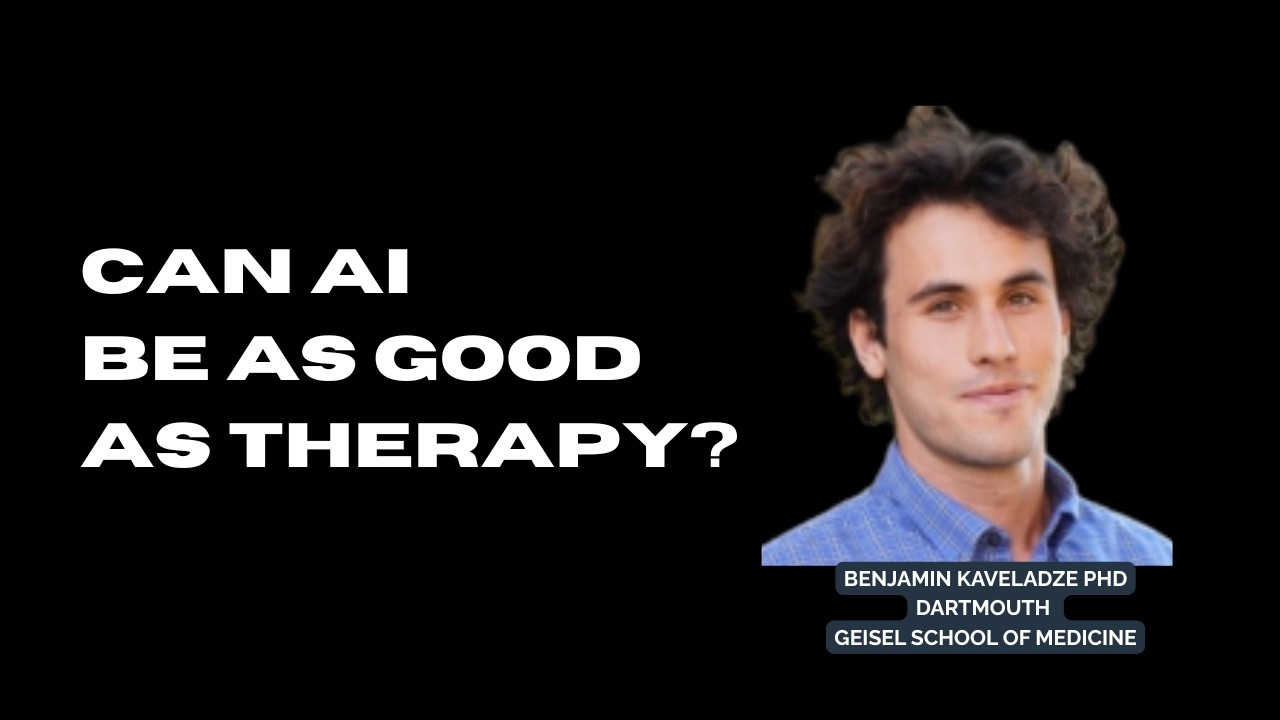
Benjamin Kaveladze, a psychologist at Dartmouth's AIM-High Lab, discusses AI chatbots for mental health. A large study of 7,500 people found that two brief interventions—a cognitive reappraisal exercise and a mindful-attention video—significantly reduced depression a month later. He warns against one-size-fits-all apps and emphasizes letting people choose what works for them.
Chapters
Now that people can get support from ChatGPT, it's kind of changed the field in huge ways, and we really have to focus on studying this right now.
Can just 10 minutes change your mental health? That's exactly what Benji and I discussed the first time he came on the show. Since then, Benji's moved to Dartmouth, and he's now deep into AI and mental health. Hey, Benji, it's so good to see you. How are you?
Good to see you too. I'm good.
I'm really excited to have you back. You being on my show was one of my highlights. I love that episode because I love everything you're working You were with Dr. Jessica Schleider at Northwestern University at her lab for scalable mental health, and now you moved to Dartmouth University.
I started here last summer. I've been here like almost a year now. I feel like this field of digital mental health and scalable mental health, AI is becoming like a really important thing to study. I feel like as a psychologist, I have a responsibility to study this. I've been learning a lot about large language models and how people are building AI mental health tools.
Can you tell us about the lab that you're working in in Dartmouth?
It's called the AIM-High Lab. We're working on building evidence-based interventions for mental health. It's led by Nick Jacobson, who's a psychologist. He and Michael Hornans, who's also a leader in our lab, they put out this paper about a year ago about Therabot, which is the first evidence-based artificial intelligence chatbot for mental health. It's not publicly available. It was just for research. I've been working on scalable mental health interventions for a long time, and now that people can get support from ChatGPT, it's kind of changed the field in huge ways. And we really have to focus on studying this right now. Yeah.
And for listeners For listeners who don't know what scalable mental health is, can you just give them a little nutshell of what that is?
Yeah, like basically the concept is that a lot of people could benefit from getting mental health support, but don't have access to a therapist, for example, or don't want to talk to a therapist. Or the idea is to provide as much support as possible using technology, for example, like giving someone an app or some kind of online resource. That way more people can get this kind of support. I mean, this field struggled for, you know, at least the time that I've been in it, struggles to get people to engage in it. Someone will download an app like Headspace, and try it for like a day or two and then get bored. But at least picking up ChatGPT, people are doing that in much larger numbers than ever before in the field.
Yeah, I do talk to ChatGPT sometimes, and it's interesting because ChatGPT just changed their whole persona because I said to it, I'm like, you're no longer being sycophantic, you're like pushing back on everything I'm saying. And it was so different from, let's say, a couple of months ago. And it's like, haha, yes, they changed it so that I don't just completely agree with everything you're saying because there's been so many mental health advocates who have complained about ChatGPT, right? Because it could get you into this loop where it just agrees with you and pushes you more towards what you're thinking, like a silo.
Yeah, that's interesting that you noticed that. I haven't tried using ChatGPT for like personal stuff. I'm trying these specialized apps. It's a free downloadable app that is trained specifically on, I guess, like a bunch of therapy transcripts, trained on different datasets. So I mean, honestly, it acts pretty similar to ChatGPT when you talk about personal issues, but it's a little bit more specialized. I mean, Sonia is one, Flourish is one.
Is it Ash?
A-S-H? Ash?
What were The other ones?
Solana, Flourish. I mean, I shouldn't endorse them.
Oh, don't endorse it. You're a researcher and you're using it just to see what it does, right? And it has been trained on research-backed things.
Somewhat. All of them have their own strengths. There hasn't even been a study comparing these apps to like ChatGPT. ChatGPT might be just as good. I feel like a good idea is to like try out and see what seems to work for you. But in general, people seem really satisfied with these things. I mean, people speak in hypothetical terms about the fact that we all have a personal AI therapist. It's possible it's gonna be a disaster. I've talked to, you know, these chatbots if I'm having some interpersonal difficulties. It says good stuff. You know, it calms me down in the moment and helps me deal with the feelings of anxiety. So I'm sort of optimistic about the future of this field.
And when you're talking to a therapist or you're journaling or doing any of those things, you're basically talking to yourself and kind of like working things through. I mean, obviously a therapist is trained and they hopefully know what to ask you to help you along, but a lot of times you're just hashing out things in your own mind and trying to get a perspective on it and trying to understand yourself, right? So I feel like when you're talking to these chatbots, you're kind of doing that. You can actually say to the chatbot, just ask me questions, don't give me your opinion, and it will do that. I used to think that Grok was one of the better ones with the therapy mode. It was a little more helpful than some of the other ones. But lately, you know, that's the thing with chatbots and AI. They seem to change month to month, like I said. So it's not reliable. In that sense.
Yeah, that is super true.
But tell us about this experiment you did. You did a mental health experiment where you had almost 7,500 people. Tell us a little bit about what happened with that, what it was, and what the results were, and what you took away from that.
So that one was one that I did at Northwestern. This is before I started working on AI. So on this topic of like making scalable mental health interventions, one approach to doing that is to have like really short interventions, an intervention that lasts 5 or 10 minutes. And by intervention, I just mean kind of an online course. How can we give as much information as possible about how to improve your mental health to someone in 5 or 10 minutes?
I love that.
Yeah. The area of research of Jessica Schleider, who I was working with at Northwestern. When I started my postdoc with her, I was really curious, like, what is the best way to give this value in 5 to 10 minutes? You know, there have been interventions made by researchers in the past that seem to do pretty well, but I wanted to know, is it possible for them to do even better? I put out a call on social media for people to submit their own ideas. If you had 10 minutes with someone and could tell them something online, what would you tell them? Or what video would you send them? Or yeah, what would you do? And tried to reach as many people as possible with that call, not just researchers. Got 66 different submissions of interventions and then selected from that 66, 12.
I made it to almost 12, but mine didn't make it to the final 12.
You were so close.
It's okay.
Thank you for submitting.
I'm just kidding. But it didn't even have to be therapists. You guys did not pick all therapists or doctors or any healthcare workers. You invited anyone to make this video. Is that correct?
Exactly. Yeah.
Okay.
And we, we had some high school students, college students, people that actually work as mental health professionals. So we took these 12 interventions and then randomized 7,500 people to complete one of those 12 interventions or a control condition where they just spent 10 minutes learning about trout.
Okay.
That was just meant to like distract them and kind of have them use their brain for 10 minutes, but not learn anything mental health relevant.
Mm-hmm.
We learned which of those interventions significantly reduced depression a month later. Only 2 of them. Significantly reduced it. It was interesting to look at how those interventions differed from the other ones that we looked at. And specifically, they like taught us a particular skill and reinforced how someone could implement that skill in their daily life. Those were more useful for improving mental health in the long term than ones where you, for example, meditated for like 10 minutes. Like that helps in the moment, but for long-term improvement, like actually learning an implementable skill, like how do you challenge negative thinking or how do you overcome that like initial fear to going out and like making a friend? Things like that seem to be more impactful.
So what were the 2 videos that were impactful and had positive outcomes?
One was not a video. It was just text-based. It was called Interactive Cognitive Reappraisal.
Reappraisal, which is just having a different shift in perspective about what you're dealing with in that moment, right? So like you might shift perspective about, let's say somebody upset you, you might shift perspective about that person or where they're coming from and kind of not take it personally or something like that.
First of all, the text itself was written I thought pretty artfully, beautifully, and they had been working on it for a long time, like doing user testing with it, trying to figure like, how do you convey this concept and have someone practice it in this 10-minute experience in a way that is like sticky?
Okay.
And that goes through fluidly. I love that. The other winner, they had also put a lot of work into it over time.
Mm-hmm.
It was more of a mindful attention approach.
Mm-hmm.
And that one was video-based. It was kind of like these cinematic videos.
Okay.
Where the concept of like how your lens on your experience colors your mood.
And we're gonna offer a link to these, right? Can people watch it or look at it?
Yes, yes, yes.
Yeah. So those 2, but there was one that was actually had the reverse effect, a participant who said that it didn't help them.
Yeah. I mean, there were a couple of interventions that had negative effects on outcomes in the long term. You know, maybe some of that is like, it's a statistical fluke that just in our sample it happened to not do well. It was kind of the outcome was readiness to change. Like how ready do you feel to engage in positive change for depression and how interested are you? For many of the interventions, 4 weeks later, that readiness to change was actually a little bit lower.
Oh, so maybe they didn't change and they lost confidence. Maybe. I don't know.
I'm just guessing. Exactly. Yeah. I think it's something like this where, like, after you complete the intervention, like, just after, you have a sense of agency. Like, I did this thing and things may be getting better.
Yeah.
But a month later, usually you forget about that thing, that experience. The feeling of hope goes down. And then, you know, a month later you're like, oh, that didn't work. And I feel a little bit bummed out about— but look, this is a really small effect, not even a validated measure. I'm careful about that finding.
I don't know.
Okay.
So the negative finding you're careful about, it might just be a fluke in statistics or something like that.
Yeah. So I really, if there are any researchers listening to this, they wanna follow up on that or have a dataset, let me talk about it more.
Are you looking for interns like high school, college?
Yeah, maybe.
Okay. Maybe. But the majority had a positive effect, especially those 2 interventions. And that's an incredible thing because one is just text-based, something you just read, and the other one was a video, but they were very short, right? Under 10 minutes. And the important thing about this is that they taught a skill that you can actually redo, right? So maybe, like you said, you have the little honeymoon period where you do something, you feel good about it. Oh, I did something about it. I feel good. When you meditate for 5 minutes, you feel good immediately, and then you forget about it. But once you learn that skill, even if it is meditation, I'm just saying, if you learn to do it every single day somehow, then you might have a lasting effect. Is that what you're saying?
Yeah. Great summary. Probably like the most important thing Moving forward is like thinking about how do we implement these, these interventions in the right settings. I'm like hearing about some research. I guess I shouldn't talk too much about it, but one of the ethnocultural interventions that was included in the MEGA study, it had pretty positive results in the MEGA study. And then they got a new sample of veterans to complete this intervention and found even stronger results.
Oh, wow.
Possibly because people from that population could benefit from it more. The people in our sample were like, they complete online research projects all the time. But if you reach someone at a moment where they really need support and this is something new to them, like this is a new kind of intervention and it's something exciting, then I think there's a lot of potential. Because in general, for most people, a 10-minute intervention, they're not going to get very excited about it. But if you get the right person at the right moment, it's like somehow really powerful.
Interesting.
Yeah.
It really depends on where the person is at in that moment when they do the intervention is what you're trying to get at, right?
Exactly. Like the right person, there's And that's actually hard to predict.
Yeah.
There's one lab which took the data from the MEGA study, all the 7,500 people. Do certain people benefit from certain kinds of single session interventions more than others? And there is some pattern there, but in general, it's also hard to predict, like, what kind of person is going to benefit the most.
I also think it's so interesting when you said if it's new to them. So if somebody finds this and there's that, I guess, sort of novelty to it, that could actually make the intervention even more powerful for that person. Is that what you're saying?
I think so, but I don't really have evidence for that claim.
Right. But actually, I'm just guessing.
Yeah. Sometimes even if you like have like hear a concept for the 5th time, but you hear it in a slightly different way, or sometimes that 5th time really sinks in.
It's that receptiveness. It's that moment when you might be receptive to something that maybe it didn't hit you before.
Yeah, totally.
Maybe you have a whole bunch of things that somebody could choose from, and maybe that would be more helpful because then they have a choice over which they want to do. Maybe a lot of times some people don't want to sit down and do a breathing exercise.
I'm totally interested in that idea. Yeah, I'm more interested in that than trying to like use machine learning to predict what is the right intervention for this person. I think it's more interesting to have them choose, see what they're naturally attracted to, except that it's kind of hard for them to know what's best for them. I mean, in reality, you go to a doctor and they offer you like 10 different treatments, you'd probably be like, shouldn't you tell me what's the best treatment?
That's kind of your job. I'm just thinking for myself or people I've known who are in the thick of it in that moment, they're not going to want to sit down and do 5 minutes, but maybe they'll do 1 breath or maybe they'll read 1 paragraph, you know, and which And this is why this single-session intervention to me is so fascinating, because when people think of traditional therapy, if you're going to a therapist every week or every other week or whatever, and it's not in that moment of distress or complicated problematic moment, it's like you either have to write it down so that you can remember when you're in the office, right? Because you have to think. And so like therapy is not really for in the moment. It's really for reflection and then coming back to the therapist to work on something that you've reflected on.
That's a, that's a really good point. Yeah, that's also one of the reasons that AI mental health support is interesting because you can get support on demand in the moment. And I don't know if it's better or worse.
I think you need both because you need to reflect on things, right? And then, and that's how you gain that memory and that perspective that you can use in the future. I think that there's probably a place for both because you have to reflect on things. You also maybe want to write things out because that's how your brain can process things in a deeper way. And then you can have that hit of single session interventions, which are brief and daily. I think that's what's missing. You need like daily practice.
Oh yeah, that is true too. I mean, there's a field of like micro-interventions, which are even shorter, that is, that are more like specific actions, like, like you said, like taking a breath or doing a little gratitude list. I personally wouldn't want to do that stuff. It sounds kind of boring.
Okay, so boring. I love that you said boring because a lot of this stuff can seem boring. Yeah, unless you're so distressed and then it works and it feels miraculous. It's so interesting. It's so dumb almost to say take a deep breath, but if physiologically it works, and that's why I go into the science of it with my students, because otherwise it's boring. But if they understand about their lungs and the, the anatomy of their lungs and the diaphragm, and that you have this little area called the costophrenic angle that goes almost all the way down your back, that's interesting. It's like about their own bodies and anatomy and the physiology. And even that, you have to be very careful because you don't want to bore them because then they're not going to want to do it. But I think that's where evidence and science comes in because it's not as boring.
I mean, science is cool and people respect science, and that's probably like one of the biggest strengths that people, or at least scientists working on mental health interventions, have. Earned or not, you have this authority and this power to tell someone something new and interesting.
I love that you said it's boring because you're a psychologist, so your PhD in psychology, and for you to say that, I think that's such an amazing thing because I find a lot of therapeutic interventions boring. Also, how do you get people who find all of this stuff very boring to engage? If you're doing single-session interventions, it's short. That's the promise of being short and it's effective. Is there any way to make it entertaining? I went to a meeting at Harvard Medical School recently and the pediatric psychiatrists and psychologists were actually using virtual reality to do some interventions.
Yeah. Virtual reality interventions are really cool, especially the ones for phobias where you can imagine that you're up on a high building And get over it that way. I don't think it's achieved really widespread reach. I mean, people have been kind of excited about it in the field for a long time, but—
I think they have the— I think they use it for phobias. Fear of flying is one that they actually do use it for often. But I was thinking today with virtual reality, I don't think it's there yet, but maybe you can have the touch sensors. I've seen Mark Zuckerberg talk about it where you have touch sensors so you could maybe feel a hug, for example, or maybe you have those kind of interventions where you mix tactile Plus some sort of virtual reality environment. That could be kind of fun. I don't know.
That, that could be kind of fun. I'm not that stoked on it.
Because it's not there yet.
I feel like, I don't know if it's gonna get there.
I actually don't know. You don't think so?
I literally don't know.
Like, you'll— Okay. Have you tried on the Meta things recently?
A couple years ago.
Yeah. I tried one on 2 years ago and it was really much better than it was 4 years ago. So I'm gonna have to try it again.
Your glasses kind of look like Meta glasses. Do you ever get accused of filming?
No. I wanna buy them, but somebody told me that it's really heavy. Oh yeah. And it's kind of annoying and it's really not cool to wear all the time. It's very heavy still.
Wow.
But tell me about what you're doing at Dartmouth now. Tell me about AI and what you hope for. And as someone who understands that these things can be boring, what is one intervention that you would like to see?
Oh.
What do you use? You said you use AI sometimes.
I do use AI sometimes, and a lot more than I used to. I mean, I'm someone that's like studying mental health apps and could not bear to use a mental health app.
Okay.
AI is responsive in a unique way. What I'm working on at Dartmouth, we're Doing some basic research on this, like, just-in-time adaptive interventions. How do you reach someone in the moment when they need it, when they're responsible? That's what it's trying to do. Previous versions of that did not have AI to support the decision-making. How does the system decide when to push an intervention and what intervention to push? Because you can get a bunch of data from someone's smartphone. Like, you'll know how much they slept, how much they've walked around that day, where they are on campus if they're on campus. But how do you decide what is right for them and when they're going to be responsive? And we're seeing—
It's almost like It's like the algorithm of like pushing you, like For You page, but in a mental health way.
Exactly. Yeah. So we're trying to see if large language models can help with that, if they can integrate data from the sensing as well as like the user's personality. So if you have the user fill out their Big 5 personality scale or the measures of mental health indexes, that can help to possibly improve the model's personalization.
Can you use your models to just talk to it about your personality? Why not have a conversation instead of fill out a form?
Yeah, that's a good idea too, that through a conversation you can infer things about someone's personality. I think there's been work done on that.
So are you actually working on an AI model now?
We're working on a campus flourishing app. Yeah, the lab I'm in got a bunch of money to work on this app we're hoping to implement on campus.
Awesome.
That will provide like these just-in-time adaptive interventions for all kinds of stuff, not mental health stuff or physical health stuff exclusively, stuff like classes, but also social well-being, like making friends and finding stuff to do on campus, especially when it gets cold here like forever. And dealing with stuff like that.
So what is it called, the app?
It's called Evergreen. We just launched a study like yesterday, a small sample, an early version of the app. Some students are using an early version.
Okay.
But I've been testing it a lot.
So give us one thing it could do like for a college kid on campus.
Okay, so this early version, it actually doesn't even include like AI dialogue. You can't talk to it like ChatGPT because the lab is being really careful about situations where it might say the wrong thing and then suddenly it's like a huge controversy. So it's all scripted dialogues, which we have a team of like 150 undergraduates at Dartmouth who wrote these dialogues that, like, based on evidence-based research—
Wow.
Give, like, every issue that a Dartmouth student will get involved in, will give you guidance. So you have this scripted conversation. But what's cool about the app is it has this information about you, so it'll recommend an appropriate dialogue for you.
I would love to see that. Let me know when we can take a look at that.
Sounds good.
So this app, actually, you have to give it permission to look at stuff on your phone?
Yeah, you have to. Well, you, you can pick which sensors it has access to. You can include any of the really creepy ones like ambient audio. What is that? So it's like your phone is always listening to you and can hear conversations.
Oh, right. You can turn that off though on your settings, right?
I don't know, but hopefully I should do that.
Both of us, we should check our phones. So if you were gonna tell a parent from all of your research, when are the most critical time periods in a child's development or adolescent to introduce them to things like single-session interventions?
I don't know.
You don't know?
That's not, that's not really my area, and I'm not really like a child mental health specialist.
Okay, then humans, when would you introduce this? What is your opinion? Okay, this is just your opinion. When would you introduce people to single-session interventions?
To a single-session intervention?
Yeah. Yeah. Or any of the concepts. That build your single-session interventions, like perspective-taking?
The thing is, those concepts and single-session interventions are both pretty low stakes. There's not a lot of risk of this resulting in serious consequences. You know, it's like general concepts that, you know, you can have negative thoughts and the thoughts aren't necessarily you. You can control them. And this doesn't mean that you're bad or something like that. You know, these are lessons that you can find in a children's book, probably. So whenever it feels appropriate—
So why is it that it's not given to every child in a systematic way? I don't understand.
It's called universal interventions where every student gets a mental health intervention. They don't really work. Sometimes they actually backfire. Like, there are some provocative studies in the UK where they randomize schools to get a 10-week mindfulness course, which is all about using mindfulness to reduce depression, and they measure depression. And on average, in some of these studies, depression symptoms got worse if you received the mindfulness thing. I think part of that is that it's compulsory. You have to do this.
Yes. And so here's that choice thing again that we were talking about, choosing something.
Exactly. That's always been the perspective of at least Jessica's lab, that these things should be available to people but not forced on them. It just kills the vibe when someone is making you do something.
Okay, so maybe this AI thing, that's where it will be so useful because it can figure out to an extent what you would respond better to.
I'm kind of skeptical, honestly, personally, about just-in-time adaptive interventions. That's the concept that I was talking about of knowing someone's current state and their personality and recommending. There's only so much that an app or all these sensors combined is gonna know about you as a person. Like, you always know best. So I would bet on having people choose and giving them a little bit of agency to choose what kind of supports they want. I'm a little skeptical about it, but I'm still working on it 'cause it's interesting and maybe I'm wrong.
So skeptical in the sense that, like, you don't think AI could sense what you might need or at least give you maybe 3 choices and you can pick from it?
Yeah, I don't know that it'll really know what is right.
But then how do humans offer you that intervention? For example, we all know that a lot of suicide attempts are in the moment, Impulsive, right?
Yeah.
So they can call a hotline and talk to somebody in that moment. So isn't that an in-the-moment intervention? Like suicidal hotlines, for example?
Yeah, but an app didn't tell them that they should do that. Someone decided that, and a resource was available for them. They had knowledge about it. I'm just a little bit skeptical about an app or technology really knowing what is best for me. Because, you know, like, it's good to go to sleep at a regular time every night.
Mm-hmm.
But sometimes it's good to stay up too, if you like have a good idea you're working on, or there's something fun going I think an app can learn to know that, but I don't know. I wouldn't want an app to be like guilt-tripping somebody. I get worried about that.
But it's just such an add because right now there's such a lack of mental health resources available. And I feel like mental health is something everybody should get. It's like brushing your teeth. It shouldn't be something that you wait until you have a cavity and your teeth fall out.
Yeah.
Although dentistry is actually seen as optional, so that's why it's not really covered by a lot of insurance. But like mental health should not be optional. I mean, it's such a big part of your overall health.
Yeah. I also question about what is the definition of mental health? What mental health lessons are we teaching?
True.
I am irritated at our culture's understanding of mental health. I don't wanna say it's dumbed down, but it's—
Say it.
Yeah. Okay. It's kind of dumbed down. Well, I don't know.
Well, also like, what is mental health? Sometimes if you are depressed, that might trigger you to do something different. These emotional states are there for a certain reason, and sometimes they could make you more resilient. You know, you can't just be even keel all the time. Is that what you're saying?
It's just It's kind of strange to me. Well, okay, I understand there's a need to have like consistent messaging. And then that in general, the mental health advice we get, it's okay to talk about your feelings, and you should check on your friends who are alone, even if they don't seem to be at risk. Those kinds of broad messages can hide some of the nuance and interesting aspects of mental health and what it is to be a human and suffering. You know, I'm not putting together the words well, it's not my strength. But—
No, but what you're saying is suffering is an important part of being human.
Yeah, and these are complex problems. You know, the former CEO of Calm, he has this whole thing about like your battery. Let's talk about what's your battery right now.
Yes.
Like, how are you feeling today? What, like, what is your energy level? Like a phone charger?
Yes.
Like, that's useful, that's cool, but it's not the whole story of mental health. So I don't know, maybe that's fine, but—
I totally get where you're going, and this is my beef with everything that people say, because it's almost like you have to have a slogan in order for people to really listen to what you're saying. But at the same time, the slogan simplifies everything, and it's not true because there's duality to everything. 2 things can be true at the same time. That is the most important thing, I think, for mental health, to understand that concept. But it's so complicated that if you try to explain it like we're trying to do, it's hard. It's hard.
That's right.
When you have these slogans, yes, if your relative is bothering you, set boundaries, and if that doesn't work, then tell them you're going to be estranged from them and you're not going to talk to them. That's such a simplification of human development, human relationships. But at the same time, If you don't simplify things, then you're not getting the message out.
Yeah, someone might hear nothing or hear the wrong thing because they have a louder message than yours.
Yeah. So maybe also what you were saying before about having the right thing at the right time or hearing the message 6 times, but then the 6th time, all of a sudden it makes sense to you. So maybe that messaging, even if it's a simplification, sometimes you need to hear it a certain way for it to have an effect on you. So I used to think if I'm going to say something, I need to explain everything about it and give every evidence about why it's true or not. But now I'm starting to think you can say one thing and then the next time say something additional so that you can cover everything, but you don't have to cover everything at once.
No, yeah, that's, that's totally right.
Because I feel like you have the same issue I do because we're both evidence-based and scientific. So you don't want to say one thing because nothing is really true 100% of the time.
Yeah, you want to put together a complete argument, which is I Yeah, but that doesn't exist. Yeah.
So don't be afraid to say what you think is helpful to people. I love the work you're doing. So before you go now, give the top 3 things that somebody might do that would help them understand that they have a lot more agency over their mental health, their brains, from what you've learned from all the research you've done.
I think probably the first piece of advice, especially now that it's summertime, is just to go outside and do something fun.
Yeah.
Something you enjoy and take it slow and take some time to enjoy something.
Number Number one, go outside and do something enjoyable.
Yeah, just because for me, being outside and on my bike or in the ocean or something is just so much better than everything else. It puts everything in context and I'm not worried about how to optimize a just-in-time intervention and things like that.
Great. I love it.
Another piece of advice, I think it's something more similar to what you were saying about teaching, like understanding the basics of mental health and well-being from like a psychobiological, biopsychosocial perspective.
Neurobiopsychosocial.
Yeah, why sleep matters so much and also why socializing matters.
Also why if you don't get a good night's sleep, like you said before, it's okay sometimes.
Yeah, that's—
If you have social problems, that's okay sometimes.
And it's totally okay to not optimize your life. It's annoying to be like a life optimizer and doing what you want is important.
Okay, so you said understanding your biopsychosocial Social.
Yeah, it's just, you know, starting to think about us as monkeys fundamentally and, you know, what, what we need, even though that's not the whole story. Okay.
See? Yeah, I know how you feel though. That's how I feel all the time, and that's why I have such problems like posting on social media.
Yeah, totally.
Number 3, from all of your experience doing all the research you've done, what are the top 3 things that would help somebody stay well and be well and prevent mental problems?
Okay.
So one you said was go outside, do something fun, enjoyable. Number 2 was that you should just understand your biology.
Yeah. Number 3, probably like if you're afraid of something like socializing, I think people struggle with that. Getting over your initial fear, doing something that feels scary to you, especially if you think that there's a chance it'll go wrong, but there's also a chance it'll go right. I would encourage people to be brave when it comes to especially social things.
So number 3 is challenge your brain in some way. Take a risk. It doesn't have to be social, right? It could just be a risk of applying for something and seeing what happens. Just doing things that might trigger a little bit of anxiety.
Totally.
Awesome. So you gotta go out there and actually manipulate your life. Like do something, apply for something, try something new.
I feel like we should try a better word than manipulate. Manipulate makes sense in an experimental manipulation, but—
That whole thing with agency where you can have an effect on your physical space. That's why when somebody does something like painting or writing something, creating something physical, Changing something physical in your life is such a positive for your brain. That's why the arts matter so much for mental health, for example. Like, you create something. Our brains are meant to create something tangible, not just something online. We want something 3D. Does that make sense?
I like that.
I'm going off now.
I believe that.
All right, well, I love talking to you. I can always think of things to talk about. It's so interesting. Thank you for all the work you're doing. Are you gonna do any more online stuff where people can participate?
Yeah, hopefully down the line, but nothing right now. But yeah, thanks so much, Juna. It's fun to talk to you too. I like that you don't warn me that I'm gonna be on a podcast. I thought we were just catching up. What?
That's hysterical. Wait, that's really funny. I'm sorry.
But it's nice not to warn because then I would've been nervous all day about what to say. Really?
Yeah, of course you're gonna be on the podcast.
Okay, cool.
This always brings me back to these conversations that I have with people who stimulate my mind and have interesting things to say, is that every time I talk to them offline, I'm always like, that should have been a podcast. So in this case, I'm glad that it was.
Nice.
Well, thanks, Benji. Thank you for catching up, and hopefully I'll meet you in person now that you're on the East Coast.
Yeah, let's talk about it.
Thank you for listening. Don't forget to hit subscribe and share, and head on over to mindbodyspace.com/store to get your copy of the Relax to Source system that will put all of those microhabits of wellness into autopilot for you. Until next time, this is Dr. Juna signing off, wishing you and your loved ones wellness.
More from Juna


How to Switch From Practice Mode to Live Stage Performance | Juilliard #Shorts







Don't Ignore Symptoms and How to Cope With A Diagnosis : With Harvard Psychologist Ellen O'Donnell

3 Habits To Prevent Acid Reflux — Dr. Peter Belafsky MD PHD Director of Voice & Swallowing
