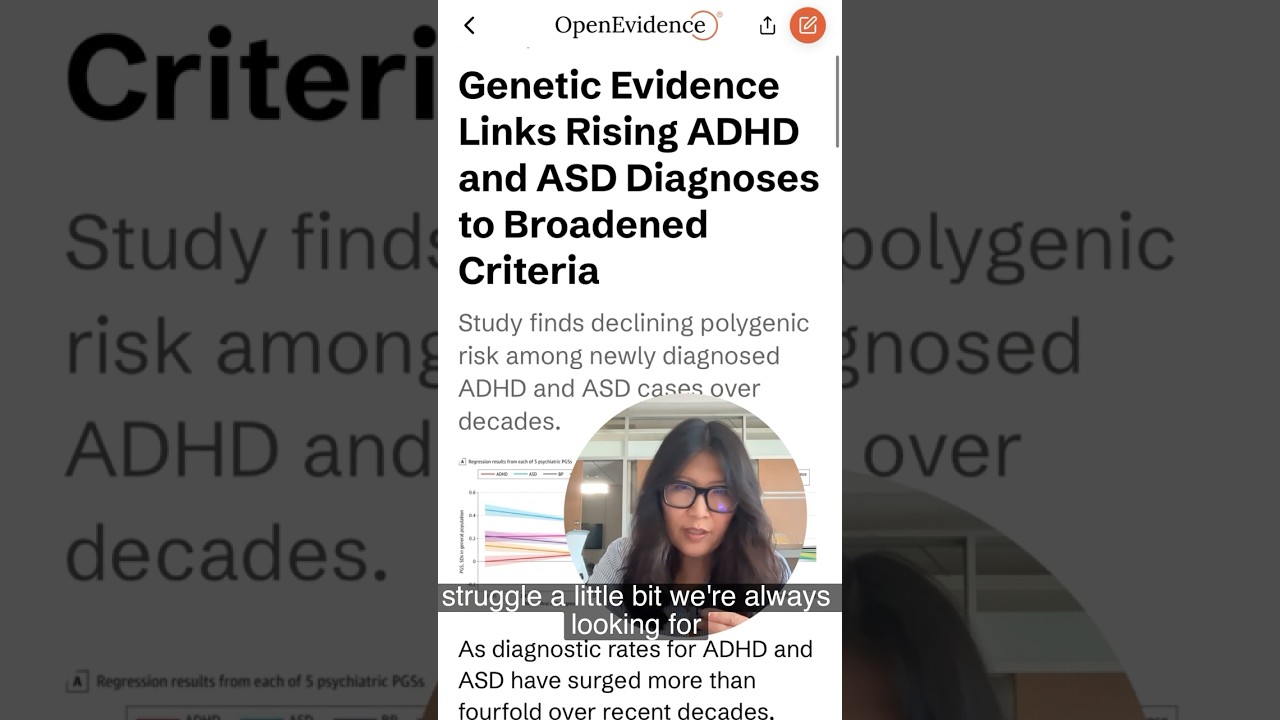
Dr. Juna explains the rise in ADHD and autism diagnoses as a finer diagnostic net catching milder cases, not an epidemic. A study of 37,000 people shows recent diagnoses still carry genetic risk, just lower than earlier cohorts. Modern life's demands and stress amplify subtle traits, making them visible.
Chapters
definitely noticed an uptick in ADHD and autism spectrum disorder diagnosis lately, and even myself feel a little bit ADHD. And what does this really mean anyway? Is it that the diagnosis have increased and there is an epidemic of some sort, or is it just that we've widened the spectrum of who will be given these diagnosis? Well, a fascinating study suggests that part of the answer might be just that the diagnosis net has gotten wider. So imagine a fishing net. Let's say the net had larger holes and mainly caught people with the most the obvious symptoms and the strongest genetic predispositions. Well, now the net might have smaller holes like a sieve. It catches all of those individuals, but it's also catching people with milder traits who may have slipped through unnoticed many years ago. So in this study, researchers looked at the genetics of more than 37,000 people diagnosed with ADHD or autism. They found that people diagnosed more recently still had elevated genetic risk compared with the general population, but on average their genetic risk was lower than those diagnosed decades earlier. It means that when you're diagnosed today, This appears to include a broader spectrum of people. That doesn't mean that the diagnosis isn't real, it just means that recognizing a wider range of presentations may be what's increasing the number of diagnosis. So some people diagnosed today may be thriving in school, at work, and in life. Maybe they're struggling a little bit with attention, organization, sensory sensitivities, maybe with close relationships, having some emotional regulation issues or social communication issues. In the previous generation, we may have just thought, oh, they're just a little peculiar, that's their personality. But my our current modern lives have increased demands on our attention. We sleep less, we have increased stress, social connection might be a little decreased, and I wonder if these conditions may amplify the traits that may have been mild or unnoticed in the past. I also think that maybe we are increasingly expecting ourselves to function perfectly, so when we struggle a little bit, we're always looking for explanations and solutions. What the study suggests is that part of the rise in diagnosis reflects a better recognition of people who have always been there but were previously vastly overlooked. And the truth is probably all of these things combined. So the question is, how can we better support, understand, and help everyone thrive? If you're having symptoms, please talk to your medical professional. I 100% do not agree that diagnoses should keep us in a box or make us feel like there is something wrong with us. However, when we understand ourselves better, and sometimes that includes a diagnosis, that can help us get out of that box to improve ourselves. And if we are neurodivergent, which I'm starting to feel like almost everybody is to a certain And when we understand these things about ourselves, it's like understanding anything else. The more you understand, the better you are at living the life that you want to live and controlling your own destiny and using neuroplasticity to your advantage. If you understand your brain, then you can also change your brain. You can also understand what you need to accommodate yourself. So in my mind, it's a win-win.