The Apostle's Table | S2, E2 with Dr. Mike Woods + Keisha Palmer + Emanuel Michael
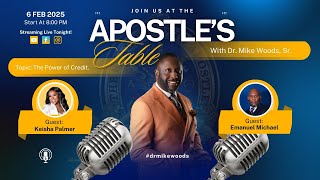
Dr. Mike Woods, Keisha Palmer, and Emanuel Michael discuss building wealth through credit repair and business funding. Palmer outlines credit habits like low utilization and account monitoring. Michael explains Blue Table Investments' private-equity model and the documentation needed to secure funding.
Chapters
All right, well, greetings everyone and welcome to The Apostles' Table. I am your host, Dr. Mike Woods. For those of you who are uninitiated, And I'm so happy that you are here with us tonight. Listen, normally Thursday nights are our Bible study night, but we have a special edition of the Apostle's Table tonight. I have two amazing people here with me, and I'm really excited to get involved with this conversation. But before I do, I need you guys to do me a favor and share this. I need you to help me share this encounter right now. We are streaming over 5 different platforms right now. We're on YouTube, we're on 3 different Facebook pages, and we're also streaming on Instagram. Wherever you're watching tonight, I need you to do me a favor and make sure you hit that share button. I need you to hit the like button, and I need you to tag people below and really comment below as well. Let us know that you are here and that you are a part of this conversation tonight. Listen, I'm telling you right now, these two people are amazing in their field, and what they got to say, I promise you, you need to hear. And I promise you, there's someone in your sphere of influence, in your family, that needs to hear it as well. So do me a kind favor, guys, and share this information tonight. Tonight's conversation is going to be phenomenal. And listen, You don't want to miss one part of it. I am really and truly excited about getting started with this conversation tonight. So what I want to do, I'm going to pray, and then after I pray, we're going to get ready to dive right into this. All right, so let's pray. Father, we give you praise and we thank you for another opportunity to gather virtually, God, around your word. And Father, we thank you for these two amazing vessels uh, that are here with us tonight. And I pray, God, that you will superimpose your power, your authority, your intellect, your wisdom, your light upon them tonight. And I pray, God, that every person would plug in and they would grab the information, and that they will be literally changed because of these few moments that will be here tonight. And we give you praise and glory for it now. In the matchless name of the Lord Jesus Christ, we do pray. Amen and amen. Listen, tonight, guys, I am— again, I'm just overwhelmed about tonight. I need you guys, uh, to do me the kind favor, all right, and hit that share button. It's real easy. I just need you to do it. Glory to God, because I believe— hallelujah— if you do it, you're going to be blessed for it, because the Bible said we're blessed to be a blessing. Now, before I bring on our first, uh, so this is the format of this tonight. I'm going to talk to each one of my guests individually, and then we're going to come together collectively as a group, um, at the end of this. And what I want you guys to do as we navigate through tonight, if you have any questions, I want you to type your questions in the comment and, uh, hopefully, uh, we'll be able to get to your question and our guests will be able to answer. So guys, again, please go ahead, hit that share button and let somebody know that we are on tonight. I want to share with you, uh, just something really quick. All right, um, we, we made an attempt at this on Tuesday and I was out of town in a hotel room and the Wi-Fi actually sucked, man. So I, I was in the middle of talking and everything just went out. Um, computer went out, Wi-Fi stopped working, couldn't get back on. But we're here tonight, we're in the studio, and I'm telling you, tonight we won't be defeated. Tonight's gonna be phenomenal. So get your pen, get your paper out, and I want you to write down Oh my God, I want you to write down this information. It's going to be very important, guys. Okay, all right. I see people tagging in the comments, man. That, that's what we— that's the, that's the flow. Uh, Sharia is, uh, she, she's, she's like going in tagging people. So follow Sharia's example and tag your friends in the comments below as well. All right, so I want to share something really quick, family, because Uh, I think it's important as we understand this space that we've created, right? So, you know, the Lord put it on my heart to create a space where people could come together for a few days and actually sit at the feet of people who are actually accomplishing what they want to accomplish, or people that have the knowledge of that is miss— the missing link in what you are trying to get done. And so we brought together some amazing speakers. And one of the reasons I, again, one, the Lord put it on my heart to do, and we're doing it at the church, we're doing it at Ellenwood location. We have few seats, but we did this on purpose because we want people to be able to be interactive. We want people to receive. And, you know, we could have got a bigger venue or did something somewhere else, but we wanted to do it in our church. And we wanted to make sure that we made an impact. We're giving it away free. And again, one of the reasons is because when you start understanding money and wealth, you got to change how you think about it, right? And I just want to share really quick. I'm going to add this. Basically, the reality is, especially with this, with this new shifts in administration in our federal government in this country, Um, I'm telling you right now, the middle class is being eliminated, okay? And, um, you gotta decide, family, whether you want to be— hear me— whether you want to be wealthy— hear me— and rich, or whether you want to be poor. Um, because this is why you see a lot of things being taken away, a lot of the crutches You got to move into the space. See, the reason people complain about what's happening in this administration, because a lot of time people used to handouts, they used to crutches. But, you know, I'm telling you, this, these next 4 years is going to put a demand on your gifting, on your faith, on your ideas, on your vision, on your dreams. You know, people that are used to getting something given to them, they're going to complain about this. You know, but at the end of the day, I don't care how much you complain, there's nothing you're going to be able to do. So my challenge to you tonight, you just probably should decide, hear me, to become rich, to become wealthy. And somebody says, again, this preacher talking about wealth, talking about money. The end of the day, this is part of God's plan. I said it last on Tuesday, nothing can be established without wealth. So I— if you look on your screen, there are two classes, the rich and wealthy, the poor and middle class. So rich equals cash flow, wealth equals generational stability and structure. And that's really what we're going for. We want to create generational stability and structure, not just influx of cash, but we want to really prepare for our children's children. We want to leave a legacy that no one in our family has to suffer financially. The poor, P-O-O-R, that simply is congruent to passing over opportunities repeatedly. And when you get opportunities to learn, to sit at the feet of people who know this and you just reject it, you think you know everything. Oh boy, here we go. You think you got it. And reality is, if you knew it, you'd be doing it. If you knew it, your situation would be actually changing and you wouldn't just be talking about it. But when opportunity presents itself, hear me, because listen, if the rooms you're walking in, if you're always the smartest person in the room, hear me, I'm gonna pull up to the camera. You're in the wrong room. I'm gonna say that again. If you're the smartest person in the room, you're in the wrong room. You— and there'll be instances where you got to lead and be smart. But at the end of the day, you should always be willing to learn so you could grow. Because here's the bottom line: none of us know everything. Second thing, 3% of all humans are rich and wealthy. They employ the poor. 97% of all Americans work for the other 3%. You know why? Because the mentality has been taught that you, hmm, punch a clock, create a linear situation where you exchange time for money. And that's what ends up happening. All right. Only 1% of that 3% in that class are billionaires. They're billionaires because they're investors, because they've learned the tools and the right things to invest in. So here's where I want to get really, guys. Staying poor, staying broke. Somebody said, why is the preacher talking like this? Because the Bible says that God— and I'm gonna unpack this tomorrow night with so much ebullience and boldness. So you need to be in service tomorrow night. We're gonna have financial revival. The power of God is gonna break yokes, is gonna remove burdens. And listen, you need to be in the building, but I'm gonna teach a word about how to assess the wealthy place. Because here's what I know, and here's what I realize: staying poor— hear me— it's a choice, people. And you gotta decide that you want more, because I'm telling you that middle class is being eliminated, and you're gonna either be on the side of the wealthy or you're gonna be poor. So you gotta decide right now what you want, all right? And you got to start positioning yourself so you can bring to pass the things you desire to see in your life, all right? So tonight, um, again, and I believe in, in, in ladies first, so we're gonna get Keisha on this stage first and, uh, we're gonna have a discussion with her. I am so glad that my wife and I met her You know, I'm a prophet. So when I meet people, I'm always slipping past the outer casing and getting into people's heart. And, you know, before she even started talking to me, she was on a— she was at the gate together. She was flying to D.C. We was flying to D.C. She was going to receive the Presidential Lifetime Achievement Award for her works. And I just began to discern her heart for people. And her desire to want to really help people be better and how she wanted to superimpose the knowledge that's in her life on others. You know, some people learn stuff and they don't want to share it with anybody, but that's not the case with Keisha Palmer. So she is here tonight, and I am super excited that she, uh, is going to be teaching on Saturday, uh, during Supernatural Wealth Weekend. But I am grateful, uh, that she has graced us tonight on this platform. And, uh, Keisha, welcome. How are you this evening?
Dr. Woods, how are you? It is a pleasure to see you again.
Likewise, likewise. How have you been?
I have been super, super, super busy. I've been super busy serving just, uh, out here in the community, like you said, teaching our people about financial literacy and really getting them to understand how to bridge that wealth gap, especially what's going on with, uh, the new administration. You definitely absolutely put your financial house in order.
Yes, absolutely. So tonight, to start, what I'd like you to do is introduce yourself to our audience and just kind of let them know how Keisha Palmer shows up in the world. How, how you show up in the world?
How do I show up in the world? Well, good afternoon everyone. Um, my name is Keisha Palmer. I am a financial strategist. and I'm also an international real estate agent and investor. I'm also a mentor as well. So, um, as Dr. Woods was stating, uh, getting your financial house is in— it's definitely needed, right? So I got started in this industry a little over 7 years ago. Reason being is because I needed to get my financial house in order. You know, growing up They didn't teach us about financial literacy in school. We were just taught to go to school, get an education, rack up student debt, and get a job, right? We were not taught about how to be entrepreneurs. We were not taught about how to invest. We were not taught about how credit actually works. We were not taught about how to turn credit into cash. We were not taught about these things. And so I found myself being in corporate America. I was the director of HR over 15 years, and I was at 6 figures, but I was still living paycheck to paycheck. Reason being is because I really didn't understand and master financial literacy. I didn't. My mom always had an 800+ credit score, but she would just say, pay your bills on time. She never said, max out your credit card because it's going to kill your debt-to-income ratio. She never said that because she didn't know. She left a balance on her card. That's why she had an 800 credit score. But for me, you know, I didn't understand that. So I found myself in a place where I was a single mother of one son. I was living check to check, and I definitely needed to increase my credit score as well as get my financial house in order overall. So that's how I got into this industry. That's how I've been able to change so many lives. I've been able to help hundreds and hundreds of individuals. Go from bad to excellent credit. I've been able to help hundreds and hundreds of people get into homes, and I've been able to help hundreds of people start businesses and thrive.
Wow, how beautiful, how beautiful. That's amazing. And you, so you're really showing up in the world because people are so— and I'm trying to find the right word— financially illiterate. And we need people like yourself who are willing to do the work you're doing. So let me say thank you. For what you're pouring back into our community. Most people that carry the weight and the knowledge that you have in your space, again, you know, it's either, you know, they're keeping all that for themselves and the people that are close to them, and they don't have a global vision to reach other people. So quick question, you said something that I, that resonates with me a lot. So how can, so someone that's listening, how can someone shift their mindset and their focus on wealth creation, financial freedom, building credit? Because like you said, growing up, you know, we were taught get a job, pay your bills, that's gonna keep your credit good. Well, How do you get a person from that mindset of what history has taught or disseminated to them to a mindset where they really want to get out, build good credit, create wealth, go after financial freedom? Talk to us a little bit about, you know, how that works, how, how a person can shift that. What's some actions people could take?
Well, first and foremost, you have to surround yourself around like-minded individuals. Like we always say, if you're the— like you just said, Dr. Woods, if you're the smartest person in the room, you're in the wrong room because your network is your net worth, right? Then you need to start also learning about credit. Start reading books about how to establish excellent credit. Adopt an abundance mindset. Nothing is too big for God. Nothing is too big for God. So, you know, scared money doesn't make money. You have to invest in yourself. Those are just a few things that you can do to start shifting your mindset.
Wow. So being out here working with people, um, what's some of the biggest misconceptions you found that people have about personal credit? I mean, What's the attitude that you get from people when you start talking to them really about, you know, their credit and making it better, getting that 800 score? Uh, what's some of the misconceptions people have in general?
Well, one of the misconceptions is, uh, checking their credit score would drastically hurt their score. No, it would not. Wow. We have free credit monitoring tools where you can actually check your credit score every day. You want to know what's going on with your credit because you can have identity theft. right?
Yes.
Anyone can do anything to your credit and you wouldn't know. So it's important to have credit monitoring on your credit profile. So checking your credit score does not affect your credit score at all. And then also the second thing is a lot of people don't understand that once you pay off that credit card, you want to keep that credit card open. You know why? Because if you close it, it's going to hurt your history and that makes up 15% of your credit score. So a lot of people think that if you close the credit, the, the, the profile, that it's gonna ding your score. I mean, that it's gonna help your score. No, it's not. It's going to actually hurt your score because it decreases the history.
That's good stuff. So what I'm hearing, Keisha, you know, a lot of these misconceptions, a lot of the, the lack of knowledge is because there are a lot of people who are really unwilling to— and I always say this— take the position of a learner and get in a position with a person like you, whether as a mentor, whether as a partner, or even like you said, investing in themselves, you know. Because I believe reality is the Bible said wisdom is the principal thing. The word principal is a financial word. So it means some— there's some wisdom you gotta buy, there's some wisdom you got to pay for. So what would you share with people to make them— because there's so many people uncomfortable making that investment in a mentor, in the products that are necessary to get them on the right track. What would you say to someone who's wrestling with, you know, paying what they need to pay to get the information they need to kind of get on that right track and help their journey?
Well, first and foremost, um, I always share with people that it's not a bill first and foremost. It's an investment in your future.
Come on.
Because if you want to continue to live the way you live, then continue to do that. But in order for you to live the life that God designed for you to live, you're going to have to invest in yourself. You have people that will stand in line to purchase $250 pair of Jordans, but they won't they won't pay a couple of $100 to start their credit restoration. You have to make that true. You have to make that make sense. You have people going to Gucci, right?
Mm-hmm.
Purchasing $500 purses with a 500 credit score. That doesn't make sense.
None. Wow.
It doesn't make sense at all.
Wow.
So you have to invest in yourself. And once I break it down to individuals and then I hit those pain points, 9 times out of 10, they're going to shift their mindset.
That's good. That's good stuff. Did y'all hear that? So she said people will go, which is true, with a 500 credit score and pay up for a $500 purse with a $500 credit score before they take that $500 and invest it in building their future. That, that is so powerful. And you know why that is? Guys, that's because we are consumers. And at the end of the day, we gotta shift from that mindset to even grasp what Keisha is saying right now. The reality is your mindset has to shift to that of a producer. And when you want to produce something, producers understand I gotta make investments in myself. I gotta make investments in the information and the knowledge I need so that I can actually advance in the purpose God has for my life.
This is good.
Um, so what strategies, Keisha, would you recommend to our audience tonight for someone that says, okay, I want to maintain healthy credit? Give us some behaviors, give us some habits, uh, talk to us about, you know, some action steps we should be taking to maintain healthy credit while we're trying to build wealth?
Well, you definitely want to keep that utilization low, right? You want to make sure that your credit card debt, uh, stays under 30% because that makes up 30% of your credit score. So anytime that debt-to-income ratio goes over 30%, it begins to drop that score dramatically. So you want to keep it under 30%. I tell my clients, keep it under 10%. Honestly, you want to diversify that credit portfolio. You know, you want to have revolving credit, right? You want to have installment, real estate, all these different things to make sure that you have a healthy credit profile. A lot of times lenders are not looking at the number per se. They're looking at how strong the profile is. So you want to make sure that your profile is diversified, right? Not only that, you want to make sure that you make your payments on time. Because if you miss one payment, that can knock your score anywhere from 50 to 100 points. That makes up 35% of your credit score. It will kill your score. So you definitely want to make sure that, um, you're making those payments on time as well. So those are just a few keys.
Wow, that's good stuff. That's good stuff. So last thing, we're gonna get Emmanuel in here and then we all gonna come back, but I want to ask you this, Keisha, um, because when I met you and all the conversations I've had with you since we met have been— your mindset is in a place where it creates. And congratulations, by the way, I saw it posted where you got, um, a new— you got promoted in your company to a different position, which, which is phenomenal. And that's all because you're helping people. Um, but it's, and it's your mindset. So how does having a wealth mindset, okay, um, directly help people with their financial habits, with, again, with taking care of the business they need to take care of as far as your credit? How does the mindset, why is that important? Because I believe that money is not currency. Your mind is. So, and credit to me is like money. So credit is not currency, your mind is. So how important is that, that mindset? I, I just want somebody to hear that tonight because I think particularly specifically amongst, uh, African Americans who've grown up in, uh, certain demographics, our mindset about money is totally off because we wasn't taught the information. So just kind of tell us why mindset is important to developing good behaviors, good habits.
Well, having a mindset, having a wealth mindset definitely impacts your financial, um, decisions in life first and foremost, because if you don't have a wealth mindset, you're not going to invest for long term, like dealing with IRAs and things of that nature. So having a wealth mindset, it definitely impacts your long-term financial goals. You have to invest in yourself personally as well. Again, scared money doesn't make money, right? If you're scared to invest in yourself and if you're scared to learn about credit, if you're afraid to understand how credit works and how to turn credit into cash, you'll never be wealthy. You'll never be wealthy. So you have to adopt a mindset of what abundance— what we just talked about. You have to adopt a mindset of overflow. You have to adopt a mindset of surrounding yourself around like-minded individuals to take you to the next level.
Yes.
So, you know, those are just a few things that, um, I practice on a daily basis because I'm never ever the smartest person in the room. I always make sure I'm Uh, I'm learning. I'm always a student before I'm a teacher.
Yes, that is so good. Keisha, thank you so much for spending this little time with us. We're gonna come back, we'll get Emmanuel in here. But thank you so much. You have dropped so many nuggets in these few moments. I pray that y'all out here were taking good notes. Uh, but listen, Keisha will be speaking on Saturday at Supernatural Wealth Weekend 2025 at Rhoda Church Atlanta. Listen, you need to be in the building. If you have not registered, you need to go ahead and get registered now. It's real simple. You just need to text the word wealth to 470-777-8279. Matter of fact, let's do this. I'm going to play a video real quick to talk to you about registration because I want to make sure you guys get registered. So check this out. Then we're going to be back with Mr. Michael. Hello, I'm Dr. Mike Woods, and I want to personally invite you to join me and an extraordinary lineup of speakers for Supernatural Wealth Weekend 2025. It's happening February 7th through the 9th at Rhoda Church. This year, our theme is Assessing and Abiding in the Wealthy Place, inspired by Psalm 66:12 and Deuteronomy 28:11. Over 3 life-changing days, we're gonna disseminate divine principles and practical strategies to help you walk in supernatural abundance. Abundance, not just financially, but in every area of your life. We've brought together some of the most powerful voices in wealth creation, all of whom are proven millionaires or better. You'll hear from Ben Tankard, Emmanuel Michael, Stan Richards, Sharice Richards, and Keisha Palmer. Of course, I'll be sharing a special word to help you cultivate what I call the 7 Fears of Wealth. Whether you're an entrepreneur, a leader, or just someone looking for financial breakthrough, listen, this meeting has been put together especially for you. And here's the best part: registration is absolutely free. Did you hear me? It's absolutely, categorically historically free, but seating is limited, so you don't want to wait to reserve your VIP seat. Text the word wealth right now to 470-777-8279 or visit rhodachurch.com/sww25 to secure your spot today. I can't I can't wait to see you. Hallelujah! As we step into the wealthy place together. You know, I've been teaching for 2 decades. You earn what you learn. If you look at the word learn closely, the word earn is inside of there. And here's a reality: if you learn what an attorney knows, you can earn what that attorney earns. If you learn what a a neurosurgeon knows, you could earn what that neurosurgeon earns. Listen, facts, friends, facts, 100%. If you learn what these multi-millionaires that we have coming to Rhoda Church knows, you can actually earn what they earn. They're gonna be principles released and disseminated that you could take from this weekend and actually immediately begin to apply to your life. You need to be in the place. This is no get rich quick. This is no prosperity scheme. This is the word of God. This is about positioning you to be the very best you could possibly be in your sphere of influence. This is your moment. Let's take it. God bless you. Well, family, listen, I want you to go ahead and get registered. Listen, if you have not registered, register tonight. And again, the great part about this, this meeting is free. I mean, honestly, you don't get to go to get this kind of information that's going to be released this weekend free. I mean, it just doesn't happen. And the reality is, the kingdom of God, people of God, and the whole world needs to hear this stuff. Because I'm telling you right now, you got to get the information so you can put it in action and shift your class. And that's what we want to see happen for each one of you. And that's why we've created this space over the— those 3 days is for you to get exactly what you need to move into the place God has prepared for you. Well, I'm getting ready to bring up my next guest, which is Mr. Emmanuel Michael. He's the principal and CEO at Blue Table Investments. Uh, I love Emmanuel. He's a great friend of mine. I've known him for quite some time. And, um, you know, only thing I regret is that these days we both are so busy, I haven't had an opportunity to spend a lot of time with him. Uh, as we normally would. But I'm so grateful that he agreed to join us for Supernatural Wealth Weekend. Uh, this man is another man who has— he always say this about me whenever he will introduce me, that I have a heart of gold, I love helping people. But for real, this dude loves helping people so much so he created Blue Table Investments so that he could really help people that traditionally couldn't do things the traditional way. He loves life. He loves his family. He's— I love his son Kai and his wife Erica. They are amazing. They're friends of Felicia and mine. And so y'all help me welcome tonight, uh, Mr. Emmanuel Michael, the CEO and principal of Blue Table Investments. How you doing, sir? Good.
I'm phenomenal, man. Pleasure, pleasure, pleasure. Thank you for having me on and a pleasure to be here. And, uh, speak to everyone. Only thing I hate is that we hadn't had an opportunity to get on the golf course.
Yes, sir.
Yes, sir.
I've been trying to get you out there, man. You got to pick them clubs up. You got them pretty clubs and don't pick them up.
Brand new.
Yes, sir. Well, how you been, Emmanuel, man? Again, you guys Um, you and America, you and Erica, I call it America. I've been knowing you guys a long time, man, back from Jackson, Mississippi days. I remember when I first met you guys, um, and you've always been driven, focused. Your heart has always been in the right place, man. What, what's the secret sauce that has kept you committed? And people don't realize this, being an entrepreneur building anything, it's hard, man. People think this is easy. This, what we do, is hard. And, but what has been the secret sauce, E, that has kept you going all these years, man? They kept you focused and to get you to the place now where you got a high-rise office in Midtown in Atlanta and you helping people, you know, fulfill their dreams with your company. What has kept you locked in?
I don't want a job. That's the number one thing. I don't want a job. I don't want to go to work for anybody. But, uh, having support from my family, from my wife, having a partner there with you to push you and encourage you, even when you start feeling down on yourself, you, you start second-guessing and questioning, and, or it may come out as second-guessing and questioning because you're just wondering why things are not going your way, when you have someone there to push you and support you and tell you to keep moving forward, that within itself will put you in a position where it'll light a fire up under you.
Yes, sir.
And not that you need that all the time because as entrepreneurs you got to be a little crazy to do this, uh, but sometimes, you know, you find yourself out on an island where you don't have any— feel like you don't have anybody to talk to or, you know, you don't know if you can talk to someone, you don't know if they're approachable, you got questions and you're trying to figure things out on your own. But one thing about my wife, she, uh, she's been right there with me and, uh, we've been growing and building together. Whether she is 100% every day on doing something, uh, with me or not is irrelevant. Sometimes she may have a contract that she's working on, but she's still there as a a support system. And, um, Miss Palmer mentioned something about being in the right room. You mentioned it as well. You got to have a support system. You got to be around the right people. And being around the right people, having that support system, is gonna get you to a point where you have a don't-quit attitude, you know, even for questioning yourself. You're like, you know what, you know, I can't let my children down. I can't let myself down Number one, can't let my children down.
I'm out here. Yes, sir.
I've been doing this since 2004. What I look like going to fill out an application? It's not gonna— I'm not mentally— it's not gonna work, number one. And then you only gonna— you're only gonna lose if you give up and quit.
Yes, sir.
Come on, all this work that you've done, you're just gonna start over? No, you have to figure it out. And I think we've missed that part about being entrepreneurs, uh, as a CEO or principal or owner of the company, you have a fiduciary duty to figure it out.
Yes, sir. Yes, sir.
You got to go pay to get the knowledge. You got to go pay to get the knowledge. You got to go pay somebody to help you, coach, coach you to what you're— what you need to do to get to the next level. That's what you have to do. Because when you go to the Secretary of State and you fill that application out and you say, I'm going to hire somebody, yes, sir, Think about when you hire somebody. Somebody's depending on you to help them pay their bills.
Yes, for sure.
That's a big, that's a big, big responsibility. So now those children are your children. That husband or wife, or no, those, those people that's in their support system that they depend on, this individual that's your employee, guess what? That's your family.
Yes, sir. Yes, sir.
So we can't make payroll next week, don't work.
No, I don't.
You gotta figure it out.
Yes, sir. Yes, sir. That's good stuff. So I'm gonna ask you what I asked Keisha off the top, because I want you to just introduce your people to the ones that are on with us. And listen, family, if you have not shared this, I need you to go ahead and share this again. We're, we're streaming over 3 Facebook pages, YouTube, and Instagram tonight. If you're on Tag your family, they need this information, and share. Tuesday we got on, I'm telling you, ain't nothing but the devil got in that live, man. We had 1,100 people that got on, and before we know it, the hotel internet killed the whole live. But we're here tonight, and I want you guys to share. Please share, because Emmanuel's going to help us tonight. He's going to drop some knowledge. But E, Tell the people, just give them a little bit about who you are and how you show up in the world.
Folks, uh, first of all, like, you know, Dr. Woods said, and you see the name there, my name is Emmanuel Michael. Uh, I'm an investor, entrepreneur. Didn't start out like that. I started out as a person that was just hungry, wanting something different, want something more.
Yes, sir.
I worked in the restaurant industry, did that for 14 years, but I knew that that it was more out in the world for me, and I didn't want to sit there and just accept what was being given to me. And I was lucky enough to get in rooms and in, uh, situations where I was able to get amongst mentors. You got to have you a mentor, uh, you don't know what you don't know. And the biggest problem that I see with entrepreneurs is ego.
Talk about that.
We gotta— we got— we know everything, we got to figure it out. No, sometimes you have to subdue your passions and put that ego aside and allow yourself to open up to learn and receive what the blessings are that's out there for you. Because you can be stopping your own blessings because you're being pigheaded. You don't want anybody to tell you anything. You got your way on how you want to do it. And it's okay to be the creative person and have an idea on how you want to do do things, but a lot of times it's just a few tweaks that you need that can help you grow and go to the next level. And so I was in the position where I was able to learn from individuals who have already done what I was trying to do.
Yes, sir.
And I had a drive about myself because I knew I didn't want to work in a restaurant for a long period of time. I'm gonna— I know I'm kind of, um, switching subjects a little bit, Mike, but you're doing good. Yeah, I know. That I started out in the restaurant industry with. And I used to tell him, I said, man, that restaurant gonna kill you. He to this day working in the restaurant industry, but he was a gentleman that worked when I was in high school. Got a great deal of respect for him. Uh, he was a general manager, I was a kitchen manager. We traveled and opened stores and did all kind of things. He had a long history in the restaurant industry, and I noticed over the last couple years he had been losing a lot of weight. I said, uh, he's out intermittent fasting. I said, well, you losing weight pretty fast, Doc. Long story short, uh, he had congestive heart failure on, uh, Sunday— on Monday.
Jesus.
Uh, double pneumonia, and, uh, had a stroke on the way to the hospital. And he didn't go. He was having problems breathing. He didn't go Sunday because he's waiting for somebody to come in to relieve him from work. And, oh, that hit me hard because he's a real good friend of mine. However, I saw that years ago. I said, I don't want to be in a position where my feet hurt. I'm standing up, I'm working this job, and it was— it had to be more. And so over the years, we started working in finance sector, helping individuals with taxes and payroll, helping individuals with credit. We had a radio show in Jackson, Mississippi on WMPR 90.1 called the Credit Masters. We was on the radio station in Dallas-Fort Worth, Texas, Heaven 970. In Lane College in Jackson, Tennessee, and we talk to people about credit. But what I realized was, Mike, as we start helping individuals with payroll and taxes, helping them with their credit, helping them with their business credit, we will still get to a point where we get to the bank and we get turned down.
Yes, sir.
And for years we would help people get to the point where they can get funded, but they get turned down. It didn't matter if it was private investors, it didn't matter if it was a credit union or a bank or a non-traditional lender, they would get turned down. And you hit all the benchmarks that they tell you to hit.
Yes.
And we got turned down. And so I just got frustrated. And a few years ago, I told, uh, my wife and my partners at the time, I said, why don't we start a company where we can fund the people we want to fund? I'm tired of going to the table and begging for a seat at the table for them to come on the door and tell us no. I said, these people are not going to give us anything. We have to set up institutions. We have to set up systems and processes that's for our people. And that's what we did. So that's how Blue Table Investments got started. Uh, we are private equity firm slash venture capital firm and, uh, we work with business owners. We help underserved and underprivileged communities go from idea implementation to funding. We are the lenders in that scenario, and our goal is to look for reasons to say yes than to say no.
I love it.
We can't fund everybody. We, we, we would love to be able to do that. However, we want to be the people that you go to because you got turned down at the bank, but you're able to get funded with Blue Table. So we're consistently working on ways to, you know, acquire more capital to deploy in the marketplace. Ways, uh, come up with more programs and tools and systems to help people, uh, understand what they're doing. Because you can have the best credit in the world, you can have the best business credit in the world, but if you can't, like Ms. Palmer said, convert that to capital and cash, if you can't leverage that and use that to get the funding that you need to grow and scale, then you need to get some mentors. You need to talk to someone that can help you do that. And a lot of times it may not be that you need more money. You may need some, some mentors or some consultants to come into your organization and help you scale. Again, like I said, it could be just a few tweaks. You may need to have more, more customers, or you maybe need to tweak your sales process so you can maximize the customers that you got. You know, it could be, uh, it could be a disgruntled employee that's working customer service and running all your people or the manager that you started with for a long time that's stealing from you, but you don't understand numbers, so you can't find out that they're being dishonest, you know. So there are a lot of things in business that can affect us, and what we want to do is be a resource for the people in our communities to not only get funded but also give them the tools, strategies, and insight so they can grow and scale and live the life that they will put on this planet to live.
Yes, sir. Yes, sir. That's good stuff. So, E, can you explain to us some key differences? Because Keisha was talking a lot about personal credit, which is important. But what— and you've worked in both arenas, helped a lot of people in both arenas. So what are some key differences between personal credit and business credit? And why do we need an understanding of both? I think a lot of people don't get it And then especially in this Instagram age where you got some people who have figured out, you know, how to do an LLC, get some business credit, and they're giving people all this information, but they still don't have a balance between that personal credit stability and the business credit, even if they are successful in setting up business credit without good personal credit. Just tell us, you know, what's the differences and why both are important.
You talking about those expert gurus?
Yeah, them IG expert gurus, experts.
You know, if you have good credit from a, a business perspective, as a lender, because I approve loans and deny loans all day, if you don't have money coming in to pay and service the debt, I don't care what your credit score is. If you can't pay me my money back, that's what every investor and lender is looking at. If you can't pay me my money back, you can have the best credit in the world, but you don't have a system in place. If someone wants to come and buy your business, they're going to buy a system.
Yes.
And if the system is 100% determined on you, that's not a system, that's a job that you created. Come on. You know, so you want to put systems in place. So when you put a system in place, your business can stand on its own. Yeah. So even if you look at the meaning of a corporation, a corporation in law is a person.
Mm-hmm.
And so a corporation has its own unique identifier, which they call a Paydex score. Dun Bradstreet has the Paydex score. Uh, Equifax and Experian, they have business credit scores and systems that they use. but whatever scoring model that the, uh, corporations are using to identify and grade your company, they're gonna grade it based on your revenue that you're generating.
Yes, sir.
How many employees that you have on, on staff.
Mm-hmm.
And that's where they have algorithms that say, okay, this person can potentially pay me this money back if I loan it to them. It's the same thing with your personal when you have your Social Security number, you know. Yes, your Social Security number, they're going to lean more towards your personal credit scores with Equifax, TransUnion, and Experian. However, if you got a, a 750 credit score and you don't have a job, no way to pay this money back, they're not gonna loan you anything either, you know. If they loan it to you, you're not gonna have it long. you know, you may get the money for, uh, tax season and get you a car and they repossessed it by May. We see that all the time. You know, you don't have any cash flow.
So, uh, you're right.
And the emphasis need to be on the cash flow. So how do we generate more cash flow? So if you're leveraging your credit to generate cash flow, like Ms. Palmer said, that's great because now maybe you buy some real estate that's gonna cash flow for you. Maybe you're able to, uh, buy some vehicles and rent them out on— a lot of people, they're doing Turo and little things like that, uh, which is a decent model. But, uh, what I would say is buy you a business. There are a lot of business owners out there that want to sell their company, and we look at creating revenue a lot of times. What I teach is leverage your credit to acquire revenue. Buy the revenue that you need.
Yes, sir.
Yes, sir. Buy the business that has the manager already there. You know, you don't have to start from scratch. You don't have to create it and build from scratch. You just buy the system that's already there, and now you take your expertise and you tweak it. So now, rather than you take that half a million dollars and buy that house, or half a million dollars and buy those 3 or 4 cars, now you can take that half a million dollars and buy a a business that's going to generate $40,000 to $60,000 a month.
Yes, sir.
It's a big difference. So now they want to loan you more money. It's funny, lenders want to loan people money they don't need it.
Wow.
Are y'all listening? I hope y'all listen.
They want to loan it to people who really don't need it, you know. So, and we understand that at Blue Table. So we do fund startup companies. We do look, like I said, we look for ways to give you a yes. We're not here to look at your file and say, oh, deny. You know, that's not what we do. That's not what we started this company, you know. But we hope that we can give you some guidance on, you know, looking at your, your business model and your process and things and your mindset, which is number one. Somebody put that in the chat. Number one is your mindset. Yeah, you got to have the right mentality. You got to have the right mindset because if you don't have this right, nothing else else is going to work. You're going to be clouded. You're going to be too clouded. You got to open yourself up and allow, uh, you know, what's for you to come to you and work towards that, you know, and learn. So, you know, your business credit can be very important for you to grow your business, just as well as your personal credit. Because if you don't have any money, you got decent personal credit where you can get a loan from your—
for your—
from your personal take that loan and see what type of money you can get for your business, you know, or see if you can get an SBA loan who only requires 10% down, or get a Blue Table loan where we can work something out. And let's get you funded where you can go and buy a business. You know, it don't have to be a million-dollar business. It could be a business for $300,000 or $400,000 where at least you getting, you know, $20,000 a month, $30,000 a month, and you take that and you stack and get you something else if you're looking to grow, you know. So those are things that we look at. Uh, there's a lot of different angles to look at this stuff, but those are the things that we, we teach and we, we hope to, uh, open people's mind up. Because like you said, I know it's a lot of people talking about business credit now, a lot of people talking about personal credit. Yeah. And once you get there, okay, you got that, now what's next?
You gotta have a system. You gotta have— that's good stuff.
That—
are y'all listening? Listen, Emmanuel's gonna be in the building on Saturday. If you got a business, you've been complaining about you ain't got no capital, you don't have any money to do what you need to do, he's the man you need to talk to. He's gonna be there. So you need to be at the conference so you can hear him share with you exactly what you need. And you can ask him the questions you might want to ask him because he's in the business. He does it every day. He loan— you just heard him say he loans money money every day to businesses. So he wants to help you learn how to capitalize your business and structure it. You need to be in the room. E, so what advice, um, would you give to entrepreneurs? Let's say someone's coming in to see you and they want a loan from Blue Table. Okay, just quickly tell us What you, what, what, what do they need to have to kind of streamline the process and guarantee that approval? What are you wanting to see from them? I mean, just the documents, the things that they, they need to have in place because some business owners, you know, they don't even have all the right stuff they need to even, to even get a loan in the name of the business. So So just give them some ABCs on, you know, what it would take to secure a million-dollar loan with Blue Table Investments if they were trying to do that.
First thing we would do, we would look at your project. We're project-driven. Uh, we do look at the personal credit and the business credit, but that's not the determining factor on if we're going to fund you or not. We're going to look at your project. We're going to see what's the likelihood of success for this project. If it's a startup company, we're going to look at the executives. Who are the principals and executives of this company? Have they done this before? Do you know what you're doing? Okay, if you don't know what you're doing, then you need to bring on a team and a staff to help you with what you're doing, you know. And that's okay if you don't know what you're doing. I'd rather you say— be honest and say, I don't know what I'm doing, but I got a great opportunity to buy this company over here, or I got a great idea over here. And these are my projections. Okay, we're going to look at your business plan. First thing you need to have: business plan, executive summary, pitch deck. If you don't have a business plan, I understand that. Okay, but you at least need to have a one-pager to say, this is what I'm trying to do, and this is the kind of money that we're gonna make. Okay, let's sit down and look at that. Now, how much, how much money do you have to put down? Because we all want a million dollars, but we don't want to putting the money down to get $1 million. We want somebody to just give it to us and then say, oh, it didn't work, I filed bankruptcy. Oh well, we went to Maldives and, you know, we, we had a good time, but we didn't make any money off the business. We gone, blue tape, we got to pay it back. No, we don't work like that, you know. So you got, so you got to make sure that you got your, uh, your baseline together, business plan, executive summary, pitch deck. If you got that together, Great. Let's sit down and talk. Let's look at what your project is. What's the likelihood of it? You know, if you're trying to buy real estate, we don't do real estate loans, but we do business-to-business term loans. So, you know, if you have— it don't matter what the company is, what the business is, as long as you got a US-based company, our corporation will loan to your corporation. So if you need $1 million, you're going to need to bring at least 20% to the table, and then you'll need to pay your due diligence fee as 1 to 10% of, uh, whatever that binder deposit is. The 20% is what we call a binder deposit. That lets us know that you are serious about your business, you got skin in the game, and it also lets us know that you're able to pay to support this loan.
Correct.
You can't be without 20% for 30 to 45 days, then you can't really afford that loan.
Come on, that's good. That's good.
That's a good indicator. See?
Yes, sir.
And the difference between Blue Table and the traditional banks, we're going to fund you 100% of your project though. You're going to get 100%. So if you need a million, you bring 20% to the table, we're going to fund you a million. The 20% is going to sit in the escrow account. Once you pay that note down 20%, you can get that money back. Nobody's doing that. Or you can put that towards your principal and interest. 'Cause you go get a million dollars from the bank and you bring 20% or 30% to the table, they're gonna fund you that $700,000, $800,000, and you still gonna be looking for another 20% from somewhere, you know, which doesn't make— don't make sense to me. But you're gonna have to pay them 100% of what it is. Don't even make it, you know. I was like, this doesn't make any sense. We're gonna do things differently. So that's a good thing about us at Blue Table, you know, uh, we can do do things as long as it's compliant how we want to do it. And so you got that, we will work with you. Um, if you're not 100% ready, we have coaches on deck that we just, we just did a joint venture with, uh, last week, and they're going to walk you through what you need to get ready for funding. So it's just like when you go to NACA to buy a house, you go to buy a house and NACA say, okay, oh, this is through this program. Yes, we got a program for people who want to get funded with Blue Table, but instead of turning them away like, you know, the large banks do, what we're gonna do, we're gonna put you through this program called Let's Get Ready for Funding. Yeah, we're gonna get you ready to get funded. We're gonna make sure you understand about business credit, personal credit, P&L statements, all your cash flow statements. We're gonna make sure you understand all that. That don't mean you gotta do it.
It, right?
But you gotta know how to hire the people to do it.
Yes, sir.
Baseline understanding of it, you know.
Yes.
The whole goal is to work above the business.
I love it.
Look at your business as a product. A lot of us have these businesses and we say, oh, we sell the water and the coffee and the phones and the tea. No, no, no, no, no, no, no. Your corporation is the project— is the product. That's how you should look at it. And if you look at it from that way then you could begin to build wealth beyond your wildest dreams.
Yes, that's good stuff, man. So listen, family, Emmanuel's gonna be in the building. I, I wanna reiterate what he said. So one, he's in business to help you get funded. Now you gotta learn all of the details of what you need. And he gave you 3 basic things. One, you need an executive summary. 2, you need a business plan. 3, you need a pitch deck. You need to know what you're doing. And if you could put those things, and then you need 20% down. Now watch this. If you could put 20% down to get $1 million, and then you're gonna, you're gonna get the whole million dollars. That just makes sense to me, right? And you got 100% chance of getting funded this way. Because you come to the table with that. So, you know, it just makes sense, guys. And again, we're trying to put you in front of people and position you where you could actually win. All right, um, E, I want to bring— because our time is slipping away, man. I can sit and talk to you all night. I want to bring Keisha back up.
I know I talk too much.
No, you all—
I'm sorry.
And, um, guys, if you're, you're still on with us and you have questions, uh, for either Keisha, Emmanuel, or myself, please— yeah, that was good. Wanted to tell you, Emmanuel said you got to work above the business. That was powerful. So if you got any questions, please drop them in the chat. Uh, we're gonna just converse. Um, and I know you guys haven't formally met, so Keisha This is Mr. Emmanuel Michael and this is Miss Keisha Palmer. Uh, I want to formally introduce you guys and you get to meet each other of course on Saturday. But, um, I'm so glad you guys came on tonight and we had this conversation. I believe that the people have been informed in a great way. Akisha, I wanted to, uh, ask you again, somebody commented, uh, I want to see if I can find her comment. Michelle Humphrey, she said she's the best. Keisha has helped me shift my mindset. So that, that's, that's a powerful thing. So I want to ask this because, you know, when I mentioned you were going to get the presidential— and let me say this, y'all, she was going to get the presidential award on the day before the inauguration. So it was the last one that the Biden administration was giving out.
Congratulations.
Yeah, which was super phenomenal. She made sure when we was in the airport, yeah, I'm getting it from Biden and Kamala. Want to make sure we were clear about that. But, uh, I, I want to say this, it's comments like what Miss Humphrey made that lets me know that you're well deserving of this award because that's proof that, you know, you're actually helping people. So, you know, if you, if you were sitting in a room with somebody like Miss Humphrey who has no knowledge of you no knowledge of what you do, what would be the top 3 things you tell them to start their financial journey? And I'm gonna ask you the same thing, E.
To start their financial journey, one, um, I would tell them to set a realistic goal of what it means to them to be financially free, first and foremost, because we have to know what that looks like. What, what does that look like for you? Right? Uh, 2, um, shifting your mindset. Again, as I stated, to have an abundance mindset. Come on, be willing to invest in yourself. That's so important. I'm always investing in myself. I'm always learning. Again, like I said, I'm always a student before I'm a teacher, right? Um, and, and 3, um, learning how to maintain healthy financial, um, statuses.
That's good, that's good, that's good. Those are power. E, same question.
What's the question again? What advice I would give them?
What's the top 3 things you would give if you were sitting in a room with a person who had no— who were totally financially illiterate? Like most of our country, right? And if you were giving them 3 main things they need to know to get started on their financial journey, what would be those 3 things?
First of all, you got to find out what you really want. A lot of times we can be all over the board because, you know, we get, uh, shiny object syndrome. I'm gonna start this business.
I'm gonna do this.
Oh, I'm gonna do this. I seen somebody doing this. Now we We got 100 businesses and hadn't accomplished not one. Find out what you really, really want to do. And once you zone in on what you really, really want to do— and I will sit down and write at least 10 things out on why do I want to do this, what could be my obstacles in this— because a lot of times we do things on impulse.
Mm-hmm.
What your obstacles could be, and then don't let the obstacles stop you. Who can you identify in your circle, in your network, to help you get over those obstacles? Once you do that and you zero in on what it is that you want to do, come up with a plan. Start feeding your brain with positive information. Cut out the noise. Stop hanging around people who are negative. Uh, I got a friend of mine, I've been knowing him forever. I— on a long— we don't know, we're on a long leash now because he negative. And I asked myself, why is he my friend? I just been knowing him a long time, you know. But when you go to talking negative, I'm out. I'm go. He check himself now, man. You know, I apologize, man. I know I can— I said, yeah, you need to get over that, you know. So get yourself in rooms and environments where people can help you grow, you know. If, if you need something done quickly, you need to be able to reach out to Dr. Woods and Miss Palmer. Stan and Sharice, I know them too. Yeah, people— Mr. Tankard, I just listened to his music. I don't know anything about him. I look forward to meeting him. However, you want to be able to reach out to people that can help you achieve what you got on your list on what you want to do. Yes, you know, so surround yourself with the right environment, in the right environment, you know. And so important, once you start, you can't quit. You got to say, I'm gonna see this through. Quitting is a bad habit. It's hard to break. Once you quit one thing, you're gonna keep quitting and keep quitting and become easy to quit.
Yes, sir.
Oh, just quit, quit, quit, quit, quit, quit, quit. No, no, you got to keep going. I never had the thought of wanting to quit with Blu Tack. We've had some rough times because we're in the industry where nobody look like us. We got— you probably got one or two people in the United States that a private equity firm that's Black.
Mm-hmm.
Real talk.
Yes, sir.
So it's hard, you know, you got to hear all kind of stuff and, and put up with a lot of things. And then you have the people that you looking to help, they give you worse pushback than the folks that you, that you're not really set up for. And you're gonna have people around you that that will pull you and pull you in different directions. They're gonna want things from you. Why you doing that? Oh man, you need to go get this job, or, uh, you need to quit that and go back to doing what you used to do. And you're gonna have all the player haters, and the biggest player hater can be your own thoughts in your own head. You got to zero in, have a positive mental attitude, and once you're able to do that, nothing can stop you. Nothing can stop you. So Setting your goals, goal setting, identifying what you want to do, and get the right people around you to help you grow.
That's good stuff. That's good stuff. My, my 3 would be, because both of you guys said some things that I would say, um, but my 3 would be if I was with someone who's totally illiterate financially, and I've done this a lot too. The first thing I will say to them is that you have to embrace the power of sacrifice. Um, people want to be wealthy, they want to be successful, but nobody wants to sacrifice. And they're basically— if you want to operate in the realm of wealth, there's basically 3 levels of sacrifice you got to make. The first one is emotional sacrifices. So you have to decide that you're not going to let your— because Emmanuel just said it, Keisha said you got to decide that you're not going to let circumstances cause you to give up, cause you to quit. And you can't let emotions in the way of your progress. The vision has to be bigger than your emotions because I'm telling there are going to be days in this journey where you're going to want to quit. But I always tell people, if you're in anything and you never wanted to quit, you ain't in much. It ain't really much if you ain't never want to quit. But if it challenges you to the point where you want to give up, it's a pretty big thing. So you might want to hold on to that. Secondly, You got to make egotistical sacrifices. Most people are arrogant and in their own way. I think he mentioned that, arrogant in their own way. The reality is arrogance is not going to get you anywhere. Here's the honest truth: arrogance leads to aloneness. You cannot build anything successful alone. You need a Keisha Palmer, you need an Emmanuel Michael, people. And when you're arrogant, don't nobody want to be around you because you think you know everything. So arrogance leads to aloneness. Purpose cannot be fulfilled in isolation. You need people. And the moment you think you don't need people, you've already failed. That aloneness that comes from arrogance leads to adventurism. Emmanuel alluded to this. You get out here, now you— because you're by yourself and you don't know what you want You done started 20 businesses, ain't none of them work because now you, you're the adventurous, taking uncalculated risk. And then here's, here's a powerful piece, guys. From arrogance, aloneness, to adventurism, you become an adulterer. Now watch this. Adultery is not just sexual unfaithfulness to somebody married. Adultery is being satisfied by something that don't belong to you, something you wasn't created to do.
Oh, that's good.
Sometime in life you— because watch this, God said to Israel, you're an adulterous nation. They had nothing to do with sex. It has something to do with them taking ownership of things that he didn't ordain. Same thing in life. You got to discover what you're supposed to be doing. Doing. Not— you can't— I can't start a Blue Table Investments and say, okay, I'm going to start Rada Investments called E Got a Loan Company. No, that's not what I'm called to do. One, I'd be repossessed. I don't have the patience. All y'all stuff will be repossessed quickly with me. I don't have the grace for that. So you gotta do what you want to do. So you got to make those emotional sacrifices, those egotistical sacrifices, so you don't end up being satisfied by something that's not yours. And then secondly, you got to make— thirdly, you got to make economic sacrifices. Guys, this is what people don't want to do. You know, the most expensive thing in the world, I heard somebody say one time, is your closed mind. But I, I differ with that. I think that might be number 2, but number 1 is a closed wallet. When you, when you decide you don't want to part with what you have and cause it to grow so you could be better, it's going to cost you way more than what you holding on to. So you have to decide if you want to go to this next space that you're going to be at. Remember I told you 97% of all Americans work for the other 3%. You know what that meant? That meant those 3% control the money. But watch this, 1% of that 3% are actually people who are billionaires who have learned the art of investing properly. So, and when you do that, the reality is, family, You can create your own bank, you can create your own legacy, but you got to open up your mind and your wallet so you could get that done. Well, I guess nobody had no questions. I was trying to give them an opportunity to ask some questions, but so any final thoughts, Keisha? Any final thoughts? And we'll close this out.
Ladies first.
No, you, you go ahead.
Well, I'm gonna let you close. You like a powerhouse. I'm gonna let you close it down. When we started Blue Table, we started this business, and my goal is to set up a company that can last— they can last 200 years.
Wow.
I got a text message from Brooks Brothers over the summer, and they said they're celebrating their 216th year in 17 years, something like that. And I thought about it, I said, wow. I said, what is the thought process? How do you have to— what kind of vision you have to have, and what's the thought process you have to have in order to say you're gonna have a business that lasts 200 years? You got to have a real progressive mindset. And a lot of times I think we, we start businesses and we don't really look at the long term, the long, long, long generational term. So that's what we've done here at Blue Table, and I would just ask you all to, you know, think about that for yourself, you know, when you're going into entrepreneurship, because it's a shift in the world happening right now. You gotta decide if you're ready to receive what God is putting in position for you. He landed out there, you can see You can see the world crumbling right now, and so you have to decide if you're going to be ready to receive the blessings that's out there waiting for you. So going back to mindset, I'll leave you with just make sure that when you start something, finish it. Have the right mindset and get around the right people. Yes, help you make the right decisions. Very important. And I yield the floor to you, Ms. Palmer.
Super awesome. Yes, Keisha.
Thank you so much. Uh, I would like to leave a quick message to all the individuals that's out there to definitely think about really getting your financial house in order because it is so important, right? Um, if you have any discrepancies on your credit profile, go ahead and start taking care of that now. Down so that you can, what, leverage your credit. Because again, in this, what's going on with the administration, you're going to need credit. Yeah, you're gonna need credit. And also credit comes with money, understand that. So if you're just working a job, think about starting a business. You know why? Because it's going to offset your taxes and it's going to give you additional income. Because once you start to change that credit score, guess what? You're going to need more money. You can't just say, for instance, you get your credit restored and you get that American Express card, but you don't have any additional income coming in. You're not going to be able to maintain that high credit score. So think about additional income as well. So like Emmanuel said, getting around the right people, shifting that mindset, and actually going out there and living the life that God intended you guys to live. That's all I have.
That's good stuff. Listen guys, I want to thank you both for being here. And guys, please make sure you follow Keisha on social media, follow Emmanuel on social media. Uh, the things they're doing is phenomenal. Um, you need to be in their lives and connect with what they're doing. Also, if you want to meet them personally again, you need to register for Supernatural Wealth Weekend 2025. Is going to be phenomenal. And again, E, Keisha, I love y'all, man. Thank y'all so much, uh, for being here. Uh, listen, if you're still with us and you want to be a blessing to what we're doing, listen, this is totally free, right? We're not charging any registration. Listen, the ways to give are scrolling at the bottom of the screen now. You get seed in the ground. I'm not going to tell you what to do, but Listen, if this is important to you and if you know that the information that you're going to receive— because again, everything we're receiving this week is going toward our budget for this meeting. So make sure you get seed in the ground tonight. Please get in the ground tonight. Give something to God to support this meeting and make sure you get registered. And my final word to you is this. You got to make a commitment. And I'm telling you, somebody gonna say the preacher saying this again, but I'm gonna say it. You got to make a commitment— watch this— to being rich, to being wealthy. You, you got to make a commitment. You just got to do it. Because at the end of the day, either you're going to commit to being poor or you can commit to being rich. What you doing? So you got to make a commitment to being rich. And it starts with how you talk. You got to create a culture with your words. Church, a culture with your voice, and begin to say what you want. Matter of fact, right now, just put your hand on your heart and say, I commit to being rich. So you can't be scared of that. And, and watch this, when you say it, you got to say it every day until you see it, and you start taking the actions and behaviors to pull you where you need to be. Now put your hand on your head. And say, I have a millionaire wealthy mind. And keep speaking to your mindset until it catches— it catches up in action. And watch this, when you, when you do that every day, I'm committed to being rich, I'm committed to being wealthy, I have a wealthy millionaire mindset, or if you already got a million, I got a billionaire mindset. That's my confession every day. I'm a billionaire. And I got a billionaire mindset. And guess what? My actions line with it. I, I learned from billionaires. I sit and listen to billionaires because I know I can't create that without getting that knowledge. Now here's, here's an assignment for everybody. When you get off of here tonight, I want you to go and I want you to write a short paragraph, just short, type it in your notes as to why you want to create wealth. And let that be your driving force to take you to the next place. Listen, I love you guys. And again, E, Keisha, thank y'all so much for being here, man. It does my heart good, and I look forward to seeing y'all on Saturday. It's going to be phenomenal. It's going to be great. Um, tell E, tell Eric and Kai say hello. And Keisha, yeah, look forward to seeing you again.
I sure will. Thank you for having me.
Thank you for having me.
My pleasure, everybody. God bless you. Thank y'all for joining us tonight. Y'all have a good night. Blessings.
More from Michael

Defeating Jezebel, Part 4: "Arise and EAT!" | Dr. Mike Woods, Sr. | 17 May 2026
Vision Power: Part 2, "Arise and Eat" | Dr. Mike Woods, Sr. | 16 May 2026 | Radah Church
THE POWER OF VISION PART 2: "THE SOURCE OF VISION" | DR MIKE WOODS | 17 MAY 2026 | RADAH CHURCH
DEFEATING JEZEBEL, PART 3: EXPOSING JEZEBELS WEAPONS | DR. MIKE WOODS, SR. | 14 MAY 2026
THE POWER OF VISION, PART ONE: VISION & PURPOSE | DR. MIKE WOODS, SR. | 10 MAY 2026 | RADAH CHURCH
Defeating Jezebel, Part 2: Exposing Jezebel Network | Dr. Mike Woods, Sr. | 7 May 2026