"Winning Against Conflict" | Apostle Mike Woods, Sr. | 1-25-24
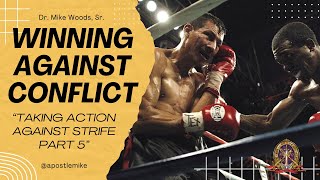
In this live‑streamed Kingdom Global Bible study, Apostle Mike Woods Sr. delivers a sermon titled “Winning Against Conflict” as part of the series “Taking Action Against Strife.” He opens with a call for viewers to share the stream, citing Genesis 12 and the principle that believers are blessed to be a blessing. He frames conflict as a spiritual stronghold that hinders God’s blessings and explains that the root of most disputes is the desire for something we are not receiving. Using James 4:1‑2, Romans 12:4‑5, and other passages, he categorises conflict into three types—external, internal, and upward (toward God)—and then outlines five common personal conflict styles: the peacemaker, the sulker, the stuffer, the litigator, and the screamer. For each style he describes its pitfalls and how it fuels strife in families, churches, and workplaces. Woods then presents a step‑by‑step, Christ‑like approach to resolving conflict: (1) overlook offenses (Proverbs 19:11, 12:16), (2) confront gently and with meekness (Galatians 6:1), (3) use “I‑language” instead of “you‑language,” (4) avoid absolute terms like “always” and “never,” (5) listen first and speak second (James 1:19, Proverbs 18:13), (6) apologize sincerely and offer restitution, (7) be quick to forgive, (8) practice wise timing (Proverbs 12:18, 25:11), and (9) give hope to observers by modelling Christ‑centered reconciliation. He emphasizes that true victory over conflict is found when the believer’s heart is fixed on God (Isaiah 26:3; Philippians 4:6‑7) rather than on the other person’s behaviour. The sermon includes personal testimony about Woods’ own childhood trauma and how he still must pray before responding on social media. He closes with a prayer, a financial appeal for the church’s building project, announcements about upcoming meetings, a 21‑day fast, and an invitation to attend the next live session. Throughout, he repeatedly urges listeners to share the message, give generously, and apply the principles so that the body of Christ can experience unity, peace, and the “kingdom‑advancing” purpose God intends.
Chapters
Well, praise the Lord, everybody, and good evening. Welcome to our Kingdom Global Bible study I am Apostle Mike Woods, and I'm so glad that I get the opportunity to share with you on tonight. Listen, I just want to do what we always do, take care some business, which I think is very important. You know, scripture says in Genesis 12 that we are blessed to be a blessing. So if you follow our live streams, many of you join us every Thursday night, um, hey, do me the kind favor and share this stream with someone. I promise you, if you do that, uh, you'll be blessed. The Bible declares that we reap what we sow. And what better thing to sow than the word of the Living God? So if these teachings are blessing you, I want you to go ahead and share it right now. Listen, I promise you, uh, you will be glad you did. So we're going to give you an opportunity to go ahead and, and get this shared and tag someone below. Glory to the name of God. Let them know that I am on and I am getting ready to teach. I am not going to tarry long tonight. I am going to here with Thus Said the Lord. Do me a kind favor, guys, and if you would just comment below and say hello. Uh, it's nice to be nice. It's nice to speak when you walk into a room. So please, as you come in tonight, whether you're watching live or by replay, I need you to do me a favor and speak and share with everyone as you come into the room. All right, again, we're gonna get started in just a few moments, but I want you to go ahead and get this shared. Listen, before we get into the heart of this, while you're sharing this and while you're gathering yourself, sending out that final text, letting people know we are here. Listen, here's what I'm gonna do. I'm gonna go ahead and play the series opener, glory to the name of God, for taking action against strife. 'Cause that's what we're teaching on again on tonight, taking action against strife. This is part 5. And we're gonna talk about winning against conflict tonight. You don't want to miss this. You don't want to just keep scrolling. Listen, you really want to get this word. Uh, I'm not going to allow myself to have strife by looking at the numbers tonight. I'm going to teach this. I have decided, guys, I promise you, I have made a determined decision that the word of God is important to me. Matter of fact, it is the very substratum of my entire life. Uh, as a little boy, I was introduced to the power of the word of God. And ever since, it's been the driving force that keeps me alive, that provides for me, that keeps me going. Listen, I'm not going to concern myself with people who should know that on Thursday night Bible study happens at 8 o'clock. You ought to be on the live stream. If nobody else that follows us is on it, you should be on it. It tells me a lot about you. Your maturity if you don't engage the word at the time we've allotted. Glory to the Lord. You should be hungry for this since Sunday. So I'm gonna give you an opportunity to get on, share, comment below. We're going to play the opener and then I'll be right back. God bless you. In a world filled with conflict and division, where strife threatens to tear us apart. We are called to a higher purpose, a greater destiny, to advance the kingdom of God and superimpose heaven on earth. Together, we explore the the wisdom of God, the wisdom of his word, and we discover a pathway to fulfillment, to peace, to harmony, and unity. Join us for our new teaching series, Taking Action Against Strife, as we seek to bring peace and understanding to our world and to our lives. Together we can make a difference. All right, well, praise God. And yes, that's, uh, it's, it's, it's interesting to me that God started me teaching this basically 5 lessons ago, uh, at the church on Sunday and on Thursday night. So it must be pretty important. Uh, there's a whole lot of other stuff I can teach, trust me, and, uh, and that I probably want to teach. But at the end of the day, I'm not my own. I'm bought with a price. The Holy Spirit still has us right here. Listen to me, guys, for a reason. Because as we've been discussing Conflict and strife hinders blessing. God is a God of peace. He's a God of unity. So what he requires, what he desires of his people, is that we— one, and I'm just going to review right here, uh, we've been talking about being at peace with ourselves. We got to be very satisfied with who God has made us, the assignment, the purpose. Uh, we're not called to walk around trying to change, uh, who God made us. We're actually here to carry out the distinct plan of God for our life. And the reality is, man, when you start moving in something outside of what was planned and you start living outside of your authentic kingdom purpose, hear me, hear me good. You end up creating delays, you start taking detours. And ultimately you destroy the original purpose. And listen, that— if that ain't missing the mark, harmisia in Greek, which is sin, I don't know what is. You know, we harp on the other stuff, but man, if you, if you're missing the mark in the area of purpose, you have sin in your life, ma'am, sir, and, and you need to get that together. So we've been talking about being at peace with yourself, we've been talking about being at peace with God and being at peace with others. We've been talking about how Unity and harmony is important. We talked about how the spirit of strife, guys, can destroy marriage, it can destroy business, it can destroy family relationships, it can destroy relationships between friends, relationships between parents and children. Strife is a dangerous thing. And so tonight I want to just kind of devolve into some principle— hear me— that I believe will help us win against conflict. Because one of the greatest causes of strife and one of the greatest portals that is open in the area of the strife— because strife is a whole demon, a whole stronghold— but the spirit of conflict is inside of there. And conflict, hear me, opens up that portal, causes you to be idle and Satan can come in and begin to wreak havoc in your family, your finances, your life. Okay, so we want to talk about how to win against conflict. Close that door, because the Bible said the idle mind is the devil's workshop. So you're not idly engaged— oh my God— in the past. You're not idly engaged in tension with other people, and you really know how to get along with others. Are y'all with me? So let's pray, and we're gonna get right into this tonight. Again, we're talking about winning against strife. What I need you guys to do, live or by replay, is share this teaching right now. This is going to help somebody. And listen, I, I need you to understand something. Hear me good, kind friends. I love you all. But I need you to hear me good. Again, we are blessed to be a blessing. So please, if you got on our text list, you got a text, copy and paste that text, send it out. If you're on here, tag someone below, send someone an inbox, share this on your timeline. Listen, if you're following me incognito or anonymously, you probably don't need to be following me because at the end of the day your motives are probably jacked up if you can't share this on your timeline, man. I share people's stuff all the time. People don't, you know, preachers that I share, they, they follow me, but they won't share my stuff because, you know, I don't know why. But at the end of the day, it could be a number of reasons, and I'm going to get into that. But I'm just, you know, it doesn't matter, you know. At the end of the day, I'm all about seeing other people be blessed. So I need you guys tonight to share. So let's pray. Father, yes, God, we love you tonight and we give you glory, we give you the honor. Beside you there is no other. It's in you we live and move and have our being. You're our strength, you're our helper, you're our king. And Father, we love you. We thank you for the word. We love the word, God. And Father, we thank you that this Bible has made it clear who we are. And so Father, we decree tonight, we are who the word says we are. We're blessed, we're the head and not the tail, we're lenders and not borrowers. It has stated our health position, with your stripes we are healed. So we believe this word, we're healed by your stripes. It has stated our position financially, you would that we prosper and be in health even as our soul prosper. So we decree and declare, dear God, Thank you, Father. Thank you, Father. Thank you, Father. Thank you, Father. We decree and declare in the name of Jesus, let it be so, that this word will come alive for us tonight, even as we teach it, as we share it. And Father, may people be blessed by you and never impressed by me. In Jesus' name, amen. And thanks be to God. Hallelujah. I love y'all tonight. Y'all are such a wonderful group of people. Again, comment, engage tonight. Uh, hello everybody. Hello Kiara, God bless you. Hello Pastor Jeffrey Jasper. Hello Sharia, God bless you, love you. God bless you Sharia for sharing and trying to tag others and get others here Glory to God, we are blessed to be a blessing. Everybody here ought to be doing this to make sure that we can get this word out. Now, this is going to be real good tonight. Hey, hey, wife, God bless you, love you, lady. Glory to the name of God. Listen, God is going to, uh, meet us here tonight. Praise God. So I need you to open your heart, get your cup out so you can receive the revelation that comes from God. I'm telling you now, as I begin to think about this today, God begin to stir something in me that is so vitally important for us to understand, that even our anger and conflict that we invite, and when we're engaged, many a times is because somewhere in our history Somewhere in our root system, we have created a root system that, or someone has engaged us in the past in a way that there's a button or a trigger down inside of us that causes us to desire conflict. And the reality is, man, this is not the will of God, and we have to dig up, break up those old systems, those old ways of thinking. Glory to God. So that— praise the name of God, hallelujah— so that we can create some new root systems that represent the peace, the unity, the harmony of God in everything we do. So tonight I just want to give some, um, background scriptures first, and then I'm gonna— I'm gonna just jump in this with both feet, man. Um, but what I do want to do, glory to God, again is give you some background. Glory to God. Hallelujah. Y'all excited about Jesus? I know I am, man. Glory to God. Hallelujah. Glory to God. All right, so this is good. Romans 12 uh, verses 4 and 5. Let's go there. Romans 12, glory to God, uh, verses 4 and 5. You'll find these words. All right, let me get there. Jesus. Romans 12, verses 4 and 5. Somebody type that in the comments for me. Glory to God. This is where we're going. Hey, Minister Tanya, God bless you. Good to see you here tonight. Um, we love Jesus. Hallelujah! I don't know about you, but I love him. Do you love him? Glory to God. All right, my Bible wants to trip, but the devil is a liar. We win. Glory to God. Somebody shout, we win! We're winning against strife. We ain't gonna even get stressed out about this. All right, here we go. Glory to God. I'm telling you, God is so good, man. Uh, Romans 12. Hallelujah! Thank you, Jesus. Shai, oh my God, we love you. Romans 12, thank you, Jesus, verses 4 and 5. The Bible says this, he said, for as we have many members in one body and all members have not the same office. I need you to say this with me, say, we are different. Glory to God. Hallelujah. All of us are unique, authentic, and vintage. The Bible says we have many members. That word members in the Greek is milos, M-I-L-O-S, milos. And it's not like, um, watch this, um, members belonging to necessarily a gym or even the church, um This is more like— watch this— your hand being a member of your body, and how your hand— watch this— is different than your foot, but your foot and your hand are both members of your body. But watch this, they both serve different purposes. Now, it should look like this in the world. It should look like this in the church, but it does not because people show up with— and this is where we want to get. We want to win against the conflict so we understand that we're all a part of one body. We're different, we're connected. It takes all of us collectively, hear me, to function. It takes Minister Tanya Anderson's gift as a worship leader. It takes Jeffrey and LQ's gift as administrator. It takes the First Lady's gifts, glory to God, as a helpmeet and as a worship leader and everything else she does to support ministry. It takes everybody, takes Kierra, it takes Mia, it takes everybody involved to make the body. So, and every person who is in the body of Christ, we're different, we're unique, and because of that it immediately proposes that conflict could arise. Yeah, it, it immediately proposes a threat, guys, because we're so different. But we have to figure out how to win against our differences. Glory to God. Hey Sharon, good to see you. Hey Zion, God bless you, I love you, thank you for being here. Glory to God. Listen, say it again. Say, we're different. Say, I am unique. I'm vintage. I'm authentic. I need you to grab that. You're different and you are important to the process of the body of Christ. Lord have mercy tonight. You're important. Glory to God. You're important. I'll say it again. You're important. Hallelujah. You're important. You're unique. You're authentic. You, you were made hallelujah, for something that nobody else was made for. Hallelujah, glory to God, glory to God, glory to God. Y'all just take a moment right there and just worship him for your uniqueness. Listen, for your significance. And you ought to be at peace with that. Let me just keep reading it. Glory to the name of God. He says, verse 5, so we being member— being many are one body in Christ, and everyone members of one another. So we are again unique We're different, but we are interdependent, interconnected. Watch this, inter-anointed to perform the works of the Lord's body. Good God Almighty. I'll say that again. We're interdependent. So that means you, you have a dependency on my gift. But wait a minute, as a leader, I also have a dependency on your gift as a leader in the body of Christ. We're interdependent. What you carry is important. Who you are is important. Glory be to God. Libesotamantaya. Reban tokosuraba. What God has said about you is important. Oh, I dare you to say it again. I'm unique. I'm vintage. Whoo! Hallelujah! I'm unique, I'm vintage, I'm authentic. I'm interdependent on my brothers and sisters. We're intertwined. Glory to God. We're inter-anointed. So watch this. It means our anointing amalgamates in our connectivity, in our unity, so that we flow at a higher level. Oh, I gotta get out of here, man. Okay, I'm going, I'm going, I'm going. So let's get into this, man. Good God, ain't nobody like you nowhere. Hey, I'm telling you, there is no one. Your purpose is so necessary in the kingdom. Matter of fact, the reason your heart is beating, the reason you're breathing, glory to God, is because there's something big, there's something awesome, there's something great. Glory God, there's something mighty that you gotta perform. Glory to God. And God is dependent on you. God is waiting for you to arise and be you. Glory to God. You ain't got to be nobody else. You ain't got to borrow nobody else's anointing, nobody else's— oh my God— gift, nobody else's flavor, nobody else's spice, nobody else's life. God says, I am waiting on you. To arise, to emerge, and impact the world. Glory to God. Hey, Shabaya! Soto monti asabatai. Rebe soto to Shabaya. We give you the glory, God. We give you the honor. I'm gonna try to slow down and be nice tonight. Glory to God. Hallelujah, hallelujah. Glory to God. We give him praise. We give him glory. We give him— we give him honor. We glorify him. Thank you, Lord. Thank you, Lord. Thank you, Lord. I don't know, but I celebrate my uniqueness. I celebrate my trials. I celebrate everything God allowed me to go through and survive, because everything in my past— glory to God— it has qualified me to be who I am today and to become who I shall become in the future. And I'm telling you right now. Don't curse where you've been. Don't curse where you come from. Everything about you and where you come from is not bad. God says everything has worked together for good. Everything has worked together for profit. Everything is working together for increase. And I challenge you tonight to emerge. Glory to God. Emerge. I challenge you to rise. I challenge you Praise God to be that unique vessel that God is calling for. So tonight we gotta win against conflict so we can emerge. We gotta defeat conflict with ourselves, conflict with others. We gotta have peace with other people. We gotta defeat conflict with God. And we— I really want to get into dealing with conflict with other people tonight in a deep way. Because at the end of the day, guys, can I tell you something? Can I really tell you something? We cannot afford— hear me— we cannot afford to miss it. Whoo! I'm just telling you right now, we cannot afford to miss what God's about to do. And we— that's why we're still on this. You need to deal with that strife. You need to deal with that conflict. In your life. Glory to God. I love Jesus, man. Hallelujah. I love him. Do y'all love him tonight? Glory to God. I love him. Thank you, Lord. So what if I told you, ah, you can solve all of the conflict in your life hear me, with one sentence. I'm gonna show you how to do this, and I'm gonna say this probably 10 or 15 different ways tonight, but really it's all about one sentence. And I was gonna save this to the end to give to you, but I'm gonna give it to you now, and then we're just gonna teach around this point because You need to understand, it's really this simple, right? So I know you said, uh, Apostle, that's a big claim, man. Yeah, I know I done wrote a check that you think I can't cash, but I'll never do that. If I'm right, if I write the check, it's gonna clear. Glory to God, this one is gonna clear. You can actually resolve your conflict with one sentence. And the first thing I want us to do really quick, I want us to do an exercise really quickly, all right? Tonight I want us to do this exercise live online, whole nine yards. Listen, if you're watching this live or replay, don't scroll. You need to do this with, with us because some of you scrolling, you're stuck and can't move forward because you got conflict in your life. You can't get along with other people, you can't get along with yourself, and you're mad at God. So you need some help tonight, stay here, stay here. So you got conflict in your marriage with your spouse, got conflict with your children, stop scrolling and stay right here. All right, so, so let's do this. All right, let's perform this exercise. So I want you to think about a fight, a quarrel, conflict, some tension. All right. Hear me— that you had recently, all right? You said, oh well, I'm— I just get along with everybody. Even if you didn't enter into the conflict, you had a conflict with what they did, what they said, what they thought, maybe in your mind. So I want you to pull that up now. I need you to pull it up without getting mad, without cussing, none of that, right? I need you to get a recent conflict in your head, okay? So it might have been something with your parents, your mom, your spouse, right? At work, wherever. Your roommate, your coworker, wherever. I want you to pull it up in your head. The worst the conflict, the better, all right? Again, and I want you to reminisce about this without punching a hole in the wall, okay? Just— but the worse the better, because I— we're going to challenge this thing, and if it's there, it's going to manifest, and we're going to cast this demon out tonight, and you're going to get free tonight. Glory to God. All right, now here's what's going to happen. Ah, God. All right, you got it yet? I'll keep it right there. Now, even though I don't know the what, why, any other details of your conflict, I'm getting ready to tell you right now why you got in that conflict. I don't know details. I wasn't there. I wasn't a fly on the wall. My prophetic is not working right now to tell you the details. I just know based on principle why you got into conflict, and I'm gonna show you in one sentence why and how in the future you can avoid it and you can resolve it. First of all, let's read James chapter 4, verses 1 and 2. The Bible says this, it says, what causes fights and quarrels among you? Now mind you, James, which is Jesus's brother, half-brother, huh, he's talking to church folk, right? He's not talking to sinners, he's talking to people who are in the body of Christ. Interesting, right? That there are fights and quarrels among them. Oh boy, oh boy, oh boy, oh boy, oh boy, oh boy, oh boy, Lord have mercy. Oh boy, it happens. There are disputes and quarrels because anytime you have more than one person in a room, it is a threat to unity. Ask Cain and Abel. We have to learn how to deal with this. God, we got to deal with it. We got— we're out of church, we got to deal with it. Body of Christ watching this, we got to deal with this. So that's the first question: what causes it? What's the reason? I'm going to tell you. That conflict in your head, what's the reason? Do they come from— here's another question— from your desires that battle within you? Suppose so. James says What's causing you to conflict? Does it come— second question— is it coming from what's in you? He says you desire but you don't have, so you kill. You covet and you cannot get what you want, so you quarrel and you fight. In other words, James is saying this, guys. He's saying that you and I experience conflict. Watch this, y'all ready? One sentence: because you can't get— stay with me, don't shoot the messenger— what you want. Uh-uh, Apostle, no, they were wrong. Wrong or not, okay, unfair or not, no matter what she said or he said or they did or what they did not do. And you're probably right, they probably are wrong, they probably should have did something different. Oh my God, they probably should have treated you better. Oh, but here's the thing. Even when you're right and the other person is wrong, hear me, the reason you're fighting is still because— you ready? You're not getting what you want. That's why you're fighting. Because, watch this, because you want them to think blank and they don't. Come on, you want them to start doing blank or stop doing blank, and they do the opposite. So it creates conflict, and you get mad because they're not— you're not getting what you want out of them. So basically, every conflict, hear me, boils down to this one truth. You, yeah, you, yeah, you that just tuned me out right there, you, you too with your deep anointed self, you, yeah, you You're in conflict because you're not getting what you want. Lord, help us. Help us tonight. Oh Jesus, Jesus, help us. Here's reality: life is not about controlling the emotions of other people. It's about controlling your own emotions, your own reaction to their emotions. Oh my God, today, yeah, some, some of y'all still don't agree, but you don't have to. That's what James said, it's the Bible. It's something in you, you want them to do something they're not doing, and when they don't do it, it creates a conflict. But if you take control of the narrative It'll no longer be a conflict. Oh Lord, give us strength. You want them to understand you, I know. You want them to love you, you want them to respect you, and they're not doing it. Guess what? You're not getting what you want. So now there's a conflict. Now you'll get it. You want them to apologize, they didn't. You're not getting what you want. That's a conflict. They're not being a puppet to what you want. They're being them. So how do we win against that? Again, this is practically the problem in every conflict. Somebody wants something that the other party is not giving. And when you don't get what you want, it becomes a conflict. Well, I don't like them. I ain't gonna spend no time with them. I'm not gonna talk to them. Because they're not giving you what you want. His question: would Jesus react that way? Oh, oh my God, oh my God. I know some people will start scrolling, it's okay, and jump off. Okay, it's okay. It's— this is for grown folk because some people are not— oh my God— happy until they're unhappy. So they want to make everybody else unhappy. You got to control the narrative. See, y'all don't like this kind of teaching. Y'all want me to teach you how to float and fly in the spirit and all this stuff. None of that is important if you can't resolve conflict with your brother. You want to learn how to prophesy, you want to lay hands, you want to move in power. Okay, moving this power, learn how to resolve your conflict. You want to walk on water. Know why you really can't do any of that? Because you, you got issues that you're unwilling to confront. The Bible even said you gotta talk with your brother, lay your gifts at the altar, go to your brother, reconcile to him, then come back and pick up the gift. How much of that we got going on in the church? Oh my God, today, how really, for real, how much of that we got going on in the church? Oh Jesus, all these gifted wonders Oh, we, oh, we, oh, we, oh, we who could prophesy, see through the wall, see through muddy waters. Or them that can't prophesy, can't see nothing, everything they say off, but can't get along. And this is precisely why people don't get saved, because church folk are in conflict with each other. Come on. Oh my God, oh my God, oh my God, oh my God, we gotta figure this out and win. So how do we win, Michael? How do we win, Apostle? Uh, I'm glad you asked. I'm glad you asked. I want to share with you right here. Write these down. I want to give you 3, 3, 3, all right, 3 types, all right, of conflict. 3 types. You ready? Write this down. Number 1, external conflict. When James is talking in 4:1, he asked the question again, what causes the fights and quarrels? And he's again, relational conflict between followers of Christ is conflict outside of yourself with other people. Say that with me. Say external conflict. That's a type of conflict. Okay, there's another type, it's internal conflict. So he starts talking about, is it something that's in you that's conflicted? So anytime you're tempted to have conflict, I want to suggest— hear me— I want to suggest you take an introspective. Right? And I want to suggest that you look at you and you see where you can be better, where you— where you can really address the root problem to really why you want to engage in conflict. Because can I tell you something? Conflict is always counterproductive. Oh, I just stepped on a limb and said that some of the psychoanalysts are gonna— oh my God, they're gonna number two bricks if they hear that. Because some people will say that conflict can be productive. The devil is a liar. It is never productive. It is always counterproductive, and it hinders blessing. Those are what James said. He said, you see something you can't have So you start conflict with the person that got it, what you want. Oh boy, whether it's an answer, whether it's for them to change or whatever, you know, I'm good and well, you can't change nobody. Only person that can change people is God. So what you need to do is take yourself somewhere and pray that God will change them. My days of trying to change people actually never began. All I'm gonna do is tell you what's right. You're grown, and if we have covenant, I'm gonna trust your grown self to see the wisdom in what's being said, overcome your internal conflict about receiving authority You know, there's some women that struggle from receiving authority from a man because they had conflict with a man in the past that was abusive. Well, that's a need for deliverance. You got to overcome that so you can receive authority. Oh my God, did they— you gotta deal with internal conflicts. And then thirdly, there's upward conflict. This is tension toward God, tension toward God. And God knows Hear me, we don't need no tension with God, for sure. Are y'all hearing this? So here's what I want you to do. Understand this, man, you got to get yourself together and we got to win this fight, this battle against conflict. Hallelujah. Lord have mercy. Glory to God. Let's keep going. Glory to God. I want to give you these because they're important. There are— because you got to be able to identify this when you're having conflict so you can resolve it. So there are different styles. Hear me. Of conflict. All right, when you're in a relationship with anybody, in a covenant with anybody, whether it's in your marriage, whether it's in a friendship, whether it's with your children, there are different styles of how humans and individuals approach conflict. Okay, and, um, I want to give them to you. First one Some of you, you are the peacemaker, all right? And this means that what you want most— hear me— is harmony, is unity, is peace, okay? So whatever happens, watch this, you're always trying to move the needle back to peace or harmony. Your attitude is basically— watch this— hey, if they're happy, I'm happy. Hmm. Which seems good, right? All of what I just said seems good. You're trying to move back to peace, you're trying to move back to harmony. And then you say something like, if long as they're happy, I'm happy. That's okay until you start papering over, covering up issues, and just stuffing things down that need to be addressed. Oh my God. See, there are some issues that really need to be dealt with, and you don't just need to resolve for the sake of peace. If they're happy, I'm happy, so I'm just gonna leave it alone, let it go. And you're gonna stuff this in and never talk about it. Unhealthy, ungodly, and you're creating a powder keg that's going to explode. Eventually. Oh God, have mercy. For those of you who are the peacemaker, let me help. Let me consider something. Maybe it's you're unwilling— watch this, hear me, hear me, loves— maybe you're unwilling to do the hard work that is necessary To create a solid relationship, a solid covenant, a solid environment, a good long-standing connection takes work. And maybe you're unwilling to do that, and all you want to do is just get back to harmony, get back to peace. Listen, if that's you and you don't want to do the work, maybe you're not a peacemaker. Maybe you're a peace faker. Oh my God, oh my God. Okay, I'm gonna move on to the next one. I'm just, I'm gonna just, that, I'ma just transition to the next one. Okay, I'ma just put my finger up and move on to the next point. Because I know some of you don't want to hear that because that's you. Long as they good, I'm good. But sometimes you gotta, you gotta learn how to move the needle back to peace and harmony with wisdom and in peace and in love, because you can't afford to sacrifice you for the sake of peace and harmony. Okay, next one. There's some of you, you're not a peacemaker or a peacemaker, you're actually a sulker. You get this look on your face, you sulk. A sulker is when someone close to you, someone you works with, your spouse, your children hurts you. Hear me? Instead of communicating, you start to sulk, and you— your whole spirit change. You just start sulking. Your demeanor is terrible, and you sulk until they figure out, oh my God, what they did to you and rectify it, you know. So they got to spend time fasting and praying around you walking on pins and needles because they don't know what's going on. Because you're a soaker. Oh my God. Because you— listen, that is no way to be. And you cannot have a successful environment. Oh my God. Oh my God. In the things of God, when nobody will talk about what's going on. Oh Jesus. Listen, when you're a soaker, you turn the whole house, the whole environment you're in, your whole workplace into one of those escape rooms. Yeah, you ever been in one of those escape rooms where you got to figure out how to get out and you have to really work together with the people you with to get out? Well, those things are pretty redundant. And at the end of the day, you— it's a puzzle. You— it's a redundant puzzle that once you figure out the pattern and you work together to put the pieces together, it's pretty easy to get out. But if you get stuck in one mold trying to figure something out, you'll never get out of there. And that's how some people do in their house or in their church or in their business or on their job or with their children. Always trying to figure out what's wrong with somebody. We just really need to say, look, this is what I'm dealing with, this is what I'm going through, this is the problem I'm having. Are y'all hearing this? Oh my God. Yeah, I mean, if you're sitting there with your spouse and you're married to one of those, just point at them and say, yeah, that's you, let's get that together. Hallelujah. Okay, I'm gonna segue to the next one. I'm gonna segue to the next one. Somebody said, Apostle Lane saying that. Yeah, you need to say it. You need to have a conversation. Stop being a stalker. I'll tell them, if you're a stalker, live or by replay, and your spouse is having to figure out What's going on with you? Because you sulk when they do something to you versus having a peaceful dialogue to resolve the conflict. You're wrong. Stop it in the name of Jesus. Yeah. Oh boy, let me keep moving, let me keep moving. Number 3, this is another style of conflict. There's the stuffer. The stuffer, okay, this is the person who constantly stuffs anger and conflict down in their heart. And you ask this person, is everything okay? They always going to say, yes, I'm fine, I'm fine. But everybody can see when you say that, them little bubbles coming out of your head that's got cuss words in them because you keep stuffing stuff down and you really won't say what you're going through. And then you get so bitter that you spit in the grass, the grass will wither because you so bitter. Don't be a stuffer. Listen, you can't do that to yourself. You got to get that root system out. You got to move in peace. You got to resolve this stuff. I'm going somewhere with this, okay? Some of you, you're not a peacemaker, you're not a soaker, you're not a stuffer, or you may be all three and this. You're a litigator. Oh my God. Which means in conflict, you know how to argue real good. You have become a skilled professional arguer. And you really think— oh my God, I already know some of your toes are hurting tonight. That was the intent of the Holy Ghost. Do not scroll, do not jump off this live. I'm trying to get your house peaceful. I'm— ah, she killed it. I'm trying to get your family in unison. Some of you are litigators, you good arguers, and in any situation you usually can prove— maybe not to them, but to yourself, and that's all that matters— that you're not wrong, because that's all that matters to you. If you can litigate well enough to convince you that you were not the person in the wrong. Oh my God, y'all know a litigator? I'm feeling it in my spirit right now. Somebody on here, glory to God, knows a litigator. You know a litigator, glory to God, or you might be him, that you can argue so perfectly, but you've convinced yourself Glory to God that you are correct. And they walk away from the conflict knowing they crazy, knowing you still wrong. Listen, listen, litigators always feel this. They're deceived. They feel like because they can't admit they're wrong, they are a blessing to either be around or live with. So they won't admit their flaws or when they've come short because they want you to think they're perfect. So that's why they have mastered litigation. But I'm telling you, when you do that, you're not winning against conflict. You, my friend, are losing. Glory to God. Hallelujah, Jesus. Thank you, Lord. We give you glory. And by the way, uh, litigators, have you figured this out for real? Have you figured this out yet? That when you win an argument at home— have you figured this out, my fellow litigators out there? I used to be this guy, man. That's why I could talk about this. Have you figured out— thank God for freedom, God have mercy— because you know what I figured out? And have you figured out that when you win an argument at home, you really never won anything? Good God, you don't win anything because you most of the time have humiliated the person you're talking to, made them feel less than, made them feel inadequate, only to stroke your terrible litigating ego. Now, other places you litigate, there's a reward. In a courtroom, yeah, there's a reward for litigation. But if you ain't no lawyer, you, you shouldn't be a litigator. Or if you're litigating for, you know, for someone, if you're working in human resources or something at the office, or you're litigating with a customer service rep trying to prove your point because you're trying to get something rectified with service. I get it. Okay, I'm gonna segue out of here. That's a great segue. Let me just segue out finally. Okay, here we go. Are y'all ready? Oh, we have the screamer. I'm gonna say this soft because screaming is no way to resolve conflict. Oh my God, oh my God. This is the person that when something goes wrong, they get it out at full volume. And you know what I've noticed? When people who have come from families who are screamers— and this is just me dealing with people— I've noticed that people who come from families of screamers usually marry people who didn't. So when they have their first fight, oh my God, the one who's a screamer— watch this— can't figure out why the other peep— oh my God— person is not screaming. Oh my God, oh my God, oh my God. Good God from Zion. Because they won't engage. Because the screamer needs to have a screaming match. They need to win that screaming match. They need to go back and forth, and they can't understand why The screamer, oh my God, they screaming. And you know what, the non-screamer is looking at you thinking, demon, come out in Jesus' name, because that's totally unfamiliar to them. So watch this, it's not effective. I need you to stop screaming. Keep your inside voice on. Watch this. If you're living with a person that's got the ability to hear, there's no need to scream. A soft answer turns away wrath. So I'm glad we got that out of the way. Let me go, let me go, let me go. I got to get out of here. So, good God from Zion, let's talk about how Jesus would de-escalate conflict, heated emotional relationship-killing conflict, covenant-breaking conflict. And to win against conflict, we need to mirror how Jesus— hear me— would deal with conflict, right? So let me just lay a backdrop to this. Let me do this and then we'll get into these ways. So first, to de— to develop the maturity to de-escalate any conflict is to acknowledge, number one, that this is conflict that needs to be de-escalated, and turn to God for help. Are you hearing me? So instead of trying to de-escalate the conflict on your own, glory to God, turn to God for help. Are you hearing me? And ask him to help you de-escalate it, and say something like, God, I ultimately trust you. You to meet my needs. Watch this, not them. See, because you feel like in order to be satisfied you need to argue with them, but you need to say to God, God, I trust you to meet my needs, to give me peace, to help me to overcome this situation. Remember I told you stimulation, space, response. So when you get stimulated, go to the space, talk to God, because he's the source of resolution. Watch this, resolution, two words, re-solution. So you find a new solution, a re-solution to the problem versus how you would normally handle it, versus being a screamer, a litigator, a peacemaker, versus Oh my God, engaging in an all-out war with someone who— that God has the ability to bring peace with. But you got to go to him. Oh my God, I said, God, give me help. All right, see, and then when God gives you help and you trust him, he'll give you the ability to confront the person in a way that they don't feel attacked. See, that's what creates conflict and make it bigger, when you go to a person and they feel attacked. Because you listen, when you go in prayer, after prayer and after spending time with God, it won't come from this spirit of desperate raging that comes at them. And that person said, you attack me where it hurts. That's why when people get in conflict, they say stuff that they really don't mean. They bring up stuff that they know will trigger you because they're trying to make the conflict greater and they're trying to win the conflict. Oh boy. But you gotta talk to God, man, because we need to win. Isaiah 26:3, let's read that. The Bible says, I will keep them in perfect peace whose mind is fixed upon you. So when your mind is fixed upon God— watch this, oh my God— when your mind is fixed upon God and you're trusting him to meet your needs, you're going to have perfect peace even in conflicts. Oh my God. So you may think what they're doing to you, what they're saying, what they did you just gotta slap them, you just gotta go off. But no, you don't have to do that if you keep your mind on Jesus. The Bible said he'll give you perfect matured peace. Oh my God, perfect peace. Philippians 4:6, go there. Philippians 4:6 says, be anxious for nothing, but in everything by prayer. Oh my God. Let your request be made known to God. So if I'm in conflict, it's okay to talk to God about what is coming against me. Listen, I'm teaching you something, guys. I've had to live because I was a damaged person. Me and my wife was talking about this, this morning. I was an angry man because I had so many things happen to me in my childhood. That created this anger. I saw abuse, I saw violence, I saw abuse toward me. I dealt with so much rejection, so I just grew up into this angry man. But thank God for deliverance. Even after I got delivered and, and, and purged about stuff out of my mouth, I still had to put into practice these principles. To date, I still have to pray and ask God to help me so I don't retaliate the wrong way. Oh my God, that's why I stay off social media. I post and run. That's— I'm that guy. I post and run, man. That's why I'm ready to get these social— Kiara and Mia I'm ready to get them totally engaged in my social media life. So I don't even have to touch it. I only have to push the Facebook app ever. I don't want to do it. I don't want to push the Instagram app ever unless I just want to post something myself. But at the end of the day, I post and run because there's some things I see I want to respond to, and I have to pray. And the Lord— many times I've been done typed a huge thing because of something I saw, and the Holy Spirit said Don't post that. What you doing? You just wasted 20 minutes on something that really, number one, has nothing to do with you, and it's something that you can't fix with this post. Pray for them, and if you're going to minister to them, I'll give you an opportunity for you to do it, but this is not the way to do it. Are y'all hearing me? Oh my God, I love Jesus, man. He said, let your request be made known to God, and the peace of God that passes all understanding will guard your hearts and mind in Christ. So you see what's happening here? I look to God first for my needs. I'm not— according to scripture, I'm not wholly dependent on who I'm arguing with or who I have a conflict with to meet my need. I depend on God, and that gives me peace that surpasses all understanding. Watch this. Would you believe it if I told you that Jesus actually, if you study it in the Bible, had a myriad of interpersonal conflicts with people? Because when you are a kingdom woman or a kingdom man and you're carrying a divine assignment, you're carrying a supernatural purpose, you're going to be— oh my God— aggressively come against. There are going to be people that are going to engage you to create a distraction But Jesus handled this thing, man. Good God. And if you read the Gospels, you'll see that he gets in a surprisingly large amount of arguments. Oh my God, in conflicts. Jesus is doing two things basically in the gospel. If you read them, he's eating and he's arguing. Oh my God, I love that. But his conflicts— hear me— were always loving conflicts. He never addressed his critics in the way they addressed him. Oh, oh, oh, even when Judas kissed him Glory to God. And he was turned over to the soldiers to die. Didn't say a mumbling word to Judas, didn't yell, didn't scream, didn't become a litigator, didn't plead a case. He knew his purpose, he knew the plan. Oh my God, Jesus had selfless conflicts. Conflict done— watch this— from a place of perfect personal peace will always end in victory. But conflicts that are confronted in the wrong spirit will eventually evolve into relationship covenant-breaking conflicts, and that's what we don't want. Listen, if you're connected with someone and the the covenant, hallelujah, is being broken. Libesatababatorataia. Because of the conflict. That ain't God, man. That ain't his way. That's not his plan. That's not his desire. Y'all stay with me, I'm almost done. Glory to God. Good God from Zion. So what does Christ-like confrontation What does it look like? Glory to God. What does Christ-like conversation feel like? Hear me, guys. So I have a little list and I'm gonna give it to you and I'll be done from the Bible because this is how we win. We have to do what Christ did. It's the only way. So number 1, write it down: Christ-like confrontation— hear me, and I want you to underline— overlooks a lot. Oh, they overlook a lot. Christ overlooked a lot to make sure that he handled confrontation properly. Proverbs 19:11. 1 is what it says. It said it is to a man's glory to overlook an offense. It's a glorious thing not to respond. And in— so you want glory in church and walk on water? I want that too. I've had all— I've had it all my life. I moved in glory longer than most people have born— been born, excuse me. All right. It doesn't make sense for me to be in the glory, get slain, fall out in the floor, roll, dance, cry, then I leave the church and cuss somebody out. I leave the church and choke somebody. Doesn't matter. But it's great honor that when you're offended, you're able to overlook it. Jesus called it turning the other cheek. I heard— I just heard that, Lord. Somebody, somebody on here said, yeah, I'm gonna turn the other cheek, but after I turn it, I'm gonna give you a left hook. Listen, that, that's not what it says. You got to turn the other cheek and overlook it. Oh boy, oh boy. Proverbs 12:16. Christlike competition overlooks a lot. Watch this. Proverbs 12:16 says this: The vexation of a fool is known at once, but the wise ignores many insults. In other words, a few— a fool is short-fused. Watch this. They gotta comment on everything. Oh my God, they gotta say something about everything and everybody. They get in people's business, that they get mad when somebody else is fighting. It ain't got nothing to do with them. Oh my God, oh my God. You ever been around somebody like that? Can't just— can't let it go, can't let nothing go. Always carrying something that they need to let go. Jesus. My God, today, my God, today. Listen, the wise, by contrast to these texts, let a lot go. Glory to God. Let it go. Stop letting it stir you up. Stop letting it defeat you. To do? Overlook it. Let it go. Handle it in wisdom. Number 2, write it down. Christlike— we're winning against confrontation, man. We're winning against conflict. Christlike confrontation. Write it down. Are you ready? It's gentle. So I ain't brazen and aggressive and brutal if I'm handling it like Christ. If I come like that I'm not coming like Christ would. Oh my God. Galatians 6:1 says this— type it on the screen, guys. Good God. If a person is overtaken in a fault, the Bible said, you that are spiritual mature, restore them in the spirit of meekness and love. The word meekness in Greek simply means gently. So if you see someone overtaken in a fault, it says restore them gently, lovingly, respectfully, not selfishly. Don't be judgmental and kill people because you know they're going through something, because you're conflicting And you got conflict because it makes you feel better because they are down. Oh my God, oh my God, oh my God. Listen, here's a litmus test for you. If you see somebody mess up and fall, watch this: are you excited to confront them? Okay, I'm just saying, are you excited to confront them because they fail, because they messed up? Okay, let me give you an example, because if you are excited to confront somebody because they messed up, they made a mistake, you're in sin. You're not following a command. Oh my God, to restore them in the spirit of gentleness and love and respect, considering you. Let me give you an example. You know, I don't agree with nothing that William Murphy did in his worship service with the swag surf thing or the walk it out thing. I'm not going to do that. But I'm not going to get online and start smashing him neither. There are some people who are so mean-spirited and venomous in the body of Christ, they cannot wait to tear someone else down when they see something they've done that they don't agree with. How about it ain't your place to tear him down? How about It is very clear he has a spiritual father. It's very clear he's a part of an organization that he's accountable to. And if those bishops and apostles in his organization have not said nothing to him, it is not your place. The Bible said, touch not my anointed, neither do my prophet no harm. But some of you see that kind of stuff and can't wait to talk about it, can't wait to tear them down, because there's something in you that you don't like. Like. People who do that do not like themselves. Oh my God. Oh, I love y'all. I— and I want us to get it right, okay? I love you. I love my online family. I love my church. And I want us to be right. I want us to get it right. I'm almost done. Almost. I've been teaching a while. I'm almost done. Hallelujah. So let me give you some practical things so you can be gentle, right? I want to do— so you can do it like Christ. So when you're confronting people and gently trying to share something with them, I want to challenge you first of all to use I language. About your feelings rather than you language. Okay, use I language rather than you language. Are you hearing me? Glory to God. What are you saying? For example, instead of saying to somebody, you hurt me, say I was hurt. Because when you say, 'You hurt me,' you know, that's not gentle, that's aggressive. But you're saying the same thing, you just— your communication is skillful, is wise. You're saying, 'I was hurt by what happened.' I'm trying to teach you how to be like Jesus. Oh Lord, oh Lord, oh Lord. Or instead of saying to your spouse, you're never at home, you're always working, you never talk to me— oh my God— how about saying, I want to spend time with you, I wish we could spend more time together? See how it works? I language versus the you language. Trust me, a person is going to take 'you ain't never at home' different than— I know I would. If Alicia says to me, 'You ain't never at home, you always working,' I'm gonna take that different than her saying, 'You know, I would really love for us to spend more time together,' which is basically what she does. So at the end of the day, I received that better than you work too much. And then I start looking at me and what I need to do to adjust. A soft answer turns away wrath, man. Oh my God, oh my God. You got to use eye language in this regard. See, guess what you're doing? When you do that, you're triggering compassion from them rather than self-defense. Again, a soft answer turns away wrath. So when I come with, I would rather spend— I want to spend more time with you. If I go downstairs and tell my wife, you don't never cook, you know, yeah, but it works better if I say, I would love to have home-cooked meal. And this is not my wife's issue, she cooks. But I'm saying, if I came at her, you don't ever cook, she's gonna receive that different. So I'm telling you, you want to trigger compassion. I'm just trying to show you how to operate like Jesus, how to deal with this like Jesus does. Whoo! Okay, here's another one. So use the I language First of all. Secondly, you want to avoid superlatives like always and never. I'll say it again: you want to avoid superlatives like always and never. Why, Apostle? Why superlatives? Escalate the conversation to something being fundamentally wrong with them versus, oh my God, being gentle and inviting a solution to an issue you're having. So like I just said, don't, don't go in there saying, oh my God, 'You always do that,' or 'You never do this.' Avoid those superlatives. Hmm. Be nice, be gentle, attack the problem, not the person. Be respectful, avoid sarcasm and name-calling. You asking for conflict when you call somebody out of their name. That's gonna make it worse. Okay, I gotta go, y'all. God, I'm— oh God, I gotta get out of here. Married people, let me help you. I never do this, never have done this in my life to any— even in my previous marriage. Married people, let me help you. Never confront your spouse publicly, okay? You're asking for trouble. Do not confront your spouse in public. First of all, not only are you embarrassing her, but you're embarrassing you, because whatever you do to her you're doing to you, because the two shall be one. Oh my God, today. Oh my God, today. You got a problem with something your spouse is doing in public? Wait till you get home. Wait till you get in the car and you confront them then. But never confront them publicly. Glory to God. Number 3, let's keep moving. So number 1, Christlike confrontation overlooks a lot. Number 2, Christlike Confrontation is gentle. Number 3, are y'all ready? Christlike confrontation— listen to this— listens as much as it talks. Oh boy. James chapter 1, verses 19 and 20 says, be slow to speak, quick to hear, and slow to anger. So if you want to control the narrative in conflict, you need to listen not only to the other person but to God, and you respond slowly and gently. Proverbs 18:13 says, he who gives a quick answer before he hears, it is a folly and a shame. So if you're answering too quickly before you listen and understand what's being said that. Listen to the whole story. Listen to all of it before you jump to a conclusion. Lord have mercy, Jesus. Oh boy. Some of y'all live about replay. This is exactly what some of y'all do though, you know. Listen, the vast majority and this is quotable, this is tweetable: the vast majority of communication problems are not expression problems, they are listening problems. Oh my God, I'm gonna say it again. The vast majority of communication problems are not expression problems, they are listening problems. And many times People miscommunicate because they have not listened effectively. Oh my God, are we here? Jesus the Christ. Oh my God. Now, Romans 18:13— Pastor, I'm sorry, Proverbs 18:13. Let me just give you a little remedial help. And I got this in my notes on listening, and I need these to myself. Glory to God. Because as I was studying today, I understood that sometimes I can be bad in a few of these areas. First of all, y'all ready? You got to be a servant listener. A servant listener seeks first to understand. Oh my God. And only secondly to be understood. So when you're a servant listener, you're trying to understand, and then second, you want to be understood. So you, you're always— and if everybody communicated like this, all of our conflicts will be peaceful, because at the end of the day, everybody comes to the table looking to understand versus being understood. Some of you, before you get to the table to talk You already enough figured out, I got to get them a piece of my mind. You rolling your neck, rolling your eyes, snapping your fingers, and I can't wait to get them on the phone. I can't wait to get to this meeting because I'm gonna tell them. That's why you ain't got no mind left now. You don't gave everybody a piece of your mind. Listen, what you gotta do is decide, I'm gonna be a servant listener and I'm gonna seek to be understood. Secondly, I despise— I don't like this in conversation. So I listen to people fully when they talking, because when I start talking, I'm demanding the same respect. All right, you hear me? You're gonna be a good listener. It's just a remedial help. It's pediatrics of listening. All right, do not interrupt when the other one is talking. When you're having a confrontation or conflicting conversation with someone, let them speak. Oh my God, take turns. Matter of fact, try asking when they get through, 'Are you finished?' And if they say yes, then you could proceed talking. Oh boy. Oh God. And here's, here's where I understand When you're talking to somebody, you don't know what to say, ask questions. Still don't know what to say, ask more questions. And if you still don't know what to say after that to what they're saying, repeat back to them what they said so you can get understanding. Oh my God, I got to get out of here. Number 4. I got so much. Good God. Christlike confrontation. Watch this. Owns, it's part of the problem. Listen, if you say I'm sorry but, you're not apologizing. I'm gonna say it again. If you say I'm sorry but, that's not an apology, ma'am, sir. You didn't apologize. Glory to God. Real apologies don't move from us— I'm sorry to but— but they go from I'm sorry— listen, to how can I make it better? What can I do to change this? Oh my God, oh my God, oh boy. Watch this. Even in this realm right here, never tell somebody when you're trying to resolve conflict. You made me do it. Oh boy, no, you're not owning your stuff. No, you made me cuss you out. No, nobody can make you do that. You made me black your eye. No, no, no, no, you gotta own what you did. On your part of the problem. Glory to God. Number 6, I'm almost done. I ain't even hitting half of the stuff I got on this. I'm gonna have to go back and teach this again. Christlike confrontation is quick to forgive. So in conflict, watch this, you have to demonstrate Glory to God. You have to demonstrate the gospels and what you believe about the gospel. What do you really believe about this book, right? You got to demonstrate that in conflict. You don't get to— listen, you don't get guys to be a hypocrite because you're mad. That. You got to believe the word all the time, so act like you believe the gospel and be quick to forgive. Hallelujah. Number 7: Christlike confrontation is wise and patient. Watch this, in the timing of confrontation. Again, you ain't in a hurry to snap. Proverbs 12:18. The Bible says there is one whose rash words are like sword thrusts, but the tongue of the wise brings healing. See, some people be waiting to use their tongue to kill people. I know some people, they can't fight a lick, but they'll kill you with their mouth. I mean, they just be talking, and I don't heard them destroy people. And I'll be saying to myself, if that person just slapped them them, they ain't gonna know what to do because they can't fight. And they be saying stuff that if the person was violent, they should have got— no, that I'm talking about winning against conflict. If the person was violent, they would have slapped them. Reality. And again, this is something because I know my triggers, I have to watch, even though, okay, I ain't forgot how to fight and I can't fight if necessary, but I'm not because I'm winning against conflict, right? Hear me, but I, I have to talk to God, especially if another grown man comes at me the wrong way, sideways. I know he wrong because that old, old trigger be trying to get pushed. I have to go to God. I have to empty myself so I don't retaliate to this grown man with words that will belittle him. Glory to God. That's not a good look. I've been there, I've done it. And so I work on that daily. Are y'all hearing this? Proverbs 25:11, you know, because listen, rash words spoken in anger are words that weren't spoken in the right time. You spoke them too quick. You spoke them while you were mad. Cool down before you God have mercy. Proverbs 25:11, the Bible says this: Like apples of gold in settings of silver, a word is spoken in right circumstances. Again, gentle Christ-like confrontation is sensitive to timing. It's like gold. Glory to God. Sometimes you got to practice a 24-hour rule. Some stimulates you, just wait, don't talk about it till you calm down. Down. Yeah, you found out about it. Well, calm down before you confront, because that's wise to do. Oh my God, women, you got to do that. I know it's hard sometimes, but y'all do it. Glory to God. Finally, finally, finally, finally. All right, number 8: Christlike confrontation. Gives hope to those who observe it. So when the world, or people who are not in Christ, sees those of us who are in Christ handle confrontation correctly, it gives them hope that they can handle all of their confrontations correctly. For many people, guys— and I'm closing, I'm done— conflict spirals downward, man, because there's an overtone that says, again, I gotta win. There's an overtone that says, I want to break you before you break me. But the reality is our goal should be is to be at peace and to have victory with each other, and then to win those that knew, or to cause them to grow, give them hope in Christ, that if they resolve their conflict, certainly I can resolve mine. Glory to God. Listen, guys, and I'm gonna pray. I'm— I've closed my iPad. I had so much on this subject, man. Because I'm telling you, God wants us to be right. He wants us to have healthy, uh, relationships. He wants us, glory to God, to move in health and peace and everything that we do. He never wants us to walk around with this mean-spirited, evil, disagreeing, frustrating, angry demon that wants to take everybody down and win every argument. Here's the reality: the only winner— are you ready? The only winner in conflict is Christ. He wins when we resolve it properly because people see him. Them in a bigger light. Let's pray. Father, in Jesus' name, I thank you for this teaching tonight. And Father, I pray that this word will land on the good ground of every heart, every mind. And I pray, God, that they will take action. They won't just be hearers of this word, but they will be doers of this word. And I thank you that this word will be strong. It will come to pass in their life, and you will get the glory out of it, and I praise you for it now. It's in the matchless, holy, and righteous name of Jesus I pray. Amen. And thanks be to God. Listen, I love you guys. Thank y'all so much for being here tonight. Listen, glory to God. I want to challenge you, as I do each and every week, to get your seed in the ground. The Bible says it's more blessed to give than it is to receive. The ways to give on the screen. When you give, you help us to continue to do what God has called us to do. I will share with you again, we are in need of a place to worship. And so every time you give, you are helping push us toward that cause. We don't have a specific building plan for a building. We just know this is what we need to do. There's a certain goal I want to reach before Easter. Easter. Glory to God, because I'm believing God. It's just me. I know Easter is close, man, but I'm believing God that by Easter Sunday we'll be in our own facility, and I need you to trust God with me for that. So every time you give, you're helping that cause. Again, the ways to give are on the screen, rodderchurch.com/donate, or on our Cash App at Rodder Church. Every gift is appreciated. Father, now I pray for the giver. And Father, return these seeds back to them, good measure, pressed down, shaken together, running over, shall men give to their bosom. And I give you praise and glory for it. Now may they respond tonight with generous generosity, God. And we praise you for it now, in Jesus' name. Amen. Listen guys, I love you with the love of the Lord. Listen, those of you live or by replay, if you're in the Atlanta area, I want encourage you join us in person on Sunday at 3:00 PM. Glory to God! We're going to have another hot time in the Lord. We're going to continue. It's going to be part 6 on Sunday of this series. Glory to God! Hopefully we'll be able to dive into some of the spirit of jealousy, greed, because that's all part of strife and conflict too. So I'm hoping that God will release us to begin to teach some of that in this message on Sunday. Listen, just make sure you're there. Worship is always great. Bring somebody with you, man. Listen, I'm looking for God to pour himself out in a strong way, so bring somebody with you and we're gonna get this thing done. I'm so excited about what's to come. Listen, I love you all. I really do. Remember, our fast starts January 30th for 21 days. We're calling it 21 Days of Action and we're believing God that as we take this action to consecrate, to turn our plate down and pray and absorb the word for 21 straight days, we're trusting God that our action level will be maximized. And when we come out of this fast, there won't be no area of our life that we will not take action in, whether it be it's starting that business, pursuing the anointing that's on your life. We're trusting God God. Now this fast is going to be life-changing. Listen, I love you guys, man. Y'all be blessed. Heaven smile upon you is my prayer. Peace.
More from Michael


Defeating Jezebel, Part 4: "Arise and EAT!" | Dr. Mike Woods, Sr. | 17 May 2026
Vision Power: Part 2, "Arise and Eat" | Dr. Mike Woods, Sr. | 16 May 2026 | Radah Church

THE POWER OF VISION PART 2: "THE SOURCE OF VISION" | DR MIKE WOODS | 17 MAY 2026 | RADAH CHURCH
DEFEATING JEZEBEL, PART 3: EXPOSING JEZEBELS WEAPONS | DR. MIKE WOODS, SR. | 14 MAY 2026


THE POWER OF VISION, PART ONE: VISION & PURPOSE | DR. MIKE WOODS, SR. | 10 MAY 2026 | RADAH CHURCH

Defeating Jezebel, Part 2: Exposing Jezebel Network | Dr. Mike Woods, Sr. | 7 May 2026