Dr. Shilpa Sayana explains why suicide risk spikes in women aged 45-55, pointing to perimenopause and plummeting estrogen and progesterone levels that disrupt serotonin and dopamine. Sleep problems, life stress, and gut health compound the risk. She recommends hormone testing and personalized treatment over standard benzodiazepines.
Chapters
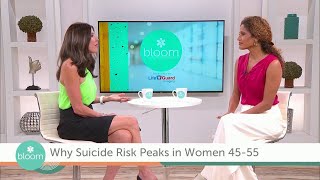
Doctors believe there is a silent crisis in this country. Suicide risks are peaking in women 45 to 55, and many believe perimenopause is playing a role. Joining me now with what women need to know is the founder of Ciana Medical and Wellness Center, Dr. Shilpa Siyana. It is such a pleasure to see you.
Thanks for having me.
So I think this is such a critical subject to talk about. I never knew until you sent over the data and the research and I was preparing for this interview that there was a link to suicide. But what I did know just from being a woman going through it, is that I remember before going through hormone replacement therapy that I would find myself in some pregnancy pretty dark spaces. And I didn't know why. I'd look around at my life. It's beautiful. I have a great husband, beautiful kids. I'm like, why am I so down in the trenches? And it could be linked to our hormones.
Absolutely. And so many women in their mid to late 40s are suddenly having panic attacks and they're like, I've never had this before. Everything is perfect, like you said in your life. And it just takes them by surprise. And a lot of it has to do with estrogen and progesterone receptors that are in the brain that do regulate your neurotransmitters, like happy hormone, serotonin, dopamine and gaba. The calming hormones. The calming neurotransmitters. So as these hormones go away, so do these neurotransmitters.
Well, what's equally concerning to me is that when women go to their primary doctors, they're walking away with a Xanax prescription.
Correct.
And they don't need Xanax.
No, they don't. They need their hormones checked. And they need to know where are these hormones? And if they're not sleeping, it's not ambient time. And it's not a deficiency of that. It's really maybe a deficiency of progesterone. So if you already have issues with sleep, brain fog, and you're fatigued, naturally, anybody would be low in mood. Plus, it's a time where maybe their kids are leaving and the empty nesters or their parents are getting really sick and they're having to care for them or they've reached their peaks in their careers and they're like, this is it. Or they're super lonely because a lot of their community were their kids and their kids lives. And on top of that, they're missing hormones. So it's a. And I think this generation between 45 and 55 is. Is really overlooked because you think they have it together, but they're silently dying.
Yeah. It's sad. So talk to me about the suicide risk associated with this. What causes that? Is it people, they ruminate or do they actually. They're obviously taking their own lives.
They are. And I think to get to that point, you really have to be super drained. You are probably not sleeping well, you're probably exhausted. You may have gone through like a divorce or something. That's a trigger that just kind of pushed you over the edge. And at that time, if you're not sleeping well, your brain is impulsive. And to do something like that makes a normal. Feels like a normal choice. But without hormones, you just feel kind of blah. And you just like, what's the point of life? And even if you. And maybe it's also to do with your gut health, if you're inflamed in your gut, there's a strong gut brain connection. So if you don't improve your gut microbiome, you are more likely to be depressed.
Yeah. When you said, what is the point of life? If I could tell you. And everything you described leading up to that is exactly. I lost both my parents, my dog died, my voice went down. You know, and then one child leaves after the next, they're going up to college, they're starting their life. And my hormones were all. And I wasn't getting sleep, I was waking up in the middle of the night every night. And while life is going to give you blows just naturally.
Right.
They're way better received if your hormones are imbalanced. And I can say on a personal level, for me, it's been a game changer.
Absolutely. And then women aren't even given that choice. Or worse, they're just told like, you know, it's all in your head. Here's an antidepressant. And if you are getting hormones, it's better to work with someone who's going to personalize it to your levels, not just give you a blanket prescription and say, this is the hormone you should take because you might have side effects. So it's super important to make sure you're working with the right team. You're you testing your levels. And also have a community, have friends, start a book club. Really work on, on not being lonely, because it can be a very lonely time. Yeah.
And we're so appreciative. I know you fly in all the way from California and we love it when you appear on Bloom because we want you to drive home the Message to patients here in the Tampa Bay area to do what you're saying. Find a doctor that's going to tailor it. Make sure they're checking, you know, your DNA.
Exactly.
See how your body's receiving these medications and balance them just perfect, perfectly. Because these mail order. Just dropping it in the mail is not the answer.
It's really not the answer. And, you know, talking about genetics, you know, genetics are important to test for how you process hormones, but it is also good tests that tell you how you react to medications. So let's say you do. You are feeling pretty dark and you do need medications. Don't just go to a doctor who's going to say, try Prozac and then try Zoloft. It's like throwing spaghetti on the wall. Which one's going to stick? You can do a simple salivary swab test that'll tell you, based on your genetics, which. Which are the correct medications to take for anxiety, for depression, for focus. We have so many great tools and they're not expensive and many times covered by insurance.
Yeah, we did that. Even my pediatrician recommended the swab for my daughter to pick the ADH medication that would best suit her nature.
I wish many doctors were like that.
Yes.
And that's why it's important for women to advocate, because I really think this concept of how we work with the provider. There used to be medicine 1.0, where you just went to the doctor and they told you what to do. And then medicine 2.0, where the pharmaceutical companies drove, like, which medications to take. And now this is medicine 3.0, which is you partnering with your doctor and really saying what? How can you guide me to be the best version of me?
Doctor, it's always such a pleasure catching up with you.