Behind the Book: The Truth About Marriage and In-Laws
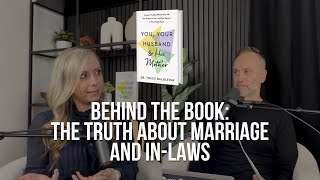
Dr. Tracy Dalgleish and her husband Greg discuss her new book You, Your Husband, and His Mother. The book uses clinical frameworks like triangles and the Vault method to map mother-in-law and daughter-in-law dynamics, born from an anecdote in Istanbul. Dalgleish wants readers to move from feeling helpless to hopeful about their in-law relationships.
Chapters
Hey, it's Dr. Tracy and thanks for clicking Play. I am sitting with my husband Greg, and this is a big week because officially my new book, you, your husband and his mother, is out in the world. And for people who are watching, I have it right here with me. I just absolutely love this cover. What do you think of it?
Yeah, it turned out amazing. I know the as we'll talk more about it, the triangles are a big part of the story. So I think how publisher the designer was able to incorporate that. It's pretty cool.
Yeah. So we are going to do a little behind the scenes episode today and.
Yeah, can I jump in? Yeah, yeah. We're going to talk about the topic of the book, but I think some of the mechanics of writing a book is for some of us equally as cool. So I think it'd be really cool for you to share that.
Thank you. So come with us, grab your tea, hang out with us. We're going to talk all things writing a book, bringing this book into the world and how important it is for others to find this resource and to be able to start these conversations in their own home. All right, let's jump into your questions.
So I think what's really been cool is I've been watching this project come to life kind of in the background. So as you said, I think we'll try and take people on a little bit of a journey behind the scenes. Some of the questions they might be thinking of as listeners about the topic and the book. So, Trey, this is your second book.
I don't know if listeners have heard you call me Trey.
Oh, yeah, a little bit. It's behind the scenes.
I know. I love it.
So this is my name of love for Tracy. So for those who don't know, this is Tracy's second book, her first book. I didn't sign up, sign up for this just over two years ago, but this is your first book with the Big Five publishing house. So congratulations again on that itself, which there's a whole process to getting to there, which I think is. Is pretty fascinating.
Yeah. And to just pause and acknowledge that I have sold over 20,000 books for my first book. We don't know what it is for the second book, but for the first book it's over 20,000. Which to sell books and to reach people and to keep books on bookshelves like that has been so cool. Just know that many people, regardless of.
Any lists or any of those kind of arbitrary metrics, I think when you just take that number in and of itself and Be like, that's pretty cool. That's, that's out into the world.
Maybe I can even contextualize that for people, that for people to sell books. I mean, sometimes we're looking at selling, selling 500 books for a first time author or when you release a book, sometimes people even only sell a thousand. And like, any sales as an author is amazing.
Yeah.
And I think recognizing that selling books is actually really hard.
Yeah. And I suspect it's gotten harder.
Yes.
Obviously, with digital and tech and everything. Yeah. So I think for me, this intersection of this legacy business with kind of the modern world we are in now is totally fascinating. I mean, I think there's pros and cons we could probably both agree, but yeah. So I'm wondering, you know, where you want to start? Like, do you want to talk about what it was like to get this deal or how it kind of came to fruition?
Maybe we even talk about how this book came to fruition because I think, you know, it's one thing to say there's this issue that repeatedly shows up in couples, but it's also another thing to see it unfold in so many different layers and, and, and places. And in the introduction, readers will actually walk with me in the spice market in Istanbul. And I still have that journal where I wrote down what the seller said to me. And it was in that moment I remember thinking and writing this down. And this is 2011. This is before you and I were married, right. Before we were engaged. And I was already working with couples already at that point for quite some time. And understanding this kind of, you know, let's even say trope.
Right.
Because we think of all of the media pieces, the nobody wants this. Which is just the previous episode. So if you haven't listened or watched that one, go back and watch that one. It's a short hit about Bina, Joanne's future mother in law. But so here I am across the world in a different culture and a different religion, and this seller makes this statement about a mother in law.
Right.
And that was of those moments where I thought, there isn't a resource for the couples that I'm working with. And it's not just about navigating family systems because that's one layer. How do we navigate the family system that we come from and that we enter into, but also then how do we do the couple's work? And that was the real sticking point. Because it's one thing for us to grab a book and to say, oh, right, here's how you can set boundaries. You. It's a completely different experience to say to your partner, how are we going to do this together? And that's really where the couples therapist lens that I bring to my work is so important. And I truly mean that. Every person I have talked to is either in some kind of struggle, has been in that struggle in the past. Many of them tell me about after they had their first baby, or they're like, this is my sister or my best friend and their experience.
Right. Yeah. It might not be first person, but they know someone in their network. Okay, so it sounds like. And I know this to be true. This book's kind of been on your radar since 2011, I suppose.
Yes. And even when I was pitching my first book, my literary agent had said to me, do you want to put this on the shelf and go to your next book?
Right, right. So is that when you knew this would be your first or next book, depending on how you look at it?
I always knew that this was going to be a book I would write. It was just a matter of when and in what order.
In what order? That's what I was just gonna say.
Yeah. And this is so with Taylor Swift's people who don't know. I am a relatively new Swifty fan, and with her new album coming out, a lot of. There's been speculation online about how long did she know that she was doing this album? And there's one image of her releasing her Midnights album. It's in the Antihero video. And. And there's two, like, versions of her behind her. One is all in White, which is the Tortured Poets Department album, and the other one is more like a showgirl color. And people were saying, how far in advance does she plan? And at the same time, initially, I was, yeah, how far in advance is this woman planned? Like, this is amazing. Talk about epic launches of your work. And then I had that moment of.
But I've known what was your Easter egg then?
What was my Easter egg?
Is that what they call it?
Lydia and Sam in book one is my Easter egg.
Okay. You'll have to get book one to get the context of that.
Yeah, I think so. And it's a great story because it really walks through this complexity of this couple and what it means to be in therapy trying to navigate this.
Yeah. So I distinctly remember you flagging the. Speaking of which. The triangle.
Yeah.
What was it that made you be like, stop and go, okay, I got to write this down? Or this was something. Something I wanted to expand on. I Think from doing some of the reading, it's, it's not an original concept, but like, how did you come to think of it in terms of this work?
We've been talking about triangles for a long time in psychotherapy literature, in family systems. I remember one of the first times I really thought about this as a triangle was between a client, her mother, and then somebody else, maybe her father. And there is this drama triangle that is described in, in psychotherapy. But there's this piece here that I remember reading about in the Dance of Anger. And this is Harriet Lerner's work. And she pitched this book in the 80s and nobody wanted to publish about angry women, why women were feeling angry. And it's such a good book. It just stands the test of time. And I remember also too then sitting in a session with a couple and one of them saying, see Dr. Tracy, he's putting me in the middle again. And then on the flip side, he was saying, what? You're putting me in the middle? And it was again right there where I'm thinking, no, this is the triangle. Nobody's in the middle. You're all influencing and impacting each other.
I think in your book, in your book you said you're both in the middle, which I think people will be like, oh, that was interesting.
And also too, understanding how triangles are formed. And that's what readers really get from this book. And that's step three in my vault method, which is what does your triangle look like? And you get to map it out with you, your husband and his mother, or if it's a sibling or a sister in law, or even your own parent.
Yeah.
You can really map out what relationship is being impacted and what's happening. Because we bring in the third when we don't know how to navigate the tension between you and the other person.
Interesting. So is this a time to flag that there's no question the mother in law, daughter in law dynamic and we can talk about the different types is pretty key, but this is also a system that can like go beyond just that.
Yeah. And I think that's really what this book is about, is it's about helping couples get aligned and feel solid in their marriage. I have heard from so many readers so far that this, the steps in the vault method are not just there to walk through what's happening with your mother in law.
Right. They.
But instead, I mean, one person described it as like, she's going to have this as her marriage summit, which is incredible. To take all five steps and to say, okay, where are we with our values? What's most important to us right now? What triangles and the sticky relationships are we getting into right now? What are our boundaries and how do we actually apply that? The steps are so good just as a relationship tuna. That I think is the complexity of this conversation is that so many people see me on Instagram separate selling the book for the mother in law.
Right.
And I have had those DMS and those conversations with people saying why did you call it this? Why didn't you call it you, your husband and your mother? And it's, it's true.
It could be. I guess it could be.
But this wasn't just an in law book. I needed to directly bring to life the conversation between daughter in law and mother in law because of its complexities when we then bring in her husband. Yeah. That being said though, every chapter I wrote, I held in mind. If you're going to read this and it's about your sister in law, does this apply?
Yeah.
Yes. If you're going to read this and it's about a kiddo, if it's about a stepchild, if it's about a stepmother in law, does it apply? Yes.
Do you know what I was thinking about reading? It was like small businesses, family businesses.
Like a mesh succession needs this book.
Well, yeah, maybe, maybe not quite to that extent, but just think of all the like small and medium sized businesses out there who might be legacy businesses or families or like, wow, could this, a lot of this, like really help create clear guidelines for. I can just imagine. Right. Interesting.
I love that you've applied that framework there because it really is, is something that's applicable to just ground and root into what's at the heart of this.
Yeah. Anyways, just a side sidebar anyway, so let's, let's come back to maybe the process of getting this book even started. Shed some light on it for people. Like what happens? So you had this idea then what, like how do you go from idea to signing with, you know, in this case a Big five publishing house.
I had signed with my literary agent in 2021 and I think that as a starting place is important for people to understand that you do need to have someone to support your work and to do this pitching. I don't do that.
That's right.
And I also will be on CC's podcast which we talk about that from her perspective. But you know, here's, here's an interesting conversation that was, was coming out around pitching. Is, is there really a need for this book and is it Too narrow versus how do we expand it? And again, do we really need this book? And then as cece was going out initially, a lot of people said so she was not pitching the book yet. So she, as the agent goes to the editors and says, I have this book. Here's this relationship expert, you know, would you like me to send it to you? And then they have to go their sales team. Right.
So do they. Is it kind of like a soft startup conversation to like take the temperature.
You think is that's a question that you should ask cc.
I will.
My sense is how she said it to me is yes, because you want to feel out for sure.
It makes sense.
Who's going to get it.
Yeah.
And when I met with my editor, Lauren, and she's just been fantastic throughout this whole process, I knew she believed in this book. She believed in the vision of this book. She didn't want to change anything about it. She just knew that people needed this book. And saying, you know, here's this book. What's really cool is that in when I'm not going to use the proper terms because it's not my area of expertise. But when an agent goes out on submission. So she's now sending the book proposal, even gets a reply. And so then we had several people wanting this book.
So reach back to the agent, reach.
Back to cece saying, book a meeting. Yes, we want to. We want this. Right. And it was just interest. And so I can still remember when cece called me and so what happens then is an editor can make a preempt and this means that before deadline they're giving you an offer.
It's like a bully offer in real estate.
Yes.
Yeah.
That's how this book was sold because Lauren believes in it so much. The whole Tarture and Penguin team has just been absolutely amazing to work with. But they wanted this book so badly they made a preempt and to make an offer that is so good that you can't turn it down. That's what this experience and. And Greg, I can still. I picture myself the first time she came to me and then when we confirmed it and I was in my office.
Yeah.
My only regret is that I don't have a camera moment of it, but.
I live almost better.
You didn't so much in my body that I can still picture, like grabbing the phone, talking to her and. And you know, I'm not speechless often I was without words.
Right.
And it's just been incredible.
Talk to us a little bit about maybe. So if you have all this interest. Yes. They give you the preemptive offer, which is huge. But like, I would imagine there's a bit of an alignment in terms of like values and vision that you want to have too. Like if this was some rogue publisher who didn't align with your vision, I mean, how do you kind of navigate that? Or is that kind of something that your agent helps you do?
Yeah, there's both.
Yeah.
And I think in that sense it is about asking yourself. And the thing too is some people might only have that one offer and so you only have that choice. The choice really is am I writing this book or am I putting it on the shelf?
Right.
And am I coming back to it in a different way? Am I pitching in a different way? And I, I think something that I really want to validate for people who are listening and who are wanting to go into this. This does not happen overnight. I mean, and you know, I would put on my snow pants and wake up at 4:30 in the morning and in the middle of the winter, walk to the office so I could spend Saturday morning, Sunday morning writing this proposal. I did that definitely for the other book. I don't, did I do it for this book? I don't think I proposal wrote in the snow in this one.
No. Because I think it was different season.
It was a different season. But, but regardless, it's just the behind the scenes piece of you, you believe in this project. You, you don't say you're going to wait until you have time. I had to find the time. I hold in mind how Glennon Doyle talks about when she first started writing. She'd wake up at 4:30 and write in her closet.
Right.
And, and then also too, you know, it doesn't always happen right away and it's, it's painful and hard. And then also when you really believe in your message, you keep making it work and you keep going back to it and you keep tweaking and changing all the things. So, um, I think back to your original question. If something doesn't align for you, you have to ask, have to ask yourself, is it something I'm still willing to go through with? Because writing a book is not just about writing it, it's also about marketing it and doing all the press with it and having to sell a book, which is a whole other layer. And I know you and I have had these conversations with family and friends to help them understand it wasn't just a writing process, it's now this whole other layer.
Afterwards, I think there's A maybe I'll say it from, from my late perspective, I think there's probably a misunderstanding writ large. A bit like, okay, you get a deal with the publisher, you write the book and then you're done. And then these publishers and these marketing experts come and lift it and do all this stuff. And that might be true for the 0.1%, but for most, that's not what it looks like. Eh. Is that fair to say?
Yeah. I don't believe John Grisham is, you know, necessarily having an Instagram post go out every day, helping people find his book. I mean, every time I go to the store, there's a new book of his.
I'm thinking that's also a totally different category, but I, I take your point. Okay. So many in your audience might be other therapists. What would you tell them? Who they. Who maybe have a wish to write a book someday or, or want to engage in social media. What kind of advice or insight might you give them?
Yeah, and I think the first thing that comes to mind with that one is this does not happen overnight. And also this is an entirely different part of work. And I think you've seen me grow through that in the sense of it was it started out in 2018 on social media with just posting one day and taking that risk and not having to get everything perfect or right, but just putting it out there and starting right and then being consistent. I don't believe you have to have the road completely mapped out. If you had asked me in 2018, how many books was I going to write, I, I didn't know at the time. And then recognizing that as you're doing this work, you're evolving over time and that it does take work and you do need support along the way. So especially for therapists, for healthcare providers, if you're saying to yourself, I'm going to run a 40 hour a clinic and then at the same time, 10 hours on social media, how do you do that all? And I, I really think that reflecting even on my own process, I think I could have easily burned myself out so many more times because I didn't believe in investing in the support.
Right.
And I think that has been something that I've struggled with, truthfully.
Yeah, I think it's been a learning curve for both of us because I, I mean, you obviously carried most of that. Still do. But I know early on you're just kind of doing it all and it's just like in retrospect it was like, whoa, we had young kids and yeah.
We had, oh, super young kids, like the first, I remember the first podcast season that was 2019 and I released 12 episodes back to back. That was on the tails of 2018. I was building my website. October 2018, I built my own website. And do you remember every night after I'd put our little one to bed, I'd be in the kitchen like playing on show it initially and then squarespace and switching providers. Oh my goodness, it's. It's bananas and at the same time it's exciting.
You enjoyed it. But when it's not your area of expertise, you're also less efficient though, right? Like, oh yeah, you're learning all that. And like, anyways, if I could go.
Back, I think I would have invested more at the beginning. And I mean, I do think that's a privilege to be able to say, to take money and invest in that. Yeah. And that being said, though, recognizing that as a therapist, as a provider and even, you know, I'm going to expand this out even broader as a mother, you can't do it all. You just can't.
Okay, let's get into the actual writing of the book. You kind of alluded to some of it, but what was it like kind of day to day trying to write the book? You know, from where I stood, it looked like finding nooks and crannies of time and doing all the things. Well, you still try to have a life and work and all that stuff.
This book is really special because when I officially signed the offer on July 17, I had said I would hand it in November 17 or November 7. I wrote this book in a crazy short amount of time.
Self imposed. A little bit.
Self imposed, yeah. And also this book was just so ready to be written and it was really about reshaping what I was doing and what the day they looked like. You know, when I write books, this is the same as last time. I don't watch tv. During that time, I'm out walking a lot. I don't write in this traditional way of sitting at a computer and writing the whole time. I do do have my standing desk and my walking pad, so that was part of it. But also walking outside and talking into voice notes and that helped me to get through kind of any writer's block or just to get ideas out. And then also because my books have that element of clarity, clinical to it, it is storytelling for sure.
Yeah.
And so while this one is more prescriptive than the first book, which reads more like fiction, this one is more self help. The way I Experience it is like this. Eat, sleep and breathe and like, I know you and the kids also experience it of like, yeah, you know, where's Tracy? Oh, she's in her head again. And it, it was like just living all of this.
Yeah.
And that's good. And challenging at times for sure.
I can, I can say though, it was so impressive like how efficient you were at writing this. I know a lot of the time was probably spent stuck in your head or whatever you want to say, but it was pretty remarkable to see because again, I think from an outsider perspective you're like, oh, this is going to take like a year to write or whatever.
Which apparently it does take a year to write a self help book. Crazy one a month, a chapter, which is okay. And I really want to emphasize that if that's your journey, that's okay. No one can tell you how fast or slow to write a book. It's all what you need. For myself though, I can't imagine writing chapter one on month one and then writing the conclusion on 12 at month 12. Because for me, if I'm going to go into something, I want to live it, I want to experience it and just, just dive right in. And that, that really is what it was.
So how do you handle, you know, you're writing a, a book about families while being in a family, while parenting, while seeing clients, while probably doing this work with clients as you're writing it. Like, how do you navigate all that or package it all together?
I, I think of, I remember reading once, I can't remember what book came out of Brene Brown's, but she had even described it as like, she goes into this cave for three months and then emerges afterwards. And like the family just knows that she does that and that that's how I feel about writing books. And also too, it's, it is this reality of these are real stories and these are real painful moments of people who have gone through this. And so yes, at times writing it, I felt down, there was pain, there was anger. Knowing that, I mean, I think of the one client and I described this in, in the book where she is like, I was told that I'm not my child's real, real family. You know, just to have those stories come through me, it's so painful. And it's this urge to want to hug and protect like all of my community and bring them in. And then at the same time I think I use the skills I use in my therapy work day to day, which is sometimes at the end of the day I literally have to package this up.
Yeah.
And I'm putting it in an imaginary box. I'm leaving it on my shelf or in my filing cabinet at the office and then coming back. And I don't write in my home. I have the privilege to write in my therapy office, which then helps me do those transitions back and forth.
I can imagine. Just a little anecdote for me. I mean, having had the privilege of seeing you work with some folks in this space recently, I can see how that would stay with you. Those stories.
Yeah. Like, just hearing the.
Yeah.
Like you're talking about the coaching call.
Yeah.
They're hard stories, aren't they? Like, they're.
Yeah. It's hard to believe. I believe. Let me be super clear. I believe these women. But it's almost hard to. Hard to understand.
It's hard to understand how we get there as family.
Sure.
And I think that really is this takeaway in this book, which is there are really good reasons why people do the things they do.
Yeah.
These are patterns. Everybody's a product of their own pattern. And we have to find a way to move forward. And that's really what the book is all about, is like, how do you go from this, like, hurt and pain? And how could you treat me this way into a what are we going to do to move forward? And only the reader, only you listening. You get to decide that. And it will always be what's best for you in this moment of time. Oh, I want to just plug the book one more way. One with this. I believe that the vault method is not something that you come to once and you're done with it. So you might do it this holiday season and then you might actually work through it again next holiday season, or you might do it again in five years or two years. Like, this is a resource on the shelf for sure, that you will continuously come back to, because even the step one, what your values are, that's going to change.
Yeah. I almost took it as, like, for lack of a better term, issue by issue, you could almost work through it kind of in silos. There's the big stuff, there's the big picture family dynamic. But you could almost bring it tighter. Right. Interesting. What was the hardest part to write?
I think it's a whole picture of the book. The hardest part was really about capturing all of the dynamics in it.
So by that, do you mean, like the 10 dynamics that kind of exist when partners come into new families?
So that's chapter two. No, I mean throughout the book to fully capture what's happening, happening for all three people. So I'm holding in mind her, her partner, him, their couple dynamic, which is a whole other layer. And then what's happening in the family system. And to really get this to like there's so many things in this is. It's. How do I communicate this in a clear way? How do I bring in the psychological concepts I teach people every single day without losing them as a reader? How do I break it down in something that you can do at home? And that as a whole, just. The whole book is complex. I do actually have a more specific answer to your question. It was the last chapter that I wrote and I knew it would be. It's so interesting. I wrote chapter. Chapter one was written already when we did the proposal. Chapter two was your family dynamics, kind of the family system you've entered into. That came really quickly. 4. Chapter four is communication. You as a couple. Like what's your stuff that you bring in? And like that. That's the stuff I do every day.
Yeah.
And then I moved into writing the system which was. It just came because this is what I do with people. And then I did the specific Q A is really specific tangible outcomes at the end. Then I went back to chapter three and chapter three is all about meeting your own stuff that shows up in this dynamic. And we don't get to have a book without looking inwards at ourselves. And it was hard because it is this really delicate position of your experience is real. And in any dynamic we bring something with us for sure. We bring something to that with us. So in that chapter, I outline the different inner childs that might still be guiding for you or even your husband to meet his inner child or both. Both, yeah.
I think the layout of the book too, for a lot of people will be really easy to digest because as I was going through it, I'm like, there's almost not too often where there's just many pages of just hard content versus like reflection, question exercises, little explainers, like it really flows nicely. Cause I think maybe even particularly thinking of some of the men who might read it, like, you know, if it's just 200 pages of, you know, theory coming at you hard, it, it's. It'd be much harder to digest. So I think people are really gonna just from a truly consumption point, be able to set it down for a day or two, come back to it, you know, just interact with it in an easy way.
It's also one of the reasons why I always say to people, I'm not going anywhere. I'm going to continue to see clients because it's the stories that help bring things to life. Not to say that every client I use, I use their story. It's not that at all. The clients are always protected. Their confidentiality is the most important thing. But. But it's more the. We live in stories, we experience stories. It's what brings things to life. Um, and so even with this book, I have sat across from a client and said, hey, heads up, my book is coming out. And you're going to recognize yourself in this story, in this chapter. And I want you to know it's not you. Like, the book is edited, signed, sealed, delivered kind of thing. But this is a very similar story.
Yeah.
And so then that is also what really brings to life my work. And it's one of the reasons why I love continuing to be therapist, coach, and writer creator, for sure.
I mean, it's. It's those stories that kind of allowed you to formulate this and kept seeing it. So you've had a lot of conversations about the book with clients. Do you have a favorite so far?
I think one of my favorite comments about this so far has been the number of women who have come to me saying, I feel seen, I feel like I'm no longer crazy and that I'm making this all up.
That was a takeaway from that coaching call.
That was yours for sure.
And because I think, and this is why this book matters so much, is because we often don't talk about the inner workings of what's happening. Despite the growth of social media and the sharing of mental health content and parenting content, we rarely sit in these kinds of stories. And that is really what I wanted to bring to light. And I. So many people in the community are saying, thank goodness. Someone else called me the mother in law therapist, which I thought was really cute. It's like, you know, just this experience where people are saying, I feel like I have hope to move forward. And that has been a gift where someone says, I want things to be different. And now you're giving me these tools. So thank you so much.
Because ultimately, that's what this is. This. This really is you giving them multiple tools for the toolbox and really creating the protection for them and their partner.
Yeah.
Regardless of the external stuff, whatever that. I think that's almost easy to gloss over.
Yeah.
Right. Okay. So in the book, you talk about the victim, villain, binary. Why was it so important for you to challenge that narrative? And maybe how did you conceptualize the vault method? As the antidote to this binary.
I love that question, Greg, because I like everything that's happening to them. And they have no voice. That's the victim position, of course. Or then they're feeling like the villain and they feel like everything they do is bad or they're scapegoated. And so my conceptualization here is you're going to learn how to take a seat at the table. You're entering into your main character energy.
I have that written down in my notes. I can't believe you said that. That's amazing.
Yes. Because, you know, here, like, what, what do we want in life? We don't want to be told. We have to or to just accept the paper cuts. Right. We're not lighting torches and going to burn down doors. But we're, we want to see that table. We want to be seen. We want to know that our voice matters, that we are important. This is our family that we're building. And so that's where the vault was really conceptualized from. And that's what I've been doing with clients throughout to help them get that seat at the table. It's not to take away your mother in law's seat. It's not to push her off the table. It's so you actually have a seat there so you and your partner can sit at the table. And it's a weird, you're not there, tense, worried, is he going to stand up for me? You're not there seething with anger, and then, you know, saying, stop commenting on our parenting or we're gonna leave. Right. Like we're not making threats, but instead we're there, we're together, we're solid. Like the vault, like what an actual vault is.
That's a great name.
And then that's how we move forward together. That's really what this is about, is helping you be aligned, a solid team. Because, hey, here's the reality. When these stressors come to us, whatever they look like, someone gets sick or someone loses their job or, you know, on the coaching call, we had someone talking about, you know, mother in law had to move. And like, that's a stressor. You don't get to choose that when you say, I do. How are we going to remain a solid team? How do we remain secure and connected? And that's, you know, and I think that's something that I really love about the work that I do with couples so much, is I bring in this, this attachment piece. What's at our core, what do we really need in long and how do we get that more as a couple? So then we're resilient and solid to then be at the table when other family members or the business or.
Yeah.
Or co workers or friends or sisters are all sitting at the table with us.
Yeah. As you're saying that, I'm thinking like it's just a. This protection that allows you to deal with whatever the problem is. Could be not family at all. But one of the things I think people are going to really like in the book is kind of there's a mother in law and daughter in law classification. I mean, I think our brains really.
Like we love categories.
Categories. Not. Not to say stereotypes, but kind of the categories. Right. So how did you come up with those?
Yeah. Hey, I. So we've called the daughter in law styles because it's within yourself and you can change and it's almost like a continuum of how you could ebb and flow and it's this kind of almost this people pleaser. So it's a good girl. You can swing in the middle into the collaborator or you swing to the other side and you're the manager. Right. So it's like a style there. And then when we look at mother in law, we did it as like I did it as types and that.
Right.
That I remember reading an article a few years ago and the types were just not rooted in the clinical experience. They're. I can't remember what the types were, but something like the gossip type. And I was like, you know, this doesn't quite hit home what the real is the real piece, like too gitchy almost. It was almost in a way of putting these like stereotype labels on women. Right. The gossip mother in law.
Yeah.
Or the performing mother in law. This goes deeper into what's the pattern of behavior.
Yeah. That you're not shaming them. It's just naming.
It's not shaming. And also too for. For people to know that this is not you reading your book beside your husband in bed and saying, I'm diagnosing your mother. And that like that's intentionally not what this conversation is, but instead it's, I can look at this group of behavior. And now with the vault method and everything, I walk you through with it. You know, the best way to communicate to her because of who she is. And then you can feel again, your seat is at the table.
Amazing. Okay, let's. Let's wrap up on this one. So if there's one thing you'd want people to feel after reading this book, I Mean, can you distill it down to one thing or is there a feeling or a group of feelings that you. That you really want people to have, whether that's the daughter in law or I think maybe even the husband or.
Maybe even the mother in law. Because I know many mothers in law have come to me saying, I'm grabbing your book because I want to make sure I do something different. And that's so cool. Hope. I want people to feel like they're going from helplessness to hope because we do want families to be in our lives. We do want to remain connected. Nobody goes and gets married to say, I can't wait to cut out my husband's mother. It's just not what we do. We're. We're creatures to be bonded and social with others. And so it's my wish. Wish that people have that sense of hope that maybe just something could be different. And also too, I always remind people when it comes to this is this is not something that changes overnight. It's. And I said this in the coaching call.
Yeah.
With. With people who ordered the book is this is a. What's the next small step? We're going to just do this because you didn't get here overnight. And I say that to all my couples too. You didn't get here overnight. This is going to take time. We need small steps to move forward with the priority of your relationship. That was. I can't remember if I said it on the coaching call, but I remember to the couple who was on and I had said, we're working on bonding the two of you and soothing each other's nervous systems.
Yes, you did.
Yeah, that right there. If even you get the book and that's the first thing you start with. That is the best thing. Just knowing that you have so much more to go through and many more exercises that are going to help you both. That is everything. So one thing that you're going to get that I hope people get out of this book is to feel seen and to know that their struggle is real, that they matter and that their relationship also matters to them.
They will feel seen.
Thank you.
Congratulations.
Thank you. Do you have any last words from the book? In this experience, I know people love hearing from you and what it's like to be you.
Well, I mean, I'm just really proud of you. I'm really proud of you. All the work you've done. I. I think people would be shocked how much you do just yourself. I mean, yes, I'm here to help, but I Can only do so much and you probably do too much, but I think that's it. I, I really hope people see this as a, a way for families to come together. This book is meeting modern women where they're at. Right. This is, you know, this is not 30 years ago. We can pretend it is or we can, you know, show up in the real world. And I think that's, I think it's really important.
And also that piece here too, where I'm seeing women who are 60 saying, I want something different with my children because I went through that. And that is a huge part of who's grabbing this book as well, because they don't want to repeat the cycles and they want to have a different kind of relationship with their kids.
I think you use the word stymied, which is a golf term, which is really interesting. They don't want to be stymied like they were from her mother in law and expected just to follow along. Had to get the golf reference in. But anyways, it's, it's.
Yeah, well, all right. Thank you for having this conversation with me, Greg. Thank you for bringing to life the end of the book launch period. I mean, the book launch never really ends. It's here, it's in the world.
But this, yeah, I think pause to say, like, it's now on the shelves in the bookstore, so if you haven't yet grab a copy, now's the time. It's one thing to pre order something, but let's face it, people are busy now. You can go get it and consume it right away. I think in this day and age, we don't want to wait. No, I know Amazon delivers in 30 minutes. You know, where is this?
You can grab the book wherever you get your books from. It's available in all formats. I just know people are going to really love the stories of this book. They're going to feel so seen. And I also want to pause just to thank you for clicking Play for joining us for this call. Behind the scenes conversation. I know a lot of people don't get to see this stuff a lot and I just love these like, thank you, thank you for having it with me, Greg. I really appreciate you doing this with me. And you know, you're, you're not just the guy sitting here on the podcast, but you're the one who receives my text where I say I'll be home at 5:15 and it's 5:30 and I'm still not home. And I, you know, you're 6:15. Yeah, no way. That's way too late. You're. You've just. Just embrace that kind of chaotic part of me and have allowed us to grow our family in this way.
So it's your creative part. You need to have your. To borrow a phrase, your unicorn space from Eve.
Yeah. All right. All right. If anything resonated from today's conversation, I'd love to hear from you. Send me a dm, Click the stars, leave a review, and don't forget to click. Subscribe. We have so many great conversations coming ahead to wrap up this year. I can't even believe we are in this season. Over a million, like 1.2 million downloads of the podcast. We're just doing some really cool things here. And so if you do have a question for us to answer, don't forget to hit the form the button is in or the link, rather, is in the show notes. Send me your questions. We answer them here in the podcast. And I'm just grateful for you, grateful that you have grabbed this book, grateful you are part of this journey to help yourself and others feel seen. And we will see you next week.










