Is it Boundaries or Avoidance?
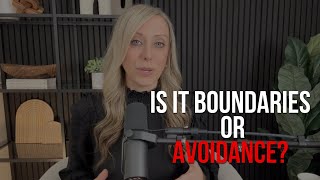
Dr. Tracy Dalgleish explains the difference between healthy boundaries and avoidance. Boundaries protect you without controlling others; avoidance is fear-driven disconnection like ghosting or using 'I need space' to shut down. The key is pausing to regulate before you respond.
Chapters
In a session last month, one of my clients said, I told her I needed space, but really I just didn't want to talk to her. I was tired of arguing. Now, from the outside, this might sound like a boundary, but in reality it was avoidance in disguise. And today I want us to talk about whether this is a true boundary or whether we are standing stepping into avoidance. Because one of the things that I am noticing is that we are sinking really into the self and using some of these terms and creating greater disconnection. So today our conversation is all about differentiating between whether it's boundaries or avoidance. The intention of the podcast here is not for me to always or even be able to sink into telling you what X, Y, Z means or how you should do the thing. Because one of the things that I'm constantly holding into context is the idea around nuance. You would have heard me talk about this in last week's podcast around a parenting reel that went viral. And I really struggled with the term gaslighting around this common sentence that people use. What I hope you get to find by listening to these episodes with me or the ones Rick, Greg or my guests join me is honoring your own truth. Learning to show up authentically, learning to trust yourself, learning to deepen your relationships in a way where you feel safe and secure with who you are. I love the analogy of a tree where you're rooting in your tree roots and your trunk is solid and your branches just wave with whatever storm comes your way. Because of course we know storms come our way, whether it's our partner having a hard time, sometimes something at work, with our kids, with family, with friends. And when you can use these episodes as a guide for you, then you're going to become more solid. So I always want to put that caveat here first, that this is about you learning the nuance and the context in your relationships to learn how to then make the best choice for you. All right, let's talk about why this conversation is everywhere right now and why we really need to talk about. And in the past five plus years, Therapy speak has gone mainstream. I hear so many people using the word boundary when just six years ago when I released my first episode with Dr. Sof, all about boundaries. It's a beautiful episode in season one, by the way, barely anyone was using the term boundary and not many people understood what it actually meant. And as a result, what ends up happening is that nuance gets lost. We start overusing terms, we start misusing terms. And in addition to misusing terms, what we also then start to do is we engage in this cut off culture or this. I've heard this between couples as well. One partner says, those are your feelings, so you go and deal with it. And when we approach things this way, then what we are really doing is shutting things down and creating more disconnection rather than opening up and creating curiosity, compassion, passion, connection. And so one of the reasons why this conversation is so important right now is because we want to work on honoring ourselves and building connection, but not doing it in this punitive or reactive way. I was thinking about how we could reframe this. And when I think about boundaries, it's often about what's happening on my property. I imagine a gate or a fence, or I also imagine a glass wall. And everything outside of that wall or the fence are things I can't control. But then I get to choose what's happening for me. I get to choose what I need, my next step, what's going to be aligned with my values. And one of the pieces around boundaries is that these want to come from a place of being aligned with their values. So boundaries are not about setting something because we're uncomfortable and we don't like it. But instead, if it's set into our values and our system about how we want to show up with things, that is much different. There's a fine line in there that we want to walk. This doesn't mean you have to engage in all conversations, but you might say my relationship with my family thrives when we're not talking about bodies. And so this allows me then to determine what my boundary is going to be that I set with them. That's not avoidance, it's a boundary. So boundaries are for me, they are not an attempt to control you. So if I go back to the conversation with families around bodies, I'm not saying I'm going to try to control you. If you want to go and have those conversations with other people, you absolutely can. But for me, that conversation doesn't feel good and I'd like to focus our relationships on something else. The key here is that if I use a boundary to make you feel bad, to shut you out, or to punish you, I have definitely crossed into something else. And often this is around avoidance or control. Let me really hit that point home. Boundaries are about creating relationships with other people. It's about bringing them into your world in a way that is going to work best for you. It's not about separation. It's not about pushing someone out. It's not about making Them feel bad for who they are. But you might be wondering, okay, Dr. Tracy, so what's the difference between a boundary and avoidance? So let's talk a little bit more about boundaries. Boundary is really about clarity and ownership. Clarity meaning I understand what I need and I'm also going to own that this is something that I can do. It's not asking other people to do things. Those are requests and other people might still choose to do it. If I go back to the bodies example, you said your family, we don't talk about bodies. They understand information. For some people it might be about ending the conversation there and changing topics. For some people it could be saying, this isn't something that we do. There's all these pieces in here that is about respecting myself while also respecting you. A recent example with a client was talking about boundaries with work. And so they made the decision, I'm not going to take work calls after 6pm that's about protecting my time. That's not about avoiding work. It's about not burning out. It's about values that I need. My evenings with my family and my work isn't paying me for that time. You might also say that a boundary is I'll end this conversation if yelling starts because I want us to communicate safely. We're saying that yelling doesn't work for us to move through this and we want to work through this together, but we can't do it when we're yelling. So now let's talk about what does the avoidance look like. The avoidance is coming up when we're entering into feelings of fear. This is often deep rooted because a lot of people will say, no, I don't think I'm afraid of anything. And that response often comes quickly. But when we can sink into it, there's sometimes fear in there. Fear of tension, fear of rejection, fear of something uncomfortable. And what comes with that as well is disconnection. And this is especially true when I think back to that couple at the beginning. He every time would say, I don't want to talk about this, I'm uncomfortable. And that then says me, unless I am at the forefront here, I am going to dictate what we talk about and what we don't talk about. And that's not how relationships work. Relationships require us to do a both end. And if this is important to one person, and I say this with my couples, if this is important to one person, if this is an issue to one person, then this is an issue in the relationship that you need to find a way to Work through it. And the question then is not so much as a I don't want to enter this conversation. It's more about how do we have this conversation in a way that's going to help me me feel safe. I often get the question, is it okay if I text my partner about this issue or can I write them an email? And my caveat to that is, can you make sure that you and your partner have an agreement about how you do that in the sense that will you allow for them to respond back? Can they ask questions by text? Is it that after I text you something, we then have our meeting that night to talk more about it? Do you write emails back and forth? Isn't it an agreement that you acknowledge the email and you respond? Or is it just that you want me to read this and to understand it? So there is always that we need to have this mutual understanding of how we're going to move forward based on the way that we're communicating. So let's think about avoidance. Avoidance sounds like something like, well, that's your feeling. You have to go work on it. I'm not taking that on in a relationship. That sounds more like avoidance. Or I'm setting a boundary and then ghosting that person. Whether it's a friend, a family member, or a coworker. This is one of the most common ones, which is I need space. And I've noticed where one partner will use this almost as a weapon and it's saying, my body's overwhelmed, I'm shutting down, I can't talk about this. And so when they say I need space, yes, there's a yes. And here in the sense that we want to acknowledge when we are getting flooded. And we can't use that to suppress and avoid repair or self reflection. When we think about these terms that are used mainstream now, I know we are doing so much more body talk. And I can remember even using the word flooded back on 2019, by the way, in 2019, I loved my Instagram stories. I used to teach so much in the stories and I don't do that as much anymore because of nobody seeing them. And the algorithm anyways, it's not here or there, but there's this element. And I know some of you have been with me since then, which is absolutely amazing. So you, you will remember those stories. So I remember first using the word flooded and a lot of people didn't necessarily know what it means. If you don't know what it means, what it means is that your body becomes overwhelmed where your Thoughts, your feelings and your emotions are such in a way that you can't coherently follow the conversation anymore. And it feels kind of like crazy making or other people have described it like static in their brains. And so we know that when one partner is flooded, then conversations are not going to be productive moving forward. And it is healthy and recommended to pause a conversation. Here's what's showing up repeatedly with relationships right now is when I talk about this being a first strategy because we want to stop the negative cycle, then the other partner will say, that's not going to work for me because when do, when do we get to work through this? And it tells me there's been this cycle of avoiding these uncomfortable conversations. And it's one thing to say, my nervous system is overwhelmed. I need to take a break. Can we come back to this? And to say I love you, we are good, we're in this together. And I'm going to come back to you after I go for my 30 minute walk. And that is what it means to have a boundary, meaning I need 30 minutes to cool off and come back to this versus avoidance, which is not going back and repairing at all. So when I was thinking about the mainstream piece is I know sometimes we are latching onto these words that our partners don't always understand or we're using them as weapons, saying, I'm dysregulated, my body needs a break. Yes, of course. But bodies don't need two, three, seven day long breaks. They need to become regulated and they need to come back into conversations to create that security and connection and that bond between you and your partner. Here's an example from sessions with a couple. Every time this couple would bring up the topic of dealing with her mother in law. So they were working on setting boundaries and getting on the same page. And every time they enter this conversation she. So the wife would leave the room mid conversation and say, I'm setting a boundary. And she would walk out. This was before they came into session, before starting to do this work together. And over time what ended up happening is they started to talk less about everything really. But really they were not solving the challenge around her mother in law. And when we slowed things down in session, when we got to her deeper fear, it wasn't the conflict that was really leading her to leave, it was more that she wasn't feeling heard. And so avoidance for this person, and I know this is for many people, avoidance feels more safe than vulnerability. Because in order for me to say to you, I need you to Hear me. I don't feel hurt. I feel scared because I feel like my voice doesn't matter here. I have to be vulnerable and vulnerability requires me to have trust that you are going to catch me when I fall. When I'm going to be vulnerable with you, I have trust. I think of Dr. Sue Johnson's co creator of Emotionally Focused Couples Therapy. She talks about the are conversation. A is accessible? Do I believe that you are accessible? R is responsiveness. You are responsive to me. You hear me. You put your phone down and listen to me. And E stands for engaged. Are you engaged with me? Are you vulnerable with me? Do you share your stories with me? Do you sit with me and say I hear you. I'm so glad you shared this with me. Me. That's what we need in conversation. Okay, let's talk about how this shows up in couples. I just gave this example, but I want to talk about maybe how this shows up in the cycle and what it looks like even though I just gave this example. But let's, let's go into this a little bit deeper. So let's take this couple that I just talked about and I'll talk about the negative interaction cycle that people get into. So that negative cycle, we all have them in relationships and, and they are self reinforcing, which means we don't blame each other for the cycle. It starts with any kind of cue. It could be how the coffee mug is set down, it could be a missed text message or coming home late and not sending a text. Those cycles take over and over time increased negative affects so more negative emotions like anger and frustration starts to take over. By the way, if you want to deep dive in this, I do this in Be Connected in my relationship program because I believe one, you have to learn to name your cycle and then two, your triggers. And three, what is actually underneath that? That's the first three lessons in be connected and then in number four, in lesson number four, I have 12 core lessons for you as well as this amazing community and so much inside be connected for you. In lesson four I go into attachment styles which is also a key part to understanding our cycles. So let's use this example. So in the example of the mother in law, my client is the more withdrawn person and she's using boundaries to disconnect. So she ends up breaking the bond. They're not working through things, but every time she disconnects that sends this panic signal to her partner who then feels abandoned, rejected, confused. And this is where their cycle takes off. When one partner feels rejected or abandoned, they're going to up the ante and then they're reaching for connection and then they're going to send the signal that leads the other person to withdraw more and disconnect. The more one person withdraws and disconnects, the more the other person will up the ante and away they go. So I want us to think about if your boundary is to shut down and to not turn to your partner, then it's actually not a boundary. You're creating a wall and you are disconnecting in some way. That withdrawing partner holds power in whether we're going to have this conversation or not. And it leads both people to feel stuck and to even feel helpless. All right, let's get really tangible in terms of what you can do next. Because it's my hope that as you listen, you can start to ask yourself, is this a true boundary that is coming from a place of looking after me, or am I trying to create disconnection and moving away from discomfort and closeness? So before you go and set that boundary, I want you to slow things down a little bit more and pause and ask yourself, am I setting this boundary to protect my peace or to avoid discomfort A lot of people don't like when I say just take a beat, let's pause, let's slow this down. It's in that moment where you can gather so much information inside your body. If you just slow that down even as your partner is talking to you about something, you can ask questions like thank you for letting me know, can you tell me more about this? Or can we slow down Because I really want to understand this. Let's now keeping with this example, use boundary with connection. It might sound like I want to talk about this and I need 30 minutes to regulate. Can we try this then? A boundary with connection would sound like we really want you to visit and we can't wait to have that time with you and we can only have that two hour time over lunch today. A boundary with connection, even if we think of our children would sound like, I'm feeling overwhelmed and I need five minutes and I'm going to come back and play with you after. It's almost like looping back into that we perspective and co creating. If you feel like you are tapping into some hyper independence, your boundary might feel more like avoidance. Or if it feels like the wall is going up, you are closing, completely closing the gate, then you might want to ask yourself, am I truly setting a boundary or am I avoiding this? And I'm thinking back to what I said earlier, I won't be able to tell you the difference here. Only you will be able to make that distinction. And this last piece is about remembering that when in relationship we want to consider the self and other. And you having that boundary is appropriate as long as we're not trying to shut the other person down or to control the other person. This all comes back to co creation and recognizing that you're two separate people with separate desires, wants, wishes, thoughts, feelings and values. And now it's like, well, how are we going to do this together as a couple, as a family, as friends? I want to add this piece around boundary setting is that boundaries are always going to look different with who you're setting it with. And you know, I announced my book last week talking about the pre orders. It's available. My book title is you, your husband and his mother and I talked about a mother in law question in last week's episode. And one of the things that is part of this conversation is really about understanding who you're setting a boundary with. Is this a person that I'm trying to deepen the relationship with? Because if it is, the way I set that boundary and how we do this together is going to sound much different than a person who isn't able to do the self, other or who isn't able to meet you with that emotional maturity to understand what your needs are. And that boundary will then sound different depending on who it is. But I think ultimately in this conversation what we're really looking at is how do I create connection? When we understand that boundaries are about the self and keeping people in our network and not excluding, shutting them down or controlling them. All right, let's wrap up. Boundaries. I can remember doing some really deep boundary work after the birth of my second As a therapist, I thought my boundaries were decent. I remember doing that first episode with Dr. So. And of course, as we all do at times, we sometimes over correct. We don't necessarily understand what boundaries are. But I think when we understand that boundaries are about something that I do, something that I want or don't want, and that I can't control other people, it really becomes this beautiful thing of understanding how we keep others who are important to us, close to us and aligned with what truly matters to us. But when we use the word boundaries to try to hide from each other, we lose the connection that we are ultimately trying to protect. Because of course we are all hardwired to connect. We need connection and closeness and security in our bonds. All right, I'm curious to hear from you. Send me a message on Instagram after you've listened to this. Leave me a comment. Fill out my podcast form. But I'd love to hear When I say I'm setting a boundary, do I actually mean that I'm moving closer to people or am I actually breaking connection with them? I just love to hear what you think of today's episode. Okay. Thank you for joining me here today. I am so grateful. Every time you click play, every time you share an episode, I see your comments, I see your DMs. This community is absolutely amazing. I was actually celebrating the win of this podcast with someone dear to me recently and I said, you know, we've reached over a million downloads and I just absolutely cannot believe it. So thank you for being here. Thank you for doing this Work with me and I will see you next time. Remember, you are right where you need to be.
I have to remind you at the end of every podcast episode that this information is for educational purposes only and does not substitute for the care from a licensed mental health care provider.










